三星电子

Search documents
智通港股解盘 | AI应用端受到冲击科技股走弱 顺周期类逻辑在走强
Zhi Tong Cai Jing· 2026-02-04 12:31
Market Overview - The Hang Seng Index showed minor fluctuations, closing up by 0.05%, but structural issues in the market are prominent [1] - The U.S. Navy has increased its military presence in the southern waters of Iran, with around 32 vessels reported as of February 3 [1] - Gold stocks, such as WanGuo Gold International, saw a rise of over 7% [1] Trade Agreements - The U.S. has reduced tariffs on Indian imports from 50% to 18%, but details of the trade agreement remain unclear [1] - India is shifting towards a more pragmatic approach in its economic development, moving away from previous over-optimism [1] Technology Sector - The technology sector is facing challenges, particularly in AI and gaming, with significant stock declines in companies like TIS and Trend Micro [3] - Samsung Electronics' market value surpassed 1 trillion Korean won (approximately 68.8 billion USD) due to strong demand for storage chips [2] - Chinese companies in the semiconductor space, such as Zhongji Xuchuang and Han's Laser, are experiencing stock declines [2] Energy Sector - Hydrogen energy is gaining traction, with the Ministry of Industry and Information Technology planning to increase green hydrogen production to 250,000 tons per year by 2025 [3] - Companies like Guofu Hydrogen Energy and Zhongshun Energy have seen stock increases of over 18% and 12%, respectively [3] Coal Industry - Indonesia's government has announced significant coal production cuts, impacting China's coal supply by 5.3% [4] - Major coal companies like Yanzhou Coal and China Coal Energy have seen stock increases of over 8% due to these developments [4] Aerospace and Technology - SpaceX announced the acquisition of xAI, aiming to integrate AI with space technology, which could lead to significant advancements in energy production and storage [5] - Companies in the solar energy sector, such as GCL-Poly and Xinyi Solar, are also performing well, with stock increases of over 2% [6] Real Estate Market - China Construction Bank is supporting the acquisition of second-hand housing for rental projects in Shanghai, which is expected to improve inventory turnover in major cities [6] - Real estate companies like Yuexiu Property and China Resources Land have seen stock increases of over 5% [6] Aviation Sector - The Spring Festival travel season has begun, with a 5.3% year-on-year increase in passenger volume on the first day [7] - Major airlines like China Eastern and China Southern have reported significant stock increases of over 5% due to improved performance and cost management [7] Digital Economy - The Guangdong government is promoting digital consumption and smart services, focusing on areas like autonomous driving and smart tourism [8] - Companies involved in autonomous driving, such as Youjia Innovation and Horizon Robotics, are expected to benefit from these initiatives [8] Company-Specific Developments - China Shipbuilding Defense announced a new contract for the construction of 16 container ships, valued between 736 million to 896 million USD, which is expected to positively impact cash flow and future performance [9] - The company anticipates a significant increase in net profit for 2025, with projections of 9.4 to 11.2 billion CNY, reflecting a year-on-year growth of 149.61% to 196.88% [9]
内存价格罕见回调 “超级周期”什么时候走到拐点?
Mei Ri Jing Ji Xin Wen· 2026-02-04 12:30
"前几天DDR4(第四代双倍数据率同步动态随机存取存储器)8GB的价格在260元~270元,2月1日的最新 报价是200元,有的出价更低,比如180元、190元。"近日,一位从事组装电脑生意的卖家在社交平台发 布的报价信息引发关注。 自2025年下半年开始,内存价格经历了一轮快速上涨。当时部分存储原厂停产LPDDR4X(低功耗双倍数 据率内存4X版)、DDR4等旧制程DRAM(动态随机存取存储器)产品,仅保留个别产线。在供应急转直下 的持续影响下,该产品价格率先止跌后强势反弹。CFM(China Flash Market,中国闪存市场)数据显示, DRAM、NAND(闪存)2025年全年涨幅分别高达386%和207%。如今内存价格罕见回落,外界也随之产 生疑问:此前最为紧缺的DDR4是否已经迎来拐点? 2月3日下午,记者实地走访了位于深圳的华强北市场,以常见的16G的DDR4内存条为例,一位商家表 示:"之前七八百元,现在650元。"但他同时强调,降价主要来自个别急于回笼资金的现货商:"年底缺 钱要抛货,比市场价低一点甩出去。"另一位卖家最初同样报出600多元的价格,但在查看当天新报价单 后又改口称,"今天还 ...
半导体行业1月份月报:算力需求驱动芯片涨价,头部CSP资本开支印证AI主线-20260204
Donghai Securities· 2026-02-04 11:02
Investment Rating - The report maintains a "Neutral" investment rating for the semiconductor industry, indicating a cautious outlook amidst ongoing recovery and price increases in the sector [4]. Core Insights - The semiconductor industry showed signs of recovery in January 2026, with prices continuing to rise, driven by demand from AI computing, AIOT, semiconductor equipment, key components, and storage price increases [4][5]. - Global semiconductor demand is improving, with slight growth in PCs and smartphones, and rapid growth in TWS headphones, wearable devices, and smart home products. AI servers and new energy vehicles are expected to maintain high growth rates [4]. - Despite high inventory levels, certain segments driven by AI demand are experiencing significant growth, leading to price increases from upstream wafer foundries [4][5]. - The report highlights that the semiconductor sector's performance in January 2026 saw a 16.23% increase, outperforming the broader market [11][13]. Summary by Sections Monthly Market Review - The semiconductor sector's performance in January 2026 was a 16.23% increase, while the overall electronic sector rose by 9.38% [11][13]. - The semiconductor valuation metrics indicate a PE of 98.68% and a PB of 82.16%, reflecting high historical percentiles [21][22]. Semiconductor Supply and Demand Tracking - Semiconductor prices continued to rise in January, with storage prices increasing significantly, reflecting a recovery in demand [4][5]. - AI server shipments are projected to grow over 28% in 2026, leading to increased prices for storage and CPU chips [5][20]. Downstream Demand Data - The report notes that AI servers, new energy vehicles, TWS headphones, and wearable devices are showing strong demand recovery, while smartphone sales may decline due to rising storage prices [4][5]. - Global smartphone shipments saw a slight increase of 2.28% in Q4 2025, while PC shipments increased by 9.61% year-on-year [4][5]. Industry News Highlights - Major CSP companies like Meta and Microsoft reported significant capital expenditures, indicating strong investment in AI infrastructure [5][20]. - The report suggests focusing on leading companies in AIOT, AI-driven innovation, and domestic supply chain replacements as potential investment opportunities [5].




存储超级周期助推:三星市值首破1000万亿韩元大关!韩国首家
Sou Hu Cai Jing· 2026-02-04 10:50
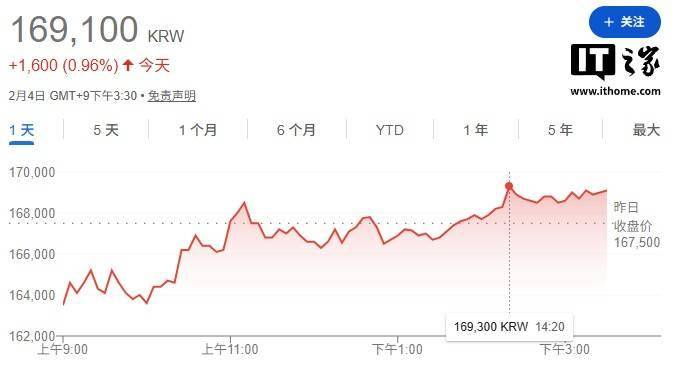
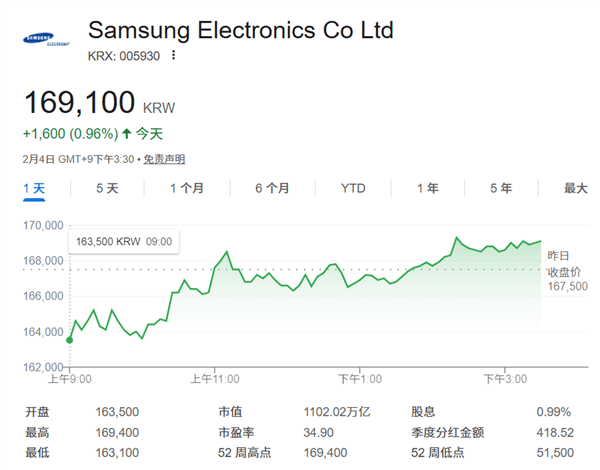
Core Insights - Samsung Electronics has reached a historic milestone by surpassing a market capitalization of 1,000 trillion Korean Won (approximately 688 billion USD), becoming the first company in South Korea to achieve this landmark [2][4]. Group 1: Market Performance - On Wednesday, Samsung's market capitalization briefly touched approximately 1,002 trillion Korean Won, with its stock price rising to 169,400 Korean Won, an increase of 1.13% from the previous trading day [4]. - At market close, the stock price settled at 169,100 Korean Won, reflecting a gain of 0.96%, stabilizing the market capitalization at around 1,001 trillion Korean Won [5]. - Since surpassing 100,000 Korean Won per share last October, Samsung's stock has surged by 125% over the past year, with a cumulative increase of about 41% in the current year [5]. Group 2: Industry Dynamics - The demand for high-performance storage chips has been robust, contributing to Samsung's stock price surge [5]. - Samsung and SK Hynix are expected to significantly raise NAND flash memory prices in the first half of this year, with product profit margins projected to reach between 40% and 50%, marking the highest levels in nearly a decade [5].

三星晶圆厂,涨价了
半导体芯闻· 2026-02-04 10:17
Core Viewpoint - Samsung Electronics is planning to increase prices for certain semiconductor foundry processes, specifically targeting 4nm and 8nm technologies, with an expected increase of approximately 10% [1][2]. Group 1: Price Increase Details - The price increase is primarily focused on the 4nm and 8nm processes, which have reached maturity and stable yield stages [1]. - The expected price increase of around 10% may vary depending on the customer and specific process [1]. - The demand for these processes is high, leading to a situation where their production capacity is nearly at its limit [1]. Group 2: Competitive Landscape - TSMC (Taiwan Semiconductor Manufacturing Company) has been raising its process prices due to surging demand from artificial intelligence and ongoing order growth, with some processes seeing price increases of up to 20% [2]. - Even with a 10% price increase, Samsung's foundry services remain competitively priced compared to TSMC, making them an attractive option for price-sensitive customers [2]. - The price adjustment is expected to help Samsung ensure its capacity is invested in its own processes while enhancing its long-term profitability [2].
HBF将超过HBM,闪存巨大利好
半导体芯闻· 2026-02-04 10:17
Core Viewpoint - The next-generation NAND flash product, High Bandwidth Flash (HBF), is expected to surpass the High Bandwidth Memory (HBM) market within approximately 10 years, driven by the increasing data demands of artificial intelligence applications [1][3]. Group 1: HBF and HBM Overview - HBF significantly enhances memory capacity through vertical stacking of NAND flash, serving as long-term storage, while HBM is crucial for speed [1][2]. - HBF is predicted to play a vital role in AI applications, taking over the "key-value" cache function previously held by HBM as the demand for data storage grows [1][2]. Group 2: Market Predictions and Trends - Professor Kim predicts that from 2038 onwards, the demand for HBF will exceed that of HBM, particularly as memory-centric computing architectures become prevalent [3][8]. - The HBF market is projected to grow from $1 billion in 2027 to $12 billion by 2030, indicating a significant opportunity for companies involved in this technology [7]. Group 3: Competitive Landscape - Samsung and SK Hynix are both developing HBF, but with differing strategies; SK Hynix focuses on HBM while positioning HBF as a complementary solution, whereas Samsung is redefining HBF's role in broader AI memory architectures [5][6]. - Collaboration with major tech companies like NVIDIA, Google, and AMD is deemed essential for market capture and technological advancement in HBF [4][9]. Group 4: Technical Specifications and Advantages - HBF is expected to achieve processing capabilities up to 10 times greater than current solutions at a lower cost, with a speed of 80% to 90% that of HBM and a capacity 8 to 16 times greater [5][6]. - The first generation of HBF is anticipated to stack 16 layers of 32GB NAND flash, totaling around 512GB [6].

存储超级周期愈演愈烈,三星市值首破1000万亿韩元
Feng Huang Wang· 2026-02-04 09:31
Core Insights - The article highlights that Samsung Electronics has surpassed a market capitalization of 1,000 trillion Korean Won (approximately 688 billion USD), becoming the first company in South Korea to reach this milestone [1] - Following a remarkable 125% increase last year, Samsung's stock price has risen approximately 41% year-to-date [1] - The company anticipates strong demand for storage chips in the future and plans to begin deliveries of its next-generation high bandwidth memory (HBM) chips, HBM4, within the current quarter [1] Company Summary - Samsung Electronics has achieved a significant market capitalization milestone, indicating strong investor confidence and market performance [1] - The stock performance reflects a substantial increase over the past year and into the current year, showcasing the company's growth trajectory [1] - The introduction of HBM4 chips is expected to further enhance Samsung's position in the storage chip market, aligning with the anticipated demand growth [1] Industry Summary - The storage industry is experiencing a supercycle driven by the AI boom, which is contributing to increased demand for memory products [1] - The strong performance of Samsung Electronics may signal positive trends for other companies in the storage sector as well [1] - The ongoing advancements in memory technology, such as the development of HBM4, are likely to play a crucial role in meeting future market demands [1]
高波动遇上真空期:大类资产配置月度展望-20260204
GF SECURITIES· 2026-02-04 09:28
Xml [Table_Page] 宏观经济研究报告 2026 年 2 月 4 日 证券研究报告 高波动遇上真空期:大类资产配置月度展望 | [Table_Title] [Tabl e_Author 分析师:] | 郭磊 | 分析师: | 陈礼清 | | --- | --- | --- | --- | | | SAC 执证号:S0260516070002 | | SAC 执证号:S0260523080003 | | | SFC CE.no: BNY419 | | | | | 021-38003572 | | 021-38003809 | | | guolei@gf.com.cn | | chenliqing@gf.com.cn | | | 请注意,陈礼清并非香港证券及期货事务监察委员会的注册持牌人,不可在香港从事受监管活动。 | | | 报告摘要: ⚫ 12026 年 1 月大类资产表现为韩国综指>原油>黄金>科创 50>南华综合>恒指>日经 225>做多 VIX>上证 综指 ≈ 恒科>标普 500>纳指>中债>美元。1 月底 2 月初,贵金属巨震联动大类资产普调。(1)股商优于债 券,新兴市场优于发达国家,春 ...
【广发宏观陈礼清】高波动遇上真空期:大类资产配置月度展望
郭磊宏观茶座· 2026-02-04 09:00
Core Viewpoint - The performance of major asset classes in January 2026 shows a trend where the Korean Composite Index outperformed other assets, with significant volatility in precious metals leading to a broad adjustment across asset classes [1][14]. Group 1: Asset Performance - In January 2026, the ranking of major asset classes was as follows: Korean Composite Index > Crude Oil > Gold > Sci-Tech 50 > Nanhua Composite > Hang Seng Index > Nikkei 225 > Long VIX > Shanghai Composite Index ≈ Hengke > S&P 500 > Nasdaq > China Bond > US Dollar [1][14]. - The commodity market experienced structural upward trends driven by both long-term narratives and short-term realities, with gold and silver showing volatility but not losing their gains [2][21]. - The global stock markets are entering a critical earnings disclosure period, with all major markets showing gains, and a shift in leading stocks within the US market [2][24]. Group 2: Macroeconomic Insights - The macroeconomic landscape is characterized by a synchronous rise in hard and soft data indices in the US and Japan, while Europe shows a V-shaped reversal in its data [4]. - China's soft data indicators are inconsistent, with hard data in a vacuum period, but nominal GDP growth is estimated at 4.94% for January, indicating a solidifying trend of improvement [4][21]. - The domestic stock and bond markets have shifted from a "seesaw" dynamic to "synchronous volatility," with the stock market experiencing a spring rally and the bond market undergoing a correction [2][4]. Group 3: Investment Strategies - The next driving factors for equity assets may stem from price increases and solidified inflation expectations, with a focus on domestic demand recovery post-holiday [5]. - The "M1-BCI-PPI timing system" indicates a slight expansion in scores, suggesting a supportive environment for risk assets despite a convergence in narratives [6]. - The bond market is showing signs of improvement in relative value, with the yield spread between 10-year government bonds and dividend yields indicating a return to a more favorable position for bonds [7]. Group 4: Sector Performance - The technology sector is currently underweighted compared to the overall market, with a significant drop in the score of high-growth assets due to internal and external liquidity conditions [9]. - The dividend asset timing model suggests that macro conditions do not favor dividends significantly, maintaining a low allocation relative to the overall market [10]. - The energy sector has shown strong performance, driven by geopolitical safety premiums and narratives around AI industrial energy consumption [24].

韩国首家:三星电子市值首次突破1000万亿韩元创韩企先河
Sou Hu Cai Jing· 2026-02-04 08:37
Core Insights - Samsung Electronics has become the first company in South Korea to surpass a market capitalization of 1,000 trillion KRW, equivalent to approximately 4.81 trillion RMB [1] - The stock price of Samsung Electronics reached a historical high of 169,400 KRW during trading, closing at 169,100 KRW, marking a 0.96% increase from the previous trading day [1] Group 1 - Samsung Electronics' stock price has been on a continuous rise, surpassing 100,000 KRW since October 27 of the previous year and recently exceeding 160,000 KRW [2] - Analysts attribute this surge to a significant increase in global AI infrastructure investments since the second half of last year, which has driven demand and prices for memory chips [2] - The company is expected to regain market share in the relatively disadvantaged HBM4 sector due to a recovery in its technological capabilities [2] Group 2 - Samsung Electronics achieved a record operating profit of 20 trillion KRW in the fourth quarter, marking the first time a South Korean company has reached this milestone in a single quarter [3] - Forecasts suggest that Samsung Electronics' total operating profit for the year could exceed 130 trillion KRW, approximately 625.56 billion RMB [3]