
比亚迪股份

Search documents
开源量化评论(121):港股CCASS优选20组合的年度回顾及最新持仓
KAIYUAN SECURITIES· 2026-02-13 06:43
- The "Hong Kong CCASS Preferred 20 Portfolio" was constructed using a two-step screening method: "select brokers first, then select stocks"[3][4] - The first step involves selecting top-performing brokers by standardizing and equally weighting their excess Sharpe ratio and monthly win rate, then selecting the top 10 brokers[4][16] - The second step involves equally distributing funds to the 10 selected brokers, aggregating their latest holdings, and retaining the top 20 stocks by weight for equal allocation[5][17] - The portfolio has shown significant outperformance over the Hang Seng Index, with an annualized excess return rate of 19.3% and an excess Sharpe ratio of 2.45 over the period from 2020 to 2025[3][12][15] - The portfolio demonstrated defensive characteristics during market adjustments, achieving a positive return of 2.05% from October 8, 2025, to December 31, 2025, while the Hang Seng Index fell by 4.47% and the Hang Seng Technology Index dropped by 15.32%[3][12] - The latest holdings of the portfolio as of February 2026 include a low valuation and high dividend yield configuration, with the banking and non-bank financial sectors accounting for about 45%, the energy sector about 10%, and the technology and internet sectors about 20%[6][19][22] Portfolio Performance Metrics - Annualized return: 19.3%[15] - Annualized volatility: 7.9%[15] - Sharpe ratio: 2.45[15] - Maximum drawdown: -7.6%[15] - Monthly win rate: 75.3%[15]
绿色资产证券化 2025 年度运营报告与 2026 年度展望要点:绿色 ABS 产品发行规模下降,基础资产类型进一步扩充;清洁能源国央企与新能源汽车金融机构为核心发行主体;政策持续赋能绿色金融高质量发展
Zhong Cheng Xin Guo Ji· 2026-02-13 06:33
1. Report Industry Investment Rating - No information provided about the industry investment rating 2. Core Viewpoints of the Report - In 2025, the issuance scale of green ABS products declined, with the structure of underlying asset types adjusted. Green financial leasing ABS rose to the top in issuance scale. Green REITs, renewable energy price subsidy ABS, and new - energy vehicle loan ABS still dominated the issuance, while new underlying assets like held real estate and consumer finance loans were added [5][35]. - Multiple departments coordinated to deepen the financial supply - side reform, continuously improving the green finance standard system and basic institutions, and promoting the high - quality development of green finance. The green ABS market is moving towards higher - quality and diversified development [5][30][35]. 3. Summary by Relevant Catalogs 3.1 Issuance - In 2025, 136 green ABS products were issued in China, a 7.48% year - on - year decrease, with a total issuance scale of 185.326 billion yuan, a 16.59% year - on - year decline. Green enterprise ABS, green ABN, and green credit ABS accounted for 50.72%, 38.01%, and 11.27% respectively [5][6]. - By underlying asset types, green financial leasing ABS ranked first with an issuance scale of 58.484 billion yuan (31.56% of the total). Green REITs, renewable energy price subsidy ABS, and new - energy vehicle loan ABS decreased but remained major issuers. Held real estate and consumer finance loans expanded the types of green underlying assets [5][14]. - In 2025, 53 carbon - neutral ABS products were issued, with a scale of 70.393 billion yuan, a 32.02% year - on - year decline, accounting for 37.98% of green ABS [5]. 3.2 Issuance Interest Rate - The issuance spread of green ABS products showed a narrowing trend. In 2025, the average spreads of AAAsf - rated green credit ABS, ABN, and enterprise ABS products to the benchmark rate were 16BP, 46BP, and 64BP respectively. The spread of green credit ABS was significantly lower than other credit ABS, while the difference between green ABN/enterprise ABS and non - green ABS was small [5][26]. 3.3 Policy - In 2025, multiple departments issued policies to deepen the financial supply - side reform, improve the green finance standard system, and promote the development of green asset securitization. Key policies included those from the China Securities Regulatory Commission, the National Administration of Financial Regulation and the People's Bank of China, etc [30][31]. 3.4 Conclusion - In 2025, the green ABS market saw a decline in issuance scale and an adjustment of underlying asset types. With policy support, the market is moving towards high - quality and diversified development. Emerging fields such as green consumer credit, carbon sink revenue rights, and held real estate may become new growth drivers [35]. 3.5 Schedule - The schedule lists the detailed issuance information of green asset - backed securitization products in 2025, including green credit ABS, green ABN, and green enterprise ABS [37][38][39].


再造新汕尾 县域主官谈|访陆河县委书记程永东
Xin Lang Cai Jing· 2026-02-13 06:16
编者按 今年是"十五五"开局之年,也是"再造一个新汕尾"的关键之年。为深入贯彻落实市委工作部署,展现各地开局之势、关键之为,把"再造一个新汕尾"宏大 蓝图变为美好现实,2月9日起,汕尾日报开设"再造新汕尾 县域主官谈"栏目,专访各县(市、区)主要负责同志,围绕贯彻落实市委关于"再造一个新汕 尾"的战略目标,谈思路、谈打算、谈举措,广泛凝聚共识,汇聚强大合力。敬请广大读者垂注。 聚焦"再造一个新汕尾" 奋力实现陆河高质量发展绿色新崛起 ——访陆河县委书记程永东 "近年来,陆河县始终坚持以习近平新时代中国特色社会主义思想为指导,认真贯彻党中央决策部署以及省委'1310'具体部署、市委'1+2+9'工作安排, 以'百千万工程'为总抓手,按照县委'1+2+5'工作思路,凝心聚力、真抓实干、攻坚克难,经济社会高质量发展取得明显成效。'十四五'时期,全县地区生 产总值年均增长10.1%,位居全省第一梯队。第一批通过'百千万工程'三年初见成效督查验收。成功入选全国文明城市提名城市、创建国家生态文明建设 示范区。省级新型城镇化试点落地生根,高质量发展的脚步更加坚实有力。"陆河县委书记程永东在接受本报记者采访时说。 程永东表示 ...

股价暴涨162%!巨力索具突发澄清公告 未签署过4.58亿元海南火箭回收项目
Chang Jiang Shang Bao· 2026-02-13 06:13
Group 1 - Aihua Long faces regulatory scrutiny after being warned about its involvement in the brain-machine interface sector, leading to a formal investigation and losses in both its main business and stock trading activities [1] - Rongbai Technology's order value plummeted from 120 billion to a fine of 9.5 million due to false disclosures, with Chairman Bai Houshan fined 3 million [1] - BYD aims to sell 1.3 million vehicles overseas by 2026, contributing to China's export of over 7 million vehicles, marking a third consecutive year of global leadership in this sector [1] Group 2 - Haichang Intelligent has accounts receivable of 450 million, accounting for 56% of its revenue, and is involved in a patent lawsuit that may result in a compensation of 10.83 million [1] - Zhiji Motors has set a target of selling 81,000 vehicles by 2025 but has failed to meet its targets for three consecutive years, with CEO Liu Tao apologizing for safety concerns related to Tesla [1] - China Shenhua's restructuring plan, involving the acquisition of 12 companies, was approved in just six days, with a total value of 133.6 billion [1] Group 3 - Changchun High-tech anticipates a loss of 1 billion in the fourth quarter due to product price adjustments, while investing over 2 billion annually in R&D to reduce reliance on growth hormones [1] - Vanke's losses are expected to deepen, projecting a loss of 82 billion by 2025, with a bond extension of 6.8 billion and additional support of 2.36 billion from Shentie [1] - GAC Group has issued a rare profit warning, expecting losses between 8 billion to 9 billion, with CEO Feng Xingya reiterating the focus on three major battles for a turnaround [1] Group 4 - Nanhai Rural Commercial Bank was fined 3.8 million, with its net interest margin dropping to 1.15% after eight years of unsuccessful A-share market attempts [1] - Yuanji Food is closing one out of every three new stores, with Yuan Lianghong's wife holding shares in six supplier companies involved in related transactions worth 130 million [1] - "Cheese Queen" Chai Xiu has exited the market after costly marketing efforts, leading to a 70% drop in the stock price of Miaokelan Duo, with Mengniu taking full control [1] Group 5 - Zijin Mining has invested an additional 28 billion in overseas acquisitions, projecting a profit of 51 billion by 2025, with its market value stabilizing above 1 trillion [1] - Hunan Gold's restructuring of 2.7 billion in assets aims to increase resource reserves, benefiting from rising prices of antimony and tungsten, resulting in record profits exceeding 1.27 billion [1] - A shareholder named Yu Han was penalized over 1 billion for manipulating stock prices, while Doctor's Optical spent 50 million on traffic acquisition but only 3 million on R&D [1] Group 6 - SAIC-GM-Wuling's debt ratio has risen to 85.24%, despite a 20.5% increase in sales, which remains 53.5 thousand units below its peak [1]

于东来:胖东来永不上市,就是不缺现金流了!那些上市的,就说明要圈钱玩资本游戏了吗?
Sou Hu Cai Jing· 2026-02-13 05:52
作为深耕实体经济与资本市场研究多年的经济学家,我始终认为,企业的上市选择,从来不是"优劣之分",而是"路径之别"。近日,胖东来创始人于东来在 社交平台发文,明确表态胖东来"永远坚定学校的性质,永不上市",并直言不讳地给出核心原因——"就是不缺现金流了"。这番直白的表述,不仅再度让胖 东来成为舆论焦点,更引发了大众对资本市场的深层追问:胖东来因不缺现金流而拒绝上市,那反过来,那些选择上市的企业,就一定是缺钱,是要圈钱玩 资本游戏吗?答案显然是否定的,上市本身是企业融资发展的正常渠道,但其异化后的"圈钱乱象"确实存在,厘清二者的边界,读懂胖东来不上市的底气与 上市企业的多元诉求,正是解读当下资本市场生态的关键。 综上,胖东来因不缺现金流而选择永不上市,是其经营理念与财务实力的体现;而上市企业的选择,本质是融资发展的正常路径,绝非"圈钱"的代名词。我 们应理性看待企业的上市选择,既警惕资本市场中的圈钱乱象,也认可上市对实体经济的赋能价值。唯有让资本回归服务实体经济的本源,让企业坚守经营 初心,无论是"不上市"的胖东来,还是"优质上市"的企业,都能在各自的路径上实现发展,这才是资本市场健康发展的应有之义,也是实体经济 ...

李迅雷:中国出口份额提升空间还有多大?| 立方大家谈
Sou Hu Cai Jing· 2026-02-13 04:14
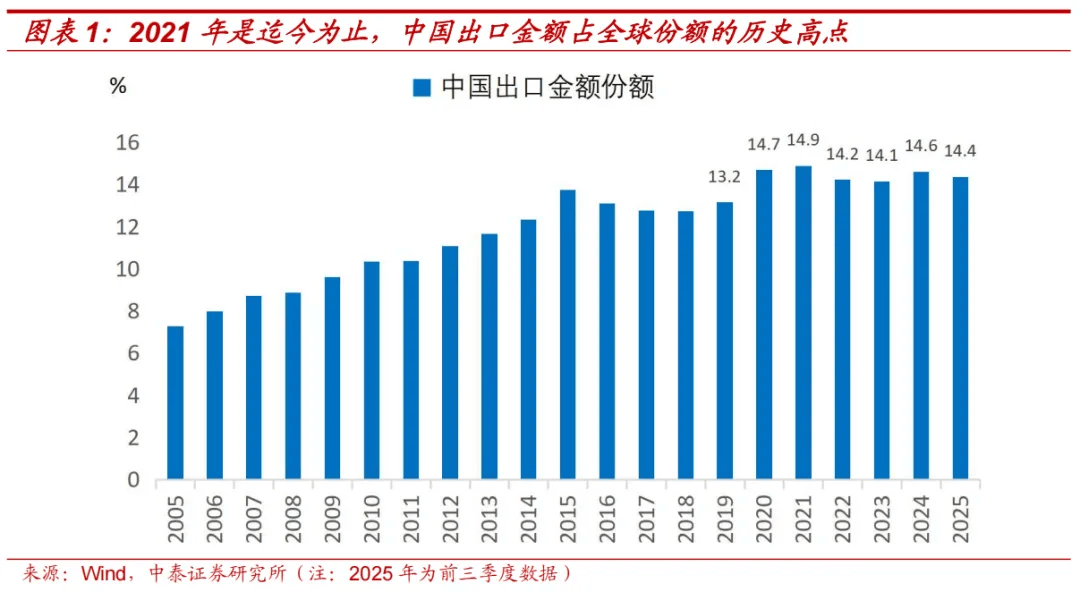
Core Viewpoint - The depreciation of the RMB and low export prices have hindered the increase of China's export value share in the global market, despite exports being a crucial driver of China's economic growth. After reaching a historical high of 14.9% in 2021, China's export share is expected to remain below this level from 2022 to 2025. However, when excluding the impacts of price and exchange rate, the quantity of China's exports continues to increase, indicating its importance as a driver of GDP growth [1][4][7]. Group 1: Export Quantity Share - China's export quantity share is projected to rise from 13.2% in 2019 to 17.0% by the third quarter of 2025, driven by the accelerated upgrade of industries and an increase in high-value-added product exports [13][16]. - The analysis of Japan and Germany's export share decline suggests that China will maintain strong competitiveness in exports, leading to an increase in export order share [38][25]. Group 2: Price Factors - The potential for trade friction risks will limit the price reduction of certain Chinese export products, while optimizing export tax policies may increase export prices. The expected decline in China's export price will narrow, with a possibility of a temporary increase due to a low base [2][44][51]. - The export price index for Chinese goods has been in negative territory for three consecutive years, with a cumulative decline of 10.1% from 2023 to 2025, indicating a strategy of "price for volume" to enhance competitiveness [16][21]. Group 3: RMB Exchange Rate - Since 2022, there has been a divergence between China's trade surplus and the actual effective exchange rate of the RMB, with expectations of a gradual appreciation of the RMB due to strong export resilience and the goal of achieving a per capita GDP comparable to that of developed countries by 2035 [2][63][67]. - The RMB is expected to appreciate against the USD, with a projected increase of 4.4% by 2025, supported by a stable economic environment and increased use of RMB in international trade [70][77]. Group 4: Future Projections - Quantitative assessments indicate that China's export value share in the global market is expected to begin a sustained recovery starting in 2026, stabilizing around 17% by 2030, suggesting that there is still room for growth in China's export share [3][89][91]. - The analysis predicts that the factors supporting China's export growth will not reverse in the short term, indicating continued resilience in exports [20][21].
中国出口份额提升空间还有多大?
李迅雷金融与投资· 2026-02-13 03:53
Core Viewpoint - The article emphasizes that despite the perception of strong export performance, China's export growth has lagged behind the global average in recent years, with only 2024 expected to exceed global growth rates in dollar terms [3][4][6]. Export Performance Analysis - Over the past four years, only in 2024 did China's dollar-denominated exports grow faster than the global average, while in 2022 and 2023, China's export growth was lower than the global average [3][4]. - China's share of global exports remained stable at around 13% from 2015 to 2019, with a slight increase to 14%-15% from 2020 to the first three quarters of 2025, but still below the historical high of 14.9% reached in 2021 [3][4][6]. - The decline in China's export share is attributed to weak export prices and currency depreciation, which have hindered the growth of export value [3][6][11]. Factors Influencing Export Growth - Analyzing the components of China's export share reveals that the decline is primarily due to export prices and exchange rates, while the quantity of exports has been increasing [6][7][8]. - China's export quantity share is projected to rise from 13.2% in 2019 to 17.0% by the first three quarters of 2025, driven by a shift towards higher value-added products [12][14]. - The article identifies three main reasons for the increase in export quantity: accelerated industrial upgrading, persistent price declines due to supply-demand imbalances, and the diversification of markets through the Belt and Road Initiative [12][14][17]. Future Projections - The article forecasts that China's export share will begin to recover in 2026 and stabilize around 17% by 2030, indicating that there is still room for growth in China's global export share [3][82]. - The expected recovery is supported by a projected appreciation of the renminbi, a narrowing of export price declines, and the competitive advantages of Chinese exporters [76][82]. Price and Currency Factors - The article suggests that the downward pressure on export prices is expected to weaken, with potential for price increases due to trade friction risks and government policy adjustments [40][41][47]. - The renminbi is anticipated to appreciate against the dollar, supported by China's resilient export performance and the government's long-term economic goals [58][61][76].

观察|1月车市三把“王座”全部易主
Guang Zhou Ri Bao· 2026-02-13 03:15
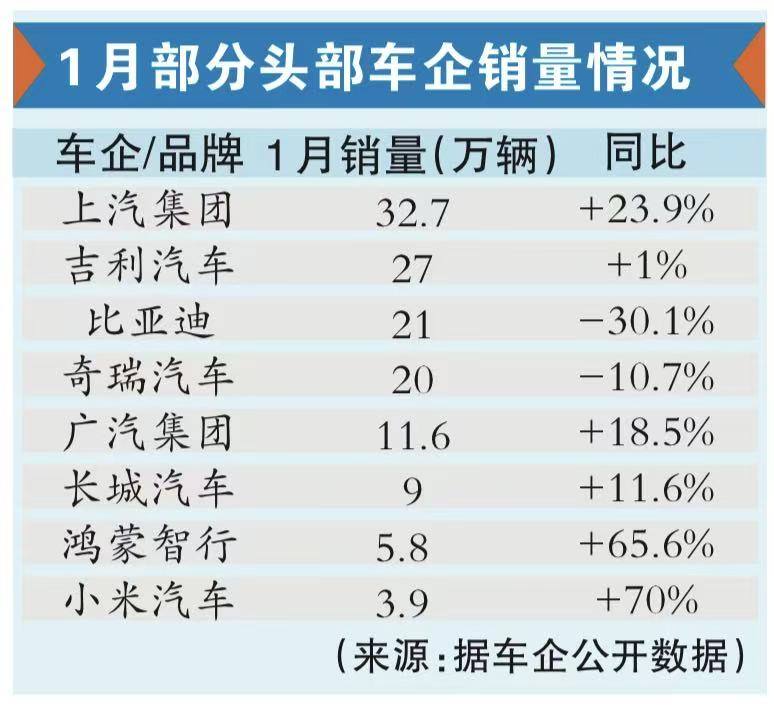
Core Insights - The January sales figures indicate a significant shift in the competitive landscape of the Chinese automotive market, with traditional giants like SAIC and Geely reclaiming leadership positions, while BYD's dominance is challenged [1][3][4] Group 1: Sales Performance - SAIC Group achieved sales of 327,000 vehicles in January, marking a year-on-year increase of 23.9% [2][4] - Geely Automotive sold 270,100 vehicles, a year-on-year growth of 1%, surpassing BYD to become the top-selling domestic brand [2][4] - BYD's sales fell to 210,000 vehicles, experiencing a significant year-on-year decline of 30.1% [2][4] - New energy vehicle sales for SAIC reached 85,000 units, growing by 39.7% [4] - The overall automotive production and sales in January were 2.45 million and 2.346 million units, respectively, with a slight year-on-year production increase of 0.01% [7] Group 2: New Players and Market Dynamics - The new energy vehicle segment saw a reshuffling, with Hongmeng Zhixing leading the new force with 57,915 units sold, a remarkable year-on-year increase of 65.6% [6] - Xiaomi Automotive followed closely with over 39,000 units sold, achieving a year-on-year growth of approximately 70% [6] - The previous leaders in the new force segment, such as Leap Motor, have seen a decline, with their sales dropping to 32,059 units [6] Group 3: International Market Growth - The overseas market is identified as a key growth area for automotive companies, with January exports reaching 681,000 vehicles, a year-on-year increase of 44.9% [7] - Exports of new energy vehicles doubled to 302,000 units, highlighting the importance of global expansion for competitive advantage [7]


比亚迪未放弃布局墨西哥,有意收购日产当地工厂
日经中文网· 2026-02-13 02:46
日本经济新闻2月12日获悉,针对日产汽车已决定退出的墨西哥市场,中国汽车大企业比亚迪 (BYD)和吉利汽车已表示有意收购其墨西哥工厂。比亚迪刚刚取消在墨西哥新建工厂的计 划,外界认为该公司已转换方针,打算活用其他企业在当地的现有生产基地。 路透社援引相关人士的话报道了这一消息。两家中国车企有意收购的是日产与德国梅赛德斯- 奔驰合资经营的COMPAS工厂(位于墨西哥中西部阿瓜斯卡连特斯州)。据称,两家车企与 其他中国大型企业及越南纯电动汽车(EV)厂商一同进入了最终候选名单。 比亚迪从2023年开始正式考虑在墨西哥建设新工厂的计划,2024年已接近敲定最终选址的阶 段。该公司还于同年5月在墨西哥城举行了非中国地区首次新车发布会,大型汽车企业聚集的 墨西哥的中西部巴希奥地区及东北部新莱昂州等具体候选地也浮出水面。当时该公司被认为 已几乎敲定进驻墨西哥。 比亚迪过去一直对在墨西哥新建工厂表现出积极意愿(2024年5月在墨西哥城举办的新车发布会) 比亚迪和吉利汽车等进入了日产与德国梅赛德斯-奔驰合资经营的墨西哥COMPAS工厂的收 购意向方的最终候选名单。比亚迪刚刚取消在墨西哥新建工厂的计划,外界认为该公司已转 换方 ...

资金借道ETF布局港股,科技赛道成配置主力,南方基金旗下恒生科技ETF南方(520570)连续8日获资金净流入
Xin Lang Cai Jing· 2026-02-13 02:39
消息面上,据业内统计,截至2月11日,跨境ETF规模达到1万亿元,其中港股主题ETF规模合计8224.51 亿元。今年来,截至2月11日,港股主题ETF净流入544.35亿元。在港股市场近期的调整行情中,大量资 金借道ETF逆势入场,推动跨境ETF规模重返万亿元。随着资金涌入,多只港股主题ETF份额创上市以 来新高。同时,韩国投资者再度扫货中国股票,大举买入大模型龙头Minimax-WP。2026年伊始,韩国 投资者再度大量买入中国股票,加仓中国人工智能大模型领军企业。 恒生科技指数主要涵盖与科技主题高度相关的香港上市公司,包括网络、金融科技、云端、电子商贸及 数码业务。经过是否利用科技平台进行营运、研究发展开支占收入之比例及收入增长等三项指标筛选 后,选出市值最高的30只个股作为指数成分,指数可代表港股科技企业龙头的整体表现。 2月12日,小米集团创办人,董事长兼CEO雷军公布了小米机器人团队的阶段性研究成果:具身智能 VLA模型Xiaomi-Robotics-0,该模型在众多主流测试集中均取得了当前最优成绩,并已完成开源。据了 解,Xiaomi-Robotics-0拥有47亿参数、兼具视觉语言理解与高性能 ...