
吉利

Search documents
TrendForce:一季度全球新能源车合计销量达402万辆 同比增长39%
智通财经网· 2025-05-21 05:54
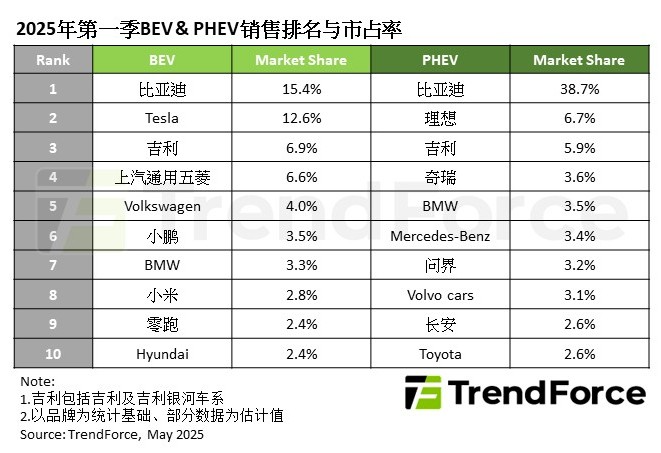
Group 1 - The global sales of new energy vehicles (NEVs), including BEVs, PHEVs, and hydrogen fuel cell vehicles, are projected to reach 4.02 million units in Q1 2025, representing a year-on-year increase of 39%, with NEVs accounting for 18.4% of total global car sales in the same period [1] - The estimated total sales of NEVs for the entire year of 2025 is 19.47 million units, reflecting a year-on-year growth of 19.6% [1] Group 2 - In Q1 2025, the sales of BEVs reached 2.67 million units, marking a year-on-year increase of 45%, with BYD maintaining the top position in sales with a market share of 15.4%, followed by Tesla at 12.6% [3] - Geely's sales saw a significant increase of 443% year-on-year, aided by the launch of new models, while Xiaopeng's sales were largely driven by its affordable model, the Mona M03 [3] - Volkswagen ranked fifth in BEV sales, with a year-on-year growth of 41%, driven by its strategy "In China, For China" to enhance its product offerings in the Chinese market [3] Group 3 - The sales of PHEVs in Q1 2025 totaled 1.35 million units, showing a year-on-year increase of 28%, with BYD leading the market with a share of approximately 38.7% [4] - Geely's PHEV sales benefited from the strong performance of the Galaxy series, achieving a 158% year-on-year increase and securing the third position in the market [4] - Some Chinese brands, such as Aito, experienced a decline in sales, with a 47% drop compared to the same period last year, indicating increased competition in the market [4]



飞行汽车量产倒计时 香山股份战略卡位低空经济蓝海迎先发优势
Quan Jing Wang· 2025-05-21 05:44
Group 1 - The production license application for Xiaopeng Huitian's flying car "land aircraft carrier" (code: X3-F) has been accepted, marking a significant step in the mass production system of flying cars in China [1] - The low-altitude economy is accelerating in China, with companies like Xiangshan Co., Ltd. strategically positioned to benefit from this emerging industry [1] - Xiangshan Co., Ltd.'s subsidiary, Junsheng Group, is a key partner for leading flying car companies, providing integrated charging and power management systems, expected to enter mass production by 2026 [1] Group 2 - Morgan Stanley predicts the global flying car market will reach $9 trillion, with China's potential market size at $2.1 trillion, and flying cars expected to grow at a compound annual growth rate of 46.2% over the next five years [2] - China Galaxy Securities believes new products in the low-altitude economy will provide new performance growth points for Xiangshan Co., Ltd. [3] - Xiangshan Co., Ltd. is a global tier-one supplier for major automotive brands, with projected revenue from new energy vehicle parts and charging systems reaching 987 million yuan in 2024, reflecting a compound annual growth rate of 21.08% [3] Group 3 - Xiangshan Co., Ltd. is transitioning from a traditional auto parts manufacturer to a leading provider of smart mobility solutions, with low-altitude economy being a key strategic focus [1] - The company has established a strong global operational capability with R&D centers in China, Germany, and North America, and 15 production bases worldwide [3] - The integration of Junsheng Electronics as a controlling shareholder has enhanced Xiangshan Co., Ltd.'s global supply chain resources and operational synergy [3]
得邦照明:车载开发将通过CNAS实验室认证 关税风险对业务影响可控
Zheng Quan Shi Bao Wang· 2025-05-21 02:51
Core Viewpoint - The company is focusing on both general lighting and automotive lighting as its primary growth drivers, with strategic investments in R&D and production capacity to enhance its market position and address potential tariff impacts from the U.S. [1][2] Group 1: Business Strategy - The company positions general lighting and automotive lighting as its first and second growth curves, respectively, aiming to solidify its leadership in general lighting while developing automotive lighting capabilities [1] - In the automotive sector, the company emphasizes "safety + electrification/intelligence" in its R&D focus, with a complete software and hardware development team [1][2] Group 2: R&D and Product Development - R&D investments in general lighting are concentrated on "intelligence + environmental protection + cost optimization," leveraging synergies between automotive and general lighting businesses [2] - The company has secured over 1 billion RMB in new project designations for automotive lighting in 2024, with additional projects in Q1 2025, covering various product categories [3] Group 3: Tariff Impact and Market Response - The company's U.S. business accounts for approximately 20% of its operations, and it has proactively established production capacity in Vietnam and Indonesia to mitigate tariff risks [2] - The impact of tariffs on the automotive business is limited, as the proportion of products exported to the U.S. is small, and the company is accelerating domestic substitution efforts [2]

一汽大众4月在华销量下滑 转型仍面临挑战
Cai Jing Wang· 2025-05-21 01:22
Group 1: Sales Performance - In April 2025, FAW-Volkswagen achieved vehicle sales of 113,406 units, with a year-on-year increase of 0.4 percentage points in fuel vehicle share [1] - Volkswagen brand sold 68,001 units, up 7.9% year-on-year, while Audi brand sales reached 36,900 units, maintaining the top market share for domestic luxury fuel vehicles from January to April [1] - However, April's sales were significantly lower than March's 154,000 units, indicating a decline in momentum [1] Group 2: Market Challenges - In the first quarter, Volkswagen's global revenue was €77.6 billion, a 2.8% increase, but operating profit fell 37% to €2.9 billion [2] - In China, Volkswagen's sales dropped by 7.1% to 644,100 units, accounting for 30% of global sales, despite growth in other markets [2] - FAW-Volkswagen's total sales for 2024 were 1.6591 million units, down approximately 13% from 2023's 1.9102 million units [2] Group 3: Electric Vehicle Transition - The electric vehicle market is expected to grow significantly, with projections of 16.5 million units sold in 2025, a nearly 30% increase [3] - FAW-Volkswagen plans to launch over 20 new energy vehicles in the Chinese market by 2027, indicating a strong commitment to electric vehicle development [4] - The company will introduce 11 new models tailored for the Chinese market starting in 2026, including 6 pure electric vehicles [4] Group 4: Competitive Landscape - The rise of domestic brands like BYD and NIO poses a challenge for Volkswagen, necessitating a proactive response to maintain market position [3] - FAW-Volkswagen's transition to electric vehicles involves local teams taking a more significant role in product development, with a focus on localized technology [5] - Despite efforts in product and technology localization, the company faces pressure on market share and profitability in the competitive electric vehicle landscape [5]
价格过千,维修隐藏式门把手为何这么贵?
36氪· 2025-05-20 13:25
Core Viewpoint - The article discusses the rising costs associated with the repair of hidden door handles in electric vehicles compared to traditional mechanical handles, highlighting the complexity and electronic components involved in the former [4][11][22]. Group 1: Repair Costs Comparison - Repair costs for hidden door handles are significantly higher than for mechanical handles, with examples showing costs of 1087.5 yuan for a hidden handle versus 120 yuan for a mechanical one [5][9]. - The average repair costs for hidden handles range from 400 to 1000 yuan for materials, with additional labor costs, while mechanical handles typically cost under 300 yuan for replacement [8][9]. Group 2: Reasons for High Repair Costs - Hidden door handles incorporate multiple electronic components such as motors and sensors, leading to higher replacement costs compared to traditional handles [11][14]. - The common practice in repairs is to replace the entire handle assembly rather than individual components, further driving up costs [12][16]. Group 3: Industry Challenges - There is a significant shortage of skilled technicians capable of repairing electronic components, which forces many repair shops to adopt a replacement-only approach, increasing costs for consumers [18][21]. - The automotive repair industry faces a talent gap, particularly in the field of electric vehicle maintenance, with estimates indicating that 80% of the talent shortage is in this area [21][23]. Group 4: Potential Solutions - Suggestions to address high repair costs include improving vocational training for technicians, establishing a certification system for repair professionals, and encouraging competition among parts suppliers to lower costs [20][23]. - The article emphasizes the need for policy support and industry self-regulation to enhance the repair ecosystem for electric vehicles [20][23].

地平线机器人-W(9660.HK):软硬一体 向高而行 开启智驾新征程
Ge Long Hui· 2025-05-19 14:06
Core Viewpoint - The company is a leading player in the domestic third-party intelligent driving chip and solution market, with advanced integrated hardware and software technology, strategic positioning, and business model [1] Company Positioning - The company is positioned as an algorithm software company disguised as a chip manufacturer, focusing on intelligent driving solutions, aiming to become the Wintel of the robotic era [1] - The company has grown into the leading third-party intelligent driving solution provider in China since shifting its strategy in 2019 [1] - The company’s full-stack hardware and software products include chips, underlying software (BPU and toolchain), and algorithms, with the Zhengcheng series of intelligent driving chips holding the largest market share domestically [1] Financial Performance - The company is expected to deliver approximately 2.9 million units in 2024, with total revenue projected at 2.38 billion yuan, a year-on-year increase of 53.6%, and a gross margin of 77.3% [1] - Revenue from technology licensing and service business is expected to reach 1.65 billion yuan, with a gross margin of 92% [1] - Revenue for 2025 is projected to reach 3.41 billion yuan, a year-on-year increase of 43.1%, and 5.8 billion yuan in 2026, a year-on-year increase of 70.1% [3] Industry Trends - The intelligent driving sector is experiencing a shift towards increased penetration and self-sufficiency in the supply chain, which is becoming a key competitive factor in the automotive industry [2] - The penetration rate of mid-to-high-end intelligent driving configurations in passenger vehicles is expected to rise significantly, with new vehicle penetration projected to increase from approximately 10% in 2024 [2] Competitive Advantages - The company’s core competitive advantage lies in its unique integrated hardware and software model, which covers high-tech barriers and high-value-added segments of the industry [2] - The company is well-positioned to establish market dominance as the trend of intelligent driving equity develops [2] Investment Value - The market's perception of the company's investment value is primarily focused on its leading position in self-sufficient intelligent driving chips, despite concerns about potential limitations from OEMs developing their own chips [2] - The company’s intelligent driving software algorithm capabilities may be undervalued, with the HSD high-end intelligent driving solution expected to reshape market perceptions in 2025 [2] Future Growth Potential - The company is expected to achieve a compound annual growth rate of 50% over the next 3-5 years, with total revenue projected to reach 12 billion yuan by 2028 and net profit exceeding 1 billion yuan [3] - Long-term projections suggest that if the company can achieve 6 million units of high-end intelligent driving solutions and a 20%-25% global market share in mid-to-low-end intelligent driving, revenue could reach 30 billion yuan, resulting in nearly 10 billion yuan in profit [3]

增程+插混占比超50%,新能源车市“销量与减碳”如何兼得?
3 6 Ke· 2025-05-19 09:50
Core Insights - In 2025, China's new energy vehicle (NEV) market is expected to reach a structural turning point, with range-extended and plug-in hybrid vehicles accounting for over 50% of the market share, driven by models like the Wanjie M8 and Avita 06 [1] - The sales of new energy vehicles in 2024 are projected to reach 11.26 million units, with range-extended and plug-in hybrid vehicles contributing 4.52 million units, showing an impressive year-on-year growth of 85.2% compared to 15% for pure electric vehicles [1] - The market is experiencing a deep competition phase regarding technology routes, raising questions about whether range-extended and plug-in hybrid technologies are practical choices for carbon neutrality or merely transitional solutions [1] User Demand and Technological Benefits - The pursuit of a "no-anxiety experience" is a core driver for consumers, with range-extended vehicles meeting both low-cost urban commuting needs and long-distance travel concerns [3] - For instance, the Li Auto L series boasts a comprehensive range exceeding 1000 km, with a cost of less than 0.1 yuan per kilometer in pure electric mode, appealing to family users [3] - Plug-in hybrid vehicles, like BYD's DM-i, maintain fuel consumption below 3L/100km even in depleted states, balancing performance and economy [3] Technological Breakthroughs - The range-extended structure has lower R&D costs (40% less than plug-in hybrids) and production line transformation costs (one-third of plug-in hybrids), facilitating rapid market entry for new players [5] - Li Auto achieved over 500,000 annual sales in 2024 with a single range-extended model, while the Wanjie M7 surpassed 190,000 units in deliveries, validating the commercial viability of this approach [5] - Plug-in hybrid technology has also seen significant sales, with BYD's DM-i models exceeding one million units, showcasing strong market penetration across various vehicle segments [5] Environmental Concerns and Technological Debate - The rise in sales of hybrid vehicles has intensified debates over technology routes, with range-extended technology facing criticism for higher energy consumption and carbon emissions compared to plug-in hybrids [6] - Critics argue that the two-step energy conversion process of range-extended vehicles is less efficient, while proponents highlight their fuel-saving potential of 30%-50% in less developed areas [6] - The market is navigating a balance between ideal environmental goals and real user needs, as highlighted by industry experts [6] Strategic Choices of Automakers - New entrants like Li Auto and Wanjie are leveraging range-extended technology to establish market recognition, while traditional automakers focus on plug-in hybrid technologies [7] - The differentiation in strategies reflects a broader trend of technological convergence, with companies like Li Auto introducing pure electric models and BYD integrating high-voltage platforms with hybrid technologies [9] Future Outlook - The potential widespread adoption of 800V platforms could mitigate the refueling disadvantages of hybrid vehicles, although it may increase costs due to the need for upgraded components [11] - Solid-state batteries are anticipated to revolutionize pure electric vehicle range by 2027, posing challenges to the transitional status of range-extended and plug-in hybrid technologies [11] - The consensus in the industry suggests that hybrid technologies will remain mainstream from 2025 to 2030, as they address user needs while filling gaps left by pure electric vehicles [12]


地平线机器人-W:软硬一体,向高而行,开启智驾新征程
China Securities· 2025-05-18 16:05
Investment Rating - The report assigns a "Buy" rating for the company [5] Core Views - The company is a leading third-party intelligent driving chip and solution provider in China, with a strong software-hardware integration technology and a leading strategic and business model [1][2] - The year 2025 marks the mass production year for the J6 series chips and high-level full-stack intelligent driving solutions (HSD), with expected shipment volumes exceeding one million units for J6M/E chips [1][2] - The company's intelligent driving solutions are expected to become the primary choice for OEMs, initiating a new growth cycle [1][3] Company Positioning - The company is positioned as an algorithm software company with a focus on intelligent driving solutions, aiming to become the Wintel of the robot era [2][17] - The company has transitioned from a pure software focus to a software-hardware integration model since 2019, becoming the leading third-party intelligent driving solution provider in China [2][17] Industry Trends - The intelligent driving sector is experiencing a shift towards higher penetration rates and a trend of self-sufficiency in the supply chain, with the new car penetration rate expected to rise significantly by 2025 [3][8] - The company is set to benefit from the trend of intelligent driving equality, with mid-to-high-end intelligent driving configurations becoming more accessible [3][8] Competitive Advantages - The company possesses a unique software-hardware integration model, enabling it to provide high-value solutions across the intelligent driving industry [3][8] - The company is leveraging its advanced algorithms and engineering capabilities to optimize performance and production efficiency [3][8] Investment Value - The company is recognized as a leader in self-sufficient intelligent driving chips and is expected to create significant value in high-level intelligent driving solutions [4][10] Financial Performance - The company anticipates total revenue of 2.38 billion yuan in 2024, representing a year-on-year growth of 53.6%, with a gross margin of 77.3% [2][36] - The revenue from technology licensing and services is projected to reach 1.65 billion yuan in 2024, with a gross margin of 92% [2][36] Product and Business Model - The company focuses on providing full-stack hardware and software products, including chips, algorithms, and development tools, covering low, mid, and high-level intelligent driving solutions [32][35] - The business model is flexible, allowing OEMs and Tier 1 customers to choose from a variety of solutions or components [43][50]
中微半导:长城证券、赢舟资本等多家机构于5月15日调研我司
Zheng Quan Zhi Xing· 2025-05-16 09:40
Core Viewpoint - Company reported significant growth in gross margin and aims to exceed historical revenue levels in 2025 [2][10] Financial Performance - In Q1 2025, the company achieved a revenue of 206 million yuan, a year-on-year increase of 0.52% [11] - The net profit attributable to shareholders was 34.42 million yuan, up 19.4% year-on-year [11] - The net profit after deducting non-recurring items was 32.58 million yuan, reflecting a 31.75% increase year-on-year [11] - The gross margin stood at 34.46% [11] - The company has a debt ratio of 7.93% and reported investment income of 9.51 million yuan [11] Product Development - The company has improved its gross margin due to lower wafer prices and the introduction of cost-effective new products [2] - The second-generation automotive-grade MCU has enhancements in frequency, interfaces, and resources compared to the first generation, making it more competitive [3] - The company is expanding its automotive-grade control chips into general and specialized products, focusing on high-performance SoC designs for applications like motor control and battery management [4] Market Presence - The automotive-grade chips have been adopted by several well-known car manufacturers, including Changan, Seres, Hongqi, and Geely [6] - The company is experiencing a continuous increase in orders for automotive MCUs [5] Industrial Growth - Growth in the industrial control sector is primarily driven by the demand for brushless motor drive control products [7] Supply Chain and Pricing - The company has not received any price adjustment notifications from foundries and maintains stable relationships with suppliers, ensuring reasonable pricing and capacity [9]

中微半导:宇树是公司终端客户
news flash· 2025-05-16 08:09
Core Viewpoint - The company, Zhongwei Semiconductor, has confirmed that Yushu is one of its end customers, indicating a strategic partnership in the automotive sector [1] Group 1: Company Developments - Zhongwei Semiconductor has successfully introduced automotive-grade chips to several car manufacturers, including Chang'an, Seres, Hongqi, and Geely, indicating a growing market presence [1] - The company reports a continuous increase in orders for automotive microcontrollers (MCUs), suggesting a strong demand in the automotive industry [1] Group 2: Customer Relationships - Yushu is identified as an end customer of Zhongwei Semiconductor, highlighting the company's involvement in the robotics sector [1]