宝马

Search documents
2025年韩国市场混合动力车销量占比创新高
Shang Wu Bu Wang Zhan· 2026-02-11 12:01
据韩联社2月8日报道,韩国土交通部8日公布汽车注册统计数据显示,2025年韩国五大整车厂商在韩国 国内市场总销量达137.32万辆,其中混合动力车销量为41.59万辆,占比达30.3%,创历史新高。 近年来混合动力车市场呈逐年增长态势,2021年至2024年依次为10.4%、13.2%、19.5%和26.5%。主要 是因为电动化转型速度低于预期,混合动力车则成为一种受欢迎的替代方案,它可以让用户体验到电动 车的许多优点,而无需承担充电基础设施的负担。汽车行业预测今年混合动力车市场将进一步扩大。在 进口车市场,宝马、奔驰等全球知名品牌,以及比亚迪(002594)、极氪等中国品牌正以高效率与性价 比为优势,持续强化对韩国市场的布局。 ...
敏实集团联手绿的谐波 布局北美人形机器人核心部件赛道
Xin Lang Cai Jing· 2026-02-11 06:09
Core Viewpoint - The partnership between Sensata Technologies and Lide Harmonic aims to establish a joint venture in the U.S. focused on humanoid robot joint module assembly, targeting the North American market to capitalize on the growing demand for core components in the humanoid robotics industry [1][6]. Company Overview - Sensata Technologies is a leading global automotive parts manufacturer with production bases in 14 countries, supplying major automakers like Tesla and BMW, and has extensive experience in large-scale manufacturing and global operations [2][7]. - Lide Harmonic is a leading domestic company in harmonic reducers, with its products already integrated into the supply chain of Tesla's Optimus robots, showcasing strong technical expertise in precision transmission [2][7]. Market Potential - The humanoid robot industry is projected to experience explosive growth, with global shipments expected to reach nearly 18,000 units by 2025, representing a 508% year-over-year increase, and order volumes exceeding 35,000 units [2][7]. - Joint modules, as core motion components of robots, integrate harmonic reducers, servo motors, and encoders, presenting high technical barriers and strong customization demands [2][7]. Strategic Goals - The joint venture aims to provide localized humanoid robot joint modules in North America, covering the entire service chain from R&D to production and maintenance, addressing the increasing demand from leading robot products like Tesla's Optimus [1][6]. Financial Market Response - The market reacted positively to the announcement, with Sensata's stock price rising over 9% on the day of the announcement, reaching a new high since January 2021, and a cumulative increase of 160% over the past year [3][8]. - Financial institutions like UBS and Citigroup have expressed optimism about the long-term value enhancement for Sensata, with UBS raising its target price to 45.5 HKD, highlighting the potential for new revenue sources from localized robot joint modules [3][8]. Challenges Ahead - The humanoid robot industry is still in its early commercialization phase, with Morgan Stanley noting that actual global shipments may fall short of 20,000 units by 2025, indicating a slower-than-expected scaling process [3][8]. - The complexity of joint modules and the dispersion of orders may hinder significant revenue contributions in the short term, alongside potential profit margin pressures from fluctuating aluminum prices and high costs of customized production [3][8]. Industry Trends - The collaboration reflects a broader trend of traditional manufacturing giants and niche technology experts working together to seize emerging market opportunities in humanoid robotics [4][9]. - The partnership signifies a shift in Chinese manufacturing from "globalized OEM" to "technology-driven ecosystems," providing a new growth narrative amid slowing electric vehicle growth [4][9].

汽车:摩托质价比破局时刻已至
HTSC· 2026-02-11 02:20
证券研究报告 汽车 摩托质价比破局时刻已至 华泰研究 2026 年 2 月 10 日│中国内地 专题研究 核心观点:质价比破局时刻已至,摩托出海步入收获期 本届米兰展上我们观察到,欧洲摩托市场的需求结构演变,以及外资二线品 牌的守成产品策略,正为中国品牌的强势突围提供契机。随着以隆鑫、春风 为代表的中国头部摩企在技术储备与渠道建设上完成质的积累,向欧洲出海 已跨越单纯的价格竞争阶段,步入以"质价比"重塑市场格局的新周期。中国 摩企凭借动总技术突破、智能化配置优势以及针对欧洲本土审美的定制化设 计,正于 300 至 800cc 黄金排量段及跨界细分市场建立明显优势,在欧洲 市场具备广阔增长空间。 米兰展透视:中量级和跨界车趋势兴起,利好中国品牌切入 行业维度看,欧洲摩托市场短期受库存调整扰动,但长期稳健扩容态势未改, 且内部结构性机遇凸显,为中国品牌创造了突围机会:1)通胀推升价格敏 感度叠加年轻骑手占比提高,驱动排量需求向中量级收敛;2)用户偏好转 向多场景兼容,供给相对稀缺的跨界车型加速渗透。格局维度看,本届米兰 展上,一线日系本田、雅马哈凭借顶尖电控技术普惠夯实护城河,宝马依托 GS 生态势能下探排量扩圈 ...

啥样的车,更受市场欢迎?
Ren Min Ri Bao Hai Wai Ban· 2026-02-10 22:52
Core Insights - The upcoming Spring Festival is driving consumer interest in the automotive market, with various incentives such as trade-in subsidies and shopping bonuses contributing to increased sales activity [2] Group 1: Market Trends and Sales Data - In 2025, the cumulative sales of new energy vehicles priced between 100,000 to 200,000 yuan are projected to reach 6.941 million units, representing the largest market share [4] - The price range of 80,000 to 100,000 yuan is expected to see a sales growth of 78.4%, making it the fastest-growing segment [4] - Sales of new energy passenger vehicles under 150,000 yuan are anticipated to grow significantly, with units sold in the 80,000 and below, 80,000 to 100,000, and 100,000 to 150,000 yuan segments reaching 1.533 million, 1.494 million, and 3.549 million respectively, reflecting year-on-year growth of 51.8%, 78.4%, and 59.5% [5] Group 2: Consumer Demand and Preferences - The 100,000 to 150,000 yuan price range is popular due to its alignment with family purchasing needs and practical value, making it a high-cost performance segment [5] - The increase in sales for the 80,000 to 100,000 yuan segment is closely linked to government policies, including a fixed subsidy for scrapping old vehicles, which encourages consumers to purchase new energy vehicles [6] - The 100,000 to 150,000 yuan segment is expected to remain the mainstay for new energy vehicle sales, while the 150,000 to 200,000 yuan segment is projected to experience rapid growth due to consumer upgrades [7] Group 3: Fuel Vehicle Market Dynamics - In 2025, traditional fuel vehicle sales are expected to reach 13.427 million units, a decline of 4% year-on-year, with the 100,000 to 150,000 yuan price range being the most concentrated segment [8] - The competitive advantage of fuel vehicles lies in their refueling convenience and stability, while new energy vehicles offer lower operating costs and advanced technology features [8] - The market for fuel vehicles is dominated by well-established joint venture brands, with models like the Nissan Sylphy and Volkswagen Lavida leading in sales [9] Group 4: Shifts in Market Structure - By 2025, domestic brand passenger vehicle sales are projected to reach 20.936 million units, a 16.5% increase, resulting in a market share of 69.5% [11] - The shift in market dynamics is attributed to domestic brands gaining a competitive edge in the transition to new energy vehicles, with several new entrants achieving significant sales milestones [11] - Domestic brands are increasingly capturing market pricing power by offering high-quality products at lower prices compared to traditional international brands, leading to a shift from price competition to value competition [12]

结构胶缺陷致一汽奥迪召回超20万辆Q2L
Guo Ji Jin Rong Bao· 2026-02-10 14:59
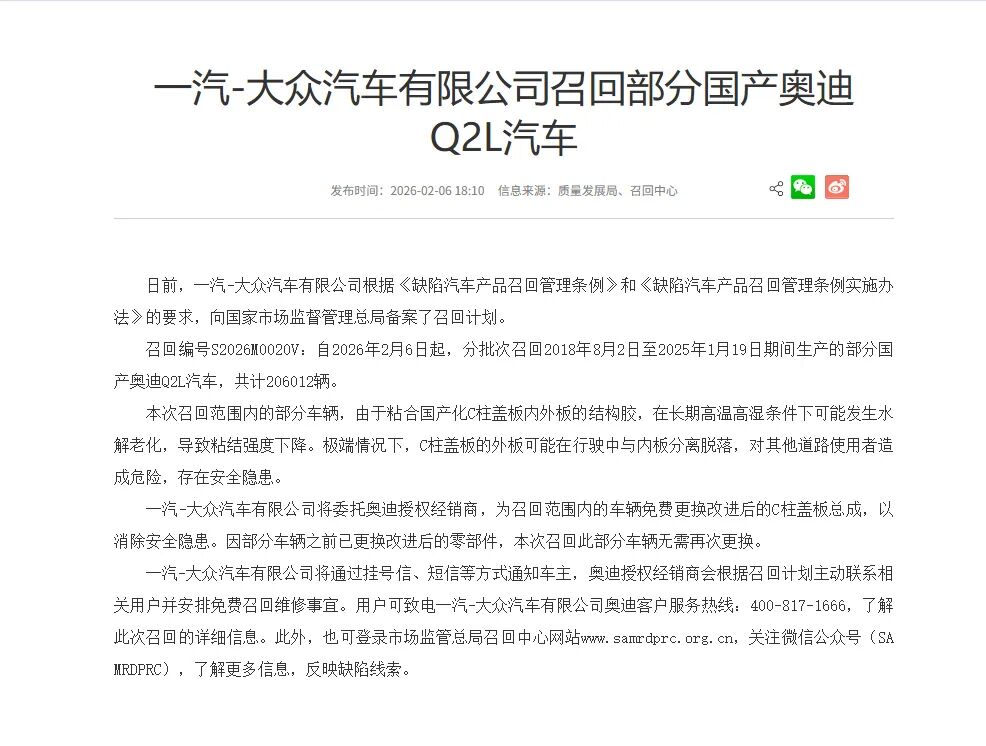
Core Insights - Audi is facing significant challenges in its global operations, with a reported global sales decline of 2.9% in 2025, totaling 1.6236 million vehicles, and a 5.0% drop in its largest market, China, where sales reached 617,500 units [1][2] Group 1: Recall Announcement - The recall is due to a durability defect in the adhesive structure of the domestic C-pillar cover, which may lead to a decrease in bonding strength under prolonged high temperature and humidity, posing a safety risk [1] - The recall will involve free replacement of the affected assembly with an improved version using hydrolysis-resistant adhesive, and vehicles that have already been upgraded will not require further action [1] - Prior to the recall announcement, there were 408 complaints related to the C-pillar cover, indicating issues such as natural loosening and detachment during driving, with some incidents occurring at high speeds [1] Group 2: Market Performance - Audi's two joint ventures in China show a divergence in performance, with FAW Audi achieving cumulative sales of 567,000 units and SAIC Audi reaching 47,300 units, a 23% year-on-year increase [2] - Overall, the BBA (BMW, Benz, Audi) group has experienced declining sales in China for two consecutive years, with Audi's sales declining by 5.6%, making it the most stable among the three [2] - The decline in global sales is primarily attributed to the North American and Chinese markets, while the German market saw a 4.0% increase in sales, totaling 206,100 units [2] Group 3: Strategic Adjustments - Audi has acknowledged a misstep in its vehicle naming strategy, particularly the renaming of the A4 to A5, which caused confusion among consumers and dealers, negatively impacting sales [3] - The company plans to revert to the A4 designation for new models, maintaining the A6L's name due to its high recognition in the Chinese market [3] - Audi's cautious approach to electrification includes continued production of gasoline and hybrid models for the next 7 to 10 years, which may widen the competitive gap with new energy vehicle companies [3] Group 4: Local Collaboration - In response to competitive pressures in the Chinese market, Audi is collaborating with local technology firms, exemplified by the SAIC Audi A5L Sportback being the first fuel vehicle equipped with Huawei's advanced driving system [4] - The recall incident and market performance reflect the ongoing restructuring of the luxury car market in China, where traditional German luxury brands are facing declines [4] - To regain consumer favor, BBA must accelerate the launch of dedicated electric vehicle platforms and enhance capabilities in smart driving and cabin interaction to better adapt to the local market [4]
汽车之家:2025年乘用车市场总结及展望
汽车之家· 2026-02-10 14:20
Investment Rating - The report does not explicitly state an investment rating for the automotive industry. Core Insights - The Chinese automotive industry is undergoing a significant transformation driven by electrification and intelligence, with both challenges and opportunities arising from macroeconomic fluctuations, technological divergence, and evolving consumer demands [2]. - The report anticipates that 2026 may be the last year of double-digit growth for the new energy vehicle (NEV) market, with a projected sales volume of 2.4 million units, reflecting a growth rate of approximately 1% [13]. - The report highlights a decrease in the effectiveness of the "Two New" policies, with a projected 3.8% year-on-year growth in passenger car sales for 2025, down from previous years [8][12]. Summary by Sections Market Trends - The effectiveness of policies is diminishing, leading to a slowdown in market growth, with 2025 passenger car sales expected to reach 23.74 million units, a 3.8% increase year-on-year [8]. - The NEV market share is projected to rise to 53.9% in 2025, with pure electric vehicles showing steady growth while plug-in hybrids and extended-range vehicles experience a decline [23][26]. - The report indicates that the growth momentum in the lower-tier markets is contributing to the overall market dynamics, with regional disparities in NEV development narrowing [3]. Policy and Economic Factors - The total amount of national subsidies is expected to decrease from 75 billion yuan per quarter to 62.5 billion yuan, potentially leading to a reduction in overall automotive subsidies [12]. - Economic growth is projected to rely heavily on policy support, with GDP growth forecasted between 4.2% and 5% for 2026, indicating a lack of consumer confidence and weak recovery in consumption [12]. Brand Performance - Chinese brands are experiencing a dual increase in volume and price, with independent NEV brands significantly boosting their market share to over 65% [46]. - The report notes that overseas brands are struggling to reverse their declining market share, particularly in the NEV segment, where their share has fallen below 10% [53]. Technological Advancements - The penetration of intelligent driving and smart cockpit features in NEVs is rapidly increasing, with smart cockpits reaching nearly 87% penetration and L2-level intelligent driving features at 66% [71]. - The report emphasizes that while overseas brands are improving their technological capabilities, they still lag behind Chinese brands in terms of market perception and differentiation [61]. Market Dynamics - The average retail price of vehicles is showing signs of recovery, but this is primarily attributed to changes in sales structure rather than genuine price increases across the board [90]. - The report suggests that the NEV market is entering a phase of adjustment, particularly for plug-in hybrids and extended-range vehicles, which are facing increased competition and regulatory challenges [41].
记者探访深圳车市:奔驰宝马纷纷降价
Shen Zhen Shang Bao· 2026-02-10 12:50
Group 1 - The luxury car market in China is experiencing significant price reductions from brands like BMW and Mercedes-Benz, with price cuts ranging from 3.37 million to 6.902 million yuan, approximately 10% for key models [1] - Mercedes-Benz plans to deliver 575,000 vehicles in China in 2025, a decline of about 19% from 714,000 units in 2024 [1] - BMW has also adjusted the suggested retail prices for several key models, with reductions generally exceeding 10%, and some models seeing cuts of over 300,000 yuan [1] Group 2 - The market for mid-to-high-end electric vehicles priced above 250,000 yuan has seen less price reduction during the Spring Festival, with brands like BYD and Volvo not offering significant discounts [1] - Domestic electric vehicle brands are introducing new models post-Spring Festival, with Xiaomi planning to launch a new generation of its SU7 model [2] - The automotive market is shifting from rapid growth to a phase of stock competition, with traditional luxury brands facing intense competition from new energy vehicles [2] Group 3 - The market for electric vehicles priced below 100,000 yuan is becoming increasingly competitive, with models like BYD's Yuan priced at 74,800 yuan and Leap Motor's Lafa5 at 97,800 yuan, both offering cash discounts during the Spring Festival [3] - GAC Toyota's Platinum 3X has dropped to 99,800 yuan, with additional promotional offers available [3] - Leap Motor has achieved significant sales success, leading the new energy vehicle segment with nearly 600,000 units sold last year [3]
【快讯】每日快讯(2026年2月10日)
乘联分会· 2026-02-10 08:37
Domestic News - The Ministry of Commerce held a meeting with automotive companies to discuss measures to expand and improve automotive consumption, emphasizing the potential of China's large market and the need for policy support and innovation [7] - Shenzhen's strategic emerging industries, including integrated circuits and industrial robots, accounted for over 10% of the national output of 39 industrial products, with the added value of strategic emerging industries expected to rise from 1.03 trillion yuan in 2020 to 1.67 trillion yuan by 2025 [8] - Shanghai's South Port exported 82,000 vehicles in January, a year-on-year increase of 65.2%, with 61,000 of those being new energy vehicles, marking a 115.92% increase [9] - FAW Bestune announced its product plan for 2026, which includes five family models and two mobility models [10] - NIO plans to build 1,000 battery swap stations in 2026, expanding its charging network [11] - Lantu Motors will launch China's first mass-produced L3 level SUV, equipped with Huawei's advanced driving system [12] - Pony.ai, in collaboration with Toyota China and GAC Toyota, will deploy the Platinum Smart 4X Robotaxi in 2026 [13] - Horizon Robotics and a subsidiary of CATL signed a strategic cooperation agreement to enhance automotive intelligence [14] International News - India revised its fuel efficiency regulations, removing exemptions for small cars, which was previously seen as favoring a single company [15] - BMW and E.ON launched Germany's first commercial vehicle-to-grid service for new generation electric vehicles [16] - South Korea's automotive parts exports to the U.S. are projected to decline by 6.7% in 2025, marking the first annual drop since 2020 [17] - Mercedes-AMG plans to launch its third electric model in the second half of 2027, following two other electric models [18] Commercial Vehicles - The Ouman Galaxy pure electric heavy truck completed extreme cold testing at -35°C, demonstrating its performance in harsh conditions [19] - The Shandong Heavy Industry's Shandeka C5L cargo truck was officially launched, marking a new benchmark in the cargo transport industry [20] - The latest announcement from the Ministry of Industry and Information Technology revealed 181 new energy heavy truck models, with a 29.29% increase from the previous batch [22] - The Great Wall Cannon will be equipped with the Hi4-T plug-in hybrid system across its entire lineup, expanding consumer access to hybrid pickup trucks [25]

固态高峰论坛拾贝,凝聚共识,洞察趋势
2026-02-10 03:24
Summary of Solid-State Battery Industry Conference Call Industry Overview - The conference focused on the solid-state battery industry, particularly its development trajectory for 2026 and beyond, emphasizing the necessity of solid-state batteries for future advancements [1] - The global battery research has transitioned from laboratory breakthroughs to engineering and mass production preparations, with significant advancements noted in companies like Solid Power collaborating with major automakers [2] Key Developments and Projections - By 2026, companies like Toyota and Zhenhua will begin mass production of high-durability solid-state batteries, with Zhenhua also establishing the world's first sulfide solid-state electrolyte factory [2] - The industry aims to achieve a solid-state battery with a capacity of 300 Wh/kg by the end of 2027, progressing to 500 Wh/kg by 2030 [3] - The focus remains on sulfide solid-state batteries, with ongoing research into materials such as high-nickel ternary and lithium-rich manganese-based materials to enhance performance [4][5] Material and Manufacturing Innovations - Innovations in electrode materials are crucial, with efforts to improve stability and capacity through interface optimization and advanced material designs [4][5] - The dry electrode process is gaining attention, with companies developing technologies to enhance production efficiency and reduce costs [9][10] - The solid electrolyte segment is primarily focused on sulfide electrolytes, with advancements in production techniques and material properties being reported [7][8] Challenges and Solutions - Key challenges include interface stability and batch consistency in solid-state electrolytes, particularly under varying pressure and temperature conditions [7][8] - Companies are exploring various strategies to enhance the performance and safety of anodes, including silicon-based and lithium metal anodes [6] Investment Opportunities - The conference highlighted potential investment opportunities in both equipment and materials sectors of the solid-state battery industry, suggesting a focus on companies with established technologies and production capabilities [15][16] - Specific companies mentioned for investment consideration include Naco, Xianhui, and leading firms in the solid-state battery equipment sector [16] Conclusion - The solid-state battery industry is experiencing rapid advancements, with significant milestones expected in the near future. The conference underscored the importance of continued investment and innovation in this sector to capitalize on emerging opportunities [14][15]
电动车不能再胖下去了
3 6 Ke· 2026-02-10 02:26
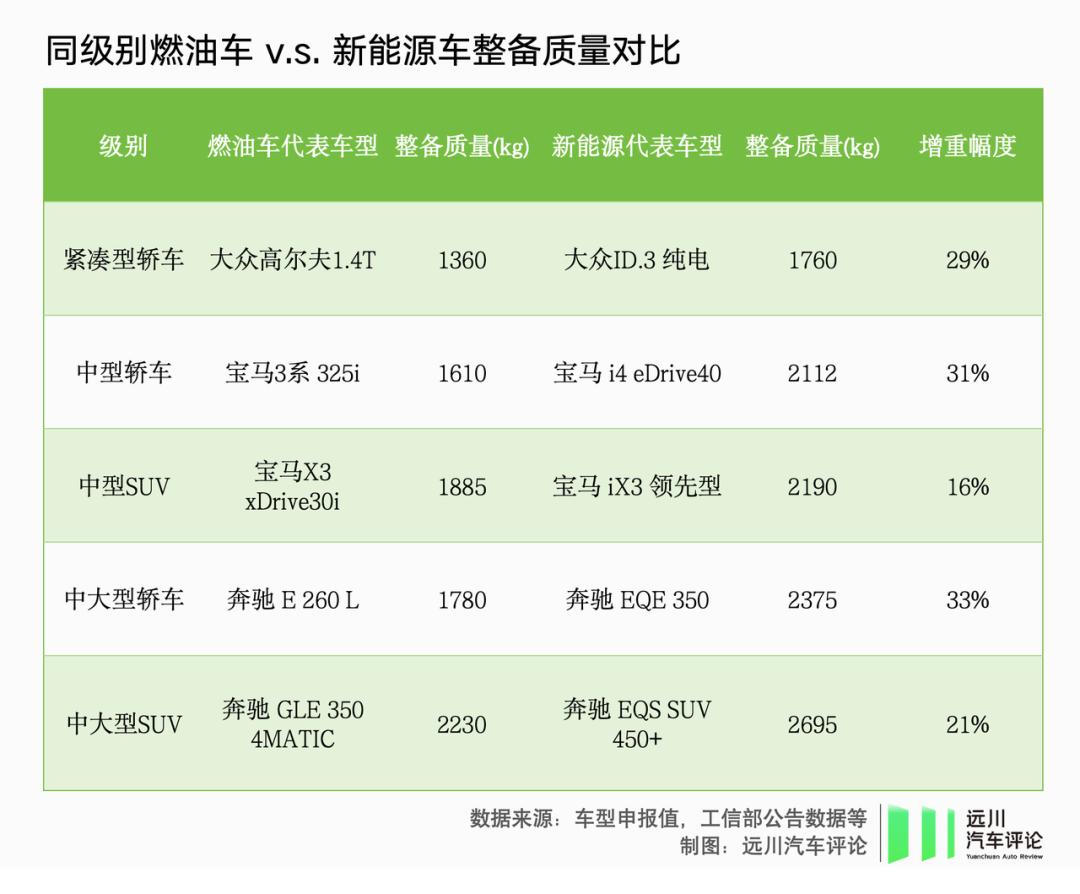
Core Viewpoint - The automotive industry is facing a significant challenge with the increasing weight of electric vehicles (EVs), which contradicts the industry's goal of lightweight design for better efficiency and performance. Group 1: Weight Increase in Electric Vehicles - The average weight of new energy vehicles in China has increased by over 300 kilograms in recent years, with some models weighing as much as traditional fuel SUVs [2][12] - Electric vehicles are becoming heavier due to consumer demand for longer range, which requires larger and heavier battery packs [2][5] - For instance, the BYD Yangwang U7 requires a 135 kWh battery pack weighing 900 kilograms to achieve a range of 700 kilometers, while a comparable fuel vehicle only needs a 50-kilogram fuel tank [5][7] Group 2: Implications of Increased Weight - The increase in vehicle weight leads to higher energy consumption; for every 100 kilograms added, the average energy consumption increases by 0.6 kWh per 100 kilometers [8][22] - Heavier vehicles require longer braking distances, which can increase accident risks, especially in emergency situations [20][22] - The perception that heavier vehicles are safer is outdated; modern safety relies more on structural integrity and design rather than just weight [16][20] Group 3: Market Trends and Consumer Preferences - Consumers in China prefer larger vehicles, prompting manufacturers to increase the size and features of electric vehicles, which adds weight [12][14] - The trend of adding luxury features to lower-priced models has further contributed to the weight increase, with some models gaining over 100 kilograms from added configurations [12][14] Group 4: Challenges in Weight Reduction - Reducing vehicle weight while maintaining cost and features is a significant challenge for manufacturers, as seen in the case of BMW's i3, which used expensive materials to achieve a lightweight design [26] - The introduction of new technologies, such as solid-state batteries, could potentially reduce weight by 50%, but cost and lifespan issues remain unresolved [29][30] - Recent regulations in China are pushing for stricter energy consumption limits based on vehicle weight, indicating a shift towards prioritizing lightweight designs [32]