萤石网络

Search documents
国补高基数下12月社零同增0.9%
HTSC· 2026-01-20 02:02
Investment Rating - The report maintains a "Buy" rating for the consumer discretionary sector, highlighting structural investment opportunities [5][10]. Core Insights - The report indicates that in December, the total retail sales of consumer goods increased by 0.9% year-on-year to 4.5 trillion yuan, with a month-on-month decline of 0.4 percentage points, primarily due to high base effects from durable goods like automobiles and home appliances [7][9]. - The report emphasizes the importance of the new round of trade-in policies for 2026, which focus on core home appliance categories and expand into new categories like smart glasses and products for the elderly, supporting demand in these segments [7]. - The report suggests that consumer sentiment remains strong, particularly in sectors like emotional consumption, technology consumption, and undervalued high-dividend stocks, recommending a focus on domestic brands and global brand expansion [10]. Summary by Sections Retail Sales Performance - In December, retail sales of food and beverages grew by 2.2% and 0.7% respectively, with urban and rural retail sales increasing by 0.7% and 1.7% year-on-year [8]. - Online retail sales of physical goods in December increased by 0.8% year-on-year, with a total annual growth of 5.2%, accounting for 26.1% of total retail sales [8]. Consumer Categories - The report notes a structural differentiation in consumer categories, with home appliances, building materials, and furniture experiencing declines of 18.7%, 11.8%, and 2.2% respectively due to high base effects and trade-in policy impacts [9]. - Conversely, communication equipment saw a significant increase of 20.9% year-on-year, while emotional and self-care products like sports and entertainment goods and cosmetics grew by 9.0% and 8.8% respectively [9]. Investment Recommendations - The report identifies four main investment themes: 1. Rise of domestic brands and global brand expansion, recommending companies like Pop Mart, Shangmei, and Anta Sports [10]. 2. Technology consumption empowered by AI, recommending companies like Midea Group and Haier Smart Home [10]. 3. Emotional consumption, recommending companies like Gu Ming and Yum China [10]. 4. Undervalued high-dividend blue-chip leaders, recommending companies like Li Ning and Shenzhou International [10]. Company-Specific Insights - For Smoore International (6969 HK), the report forecasts a revenue of 10.21 billion yuan for Q1-3 2025, with a year-on-year growth of 21.8%, and maintains a "Buy" rating with a target price of 27.00 HKD [48]. - For Juzhibio (2367 HK), the report highlights the approval of a new collagen product, projecting significant sales potential and maintaining a "Buy" rating with a target price of 85.00 HKD [49]. - For Pop Mart (9992 HK), the report notes a revenue increase of 245-250% in Q3 2025, driven by strong performance in both domestic and international markets, maintaining a "Buy" rating with an updated target price of 410 HKD [51].




建筑材料行业跟踪周报:社融增速小幅回落,关注红利高股息等方向-20260119
Soochow Securities· 2026-01-19 05:21
Investment Rating - Maintain "Overweight" rating for the construction materials industry [1] Core Insights - The construction materials sector has shown a slight decline in performance, with the sector index down by 0.67% compared to the Shanghai and Shenzhen 300 index, which decreased by 0.57% [3] - The report highlights the importance of focusing on high-dividend stocks and sectors such as home decoration and technology, as well as the potential for recovery in the real estate chain [3] Summary by Sections 1. Bulk Construction Materials Fundamentals and High-Frequency Data - **Cement**: The national average price for high-standard cement is 347.7 yuan/ton, down by 4.8 yuan/ton from last week and down by 56.2 yuan/ton from the same period in 2025. The average cement inventory ratio is 58.9%, down by 1.4 percentage points from last week but up by 1.4 percentage points from 2025 [9][10][16] - **Glass**: The average price for float glass is 1138.3 yuan/ton, an increase of 16.3 yuan/ton from last week but a decrease of 246.1 yuan/ton from 2025. The inventory of float glass stands at 4,986 million weight boxes, down by 209 million from last week but up by 1,071 million from 2025 [41][46] - **Fiberglass**: The market for fiberglass remains stable, with no significant price changes reported. The mainstream transaction price for 2400tex alkali-free winding direct yarn is between 3250-3700 yuan/ton [3][4] 2. Industry Dynamics Tracking - The report indicates that the cement industry is undergoing supply-side adjustments, with a focus on eliminating outdated capacity. The effective capacity for fiberglass is expected to reach 759.2 million tons in 2026, a year-on-year increase of 6.9% [4][9] - The report emphasizes the potential for recovery in the real estate sector, with companies like Arrow Home, Sanhe Tree, and Op Lighting being highlighted for their strategic positioning [3][4] 3. Weekly Market Review and Sector Valuation - The construction materials sector has shown a mixed performance, with some companies demonstrating resilience in their earnings despite overall market challenges. The report suggests that the sector's valuation is at historical lows, indicating potential for recovery [3][4] - Recommendations include focusing on companies with strong dividend commitments and those positioned to benefit from technological advancements and market recovery [3][4]
计算机行业事件点评:2026:具身智能与机器人关键一年
Guolian Minsheng Securities· 2026-01-18 12:37
Investment Rating - The report maintains a "Recommended" rating for the industry, indicating an expected stock price increase of over 15% relative to the benchmark index within the next 12 months [8]. Core Insights - The collaboration between Star Dynamics and SF Technology focuses on the development and application of embodied intelligent robotics in logistics, addressing labor shortages and automation flexibility issues [4]. - The report highlights the accelerating progress of embodied intelligence in logistics, with Star Dynamics leveraging its self-developed VLA model and humanoid robots to provide comprehensive solutions for warehousing and logistics [4]. - Major tech companies are investing in physical AI, with advancements in humanoid robots and their applications in autonomous driving and robotics [5][6]. - Tesla's Optimus robot is expected to achieve significant advancements, with plans for mass production and potential applications in space missions [7]. Summary by Sections Industry Collaboration - Star Dynamics and SF Technology have signed a deep cooperation agreement to develop embodied intelligent robotics for logistics, focusing on areas like warehousing and express delivery [4]. Technological Advancements - The CES 2026 showcased advancements in physical AI, with Nvidia introducing the Cosmos model for understanding and simulating real-world scenarios, enhancing humanoid robot capabilities [6]. - Nvidia's collaboration with Hugging Face aims to streamline the workflow from simulation training to real-world deployment of humanoid robots [6]. Market Potential - The report emphasizes the long-term potential of embodied intelligence, with key companies such as Slin Technology, Pinming Technology, and others identified as significant players in the market [11].


研判2026!中国智能安防摄像机行业进入壁垒、市场政策汇总、产业链图谱、市场规模、竞争格局及发展趋势分析:用户规模持续扩大[图]
Chan Ye Xin Xi Wang· 2026-01-17 23:24
Core Viewpoint - The demand for smart security cameras in China is rapidly increasing due to heightened national security awareness and the transition from traditional passive security measures to intelligent proactive warning systems, driven by initiatives like "Digital China" and "Safe China" [1][6]. Industry Overview - Smart security cameras integrate technologies such as artificial intelligence, IoT, and computer vision, distinguishing them from traditional analog cameras by their ability to perform intelligent operations like video content analysis and anomaly detection [2][4]. - The market for smart security cameras in China is projected to reach 1.79 billion users and a market size of $3.5 billion by 2025, marking a year-on-year growth of 5.3% and 12.9% respectively, making it the second-largest market after the United States [1][6]. Industry Entry Barriers - The smart security camera sector requires expertise in various technologies, including audio and video coding, image processing, and network control, creating high entry barriers for new companies [4]. - The rapid technological advancements necessitate continuous product upgrades every 1-2 years, increasing the demand for strong R&D capabilities among industry players [4]. Relevant Policies - The Chinese government has issued several policies to support the development of the smart security industry, including the "14th Five-Year Plan for the Security Industry" and various measures to promote electronic product consumption [5]. Industry Chain - The industry chain consists of upstream components like IC chips and communication modules, midstream manufacturers of smart security cameras, and downstream sales channels including retail and e-commerce platforms [5]. Current Development - The global urbanization trend and rising living standards have made home security a priority, with the smart security camera market showing strong growth potential, projected to reach 487 million users and a market size of $17.2 billion globally by 2024 [6]. Competitive Landscape - The smart camera industry in China features a diverse competitive landscape with brand manufacturers, ODM service providers, and small-scale processing companies, with major brands including Hikvision, Xiaomi, and Arlo [7]. - Brand manufacturers focus on brand management and marketing, while ODM service providers offer comprehensive solutions, leveraging their technical expertise [7]. Domestic Company Analysis - **Hikvision**: Focuses on AI and IoT technologies, with significant revenue from smart home cameras, achieving $4.27 billion in total revenue in the first half of 2025, with smart home camera sales accounting for 54.76% [8]. - **Jiuan Technology**: A manufacturer of smart visual products, reported $0.32 billion in total revenue in the first half of 2025, with smart hardware contributing 79.97% [9]. Development Trends - The integration of AI and edge computing will enhance the proactive capabilities of smart security cameras, enabling better data processing and decision-making [10]. - Privacy protection and compliance requirements are becoming stricter, necessitating the incorporation of security measures in product design [11]. - The business model is shifting from hardware sales to a subscription-based model that includes value-added services like cloud storage and AI analysis [12].



AI应用催化密集,AI+家电落地加速
Orient Securities· 2026-01-13 12:57
Investment Rating - The report maintains a "Positive" investment rating for the home appliance industry, indicating an expectation of returns exceeding the market benchmark by more than 5% [4][11]. Core Insights - The report highlights that the domestic market's consumption potential is expected to be activated by the continuation of national subsidies, despite a marginal slowdown in their impact. The "Two New" policies are anticipated to further stimulate demand in the home appliance sector [3]. - The report emphasizes the acceleration of AI applications in the home appliance industry, with significant developments expected from AI models and smart hardware products [2][6]. Summary by Sections Domestic Market Outlook - The report notes that the leading companies in the white goods sector have a higher proportion of first-level energy-efficient products and more mature management processes for trade-in programs, positioning them to benefit more significantly from the evolving market dynamics [3]. - The first quarter of 2026 is projected to see stable production schedules for white goods, aligning with domestic market expectations [5]. International Expansion - The report identifies international expansion as a long-term strategy, with companies that diversify their production capacity being favored. A valuation shift is anticipated by 2026 [3]. AI Integration - The report discusses the rapid iteration of AI models and their broad application in the home appliance sector, suggesting that smart hardware products integrated with AI services are becoming a key trend. Companies like Yingzi Network are highlighted for their deep engagement in smart home segments [6].




建筑材料行业跟踪周报:价格信号好于预期,26年或迎来地产链业绩的拐点-20260113
Soochow Securities· 2026-01-13 01:04
Investment Rating - The report maintains an "Overweight" rating for the construction materials industry [1]. Core Insights - The report indicates that the CPI and PPI are better than expected, reflecting a gradual recovery in the real estate chain prices, suggesting that 2026 may mark a turning point for the industry's performance [2]. - Short-term market conditions remain volatile, with a focus on high-dividend stocks and sectors such as exports and home improvement [2]. - The report highlights the importance of technological self-reliance during the 14th Five-Year Plan, particularly in the semiconductor sector, which is expected to benefit cleanroom engineering and related companies [2]. - The real estate sector continues to face challenges, but signs of recovery are emerging as companies reduce personnel and expenses [2]. - The report emphasizes the potential for structural growth in the glass fiber and cement sectors, driven by demand from wind power and new applications [2]. Summary by Sections 1. Bulk Construction Materials Fundamentals and High-Frequency Data - Cement prices have shown a slight decline, with the national average at 352.5 RMB/ton, down 0.3 RMB/ton from the previous week and down 51.7 RMB/ton year-on-year [7][18]. - The average cement inventory ratio is 60.3%, a decrease of 0.1 percentage points from the previous week but an increase of 2.8 percentage points year-on-year [25]. - The average daily cement shipment rate is 38.7%, down 1.6 percentage points from the previous week but up 0.5 percentage points year-on-year [25]. 2. Industry Dynamics Tracking - The report notes that the glass fiber industry is expected to see stable growth in demand, with effective production capacity projected to reach 759.2 million tons in 2026, a year-on-year increase of 6.9% [11]. - The cement industry is undergoing supply-side adjustments, with a focus on eliminating outdated capacity, which is expected to support profitability in 2026 [11]. - The glass market is experiencing a supply contraction, which may provide price elasticity in 2026, although current demand remains weak [11]. 3. Weekly Market Review and Sector Valuation - The construction materials sector saw a weekly increase of 3.68%, outperforming the Shanghai and Shenzhen 300 index by 0.90% [7]. - The report suggests that the valuation of leading companies in the construction materials sector is at historical lows, indicating potential for recovery as industry dynamics improve [11]. - Recommendations include companies like China National Building Material and Conch Cement, which are expected to benefit from the ongoing industry consolidation and recovery [11].
视声智能(920976):KNX产品数量中国第一,绑定国际客户大力拓展海外高潜力市场
Hua Yuan Zheng Quan· 2026-01-12 11:11
Investment Rating - The report assigns an "Accumulate" rating for the company, marking its first coverage [5][9]. Core Insights - The company is a leader in the building intelligence sector, focusing on smart home solutions and has a strong presence in the KNX product market, which is expected to grow significantly [8][11]. - The company has a competitive edge due to its early entry into the KNX technology field and continuous investment in research and development, which is anticipated to enhance its market share as production capacity expands [6][11]. Summary by Sections 1. Company Overview - The company, established in 2011, specializes in building intelligence, providing integrated solutions including smart control systems and visual intercom systems, with a focus on smart homes, visual intercoms, and LCD displays [16][19]. 2. Market Growth - The Chinese smart home market is projected to exceed 1 trillion yuan by 2025, with a compound annual growth rate (CAGR) of 10.3% for global KNX products from 2025 to 2031 [48][46]. 3. Technical Advantages - The company holds the largest number of KNX products in China and ranks sixth globally, with a strong emphasis on R&D, having developed proprietary technologies and standards in the KNX domain [62][64]. 4. Financial Projections - The company forecasts a net profit of 0.64 billion yuan in 2025, increasing to 0.88 billion yuan by 2027, with corresponding price-to-earnings (P/E) ratios of 33.5, 28.5, and 24.4 [6][9]. 5. Revenue Breakdown - The revenue from smart home products is expected to constitute 65.7% of total revenue in 2024, with a growth rate of 21.2% and a gross margin of 63.21% [19][24].
萤石网络股价涨5.36%,易方达基金旗下1只基金位居十大流通股东,持有569.2万股浮盈赚取950.56万元
Xin Lang Cai Jing· 2026-01-12 06:49
Group 1 - The core viewpoint of the news is that Yingzi Network's stock has seen a significant increase of 5.36%, reaching a price of 32.82 yuan per share, with a total market capitalization of 25.846 billion yuan as of January 12 [1] - Yingzi Network, established on March 25, 2015, and listed on December 28, 2022, specializes in providing intelligent living solutions primarily focused on visual interaction and offers an open cloud platform service for managing IoT devices [1] - The revenue composition of Yingzi Network includes smart home cameras (54.75%), IoT cloud platform services (19.63%), smart entry products (15.43%), accessory products (6.36%), smart service robots (2.12%), other smart home products (1.13%), and other supplementary products (0.59%) [1] Group 2 - Among the top ten circulating shareholders of Yingzi Network, E Fund's fund holds a position, having reduced its holdings by 830,000 shares to 5.692 million shares, representing 1.39% of the circulating shares [2] - E Fund's Shanghai Stock Exchange Sci-Tech Innovation Board 50 ETF (588080) has a current scale of 76.761 billion yuan and has achieved a year-to-date return of 9.8%, ranking 519 out of 5580 in its category [2] - The fund has a one-year return of 54.26%, ranking 1065 out of 4203, and a since inception return of 6.46% [2]
预见2025:《2025年中国全屋智能行业全景图谱》(附市场现状和发展趋势等)
Qian Zhan Wang· 2026-01-12 01:35
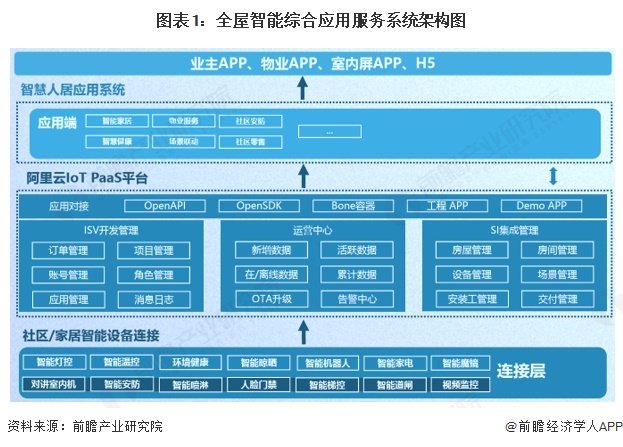
Industry Overview - The concept of "whole-house intelligence" refers to an integrated smart home system that combines smart lighting, security, audio-visual, and appliance control into a comprehensive home solution. This system allows for automated operations based on environmental and personal needs, enabling connectivity between individual smart products for a more personalized home experience [1][2] - The whole-house intelligent system relies on cloud platform capabilities and channel resources to create mature smart home applications, smart community applications, and market solutions, forming an IoT ecosystem that includes home device connectivity, automated control, data analysis, health care, community services, and new retail [1] Industry Chain Analysis - The whole-house intelligent field has developed a complete industrial chain, with upstream consisting of component suppliers, middleware suppliers, and software technology providers. The midstream includes whole-house smart home brand manufacturers that sell products directly to consumers and provide solutions to real estate and home decoration companies [2][5] Industry Development Status - The global whole-house intelligent industry is in a rapid development phase, supported by the maturity and integration of IoT, AI, and 5G technologies. This has facilitated easier interconnectivity between devices and enhanced system intelligence and interactivity. Market demand for convenient, healthy, and safe home environments is driving the transition from niche to mass markets [13][15] - In China, the whole-house intelligent industry is experiencing rapid growth driven by both policy and market forces, with a projected market size of approximately 222.4 billion yuan in 2024 [15][25] Competitive Landscape - The competitive landscape of China's whole-house intelligent industry can be categorized into three factions: traditional home appliance companies (e.g., Haier, Midea, Gree), internet companies (e.g., Xiaomi, Huawei), and other specialized firms. Traditional companies leverage supply chain and brand advantages, while internet firms possess strong technological and financial capabilities [17][19] Industry Development Trends - The Chinese whole-house intelligent industry is moving towards standardization in technology, market scenario development, and ecological competition. The combined push from policies, technology, and consumer demand is expected to facilitate a transition from rapid expansion to high-quality development, gradually building a more complete smart living ecosystem [23][25] - The market is expected to see a compound annual growth rate of 9.8%, with the market size projected to reach approximately 390 billion yuan by 2030 [25]
高中老板身家暴增25倍?九安智能IPO“反向增长”:人越少,利越多
Sou Hu Cai Jing· 2026-01-10 01:06
Core Viewpoint - Jiuan Intelligent Technology Co., Ltd. has achieved net profit growth significantly exceeding industry standards, attributed to a low expense ratio, raising questions about data integrity and the sustainability of its profitability [1][3]. Group 1: Business Background - Jiuan Intelligent was established on January 15, 2007, and is headquartered in Panyu District, Guangzhou. The company claims to be a manufacturer of intelligent visual products, an IoT service provider, and a technology solution provider [4]. - The founder and actual controller, Li Yuan, holds 66.04% of the company's shares directly and controls an additional 8.25% indirectly through an employee stock ownership platform, totaling 74.29% [6]. Group 2: Financial Performance - From 2022 to 2024, the company's revenue increased from 484 million to 780 million yuan, while net profit surged from 34.03 million to 102 million yuan, marking a nearly 200% growth over two years [3]. - In 2023, Jiuan Intelligent reported a remarkable 150% increase in net profit, despite a 12.58% reduction in total employees from 485 to 424 [9][10]. Group 3: Profitability and Cost Structure - The company maintains a significantly lower expense ratio compared to industry peers, which has contributed to its rapid net profit growth. However, this raises concerns about the quality and sustainability of its earnings [15]. - Jiuan Intelligent's gross profit margins are the lowest among comparable companies, with rates of 24.58%, 32.02%, and 29.55% from 2022 to 2024 [11]. Group 4: Product Pricing Trends - The average selling price of Jiuan Intelligent's module products has decreased from 53 yuan in 2022 to 40.50 yuan in 2024, while terminal product prices fell from 143.27 yuan to 109.61 yuan in the same period [13]. - This decline in product pricing is closely linked to the company's overall gross margin performance and may indicate a strategy of gaining market share through price reductions [15]. Group 5: Market Position and Future Outlook - Jiuan Intelligent acknowledges a significant gap in brand influence and sales channels compared to industry leader Yingxi Network. The company’s growth quality and sustainability remain focal points for regulatory bodies and investors [16]. - The company plans to issue up to 16.16667 million shares, aiming to raise approximately 1.06438 billion yuan, with a projected valuation of around 4.256 billion yuan, reflecting a more than 25-fold increase in valuation over two years [8].