
银华

Search documents
参观小米汽车工厂的一些感受
表舅是养基大户· 2025-09-12 13:13
Core Viewpoint - The article discusses the advancements in automation and AI in manufacturing, particularly in Xiaomi's new automotive factory, and highlights the implications for employment and investment opportunities in the industry. Group 1: Automation and Employment - The automation rate in high-end manufacturing has reached an impressive level, with Xiaomi claiming a 91% overall automation rate and 100% automated component connections, resulting in minimal manual labor requirements [2] - The rise of AI is expected to further decrease labor demand in factories, leading to fewer job opportunities in traditional manufacturing roles [2][3] - Despite the decline in manufacturing jobs, sectors like delivery services (e.g., food delivery, ride-hailing) will continue to have significant employment needs due to their complex operational requirements [3] Group 2: Competitive Advantages and Industry Dynamics - Xiaomi's factory exemplifies a "latecomer advantage" in automation, as it can implement fully automated systems without the legacy constraints faced by older manufacturers [3][4] - The article suggests that high-quality equity in companies like Xiaomi may offer better investment value compared to real estate, especially as depreciation of manufacturing assets occurs over time [4] - The marketing strategies employed by internet companies like Xiaomi enhance their competitive edge, as they leverage user-centric approaches in their operations and branding [4][6] Group 3: Broader Market Trends - The article notes that the current market environment is characterized by high concentration, with a small number of stocks dominating trading volumes, leading to increased volatility [16][18] - Recent trends in the bond market indicate a targeted approach by the central bank to manage liquidity through reverse repos, which may influence investment strategies [20][21]





14只第二批科创债ETF全部“一日售罄” 合计“吸金”约达400亿元
Zhong Guo Ji Jin Bao· 2025-09-12 12:11
Core Insights - The second batch of 14 Sci-Tech Bond ETFs was fully subscribed on the first day of issuance, raising approximately 40 billion yuan, setting a new record for single-day fundraising in the fund issuance market [1][4][2] - The overall scale of Sci-Tech Bond ETFs has surpassed 160 billion yuan, with the first batch of 10 ETFs reaching over 123 billion yuan as of September 11 [1][5][6] - The issuance of these ETFs is supported by favorable regulatory changes, which encourage the development of bond funds focused on green and technology innovation bonds [4][6] Fund Issuance Market - The second batch of 14 Sci-Tech Bond ETFs was launched on September 12, with most funds reaching the 3 billion yuan fundraising cap [2][4] - The issuance was so popular that five of the ETFs ended their fundraising early, indicating strong market demand [2][4] - The total fundraising amount from this batch is estimated to be around 40 billion yuan, contributing to a significant increase in the overall market size [4][5] Market Performance - As of September 11, the total scale of bond ETFs reached approximately 571.9 billion yuan, a 228.72% increase from the previous year [5][6] - The first batch of Sci-Tech Bond ETFs, launched earlier, has shown robust growth, with eight out of ten funds exceeding 10 billion yuan in size [6] - The introduction of these ETFs has filled a market gap in the technology finance bond fund sector, enhancing the product matrix of bond index funds [6][7] Future Outlook - The regulatory environment is increasingly favorable for the development of bond ETFs, with new guidelines expected to further stimulate market growth [4][6] - There is potential for further innovation in the bond ETF market, including high-yield bond ETFs and other alternative strategies, as identified by industry analysts [7]
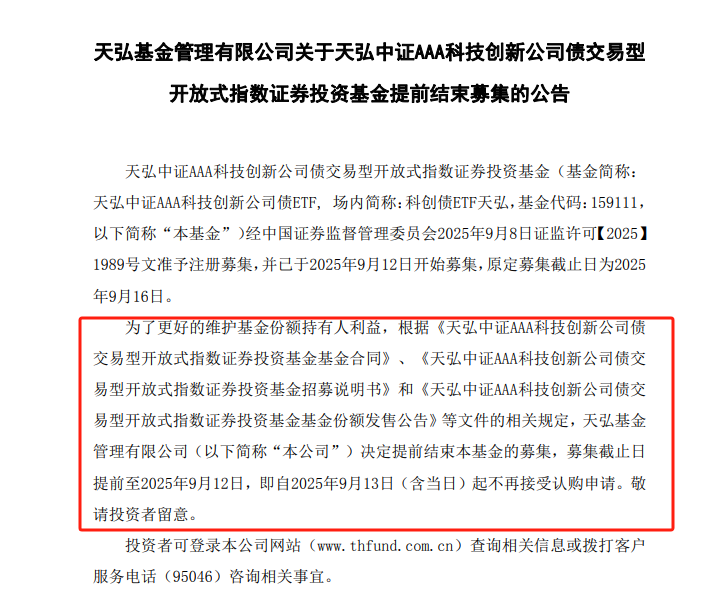
刚刚!大消息传来,果然全“爆了”!
中国基金报· 2025-09-12 11:09
Core Viewpoint - The second batch of 14 Sci-Tech Bond ETFs was fully subscribed on the first day, raising approximately 40 billion yuan, marking a record for single-day fundraising in the fund issuance market this year [2][6]. Fund Issuance Market - The second batch of 14 Sci-Tech Bond ETFs was launched on September 12, with most funds reaching close to the 3 billion yuan fundraising cap, leading to a total of about 40 billion yuan raised [4][6]. - The first batch of 10 Sci-Tech Bond ETFs has a total scale exceeding 123 billion yuan as of September 11, contributing to an overall scale of over 160 billion yuan for Sci-Tech Bond ETFs [2][8]. Market Growth - The total scale of bond ETFs has seen rapid growth, reaching 571.89 billion yuan as of September 11, a 228.72% increase from the end of last year [8]. - With the establishment of the second batch of Sci-Tech Bond ETFs, the overall market scale for bond ETFs is expected to surpass 600 billion yuan [8]. Industry Dynamics - The issuance of Sci-Tech Bond ETFs is driven by favorable regulatory changes, including differentiated approval arrangements for bond funds that align with national strategies [6][9]. - The market is witnessing a structural optimization and expansion of bond ETFs, with increasing liquidity and a diverse investor base [9].

ETF日报2025.09.12-20250912
天府证券· 2025-09-12 09:42
Report Summary 1. Market Overview - The Shanghai Composite Index fell 0.12% to 3870.60 points, the Shenzhen Component Index dropped 0.43% to 12924.13 points, and the ChiNext Index declined 1.09% to 3020.42 points. The total trading volume of A - shares in the two markets was 25486 billion yuan. [2][6] - The top - performing sectors were non - ferrous metals (1.96%), real estate (1.51%), and steel (1.41%), while the worst - performing sectors were communications (-2.13%), comprehensive (-1.95%), and beauty care (-1.52%). [2][6] 2. Stock ETFs - The top - traded stock ETFs included E Fund ChiNext ETF (down 0.99% with a discount rate of -1.07%), Huaxia SSE STAR Market 50 ETF (up 0.93% with a discount rate of 0.81%), and Huaxia CSI A500 ETF (down 0.61% with a discount rate of -0.36%). [3][7] 3. Bond ETFs - The top - traded bond ETFs were Haifutong CSI Short - Term Financing Bond ETF (up 0.01% with a discount rate of -0.00%), Boshi CSI Convertible and Exchangeable Bond ETF (down 0.07% with a discount rate of -0.10%), and Southern CSI AAA Science and Technology Innovation Corporate Bond ETF (down 0.02% with a discount rate of 0.01%). [4][9] 4. Gold ETFs - Gold AU9999 rose 0.47% and Shanghai Gold rose 0.39%. The top - traded gold ETFs were Huaan Gold ETF (up 0.39% with a discount rate of 0.52%), Boshi Gold ETF (up 0.39% with a discount rate of 0.52%), and E Fund Gold ETF (up 0.34% with a discount rate of 0.48%). [12] 5. Commodity Futures ETFs - Dacheng Non - Ferrous Metals Futures ETF rose 1.22% with a discount rate of 1.33%, Jianxin Yisheng Zhengzhou Commodity Exchange Energy and Chemical Futures ETF fell 0.69% with a discount rate of -0.75%, and Huaxia Feed Soybean Meal Futures ETF rose 0.20% with a discount rate of 1.76%. [13] 6. Cross - border ETFs - The previous trading day, the Dow Jones Industrial Average rose 1.36%, the Nasdaq Composite rose 0.72%, the S&P 500 rose 0.85%, and the German DAX rose 0.30%. Today, the Hang Seng Index rose 1.16% and the Hang Seng China Enterprises Index rose 1.13%. The top - traded cross - border ETFs were E Fund CSI Hong Kong Securities Investment Theme ETF (down 0.26% with a discount rate of 0.08%), GF CSI Hong Kong Innovative Drugs ETF (up 0.26% with a discount rate of 2.59%), and Huaxia Hang Seng Technology ETF (up 0.87% with a discount rate of 1.93%). [16] 7. Money ETFs - The top - traded money ETFs were Yin Hua Ri Li ETF, Hua Bao Tian Yi ETF, and Money ETF Jian Xin Tian Yi. [18]
ETF日报20250911-20250911
天府证券· 2025-09-11 09:45
Market Overview - The Shanghai Composite Index rose 1.65% to close at 3875.31 points, the Shenzhen Component Index rose 3.36% to close at 12979.89 points, and the ChiNext Index rose 5.15% to close at 3053.75 points. The total trading volume of A-shares in the two markets was 2464.9 billion yuan. The top-performing sectors were communications (7.39%), electronics (5.96%), and computer (3.71%) [2][6] Stock ETF - The top-traded stock ETFs were E Fund ChiNext ETF (up 5.22% with a discount rate of 5.07%), Huaxia SSE STAR 50 ETF (up 5.45% with a discount rate of 5.18%), and Guotai CSI All-Securities Company ETF (up 3.13% with a discount rate of 3.21%) [3][7] Bond ETF - The top-traded bond ETFs were Haifutong CSI Short-Term Commercial Paper ETF (up 0.01% with a discount rate of -0.01%), Bosera CSI Convertible and Exchangeable Bond ETF (up 1.36% with a discount rate of 1.17%), and Penghang ChinaBond 30-Year Treasury Bond ETF (down 0.25% with a discount rate of -0.05%) [4][9] Gold ETF - Gold AU9999 fell 0.39% and Shanghai Gold fell 0.25%. The top-traded gold ETFs were Huaan Gold ETF (down 0.30% with a discount rate of -0.26%), Bosera Gold ETF (down 0.30% with a discount rate of -0.26%), and E Fund Gold ETF (down 0.33% with a discount rate of -0.26%) [12] Commodity Futures ETF - Dacheng Nonferrous Metals Futures ETF rose 0.29% with a discount rate of 0.52%, Huaxia Feed Soybean Meal Futures ETF rose 0.10% with a discount rate of 1.92%, and Jianxin Yisheng Zhengzhou Commodity Exchange Energy and Chemical Futures ETF fell 0.23% with a discount rate of -0.11% [13] Cross-Border ETF - The Dow Jones Industrial Average fell 0.48%, the Nasdaq Composite rose 0.03%, the S&P 500 rose 0.30%, and the German DAX fell 0.36% the previous day. The Hang Seng Index fell 0.43% and the Hang Seng China Enterprises Index fell 0.73% today. The top-traded cross-border ETFs were E Fund CSI Hong Kong Securities Investment Theme ETF (up 0.91% with a discount rate of 1.39%), GF CSI Hong Kong Innovative Drug ETF (down 2.25% with a discount rate of -1.46%), and Huitianfu China Securities Hong Kong Stock Connect Innovative Drug ETF (down 1.48% with a discount rate of -1.10%) [15] Money ETF - The top-traded money ETFs were Yin Hua Day Profit ETF, Hua Bao Add Benefit ETF, and Money ETF Jianxin Add Benefit [17]
第二批14只科创债ETF明日开启募集!首批10只科创债ETF规模已突破1200亿元
Ge Long Hui· 2025-09-11 09:18
Group 1 - The second batch of 14 science and technology innovation bond ETFs will begin fundraising, with 9 products available for one day and 4 for three trading days, while 1 product will have a five-day fundraising period [1] - The first batch of 10 science and technology innovation bond ETFs has exceeded a total scale of 120 billion yuan, growing over 300% from the initial fundraising amount [2] - The introduction of the new batch of products is expected to further accelerate the expansion of the bond ETF market, with science and technology innovation bond ETFs becoming the highest market capitalization subcategory [2] Group 2 - According to Guotai Junan Securities, the interest rate strategy has been dominant since 2025, with science and technology innovation bond ETFs showing certain resilience during adjustment periods [3] - The bond market has experienced significant volatility since 2025, with the value of duration strategies declining, while credit bond interest rate strategies have shown advantages [3] - The recent regulatory changes regarding fund sales fees are expected to create greater development opportunities for bond ETFs, as higher redemption fee thresholds may redirect investments from other bond funds to bond ETFs [3]
创新药中报强劲,未来还有多少潜力可挖?
Xin Lang Ji Jin· 2025-09-11 08:56
Core Viewpoint - The innovative pharmaceutical sector has become a key driver of revenue growth for listed companies, with some companies reporting that innovative drug revenue has surpassed 50% of total revenue, indicating a significant shift towards innovation-driven business models [1][3]. Group 1: Performance Highlights - In the first half of 2025, multiple innovative pharmaceutical companies in the A-share market reported both revenue and profit growth, with the proportion of innovative drugs continuing to rise [3]. - A representative product, the BTK inhibitor Zebutini, achieved global sales of 12.527 billion yuan in the first half of 2025, marking a year-on-year increase of 56.2% [3]. - In the Hong Kong stock market, 39 innovative pharmaceutical companies reported total revenue of 152.061 billion yuan in the first half of 2025, a year-on-year growth of 7.66%, with net profit attributable to shareholders reaching 28.266 billion yuan, a significant increase of 54.37% [3]. Group 2: Market Signals - The strong performance of innovative pharmaceutical companies indicates that the long-term innovation-driven strategies are beginning to yield results, with sustained R&D investments gaining market recognition [3][6]. - Increased health awareness among residents and supportive healthcare policies are contributing to the growing market demand for innovative drugs [3]. Group 3: Growth Drivers - R&D capabilities are improving in both quantity and quality, with China becoming a global center for new drug development, particularly in areas like ADC and multi-antibody technologies [7]. - Continuous policy support from the government, including 32 specific measures aimed at enhancing the innovative pharmaceutical sector, is fostering overall industry vitality [7]. - The trend of Chinese innovative drugs entering international markets is expected to enhance company performance through upfront and milestone payments from overseas collaborations [7]. Group 4: Market Potential - The Chinese innovative pharmaceutical market is projected to exceed 750 billion yuan in 2025, representing an 18% increase from 2024, and is expected to capture 6% of the global market share [8]. - By 2030, the market size is anticipated to surpass 2.3 trillion yuan, with a compound annual growth rate of 15% from 2025 to 2030 [8]. - The transition from "Made in China" to "Created in China" signifies the beginning of a new growth phase for the industry, with several quarters of growth expected to be relatively certain [8].

消费基金首尾业绩差超80%!传统消费股“春天”何时来?
Guo Ji Jin Rong Bao· 2025-09-06 07:04
Core Viewpoint - The traditional consumer sector, particularly food and beverage stocks, has underperformed in 2023 compared to other sectors, with the food and beverage index showing a year-to-date decline of -1.92%, significantly lagging behind the top-performing communication index by over 60 percentage points [1]. Group 1: Performance of Consumer Funds - There is a significant performance divergence among consumer funds, with a difference of over 80 percentage points between the best and worst performing funds. The top-performing fund has achieved over 70% returns, while the lowest has seen losses exceeding 8% [3]. - As of early September, 71 consumer funds have reported net value increases of over 20%, while 90 funds have seen increases of less than 10% [3]. Group 2: Investment Strategies and Trends - To generate excess returns, funds heavily invested in consumer stocks need to align with new trends. For instance, the Hai Fu Tong Consumer Select Fund has increased its allocation to new consumption sub-sectors while enhancing research on both traditional and tech-driven consumer sectors [4]. - Some funds are capitalizing on overseas consumption growth opportunities, such as the Yongying Emerging Consumer Fund, which has invested in Hong Kong-listed companies in trendy toys and innovative pharmaceuticals, benefiting from "going abroad" dividends [4]. Group 3: Challenges for Traditional Consumer Stocks - Funds that have maintained a focus on traditional consumer stocks have struggled, with some experiencing significant losses. For example, the Guorong Rongxin Consumer Fund has heavily invested in liquor, beverages, and other traditional sectors but has reported a loss of over 8% [5]. - The Pu Yin An Sheng Consumer Upgrade Fund, which also focuses on traditional consumer stocks, has seen a decline of over 5% in net value, reflecting the challenges faced by traditional sectors [5]. Group 4: Future Outlook - The consumer sector is experiencing extreme differentiation, with traditional consumer stocks, particularly those linked to economic cycles like liquor, facing downward pressure, while new consumption companies are thriving [6]. - Fund managers believe that traditional consumption is nearing a bottom, while new consumption continues to present significant growth opportunities. For instance, the Yin Hua Consumer Theme Fund manager noted that traditional industries are giving rise to new development opportunities, such as supply chain integration and the rise of domestic brands [7]. - The manager of the Yongying Emerging Consumer Fund highlighted that leading companies in the trendy toy sector are in the early stages of explosive growth in the European and American markets, indicating high growth potential and certainty [7].
Alpha因子拥挤度高企的当下,指数增强基金是否依然有魅力?
Sou Hu Cai Jing· 2025-09-04 07:53
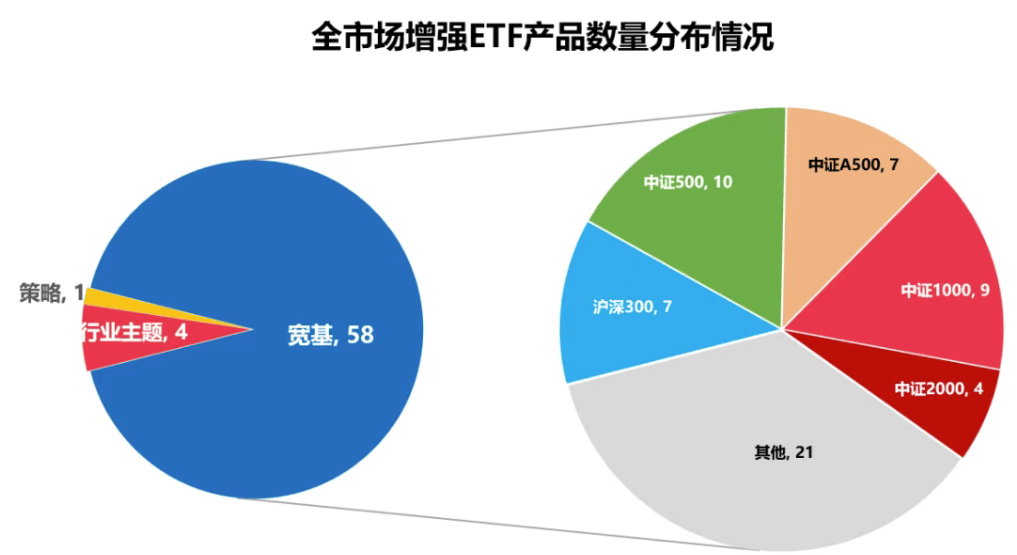
Core Insights - The article discusses the concept of enhanced index funds, which aim to achieve excess returns (Alpha) while passively tracking an index, using various strategies such as multi-factor models and quantitative analysis [1][9] - Enhanced index ETFs have seen significant growth, with over 60 products available as of August 22, 2025, nearly half of which were established in the last two years [1][9] Performance Analysis - Traditional index-enhanced strategies have faced challenges, with some funds underperforming compared to fully replicated index ETFs, particularly in the past year [2][4] - For instance, the annual returns of several enhanced strategy ETFs, such as the Guotai Hushen 300 Enhanced Strategy ETF, were lower than those of standard ETFs [3][4] Market Dynamics - Large-cap stocks, like those in the Hushen 300 index, are often well-covered by institutions, leading to high pricing efficiency and making it difficult for quantitative strategies to identify mispricings [4] - Conversely, small-cap stocks, particularly those in indices like the CSI 2000, have shown higher Alpha potential due to less institutional coverage and greater pricing inefficiencies [5][6] Long-term Trends - Enhanced index strategies have demonstrated superior long-term performance, with the CSI 500 Enhanced Index outperforming its benchmark over three, five, and ten-year periods [7][8] - The article emphasizes that the probability of achieving excess returns with enhanced index funds is over 90%, making them an attractive option for both retail and professional investors [9]
数说公募纯债及混合资产策略基金2025半年报:机构增配“固收+”,含权资产加仓成长方向
SINOLINK SECURITIES· 2025-09-02 11:39
Report Title - "Number Analysis of Public Offering Pure Bond and Hybrid Asset Strategy Funds' 2025 Semi-Annual Report - Institutions Increase Allocation to 'Fixed Income +', and Allocate More Growth-Oriented Equity Assets" [1] Report Date - September 2, 2025 [2] Core View - The report analyzes the performance, asset allocation, and institutional holding changes of various types of bond and hybrid asset strategy funds, showing that institutions are increasing their allocation to 'fixed income +' funds and shifting their equity asset allocation towards growth directions. Summary by Fund Type Short-Term Pure Bond Funds - Multiple funds are listed, such as Great Wall Short Bond A (007194.OF) with a scale of 3.2686 billion yuan, an institutional holding of 1.7147 billion shares, and an institutional increase of 0.5179 billion shares. Its 1-year return is 2.91% (ranked 22/347), and the 3-year return is 3.81% (ranked 2/278) [21]. - Another example is Boshi Credit Preferred A (009271.OF) with a scale of 2.0333 billion yuan, an institutional holding of 1.0058 billion shares, and an institutional increase of 0.7677 billion shares. Its 1-year return is 2.24% (ranked 127/347), and the 3-year return is 3.37% (ranked 13/278) [23]. Medium and Long-Term Pure Bond Funds - For instance, Bank of China Fenghe Regular Open (004722.OF) has a scale of 4.8366 billion yuan, an institutional holding of 4.3551 billion shares, and no institutional increase. Its 1-year return is 2.68% (ranked 1287/1965), and the 3-year return is 3.28% (ranked 841/1509) [21]. - Guoshou Anbao Tai'an Pure Bond (010232.OF) has a scale of 2.401 billion yuan, an institutional holding of 2.2246 billion shares, and an institutional increase of 0.2758 billion shares. Its 1-year return is 3.93% (ranked 315/1965), and the 3-year return is 4.18% (ranked 152/1509) [21]. Mixed Bond - Type I Funds - Invesco Great Wall Jingtai Pure Profit A (007562.OF) has a scale of 1.9143 billion yuan, an institutional holding of 1.1324 billion shares, and an institutional increase of 0.4631 billion shares. Its 1-year return is 5.32%, and the 3-year return is 4.33% (ranked 43/329) [21]. - E Fund Enhanced Return A (110017.OF) has a scale of 3.1526 billion yuan, an institutional holding of 0.8182 billion shares, and an institutional increase of 0.0847 billion shares. Its 1-year return is 4.62%, and the 3-year return is 4.32% (ranked 45/329) [21]. Mixed Bond - Type II Funds - E Fund Yuxiang Return A (002351.OF) has a scale of 2.6613 billion yuan, an institutional holding of 1.5665 billion shares, and an institutional increase of 0.1322 billion shares. Its 1-year return is 5.42% (ranked 173/507), and the 3-year return is 3.05% (ranked 76/340) [21]. - Invesco Great Wall Jingsheng Double Dividend A (002065.OF) has a scale of 1.1558 billion yuan, an institutional holding of 0.9907 billion shares, and an institutional increase of 0.2778 billion shares. Its 1-year return is 4.20% (ranked 265/507), and the 3-year return is 4.49% (ranked 11/340) [21]. Partial - Bond Hybrid Funds - E Fund Hengsheng 3 - Month Fixed - Open (007884.OF) has a scale of 0.2021 billion yuan, an institutional holding of 0.1734 billion shares, and no institutional increase. Its 1-year return is 8.71% (ranked 117/674), and the 3-year return is 5.36% (ranked 15/587) [21]. - Anxin Minwen Growth A (008809.OF) has a scale of 0.3115 billion yuan, an institutional holding of 0.1198 billion shares, and an institutional decrease of 0.0067 billion shares. Its 1-year return is 7.60% (ranked 169/674), and the 3-year return is 4.33% (ranked 41/587) [21]. Flexible Allocation - Partial - Bond Funds - Boshi Hongkang A (003411.OF) has a scale of 0.3552 billion yuan, an institutional holding of 0.1264 billion shares, and an institutional increase of 0.0177 billion shares. Its 1-year return is 1.64% (ranked 127/139), and the 3-year return is 2.60% (ranked 40/139) [21]. - E Fund Ruicai I (001802.OF) has a scale of 0.1288 billion yuan, an institutional holding of 0.1088 billion shares, and no institutional increase. Its 1-year return is 9.31% (ranked 10/139), and the 3-year return is 4.79% (ranked 5/139) [21]. Convertible Bond - Style Funds - Huatai Baoxing Zunli A (005908.OF) has a scale of 0.7893 billion yuan, an institutional holding of 0.5427 billion shares, and an institutional increase of 0.0791 billion shares. Its 1-year return is 12.89% (ranked 45/102), and the 3-year return is 6.77% (ranked 4/102) [21]. - Huashang Credit Enhancement A (001751.OF) has a scale of 0.7591 billion yuan, an institutional holding of 0.3941 billion shares, and an institutional increase of 0.0952 billion shares. Its 1-year return is 22.38% (ranked 9/102), and the 3-year return is 5.17% (ranked 13/102) [21]. Convertible Bond - Type Funds - China - Europe Convertible Bond A (004993.OF) has a scale of 0.7529 billion yuan, an institutional holding of 0.511 billion shares, and an institutional increase of 0.2871 billion shares. Its 1-year return is 20.92% (ranked 1/39), and the 3-year return is - 2.06% (ranked 22/39) [21]. - Penghua Convertible Bond A (000297.OF) has a scale of 0.635 billion yuan, an institutional holding of 0.4305 billion shares, and an institutional decrease of 0.0113 billion shares. Its 1-year return is 12.89% (ranked 17/39), and the 3-year return is - 2.84% (ranked 26/39) [21].