鸿蒙智行

Search documents
【月度排名】2025年12月厂商销量排名快报
乘联分会· 2026-01-12 09:28
Core Viewpoint - The article highlights the performance of the Chinese automotive market in December 2025, noting a decline in retail sales for traditional vehicles while emphasizing growth in the new energy vehicle (NEV) sector and exports. The market is expected to transition into 2026 with a focus on new energy vehicles and a recovery in demand [4]. Sales Performance - In December 2025, the domestic narrow passenger car market retail sales reached 2.261 million units, a year-on-year decrease of 14.0% but a month-on-month increase of 1.6%. Cumulative sales for the year totaled 23.744 million units, reflecting a year-on-year growth of 3.8% [2]. - The wholesale sales ranking for December 2025 shows BYD leading with 414,784 units sold, followed by Geely and Chery with 236,817 and 234,736 units, respectively. Notably, BYD's sales decreased by 12.7% month-on-month and 18.6% year-on-year [5]. - For the entire year of 2025, BYD also topped the wholesale sales with 4.545 million units, marking a 6.9% increase year-on-year, while Geely's sales surged by 39.0% to 3.025 million units [6]. New Energy Vehicle Market - In December 2025, the NEV wholesale sales ranking was led by BYD with 414,784 units, despite a month-on-month decline of 12.7% and a year-on-year drop of 18.6%. Geely followed with 154,264 units, showing a year-on-year increase of 38.7% [9]. - The retail sales for NEVs in December 2025 also saw BYD at the forefront with 339,854 units sold, a month-on-month increase of 10.9% but a year-on-year decrease of 15.7% [13]. - For the full year, BYD maintained its dominance in the NEV sector with 3.485 million units sold, although this represented a year-on-year decline of 6.3% [14]. Market Trends and Future Outlook - The article notes that the end of the year typically sees a surge in vehicle purchases, but the depletion of subsidy funds across provinces has tempered this effect, leading to a more stable demand outlook heading into 2026 [4]. - The performance of various manufacturers indicates a competitive landscape, with traditional automakers facing challenges while NEV manufacturers like BYD and Geely continue to show resilience and growth potential [6][9].






放下直营执念,新能源车企扎堆拥抱经销商
3 6 Ke· 2026-01-12 00:27
Core Insights - The operational costs of direct sales show significant financial strain for new energy vehicle companies, with annual costs for a single store reaching up to 5-6 million yuan, and a potential total investment of around 1 billion yuan for 200 stores [1][4][12] - The direct sales model, initially seen as a revolutionary approach, is shifting towards a mixed model of direct sales and dealerships due to increasing cost pressures and market competition [1][2][12] Group 1: Cost and Operational Challenges - The high operational costs in prime urban areas are forcing companies to reconsider their direct sales strategies, with some brands like Tesla and Xiaopeng transitioning to dealership models to share costs and expand market reach [1][2][5] - The average price of new energy vehicles is declining, with projections showing a drop from 184,000 yuan in 2023 to 169,000 yuan in 2025, which is squeezing profit margins further [4][8] - The automotive industry's sales profit margin fell to a record low of 4.4% in 2025, highlighting the unsustainable nature of the direct sales model under current market conditions [4][12] Group 2: Market Adaptation and Strategy Shifts - Companies like NIO and Zeekr are exploring more cost-effective channel strategies, with NIO testing a partnership model in lower-tier cities while Zeekr has shifted to a mixed model of direct sales and dealerships [5][6][11] - The shift towards dealership models is becoming widespread, with brands like Avita planning to convert 90% of their stores to a dealership system by 2024 [6][7] - The competition for market share is intensifying, particularly in lower-tier cities where sales growth is significantly higher than in first and second-tier cities, making these markets critical for future growth [9][10] Group 3: Channel Dynamics and Profitability - The transition to dealership models is reshaping the competitive landscape, as dealerships can offer lower prices and additional benefits, leading to a decline in foot traffic for direct sales stores [12][13] - Despite the advantages of dealership models, profitability remains a challenge, with only 42.9% of independent new energy vehicle dealerships reporting profits, while 34.4% are operating at a loss [12][13] - The high initial investment required for dealerships, including showroom renovations and training, poses a significant risk, especially if market performance does not meet expectations [13]
造车新势力10年沉浮:既分高下,也决生死
Jing Ji Guan Cha Wang· 2026-01-08 07:36
Core Insights - The article highlights the contrasting fates of new energy vehicle manufacturers in China, with Leap Motor achieving significant sales success while Neta Auto faces bankruptcy [2] - The landscape of new car manufacturers has drastically changed since 2015, with only a few remaining competitive players in the market [2] Group 1: Leap Motor's Success - Leap Motor is projected to sell nearly 600,000 vehicles in 2025, marking a 103% year-on-year increase and securing the title of sales champion among new car manufacturers [3] - The company shifted its strategy to target the mainstream market, launching models like the T03 and C11, which contributed to its sales growth [3] - Leap Motor has formed strategic partnerships with Stellantis and FAW, enhancing its brand credibility and accelerating its international expansion [3] Group 2: Hongmeng Zhixing's Rise - Hongmeng Zhixing, formerly Huawei Smart Selection, has seen rapid growth, with total deliveries reaching 589,000 units in 2025, a 32% increase from the previous year [4][5] - The AITO Wenjie brand, particularly the Wenjie M7, has been a significant contributor to this growth, with 420,000 units delivered in 2025, accounting for 71% of total sales [5] Group 3: Xiaomi's Entry - Xiaomi, entering the automotive sector later than its competitors, achieved sales of 412,000 vehicles in 2025, surpassing its target and ranking fifth among new energy vehicle manufacturers [5] - Despite its success, Xiaomi has faced challenges, including negative publicity related to safety incidents and design issues [5] Group 4: The Decline of "Wei Xiao Li" - The trio of "Wei Xiao Li" (NIO, Li Auto, and Xpeng) has experienced a divergence in performance, with NIO's sales declining to 326,000 units in 2025, despite a 47% year-on-year increase [6][7] - Xpeng led the trio with sales of 429,000 units, a 126% increase, while Li Auto's sales fell by 19.6% to 405,900 units, marking a significant drop from its previous leadership position [7][8] Group 5: Industry Challenges and Failures - The article discusses the decline of many new energy vehicle manufacturers, categorizing them into three groups: those that failed before mass production, those that made strategic errors, and those that faced funding issues [9][10] - Notable failures include companies like LeEco and Byton, which struggled with financial sustainability and market competition [10] Group 6: Future Outlook - The article suggests that the next decade will be more challenging for remaining players, emphasizing the need for operational efficiency and cost control to survive in a competitive environment [10][11] - New entrants continue to emerge, indicating ongoing interest in the automotive sector despite the challenges faced by existing manufacturers [11]


德系豪华车新年搞“突袭”?宝马开年官降最高30万
Zhong Guo Jing Ji Wang· 2026-01-05 11:49
Core Viewpoint - BMW has initiated a significant price reduction across 31 key models, with discounts reaching up to 300,000 yuan, marking a departure from its previous stance against price wars in the luxury car market [1][4]. Group 1: Price Reduction Details - The price cuts affect a wide range of models, with reductions generally exceeding 10%, and 24 models seeing cuts over 10%, while 5 models have reductions over 20% [2]. - The model with the largest price drop is the BMW i7 M70L, which saw a reduction from 1.899 million yuan to 1.598 million yuan, a decrease of 301,000 yuan [3][4]. - The entry-level BMW 225L M Sport model's price was reduced from 259,900 yuan to 208,000 yuan, lowering the entry barrier for consumers [2]. Group 2: Market Context and Strategy - BMW's price reduction is framed as a "value upgrade" rather than a price war, indicating a strategic response to market dynamics [4]. - The luxury car market in China is undergoing rapid restructuring, with traditional German brands like BMW, Mercedes-Benz, and Audi facing declining sales, as evidenced by a 14.7% drop in BMW's sales from January to November 2025 [6]. - The rise of Chinese brands, which have seen significant sales growth, poses a challenge to established luxury brands, with companies like Hongmeng Zhixing and Zeekr achieving sales of 589,000 and 575,000 units respectively in 2025 [7][8]. Group 3: Regulatory Environment and Implications - The Chinese government has been actively regulating price wars in the automotive sector, emphasizing compliance with pricing guidelines to promote healthy market development [9]. - BMW's decision to lower prices may attract consumer interest in the short term but could undermine its brand's pricing integrity and consumer perception in the long run [9]. - The competitive landscape may prompt other luxury brands like Mercedes-Benz and Audi to reconsider their pricing strategies in response to BMW's actions, potentially reshaping the market dynamics further [10].
车企2025“年终考”成绩单出炉
Mei Ri Jing Ji Xin Wen· 2026-01-04 14:21
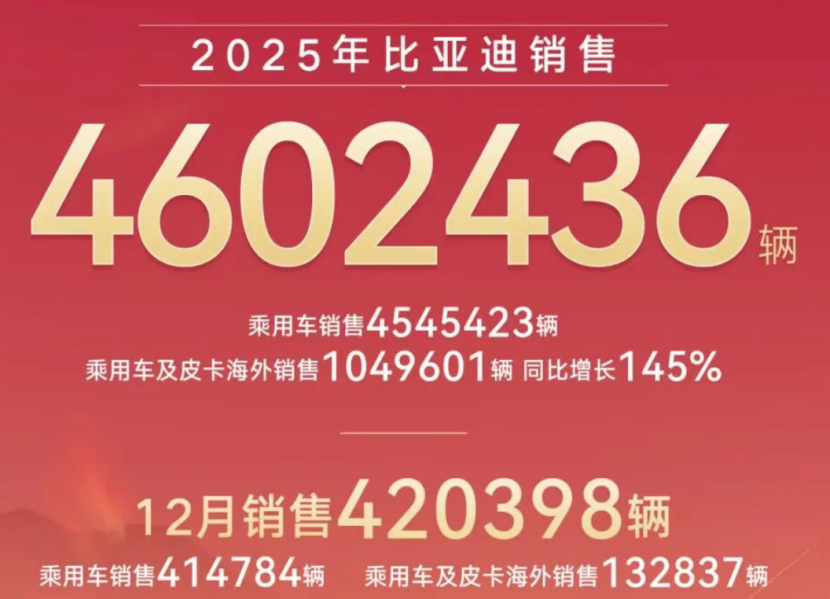
Core Insights - The 2025 Chinese automotive market showcased a "stronger getting stronger, increasing differentiation" trend amid deepening new energy transitions and intense industry competition [1] Group 1: Performance of Leading Companies - BYD achieved sales of 4.6024 million vehicles in 2025, with overseas sales surpassing 1 million for the first time, marking a 145% year-on-year increase in passenger and pickup truck sales [2] - BYD's pure electric vehicle sales reached 2.2567 million units, a nearly 28% increase, surpassing Tesla's 1.636 million units, making BYD the global leader in annual electric vehicle sales [2] - Geely also exceeded its annual sales target, achieving 3.0246 million units sold, a 39% year-on-year increase, with new energy vehicle sales reaching 1.6878 million units, up 90% [2] Group 2: Performance of Other Companies - Dongfeng Motor achieved its dual target of over 1 million new energy vehicles and 1.5 million total vehicle sales, with new energy vehicle sales reaching 1.04 million, a 21% increase [3] - Changan Automobile reported sales of 2.913 million vehicles, a growth of 8.5%, with new energy vehicle sales of 1.109 million, up 51% [5] - Chery Group sold 2.8064 million vehicles, a 7.8% increase, with new energy vehicle sales reaching 903,800 units, a 54.9% increase [5] Group 3: Underperformance of Certain Companies - China FAW achieved a total vehicle sales of 3.302 million, a 3.2% increase, but fell short of its target of 3.45 million [4] - Great Wall Motors reported sales of 1.3237 million vehicles, a 7.33% increase, but only achieved 33.09% of its 4 million target [5][6] - New energy vehicle sales for Great Wall reached 403,700 units, a 25.44% increase, but the overall performance was below expectations [5][6] Group 4: New Forces in the Market - Among new forces, Leap Motor, Xiaomi, and Xpeng all exceeded their annual sales targets, with Leap Motor achieving 596,600 units sold, marking a 119.3% target completion rate [7] - Xiaomi's vehicle deliveries surpassed 50,000 in December 2025, exceeding its annual target of 350,000 [7] - NIO and Li Auto, however, did not meet their targets, with NIO selling 326,000 units and Li Auto selling 406,300 units, both falling short of their respective goals [8][9]
2025成绩单出炉:14家车企5家达成年度目标!多品牌单月创新高 | 12月新能源销量快报
Zhong Guo Qi Che Bao Wang· 2026-01-04 02:58
Group 1 - The overall retail and wholesale data for passenger cars in December 2025 showed a decline, with retail down 19% year-on-year and wholesale down 23% year-on-year, but this did not affect the steady growth of new energy vehicle (NEV) sales [2] - BYD achieved a December sales figure of 420,398 units and a total annual sales of 4,602,436 units, maintaining its position as the global leader in NEV sales [7] - SAIC-GM-Wuling's annual NEV sales exceeded 1 million units, with a year-on-year growth of 31.9%, and its NEV penetration rate increased from 50% to 61% [10] Group 2 - Leap Motor delivered 60,423 vehicles in December 2025, achieving a total annual delivery of 596,555 units, representing a year-on-year growth of 103% [13] - Xiaomi's December sales exceeded 50,000 units, contributing to an annual total of over 400,000 units, successfully meeting its sales target [14] - NIO delivered 48,135 vehicles in December, marking a historical high with a year-on-year growth of 54.6%, and an annual total of 326,028 vehicles [17] Group 3 - Li Auto delivered 44,246 vehicles in December, bringing its total annual sales to 406,343 units [20] - Xpeng Motors achieved a record annual delivery of 429,445 vehicles, exceeding its revised target of 380,000 units, with December sales of 37,508 units [22] - Deep Blue's December sales reached 30,999 units, contributing to an annual total of over 330,000 units [26] Group 4 - Zeekr delivered 30,267 vehicles in December, achieving a total annual sales of over 224,000 units, with a year-on-year growth [28] - Lantu's December sales exceeded 15,900 units, with an annual total of 150,169 units, reflecting a year-on-year growth of 87% [30] - IM Motors achieved an annual sales figure of 81,017 units, with December sales of 11,818 units [35] Group 5 - Avita's annual sales surpassed 120,000 units, with December sales of 10,470 units, marking ten consecutive months of sales exceeding 10,000 units [37] - Extreme Stone's December sales reached 2,528 units, with an annual total of 15,318 units, nearly tripling from the previous year [40] - Hongmeng Zhixing delivered 589,107 vehicles in 2025, with December sales of 89,611 units, marking a historical high for three consecutive months [42]

在一片销量创新高的欢呼声中,车企们将迎战更惨烈的2026年
3 6 Ke· 2026-01-04 02:11
Core Viewpoint - The Chinese automotive market is experiencing a downturn in December, with a significant year-on-year decline in retail sales, prompting companies to seek growth opportunities amidst challenging conditions [1][10]. Market Performance - From December 1 to 28, retail sales of passenger vehicles in China reached 1.928 million units, a 17% decrease compared to the same period last year and a 3% decline from the previous month [1]. - Traditional automakers like BYD reported a sales drop of 12% month-on-month and 18% year-on-year, despite achieving a total of 4.273 million units sold in 2023, marking a 144% increase in exports [6][7]. Company Highlights - NIO achieved a record delivery of 48,000 units in December, with 46% of this volume coming from the new ES8 model [3]. - Xpeng and Xiaomi also saw increases in deliveries, with Xpeng delivering 37,000 units and Xiaomi exceeding 50,000 units [3]. - Li Auto's monthly deliveries rose from 30,000 in November to 40,000 in December, aided by adjustments in production capacity [3][17]. - Homologous Intelligent achieved nearly 90,000 deliveries in December, becoming the top performer among new energy vehicle brands [4][13]. Future Outlook - Industry experts anticipate a rebound in January 2026 due to the timing of the Spring Festival and the implementation of new subsidy policies [8]. - However, the overall automotive industry is expected to remain under pressure throughout 2026 [9]. Competitive Landscape - The competition among automakers is intensifying, with companies like BYD, Li Auto, and others adjusting their sales targets and strategies in response to market conditions [20][23]. - New models and technological advancements are being prioritized, with companies focusing on high-value offerings to navigate the changing market dynamics [30][31].
节假日消费观察|销售称试驾排到凌晨一两点,20余家车企推购置税托底吸引客流
Di Yi Cai Jing· 2026-01-03 15:09
Group 1 - The core observation is that during the New Year holiday, there was a significant increase in customer traffic and test drive demand at various new energy vehicle (NEV) stores, including NIO, Tesla, and others, indicating strong consumer interest despite upcoming policy changes [1][2] - NIO's store in Shanghai reported test drives extending until 1-2 AM, reflecting high customer engagement [1] - The sales performance of new energy vehicle stores during the holiday period suggests that the impact of the new policies on market sales has been limited, as many new energy vehicles are priced above the thresholds for full subsidies [2] Group 2 - In 2026, two major policy changes will affect the NEV market: the vehicle purchase tax will shift from full exemption to a 5% tax rate, and the subsidy structure will change from fixed amounts to a percentage of the vehicle price, although the maximum subsidy remains unchanged [1] - The new policies are expected to increase consumer costs for purchasing NEVs, but many automakers have implemented "bottom-line" measures to attract customers [2] - The current national subsidy policy allows for full rebates for vehicles priced above 166,700 yuan and full trade-in subsidies for those above 187,500 yuan, which aligns with the average prices of many new energy vehicles [2]

2025年车企销量排名出炉:比亚迪、吉利、奇瑞稳居前三,造车新势力分化加剧,零跑、小鹏、小米完成目标
Feng Huang Wang Cai Jing· 2026-01-02 14:45
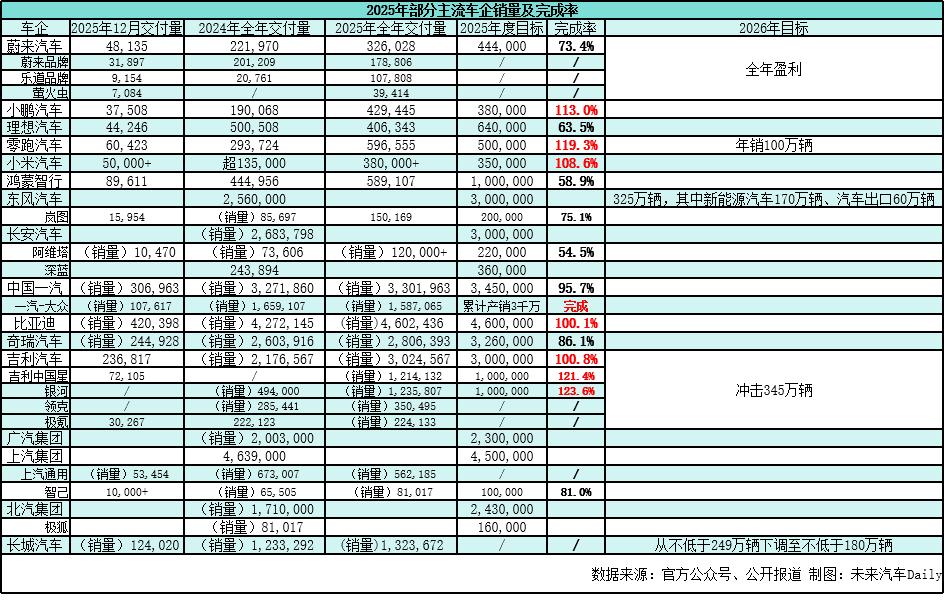
Core Insights - The Chinese automotive industry is experiencing a significant transformation, with traditional giants expanding rapidly while new energy vehicle startups face intense competition and market reshuffling [1] Traditional Giants' Performance - BYD continues to lead the market with total sales exceeding 4.6 million units in 2025, marking a nearly 8% year-on-year increase. Pure electric vehicle sales reached 2.2567 million units, up 27.86% [2] - BYD's overseas sales surpassed 1 million units for the first time, achieving 1.0496 million units, a staggering 145% increase year-on-year [2] - Geely Automotive achieved over 3.02 million units in sales, exceeding its target of 3 million units with a 39% year-on-year growth, driven by a 90% increase in new energy vehicle sales [3] - Chery Automotive sold over 2.8 million units, a 7.8% increase, and maintained its position as the top exporter of Chinese passenger cars for 23 consecutive years [5] - Great Wall Motors sold over 1.32 million units, a 7.33% increase, with new energy vehicle sales reaching 403,700 units, up 25.44% [7] New Energy Vehicle Startups' Struggles - The new energy vehicle sector shows significant differentiation, with only Leap Motor, Xiaomi, and XPeng meeting their annual sales targets [8] - Leap Motor emerged as a surprise leader with nearly 600,000 units sold, achieving a target completion rate of over 119% [8] - Homtruck followed closely with 589,100 units sold, but fell short of its 1 million target, achieving only 59% of its goal [8] - XPeng sold 429,400 units, surpassing Li Auto, with a year-on-year growth of 125.94% and a target completion rate of over 113% [10] - Li Auto faced a decline, selling 406,300 units, down 18.81% year-on-year, and only achieving 58.05% of its target [10] Market Dynamics and Future Outlook - The competitive landscape is shifting, with traditional automakers gaining strength while new entrants like Leap Motor and Xiaomi are rising [11] - The upcoming subsidy policies for 2026 are expected to intensify competition, focusing on product strength, technological capabilities, and brand value [12] - The automotive industry is poised for further transformation as market dynamics evolve, indicating that no company's position is guaranteed [12]
交付量狂飙!车企12月收官榜出炉,车市1月开门红稳了?
Ge Long Hui· 2026-01-02 02:26
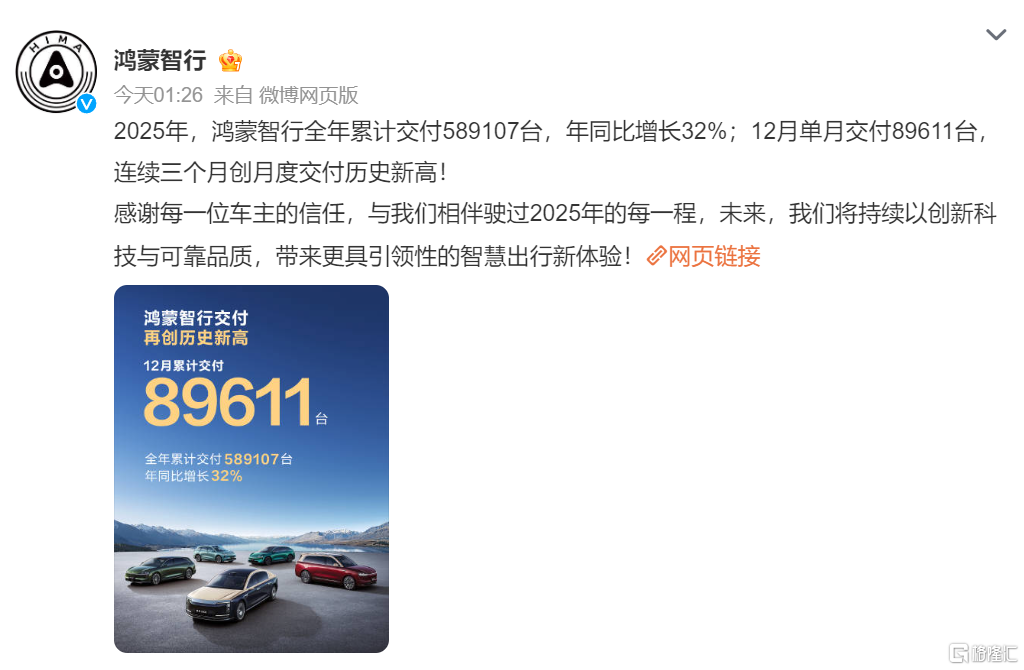
2025年已落幕,各大车企陆续披露12月销量成绩单,为全年收官。 从交付表现来看,鸿蒙智行单月交付89611台,零跑交付60423台,小米交付量超5万台紧随其后;蔚来交付48135台创下月度新高,理想、小鹏分别交出 44246辆、37508辆的成绩单;极氪也实现突破,月交付量首次迈过3万台门槛。 车企12月成绩出炉 今日,多家新能源车企相继披露全年及12月交付数据。 鸿蒙智行12月单月交付89611台,连续三个月创月度交付历史新高;全年累计交付589107台,年同比增长32%。 零跑汽车12月全系交付60423台,同比增长42%;全年累计交付596555台,同比增幅达103%。 小米汽车12月交付量超5万台,产品矩阵扩张计划同步曝光。据产业端信息,其2026年拟推出4款新车,包括SU7改款、SU7行政版,以及一款增程五 座SUV和一款增程七座SUV,其中SU7改款与增程七座SUV计划上半年推出,另外两款则安排在下半年至年底亮相。 蔚来12月交付新车48135台,同比增长54.6%,创下月度交付历史新高;全年累计交付326028台,同比增长46.9%,同样刷新年度交付纪录。 理想汽车12月交付44246辆,第四 ...