泸州老窖

Search documents
当政策红利遇上消费刚需 中证主要消费指数如何成为行业压舱石?
Sou Hu Cai Jing· 2026-01-14 06:27
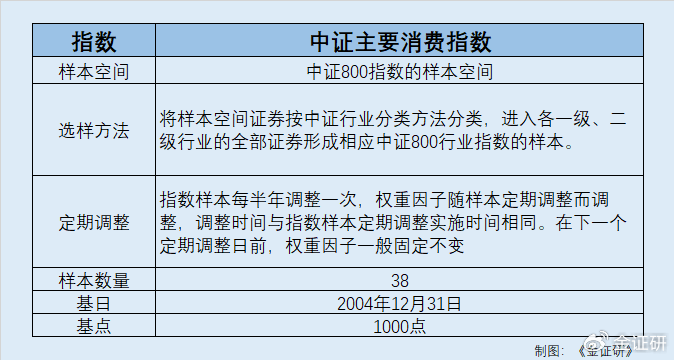
Group 1 - The core viewpoint of the article emphasizes the importance of policies aimed at boosting consumption, highlighting the collaboration between business and financial sectors to enhance consumer spending [1][2] - The China Securities Major Consumption Index, which focuses on the consumption sector, has an average free float market capitalization exceeding 600 billion yuan, reflecting the overall performance of major consumption stocks in the A-share market [2][3] - The index includes 38 sample stocks, with a free float market capitalization ranging from 36.47 billion yuan to 8,885.48 billion yuan, indicating significant growth potential in the consumption sector [2][4] Group 2 - The index is heavily concentrated in the food and beverage sector, with a weight of 67.62%, and agriculture, forestry, animal husbandry, and fishery at 28.42%, together covering over 96% of the index's weight [4][5] - The top ten stocks in the index are supported by leading companies such as Kweichow Moutai, Yili, and Wuliangye, which have strong brand recognition and stable cash flows [5][6] - The ongoing policy support for consumption is expected to enhance the long-term value and growth potential of the consumption sector, making the China Securities Major Consumption Index a quality benchmark for investing in core consumption assets [7]





90%的名酒在跌价,2026年酒企怎么活?
首席商业评论· 2026-01-14 04:34
Core Viewpoint - The article discusses the significant changes in the Chinese liquor industry, particularly the white wine sector, highlighting a shift from a focus on brand prestige and social status to a more value-driven approach based on product quality and consumer experience [3][5][21]. Group 1: Industry Overview - As of early 2026, the white wine industry is undergoing a deep adjustment, with a notable decline in both revenue and profit across major companies, marking the first time in a decade that the industry has experienced consecutive quarters of double-digit declines [14][21]. - The average inventory turnover days for 20 listed liquor companies reached 1,424 days by the end of Q3 2025, indicating that some inventory may take nearly four years to deplete [10]. - The overall revenue for 20 A-share listed liquor companies in the first three quarters of 2025 was 3,177.79 billion yuan, a year-on-year decrease of 5.90% [14]. Group 2: Market Dynamics - The price system in the white wine market has collapsed, with the market price of premium brands like Moutai dropping below 1,600 yuan, a decline of over 15% for other high-end products [12][14]. - Over 99% of famous liquor prices have fallen, with average retail prices decreasing by more than 30% [12]. - The industry is witnessing a "devaluation of value," where consumers are no longer willing to pay for brands that do not deliver tangible quality or experience [16][18]. Group 3: Future Trends - The future of the liquor industry will be characterized by a "polarization" where companies must either provide "extreme experiences" or "precise value" to survive [8][21]. - High-end products will focus on exceptional craftsmanship and unique experiences, while lower-end products will cater to specific daily needs with high cost-effectiveness [25][29]. - The younger demographic is increasingly important, with 95 post-90s consumers making up only 18% of the white wine market, prompting a need for products that resonate with their lifestyle [25]. Group 4: Strategic Shifts - Companies are exploring new distribution models, such as direct-to-consumer sales, and are innovating product lines to meet changing consumer preferences [18][20]. - Regulatory changes are pushing for clearer labeling of production processes and ingredients, moving away from vague marketing strategies [18]. - The industry is transitioning from a focus on speculative investment to a more grounded approach centered on genuine consumer value and experience [21][31].


i茅台越火,五粮液越惨
Sou Hu Cai Jing· 2026-01-14 01:48
Core Viewpoint - The article highlights the contrasting fortunes of Kweichow Moutai and Wuliangye in the Chinese liquor industry, emphasizing Moutai's successful pricing strategy through the iMoutai app, while Wuliangye struggles with pricing chaos and declining performance [2][3][7]. Group 1: Moutai's Strategy - Moutai's use of the iMoutai app has effectively stabilized prices and increased direct sales, benefiting its financial performance while undermining competitors like Wuliangye [3][6]. - The app serves as a "price stabilizer" and "profit harvester," allowing Moutai to control pricing and combat scalpers, making the product more accessible to genuine consumers [2][3]. Group 2: Wuliangye's Challenges - Wuliangye is facing unprecedented difficulties, including price discrepancies, a significant drop in performance, and a chaotic distribution channel [2][7]. - The launch of Wuliangye's new retail platform in 2022 has not resolved its issues; instead, it has led to confusion among consumers due to inconsistent pricing across different sales channels [4][5]. - In Q3 2025, Wuliangye reported a revenue of 8.174 billion yuan, a year-on-year decline of 52.66%, marking its first revenue drop since 2015 [7]. - Wuliangye's reliance on its flagship product, the "Pu Wu," which accounts for over 50% of its revenue, has become a liability as it faces intense competition from brands like Moutai and others in the market [8][9]. Group 3: Competitive Landscape - Moutai's growth contrasts sharply with Wuliangye's decline, as Moutai's revenue and net profit showed slight increases, while competitors like Shanxi Fenjiu have surpassed Wuliangye in both revenue and profit [7][9]. - Wuliangye's struggle to maintain its "second place" status is compounded by the aggressive strategies of competitors, leading to a potential loss of market position if it fails to address its pricing and distribution issues [9].
酒价内参1月14日价格发布 洋河梦之蓝M6+下跌4元
Xin Lang Cai Jing· 2026-01-14 01:32
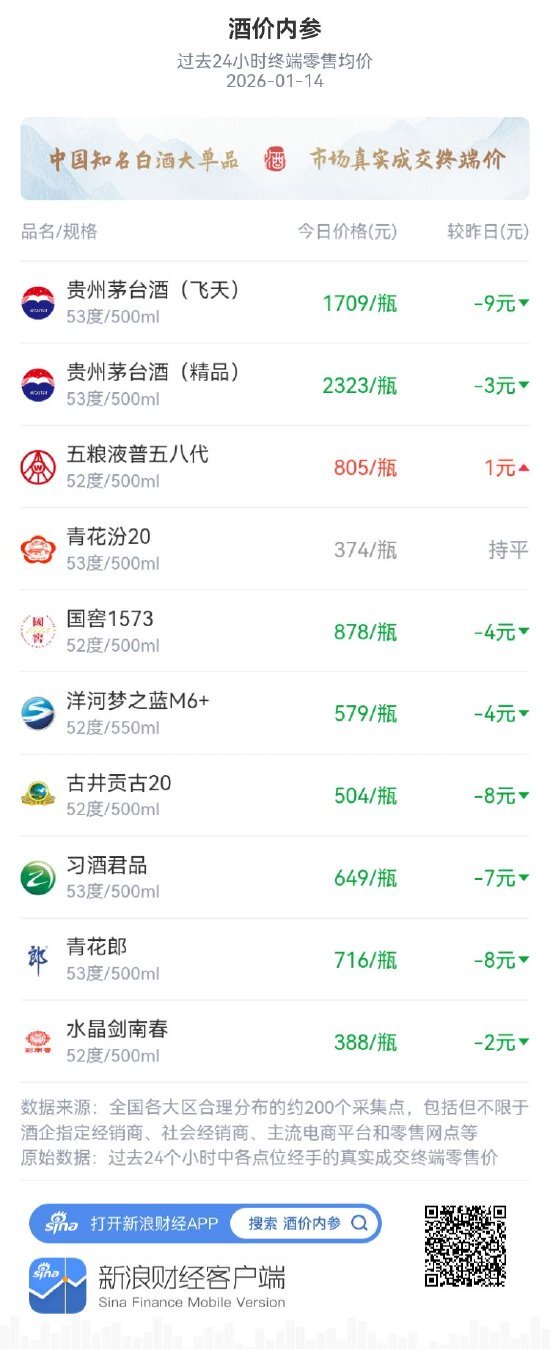
Core Viewpoint - The Chinese liquor market is experiencing a price adjustment, with the average retail price of the top ten liquor products declining, indicating cautious market sentiment [1]. Group 1: Market Price Trends - On January 14, the average retail price of the top ten liquor products decreased by 44 yuan, bringing the total price to 8925 yuan [1]. - Eight out of the ten products saw price declines, with Feitian Moutai leading the drop at 9 yuan per bottle [1]. - Other notable declines include Gujing Gonggu 20 and Qinghua Lang, both down 8 yuan per bottle, while Guojiao 1573 and Yanghe Dream Blue M6+ fell by 4 yuan each [1]. Group 2: Market Dynamics - The market is characterized by a general downward trend, with a narrowing trading volume and a clear differentiation among products [1]. - Only Wuliangye Pu 58th generation saw a slight increase of 1 yuan per bottle, while Qinghua Fen 20 remained unchanged [1]. Group 3: Pricing Mechanism Changes - On January 13, Kweichow Moutai announced a new market-oriented pricing strategy, moving away from fixed factory prices to a dynamic pricing mechanism based on market conditions [3]. - This new pricing system aims to enhance the company's control over retail prices and stabilize the market, allowing for flexible pricing based on product, channel, and operational model differences [3]. - The company is piloting a consignment model for new products, allowing consumers to order online and pick up in-store, aiming for a win-win situation between manufacturers and channels [3].



酒价内参1月14日价格发布 青花郎下跌8元
Xin Lang Cai Jing· 2026-01-14 01:20
Core Insights - The article highlights a recent decline in the retail prices of major Chinese liquor brands, indicating a cautious market sentiment and a general downward trend in prices [1][6]. Price Trends - The average retail price of the top ten Chinese liquor products decreased to 8,925 yuan on January 14, down by 44 yuan from the previous day [1][6]. - Eight out of the ten major products experienced price drops, with Feitian Moutai leading the decline at 9 yuan per bottle [1][6]. - Other notable price decreases include Gujing Gong and Qinghua Lang, both down by 8 yuan per bottle, while Guojiao 1573 and Yanghe Dream Blue M6+ fell by 4 yuan per bottle [1][6]. Market Dynamics - The market is currently characterized by a broad decline in prices, with a notable contraction in trading volume [1][6]. - Only Wuliangye's Pu Wuhai Dai saw a slight increase of 1 yuan per bottle, while Qinghua Fen 20 remained unchanged [1][6]. Data Collection Methodology - The "Wine Price Reference" collects data from approximately 200 sampling points across various regions, including designated distributors, social distributors, e-commerce platforms, and retail outlets [2][7]. - The data aims to provide an objective and traceable representation of the market prices for well-known liquor brands [2][7]. Strategic Changes in Pricing - On January 13, 2026, Kweichow Moutai announced a new market-oriented operational plan, which includes a dynamic pricing mechanism that deviates from the traditional fixed pricing model [3][8]. - This new pricing strategy allows for flexible pricing based on market conditions, enhancing the company's ability to control retail prices and stabilize the market [3][8]. - The company is testing a consignment model where consumers can order online and pick up in-store, aiming for a win-win situation between manufacturers and distributors [3][8].

酒价内参1月14日价格发布 古井贡古20下跌8元
Xin Lang Cai Jing· 2026-01-14 01:20
Core Insights - The article highlights a general price adjustment in the Chinese liquor market, particularly for the top ten liquor products, indicating a cautious market sentiment with a total price drop of 44 yuan to 8925 yuan for a bundled sale of these products [1][6]. Price Trends - The average retail price of the top ten liquor products has decreased, with eight out of ten products experiencing price drops, reflecting a bearish market trend [1][6]. - Notable price declines include: - Feitian Moutai leading the drop with a decrease of 9 yuan per bottle - Gujinggong 20 and Qinghualang both down by 8 yuan per bottle - Guojiao 1573 and Yanghe Dream Blue M6+ each down by 4 yuan per bottle - Other products like Jingpin Moutai and Shuijing Jian'nanchun saw smaller declines of 3 yuan and 2 yuan respectively [1][6]. Market Dynamics - The market is characterized by a broad decline in prices, with only Wuliangye Pu 58th generation showing a slight increase of 1 yuan per bottle, while Qinghualang remained stable [1][6]. - The introduction of new pricing mechanisms by Kweichow Moutai aims to establish a market-oriented pricing system, moving away from fixed factory prices to a dynamic pricing model that adjusts based on market conditions [3][8]. Data Collection Methodology - The "Liquor Price Reference" collects data from approximately 200 sampling points across various regions, including designated distributors and retail outlets, to provide accurate and traceable retail price information [2][7]. - The pricing data is weighted based on actual transaction volumes to reflect true market conditions, particularly for products like Feitian Moutai and Jingpin Moutai [2][7].
深圳这场盛会,TCL李东生、小鹏汽车何小鹏等企业家都说了啥?
Sou Hu Cai Jing· 2026-01-13 12:35
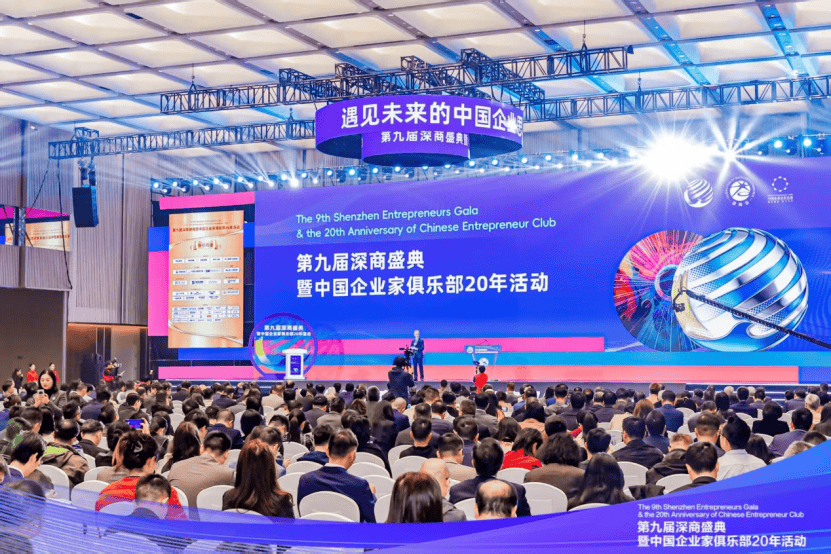
Group 1 - The event "The 9th Shenzhen Business Convention and 20 Years of China Entrepreneurs Club" focused on themes such as industrial innovation, technological breakthroughs, ecological construction, and social responsibility [1] - Notable entrepreneurs shared insights on technology innovation and development paths, highlighting China's evolution from a follower in the global supply chain to a pioneer in new strategic industries [3] - The global competition in technology is intensifying, with artificial intelligence transitioning from concept to deep industrialization, becoming a key driver of future economic growth [3] Group 2 - Companies like TCL, iFlytek, and XPeng Motors discussed their advancements in AI, automotive technology, and the importance of core technology autonomy for long-term success [3][4] - The Chinese automotive industry is moving from "electrification" to "intelligent competition," with breakthroughs in autonomous driving and smart cockpit technologies being crucial for gaining a competitive edge globally [3] - The concept of ESG (Environmental, Social, and Governance) has become a significant guiding principle for high-quality corporate development, emphasizing the integration of sustainability into business strategies [4]



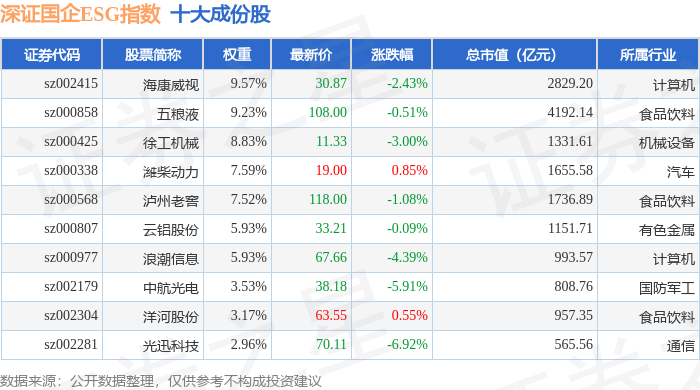
1月13日深证国企ESG(970055)指数跌1.7%,成份股中核科技(000777)领跌
Sou Hu Cai Jing· 2026-01-13 10:53
Group 1 - The Shenzhen State-owned Enterprise ESG Index (970055) closed at 1462.82 points, down 1.7%, with a trading volume of 56.526 billion yuan and a turnover rate of 2.08% [1] - Among the index constituents, 9 stocks rose while 40 stocks fell, with Dengkang Dental leading the gainers at a 6.17% increase and China Nuclear Technology leading the decliners at a 9.27% decrease [1] - The top ten constituents of the Shenzhen State-owned Enterprise ESG Index include Hikvision, Wuliangye, and Xugong Machinery, with respective weights of 9.57%, 9.23%, and 8.83% [1] Group 2 - The net outflow of main funds from the index constituents totaled 2.961 billion yuan, while retail investors saw a net inflow of 2.199 billion yuan [1] - Detailed fund flow data indicates that Yunnan Energy Investment and Yanghe Brewery experienced net inflows from retail investors, while major funds showed outflows for several stocks including Yun Aluminum and Wuliangye [2] - The fund flow analysis highlights the varying investor sentiment, with significant retail interest in certain stocks despite overall net outflows from institutional investors [2]



食品饮料行业周报:食品价格继续改善,消费潜力不断释放-20260113
Donghai Securities· 2026-01-13 09:17
Investment Rating - The report assigns an "Overweight" rating for the food and beverage industry, indicating a positive outlook for the sector relative to the broader market [1]. Core Insights - The report highlights that the Consumer Price Index (CPI) in December 2025 reached its highest year-on-year increase since March 2023, with food prices continuing to improve. This is attributed to policies aimed at boosting domestic demand and increased consumer spending during the New Year period [5][48]. - The food and beverage sector saw a 2.12% increase in the market last week, underperforming the CSI 300 index by 0.66 percentage points, ranking 26th among 31 sectors [10]. - Key companies such as Sam's Club and Alibaba are expanding aggressively, with Sam's Club projected to exceed 140 billion yuan in sales for 2025, marking a 40% increase from 2024 [48]. Summary by Sections 1. Market Performance - The food and beverage sector's performance was highlighted, with a 2.12% increase last week, while the pre-processed food sub-sector performed particularly well with a 6.72% increase [10][13]. - The top five performing stocks included Qianwei Yangchun, Anji Food, and Yangyuan Beverage, with respective increases of 22.52%, 18.34%, and 14.78% [10][15]. 2. Price Trends - The report notes that food prices have shown significant increases, particularly in fresh vegetables and fruits, which rose by 18.2% and 4.4% year-on-year, respectively [5]. - The price of milk was reported at 12.17 yuan per liter, with a slight year-on-year decrease of 0.16% [26]. 3. Industry Dynamics - The report discusses the expansion of membership supermarkets and instant retail, with notable growth in companies like Sam's Club and Alibaba's Taobao Flash Sale [48][49]. - The government is implementing a comprehensive policy to stimulate domestic demand, focusing on enhancing consumer spending and supporting private investment [49]. 4. Core Company Updates - New Dairy announced a cash dividend of 0.70 yuan per share, while Fuling Pickled Vegetables and Luzhou Laojiao also declared significant cash dividends [51].



白酒板块1月13日跌0.9%,*ST岩石领跌,主力资金净流出8.17亿元
Zheng Xing Xing Ye Ri Bao· 2026-01-13 09:00
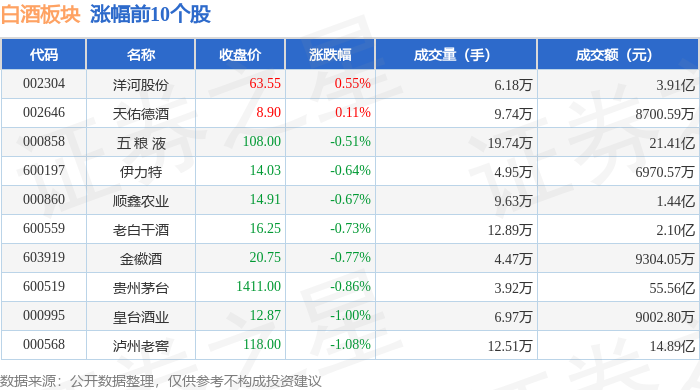
Group 1 - The liquor sector experienced a decline of 0.9% on January 13, with *ST Rock leading the drop [1] - The Shanghai Composite Index closed at 4138.76, down 0.64%, while the Shenzhen Component Index closed at 14169.4, down 1.37% [1] - Major liquor stocks showed mixed performance, with Wuliangye down 0.51% to 108.00 and Moutai down 0.86% to 1411.00 [1] Group 2 - The liquor sector saw a net outflow of 8.17 billion yuan from institutional investors, while retail investors contributed a net inflow of 3.19 billion yuan [2] - The top stocks by net inflow included Wuliangye with a net inflow of 46.20 million yuan from institutional investors, while *ST Rock had a net outflow of 38.73 million yuan [3] - Retail investors showed a preference for stocks like Moutai and Gujing Gongjiu, with net inflows of 15.08 million yuan and 15.08 million yuan respectively [3]