预加工食品

Search documents
食品饮料行业周报:餐饮供应链边际改善,盈利能力提升-20260331
Donghai Securities· 2026-03-31 07:45
Investment Rating - The industry investment rating is "Overweight" indicating a positive outlook for the sector relative to the broader market [1]. Core Insights - The report highlights that the restaurant supply chain is showing marginal improvement, with Q1 performance expected to demonstrate rapid growth. Retail sales in the restaurant sector increased by 4.8% year-on-year in January-February, and the cessation of the "takeaway war" is expected to lead to a recovery in demand [4][49]. - The beer sector is entering a sales peak, with the upcoming World Cup in June likely to accelerate recovery in on-premise consumption. The report suggests focusing on opportunities within the beer sector, particularly for companies like Yanjing Beer, which is expected to achieve significant growth in production [4]. - The report notes that raw milk prices are stabilizing, with the average price of fresh milk at 3.03 yuan/kg as of March 20, showing a year-on-year decrease of 1.9%. The report anticipates a positive shift in the supply-demand dynamics for meat and dairy prices in 2026 [4]. Summary by Sections 1. Market Performance - The food and beverage sector experienced a decline of 0.99%, underperforming the CSI 300 index by 0.42 percentage points, ranking 18th among 31 sectors [8]. - Among sub-sectors, processed foods saw a notable increase of 4.26% [8]. 2. Key Consumer Goods and Raw Material Prices - As of March 27, the price of fresh milk was 12.20 yuan/liter, with a slight week-on-week decrease of 0.16% [26]. - The price of beef was reported at 66.10 yuan/kg, reflecting a year-on-year increase of 11.09% [26]. 3. Industry Dynamics - The report discusses the end of the "takeaway war," emphasizing the need for the industry to shift from price wars to service and innovation [49]. - It also mentions potential shortages of glass bottles and cans in India due to geopolitical issues affecting raw material costs [49]. 4. Core Company Updates - New Dairy reported a revenue of 11.233 billion yuan for 2025, a year-on-year increase of 5.33%, with a net profit of 731 million yuan, up 35.98% [51]. - Qingdao Beer achieved a revenue of 32.473 billion yuan, reflecting a 1.04% increase year-on-year, with a net profit of 4.588 billion yuan, up 5.60% [51].
食品饮料行业 2025 年四季度基金持仓分析:食饮板块超配比例略有回升,乳品、预加工食品等获得增持
Guoxin Securities· 2026-01-25 12:40
Investment Rating - The food and beverage industry maintains an "Outperform" rating [4][5][35] Core Views - The food and beverage sector's fund holding ratio is 4.48%, with a slight decrease of 0.25 percentage points from the previous quarter, ranking eighth among Shenwan's primary industries. The sector continues to be overweight, with an overweight ratio increasing by 0.02 percentage points [1][11] - The white liquor sector remains the most heavily weighted, but its overweight ratio has decreased. Conversely, the dairy, snacks, and seasoning sectors have seen an increase in fund holding ratios [2][16] - Key individual stocks such as Kweichow Moutai and Wuliangye have seen a decrease in their heavy holding ratios, while Yuran Dairy and Angel Yeast have received increased allocations [3][27] Summary by Sections Fund Holdings Analysis - The food and beverage industry has a fund holding ratio of 4.48%, with a total institutional heavy holding market value of approximately 117.8 billion yuan [1][11] - The white liquor sector's fund holding ratio is 3.32%, while the ratio excluding Kweichow Moutai is 1.84% [2][16] Subsector Performance - White liquor: Fund holding ratio decreased by 0.37 percentage points to 3.32%, with an overweight ratio down to 0.84% [2][16] - Dairy: Fund holding ratio increased by 0.10 percentage points to 0.25%, with an overweight ratio up to -0.16% [17] - Snacks: Fund holding ratio increased by 0.03 percentage points to 0.22%, with an overweight ratio up to 0.12% [17] Individual Stock Analysis - Kweichow Moutai's heavy holding ratio decreased to 1.47%, despite an increase in the number of funds holding it to 296 [3][27] - Wuliangye's heavy holding ratio decreased to 0.41%, with a reduction in the number of funds holding it [3][27] - Yuran Dairy's heavy holding ratio increased to 0.07%, indicating a positive shift in fund allocations [3][27]




食品饮料行业周报:食品价格继续改善,消费潜力不断释放-20260113
Donghai Securities· 2026-01-13 09:17
Investment Rating - The report assigns an "Overweight" rating for the food and beverage industry, indicating a positive outlook for the sector relative to the broader market [1]. Core Insights - The report highlights that the Consumer Price Index (CPI) in December 2025 reached its highest year-on-year increase since March 2023, with food prices continuing to improve. This is attributed to policies aimed at boosting domestic demand and increased consumer spending during the New Year period [5][48]. - The food and beverage sector saw a 2.12% increase in the market last week, underperforming the CSI 300 index by 0.66 percentage points, ranking 26th among 31 sectors [10]. - Key companies such as Sam's Club and Alibaba are expanding aggressively, with Sam's Club projected to exceed 140 billion yuan in sales for 2025, marking a 40% increase from 2024 [48]. Summary by Sections 1. Market Performance - The food and beverage sector's performance was highlighted, with a 2.12% increase last week, while the pre-processed food sub-sector performed particularly well with a 6.72% increase [10][13]. - The top five performing stocks included Qianwei Yangchun, Anji Food, and Yangyuan Beverage, with respective increases of 22.52%, 18.34%, and 14.78% [10][15]. 2. Price Trends - The report notes that food prices have shown significant increases, particularly in fresh vegetables and fruits, which rose by 18.2% and 4.4% year-on-year, respectively [5]. - The price of milk was reported at 12.17 yuan per liter, with a slight year-on-year decrease of 0.16% [26]. 3. Industry Dynamics - The report discusses the expansion of membership supermarkets and instant retail, with notable growth in companies like Sam's Club and Alibaba's Taobao Flash Sale [48][49]. - The government is implementing a comprehensive policy to stimulate domestic demand, focusing on enhancing consumer spending and supporting private investment [49]. 4. Core Company Updates - New Dairy announced a cash dividend of 0.70 yuan per share, while Fuling Pickled Vegetables and Luzhou Laojiao also declared significant cash dividends [51].




2026年中国食品饮料行业投资策略——捕捉细分渠道及品类增长
野村东方国际证券· 2025-12-19 10:03
Core Viewpoint - The retail sector is under pressure, with social retail sales growth slowing down and valuations in the food and beverage sector at a low point [2][3][10]. Group 1: Social Retail Sales and Consumer Price Index - Social retail sales growth has declined, with total retail sales in October 2025 increasing by 2.9% year-on-year, while the growth rates for dining and commodity retail sales were 1.1% and 4.0% respectively [3][6]. - The Consumer Price Index (CPI) turned positive in October 2025, following a decline in food prices, with food CPI down 2.9% year-on-year [3][10]. Group 2: Food and Beverage Sector Performance - The food and beverage sector is experiencing significant pressure, with the overall profit of the liquor sector down 23.9% year-on-year in Q3 2025, largely due to strict regulations impacting the industry [12]. - The beverage segment shows strong growth from leading companies, with soft drink revenue reaching 106.2 billion yuan, up 14.4% year-on-year, while the dairy sector faced challenges with a slight decline in revenue [13][14]. Group 3: Market Trends and Consumer Confidence - The online retail channel is growing faster than offline, with a 6.3% year-on-year increase in online sales as of October 2025, driven by food categories [16]. - Consumer confidence is gradually improving, with the consumer confidence index rising from 87.5 in January to 89.4 in October 2025, contributing significantly to GDP growth [18][21]. Group 4: Valuation and Investment Opportunities - The food and beverage sector is currently at a low valuation level, with a price-to-earnings ratio of approximately 21.4 times, placing it in the 10.9% percentile of the last decade [10][11]. - The sector's dividend rate has slightly decreased but still has room for improvement, with the overall dividend rate fluctuating between 60% and 73% from 2019 to 2023 [23].

巴比食品(605338):单店收入持续反弹,扣非净利率协同提升
Huafu Securities· 2025-11-04 13:08
Investment Rating - The report maintains a "Buy" rating for the company, expecting a relative price increase of over 20% compared to the market benchmark index within the next six months [5][19]. Core Insights - The company reported a revenue of 1.356 billion yuan for the first three quarters of 2025, a year-on-year increase of 12.1%, with a net profit of 201 million yuan, up 3.5% year-on-year. The non-recurring net profit reached 175 million yuan, reflecting a 19.4% increase year-on-year [1]. - The single-store revenue showed a significant rebound, with a quarterly revenue of 522 million yuan in Q3 2025, marking a 16.7% year-on-year increase. The non-recurring net profit for Q3 was 74 million yuan, up 25.5% year-on-year [1][4]. - The company is experiencing steady growth in its catering business, with a total of 5,934 franchise stores as of Q3 2025, netting an increase of 791 stores [3][4]. Revenue and Profitability - The overall gross margin for the first three quarters of 2025 was 28.01%, an increase of 1.61 percentage points year-on-year. The net profit margin was 14.83%, a decrease of 1.22 percentage points year-on-year, while the non-recurring net profit margin improved to 12.91%, up 0.79 percentage points [4]. - The company’s franchise sales, direct store sales, and catering sales for Q1-Q3 2025 were 1.014 billion yuan, 17 million yuan, and 307 million yuan, respectively, showing year-on-year growth of 11%, 12.12%, and 16.28% [3]. Regional Performance - Revenue by region for Q1-Q3 2025 was 1.116 billion yuan in East China, 115 million yuan in South China, 81 million yuan in Central China, and 43 million yuan in North China, with East China showing the fastest growth at 12.78% year-on-year [3]. Future Earnings Forecast - The projected net profits for the company from 2025 to 2027 are 276 million yuan, 304 million yuan, and 335 million yuan, corresponding to price-to-earnings ratios of 24, 22, and 20 times, respectively [5].

行业周报:社零降速,食饮分化-20250921
KAIYUAN SECURITIES· 2025-09-21 07:43
Investment Rating - The industry investment rating is "Positive" (maintained) [1] Core Viewpoints - In August, the growth rate of social retail sales declined, with the liquor sector stabilizing and a focus on niche segments in consumer goods. The food and beverage index fell by 2.5%, ranking 23rd among primary sub-industries, underperforming the CSI 300 by approximately 2.1 percentage points. The sub-industries of processed foods (+0.3%), soft drinks (+0.1%), and health products (0.0%) performed relatively well [4][13][15] - The total retail sales of consumer goods in August 2025 increased by 3.4% year-on-year, with a month-on-month decline of 0.3 percentage points from July. The weakening growth rate is attributed to the diminishing marginal effects of the "old-for-new" policy and a general weakness in consumer demand across various categories [4][13] - The liquor industry is currently in a destocking phase, with high inventory levels in some products. However, there are signs of improvement in terminal demand, and the sector is expected to see a recovery in consumption during the upcoming Mid-Autumn Festival and National Day holidays [5][14] Summary by Sections Market Performance - The food and beverage index experienced a decline of 2.5%, ranking 23rd out of 28 sectors, and underperformed the CSI 300 by about 2.1 percentage points. Leading individual stocks included Qianwei Yangchun, Rizhiyuan, and Weizhi Xiang, while Jiahe Foods, Jinzi Ham, and Junyao Health saw significant declines [15][17] Upstream Data - Some upstream raw material prices have decreased. For instance, the price of whole milk powder was $3,790 per ton, down 0.5% month-on-month but up 9.9% year-on-year. Conversely, the price of fresh milk was 3.0 yuan per kilogram, unchanged month-on-month but down 3.5% year-on-year [18][20] Liquor Industry Data - The cumulative production of liquor from January to August 2025 was 2.352 million kiloliters, a decrease of 9% year-on-year. In August alone, production fell by 18.2% year-on-year [41][43] Recommended Portfolio - The report recommends a portfolio including Guizhou Moutai, Shanxi Fenjiu, Ximai Foods, Wancheng Group, and Bairun Shares, highlighting their growth potential and market positioning [6][14]

食品饮料行业5月月报:食饮行情延续,多数子板块表现优异
Zhongyuan Securities· 2025-06-06 12:33
Investment Rating - The industry investment rating is "In line with the market," indicating that the industry index is expected to fluctuate between -10% to 10% relative to the CSI 300 index over the next six months [58]. Core Insights - The food and beverage sector showed a slight increase, primarily affected by the decline in the liquor segment. In May 2025, the sector's overall performance was a 0.25% increase, with significant net outflows from major funds totaling 15.43 billion yuan, while small investors showed a net inflow of 15.57 billion yuan, indicating a positive sentiment among retail investors [5][7]. - The valuation of the food and beverage sector has decreased slightly, currently at 21.50 times earnings, which is at a ten-year historical low. The liquor segment's valuation is even lower at 19.06 times [18][23]. - In May 2025, over 70% of the listed companies in the food and beverage sector saw their stock prices rise, with notable increases in other liquor, health products, snacks, dairy, and soft drinks [23][24]. - Investment in the food and beverage manufacturing sector has continued to grow significantly, with fixed asset investments in food manufacturing up 16.6% year-on-year as of April 2025, compared to a 4% increase in overall social fixed asset investments [27][31]. Summary by Sections 1. Market Performance - The food and beverage sector experienced a slight increase of 0.25% in May 2025, heavily influenced by the liquor segment's decline. Major funds saw a net outflow of 15.43 billion yuan, while retail investors contributed a net inflow of 15.57 billion yuan [5][7]. - The sector's performance was better than the same period last year, with significant gains in other liquor, health products, soft drinks, baking, and pre-processed foods, which rose by 20.71%, 19.62%, 10.99%, 8.25%, and 6.42% respectively [8][11]. 2. Valuation - As of May 31, 2025, the food and beverage sector's valuation is at 21.50 times earnings, slightly down from 21.59 times the previous month, marking a ten-year low. The liquor segment's valuation is at 19.06 times, while health products, snacks, and other segments exceed 30 times [18][23]. 3. Individual Stock Performance - In May 2025, 90 out of 127 listed companies in the food and beverage sector reported stock price increases, with a rise rate of 70.87%. Notable performers included companies in the liquor, health products, dairy, and snack sectors [23][24]. 4. Investment Trends - The food and beverage manufacturing sector's investment growth has continued to exceed the overall social investment growth, with fixed asset investments in food manufacturing up 16.6% year-on-year as of April 2025 [27][31]. - The report recommends focusing on investment opportunities in soft drinks, health products, baking, beer, and snacks for June 2025, highlighting the potential for growth in these segments [52][55].
2025年下半年食品饮料行业展望|趋势分化,内需消费擎动发展
野村东方国际证券· 2025-05-30 09:38
Core Viewpoint - The article highlights the recovery trend in consumer goods, driven by a rebound in retail sales and an increase in disposable income, alongside a notable recovery in the food and beverage sector [2][3]. Retail Sales and Consumer Income - In March 2025, total retail sales increased by 5.9% year-on-year, while per capita disposable income saw a cumulative real increase of 5.6% [3][5][7]. - The Consumer Price Index (CPI) for food declined by 1.4%, contributing to an overall CPI decrease of 0.1% [3][8]. Market Dynamics - The second-hand housing market is experiencing significant price differentiation, with overall transaction volumes under pressure [3]. - The food and beverage sector is currently undervalued, with sales of liquor and beer facing pressure, while the price index for condiments has risen to its highest level in nearly a year, indicating a recovery in the dining industry [3][9]. Investment Themes Theme 1: Urban Consumption Recovery - High-tier cities are leading the recovery in domestic demand, with cities like Chongqing showing strong growth in retail sales, while traditional high-tier cities like Shanghai and Beijing are under pressure [9][10]. - In the first two months of 2025, Chongqing's retail sales reached 28.32 billion, up 8% year-on-year, while Shanghai's sales fell by 11% [14]. Theme 2: Restaurant Consumption Recovery - The restaurant sector is showing a positive trend, with total revenue from large-scale enterprises reaching 134 billion in March 2025, marking a year-on-year increase of 6.8% [15][20]. - The recovery in restaurant consumption is expected to boost the performance of upstream suppliers and drive growth in ready-to-drink products, particularly in the beer sector [15][17]. Theme 3: Domestic Demand vs. Export Fluctuations - Policies aimed at boosting consumption and expanding domestic demand have been introduced, with infrastructure investment growing by 11.5% year-on-year in the first quarter of 2025 [18][25]. - The consumer confidence index showed a slight increase in February 2025, indicating a gradual expansion of domestic demand [18][19]. Theme 4: High Dividend Yield - The food and beverage sector has a relatively high dividend payout ratio, with an average cash market value ratio of 11% and an average payout ratio of 112% in 2024, suggesting a strong willingness to distribute dividends [21][27].
中信建投:大力提振消费背景下食饮将明显受益 重点看好四个板块
智通财经网· 2025-05-11 23:52
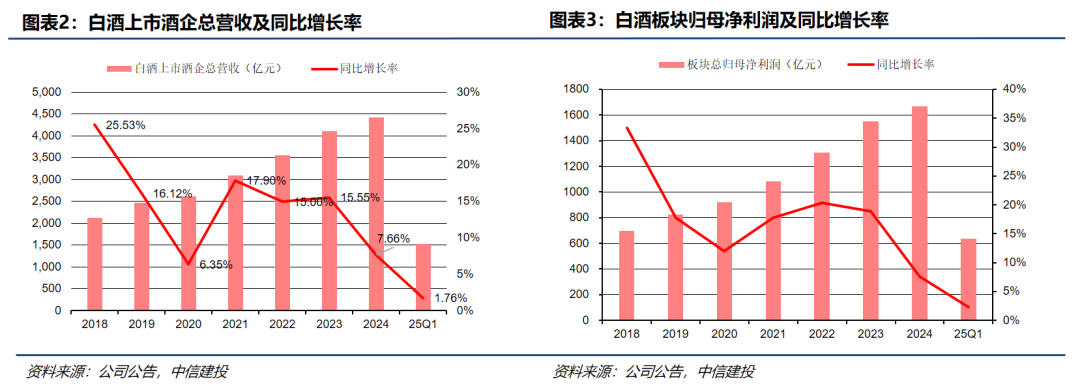
Group 1: Core Insights - The report from CITIC Securities highlights the importance of boosting consumption as a key driver for economic growth, with the food and beverage sector expected to benefit significantly from this focus on domestic demand [1] - The white liquor sector is projected to achieve total revenue of 441.94 billion yuan in 2024, representing a year-on-year growth of 7.66%, with net profit expected to reach 166.85 billion yuan, also up 7.60% [1] - The beer segment is showing signs of recovery, with sales and profit margins improving, indicating that it may have entered a growth phase [19] Group 2: Sector Analysis - **White Liquor**: The industry is currently facing a deep adjustment period, with sales pressures due to weak demand in gifting and banquet consumption, but leading companies are expected to strengthen their market positions through brand and operational advantages [1][6] - **Pre-processed Foods**: The sector is experiencing weak performance due to sluggish B-end restaurant demand, but is expected to benefit from a recovery in the C-end market, particularly in pre-prepared dishes [17] - **Dairy Products**: The dairy sector's revenue for 2024 is projected at 292.5 billion yuan, down 7.7% year-on-year, with net profit declining by 38.5% to 12.92 billion yuan [21][22] - **Snack Foods**: The sector is thriving, particularly with the popularity of konjac products, and companies are adapting to new retail formats like discount stores [24] - **Soft Drinks**: The functional beverage market continues to expand, with a notable increase in demand for sugar-free tea and functional drinks [26] - **Yellow Wine**: Leading companies in the yellow wine sector are expanding their advantages and driving the industry's high-end development [30]

食品饮料周报:政治局会议定调积极,看好饮料旺季催化-20250429
Tianfeng Securities· 2025-04-29 08:46
Investment Rating - The industry rating is "Outperform" (maintained rating) [5] Core Viewpoints - The report highlights a positive outlook for the beverage sector, driven by the upcoming peak season and supportive macroeconomic policies from the central government [2][12] - The report emphasizes the potential for valuation recovery in the liquor sector, particularly in light of the recent political bureau meeting that indicated a more proactive fiscal and monetary policy [2][12] Summary by Sections Market Performance Review - For the week of April 21 to April 25, the food and beverage sector declined by 1.36%, while the Shanghai Composite Index rose by 0.38%. Notable performances included snacks (+4.50%) and soft drinks (+2.21%), while categories like beer (-0.72%) and health products (-1.28%) saw declines [1][19] Weekly Perspective Updates - **Liquor Sector**: The liquor sector saw a decline of 1.75%, attributed to the off-peak consumption period and inventory adjustments. However, the upcoming May Day holiday is expected to boost demand for banquet scenarios, aiding in inventory reduction [2][12] - **Beer and Beverage Sector**: The beer sector decreased by 0.72%, but companies like Zhujiang Brewery saw a 5.7% increase in stock price due to better-than-expected Q1 performance. The report anticipates improved demand as the weather warms and consumption policies are implemented [3][13] - **Consumer Goods Sector**: The report identifies opportunities in the snack sector, with a focus on companies that have shown resilience and potential for growth. The upcoming sales season for soft drinks is also highlighted as a catalyst for growth [3][14] Investment Recommendations - **Liquor Sector**: Recommended stocks include strong alpha leaders like Moutai and Shanxi Fenjiu, as well as cyclical stocks like Luzhou Laojiao and Jiugui Liquor [4][18] - **Consumer Goods**: The report recommends focusing on snacks and dairy products, with specific mentions of companies like Ganyuan Foods and Yuyuan Foods, which are expected to benefit from low base effects in Q2 [4][18] Sector and Individual Stock Performance - The report provides detailed performance metrics for various sectors, indicating that the snack and soft drink sectors are currently outperforming others, while the liquor sector is under pressure [19][22]