
谷歌

Search documents
2025收官日美国股债双杀
Hua Er Jie Jian Wen· 2026-01-01 02:01
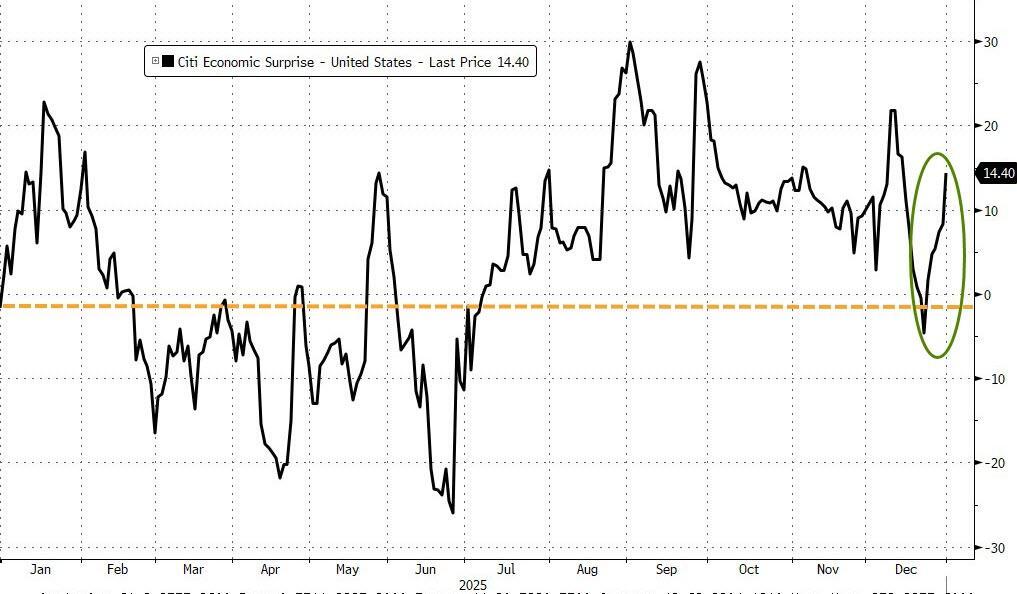
Market Overview - The U.S. stock market faced a setback at the end of 2025, with major indices unable to maintain upward momentum due to pressure from technology stocks, particularly the "Magnificent 7" [2][10] - Despite the challenges, the overall performance for the year remained positive, with the S&P 500, Dow Jones, and Nasdaq all achieving annual gains of over 10% [18][11][12][13] Economic Indicators - U.S. unemployment claims fell to 199,000, the lowest level since late November, indicating a resilient labor market and suggesting that the Federal Reserve may delay interest rate cuts [7][5] - The dollar index experienced a significant annual decline of over 9%, marking its largest yearly drop since 2017, influenced by expectations of future rate cuts by the Federal Reserve [40][42] Sector Performance - The technology sector, led by AI-related stocks, saw substantial gains in 2025, with the Nasdaq index rising over 20% for the year, although individual stocks like Nvidia underperformed compared to previous years [10][21] - Precious metals, including gold and silver, had a remarkable year, with gold rising over 60% and silver increasing by nearly 150%, marking their best annual performance since 1979 [47][48][53] Commodity Trends - Crude oil prices fell approximately 20% in 2025, attributed to the impact of tariffs and increased supply concerns, marking the largest annual decline in five years [55][54] - The performance of base metals was generally strong, with copper achieving a nearly 42% increase, the highest annual gain since 2009 [53] Cryptocurrency Market - Bitcoin experienced its largest annual decline in three years, while Ethereum also faced significant losses, reflecting a broader downturn in the cryptocurrency market [46][44]

华尔街见闻早餐FM-Radio|2026年1月1日
Sou Hu Cai Jing· 2025-12-31 23:52
Market Overview - In 2025, U.S. stock and bond markets faced declines, with major indices experiencing four consecutive days of losses. However, the tech sector supported the Nasdaq, which rose over 20% for the year, while Nvidia and Google saw annual gains of nearly 40% and 65%, respectively [1] - The U.S. unemployment claims fell to 199,000, nearing historical lows, while the dollar index rose to a one-week high despite an eight-year record annual decline [1][11] - The offshore RMB broke through 6.98, reaching a 15-month high, with an annual increase of over 3000 points, reversing three years of decline [1] - The cryptocurrency market saw significant declines, with Bitcoin dropping over 6% and Ethereum falling more than 10% for the year [1] - Precious metals experienced a significant annual increase, with gold and silver rising over 60% and nearly 150%, respectively, marking the largest annual gains since 1979 [1][3] A-Share Market - The Shanghai Composite Index closed at 3968.84 points, up 0.09%, while the Shenzhen Component Index fell 0.58% to 13525.02 points. The ChiNext Index dropped 1.23% to 3203.17 points [3] - The A-share market saw a strong performance in 2025, with the Shanghai Index gaining nearly 20% and the ChiNext Index soaring close to 50% [1] Commodity Market - The commodity market in 2025 displayed a historic divergence, with precious metals leading a bull market. Silver surged over 140%, while gold rose over 60%, marking the strongest performance since 1979 [14] - Copper prices increased over 40%, achieving the largest annual gain since 2009, while energy and agricultural products faced a bear market, with crude oil prices dropping over 15% [14] Regulatory Changes - The China Securities Regulatory Commission (CSRC) announced a reduction in public fund subscription fees and sales service fees, with no sales service fees for fund shares held for over a year [8] - The CSRC's measures aim to enhance investor protection and improve the investment environment [8] Manufacturing Sector - China's official manufacturing PMI for December was reported at 50.1, returning to the expansion zone, while the non-manufacturing PMI was at 50.2. This indicates a recovery in manufacturing and service sectors [9][10] - The increase in PMI is attributed to policy support, rising external demand, and a favorable seasonal effect due to the late timing of the Spring Festival [10] Technology Sector - OpenAI reported an average employee compensation of $1.5 million, setting a record in the tech industry, with stock compensation expected to increase significantly in the coming years [12] - The launch of the first personal robot by Upwind New Materials marks a strategic entry into the personal robotics market, showcasing advancements in technology [21]

华尔街见闻早餐FM-Radio | 2026年1月1日
Hua Er Jie Jian Wen· 2025-12-31 23:28
Market Overview - In 2025, U.S. stock and bond markets faced declines, with major indices experiencing four consecutive days of losses. However, the tech sector supported the Nasdaq, which rose over 20% for the year, while Nvidia and Google saw annual gains of nearly 40% and 65%, respectively [2] - The U.S. unemployment claims fell to 199,000, nearing historical lows, indicating a recovering job market [19] - The Chinese manufacturing PMI for December returned to the expansion zone at 50.1, while the non-manufacturing PMI was at 50.2, suggesting a slight improvement in economic activity [27] Commodity Market - Precious metals experienced significant volatility, with gold and silver prices rising over 60% and nearly 150% for the year, marking the largest annual gains since 1979 [2] - Crude oil prices fell approximately 20% in 2025, representing the largest annual decline in five years, with Brent crude also experiencing a three-year consecutive drop [2] - Copper prices increased over 40% for the year, achieving the highest annual gain since 2009 [2] Company and Industry Developments - OpenAI reported an average employee compensation of $1.5 million, setting a record in the tech industry [20] - Blue Arrow Aerospace's IPO has been accepted, aiming to become the first commercial rocket company listed in China, following a successful launch of its reusable rocket [29] - Chinese electric vehicle brands achieved a record market share of 12.8% in Europe, with significant sales increases for companies like BYD and Chery [29] Financial Regulations - The China Securities Regulatory Commission announced a reduction in public fund subscription fees and sales service fees, with no sales service fees for fund shares held for over a year [18]

新浪财经资讯AI速递:昨夜今晨财经热点一览 丨2026年1月1日
Xin Lang Cai Jing· 2025-12-31 23:18
Group 1: Corporate Developments - Warren Buffett officially retired as CEO of Berkshire Hathaway on December 31, 2025, at the age of 95, but will continue as chairman of the board and retain a significant stake in the company [6][7]. Group 2: Economic Policies and Market Trends - The National Development and Reform Commission of China is addressing issues related to the "old-for-new" consumption policy, focusing on five typical problems, and will implement three major measures to optimize the 2026 policy [8]. - The U.S. stock market indices recorded double-digit gains for three consecutive years, with the Dow Jones Industrial Average increasing nearly 13% in 2025, while the Nasdaq and S&P 500 rose over 20% and 16% respectively [9]. - The dollar index fell by 9.6% in 2025, marking its worst annual performance since 2017, primarily due to interest rate cuts by the Federal Reserve, trade protection policies, and concerns over U.S. debt and fiscal deficits [10]. - The North Exchange's 50 Index rose approximately 38.80% in 2025, with daily trading volume exceeding 32.9 billion yuan, doubling from 2024 [11]. - The Federal Reserve's internal policy disagreements intensified, with a recent decision to cut rates by 25 basis points facing the highest dissent since 2019, indicating ongoing debates about inflation and employment risks [12]. Group 3: Investment Insights - Two ordinary investors in Hangzhou achieved significant returns in 2025, with one investing 600,000 yuan in gold, benefiting from a price increase of over 70%, and another investing 200,000 yuan in a silver fund, realizing over 85% gains [13].
今夜!跳水了!
Zhong Guo Ji Jin Bao· 2025-12-31 16:20
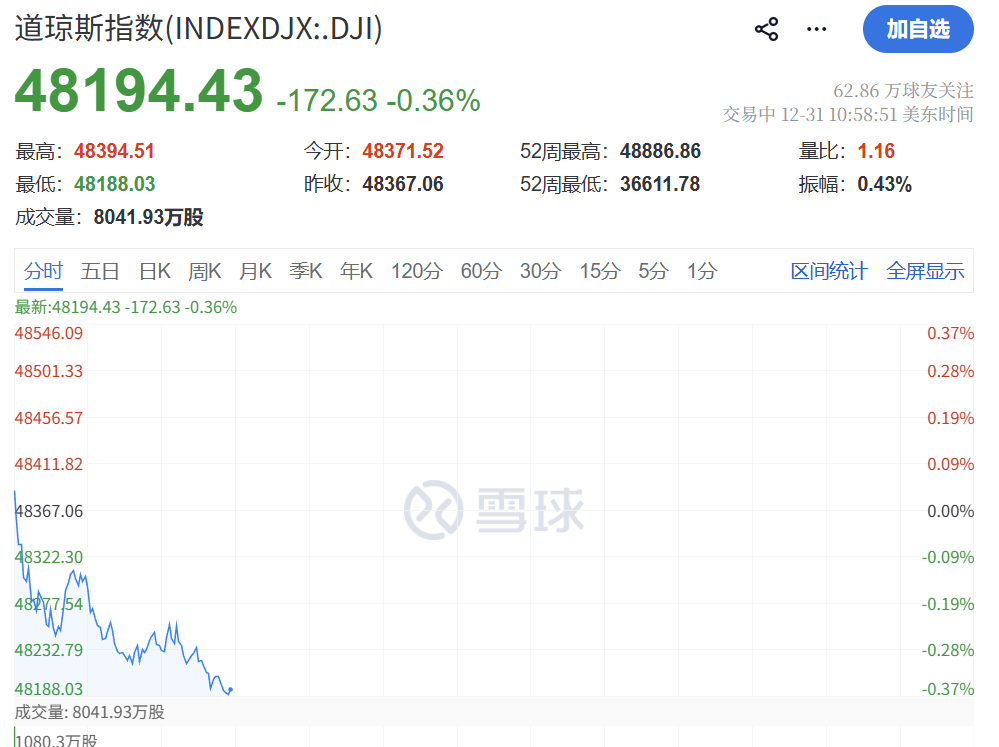
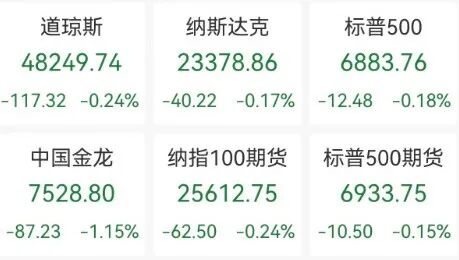
Group 1 - The US stock market experienced a slight decline on December 31, with the Dow Jones dropping nearly 200 points and the Nasdaq falling approximately 0.4% [2] - Chinese concept stocks saw a more significant drop, with the index declining by 1.4% [4] - Notable declines were observed in electric vehicle manufacturers, with NIO falling nearly 10% and other companies like Xpeng and Li Auto also experiencing significant losses [5][6] Group 2 - The anticipated year-end rally in the US stock market, often referred to as the "Santa Rally," has not materialized, attributed to traders delaying major decisions during the holiday season [9] - Despite a strong performance in 2023 driven by optimism around artificial intelligence, market volatility remains high due to concerns over trade policies and geopolitical tensions [9] - Analysts expect the S&P 500 index to achieve double-digit growth in 2026, but there are concerns about prolonged market fluctuations until corporate earnings catch up with high valuations [10]
美股全线转跌,中概股下挫,蔚来跌超8%,贵金属再跳水,巴菲特正式退休
2 1 Shi Ji Jing Ji Bao Dao· 2025-12-31 15:44
北京时间12月31日晚,美股三大指数小幅高开后全线转跌。 多只热门中概股下跌,纳斯达克中国金龙指数目前跌幅扩大至1%。蔚小理跌幅居前,分别跌8.2%、 5.9%和4.9%,百度、网易、新东方、阿里巴巴均跌超1%。上涨方面,联掌门户大涨超25%,灿谷涨超 4%。 | 名称 | 现价 | 涨跌幅 | | --- | --- | --- | | 蔚来 | 5.047 | -8.24% | | 小鹏汽车 | 20.020 | -5.92% | | 理想汽车 | 16.425 | -4.89% | | 博美 | 3.720 | -3.38% | | 水滴公司 | 1.827 | -3.32% | | EPSIUM ENTERPRISE | 2.080 | -2.80% | | ટેટ | 1.510 | -2.49% | | 小牛电动 | 3.090 | -2.22% | | 嘉银科技 | 5.830 | -2.18% | | 小赢科技 | 5.660 | -2.07% | 反弹仅一天,贵金属再度跳水,目前跌幅有所收窄。截至23:00左右: | 道琼斯 | 纳斯达克 | 标普500 | | --- | --- | -- ...

中美AI竞赛:界限日益模糊,下一战关键何在?
财富FORTUNE· 2025-12-31 13:06
Core Insights - The article discusses the current state and future prospects of AI investment, highlighting the presence of a potential bubble in the market, particularly in the valuation of AI companies with no revenue [2][3][13] - It emphasizes the shift from consumer-focused AI applications to business-oriented solutions, suggesting that this transition will lead to more stable revenue streams for AI companies [3][15] - The article also contrasts the AI landscapes in the US and China, noting the strengths and weaknesses of each in terms of technology, infrastructure, and user adoption [8][10] Group 1: AI Investment Landscape - The term "bubble" is prevalent among investors in Silicon Valley, with some AI model companies being valued at hundreds of millions despite having no revenue [2][3] - Oracle and CoreWeave have recently experienced significant market cap declines, reminiscent of past market downturns [2] - Zhang Lu expresses cautious optimism about the AI bubble, citing real industrial demand supporting AI innovations, unlike the 2000 internet bubble [3][15] Group 2: Technological Advancements - The AI infrastructure landscape is diversifying, with new chip architectures like TPUs and NPUs improving efficiency [4] - OpenAI has significantly reduced its token prices, indicating a trend towards cost-effective AI solutions [4] - Edge AI is advancing rapidly, with companies developing small models that can run locally on devices, enhancing data privacy [4][5] Group 3: Application Trends - Non-tech sectors in the US, such as healthcare and finance, are rapidly adopting AI, leading to a surge in startup activity and corporate acquisitions [6] - Major companies are increasingly acquiring startups, with Fusion Fund reporting five acquisitions this year, three of which were founded less than two years ago [6] - The integration of AI into business processes is expected to drive revenue growth as companies automate and optimize operations [15] Group 4: US-China Comparison - Despite Silicon Valley's lead in AI technology, the aging US power grid poses challenges for energy demands, prompting companies to build their own energy systems [8] - China has advantages in renewable energy infrastructure and a robust robotics supply chain, fostering a conducive environment for AI applications [8] - The willingness of US companies to collaborate with startups creates a unique ecosystem that supports innovation [19] Group 5: Investment Strategy - The company focuses on B2B AI projects, emphasizing the importance of market size and timing in investment decisions [18][28] - A significant portion of investments has seen revenue growth exceeding 20 times, reflecting the market's rapid embrace of AI [12] - The company maintains a cautious approach to valuations, avoiding overvalued projects and focusing on long-term growth potential [16][25] Group 6: Future Outlook - The article predicts that AI will increasingly integrate into various industries, with significant breakthroughs expected in the next three to five years [32] - The emergence of intelligent agents is anticipated, with coding agents already showing potential as a killer application [23] - The company believes that while AI may replace some jobs, it will also create new opportunities, leading to a reconfiguration of the labor market [31]
深圳创新四姐妹,2025年三大关键词
2 1 Shi Ji Jing Ji Bao Dao· 2025-12-31 13:03
Core Viewpoint - The rapid development of artificial intelligence (AI) is prompting a revaluation of technology assets globally, with Shenzhen emerging as a focal point for investors seeking opportunities in China. The city has produced several leading tech giants, referred to as the "Four Sisters" of innovation: Huawei, Tencent, Ping An, and BYD, all of which have market capitalizations exceeding 1 trillion yuan and revenues above 600 billion yuan, with Ping An surpassing 1 trillion yuan in revenue for 2024 [1][2][4]. Group 1: Value Reassessment - The "Four Sisters" have experienced a collective value reassessment, with stock prices and market capitalizations reaching new highs. Excluding Huawei, which is not publicly listed, Tencent, Ping An, and BYD have all recorded significant stock price increases this year, benefiting from the narrative of asset revaluation in China [4][5]. - As of December 29, the average stock price increase for the "Four Sisters" was 44.87%, outperforming the average increase of 27.95% for the "Magnificent Seven" in the U.S. [5][6]. - Ping An's stock price rose by 52.25%, Tencent by 44.29%, and BYD by 10.47% this year, with all three companies achieving new market capitalization highs [7][9]. Group 2: AI Development - The "Four Sisters" are heavily investing in AI, engaging in a talent acquisition race and increasing R&D expenditures to secure a competitive edge in AI technology. For instance, Tencent has recruited top AI talent, while Huawei has launched a global recruitment initiative for AI experts [11][12]. - R&D spending has surged, with Huawei's R&D expenses reaching 96.95 billion yuan, accounting for 22.7% of its revenue, and Tencent's R&D expenditure hitting 22.82 billion yuan, a 28% increase year-on-year [12][13]. - Each company has adopted a differentiated approach to AI: Huawei focuses on foundational technologies, Tencent aims to integrate AI into its social applications, Ping An emphasizes AI in financial and healthcare services, and BYD incorporates AI into smart transportation solutions [15][16]. Group 3: Global Influence and Expansion - The global influence of the "Four Sisters" has increased, as evidenced by their improved rankings in the 2025 Fortune Global 500 and Kantar BrandZ lists. Ping An ranked 13th, Huawei 24th, BYD 27th, and Tencent 32nd in the Fortune list [16][17]. - BYD has surpassed Tesla to become the world's top electric vehicle seller, with exports growing by 144% year-on-year [16][17]. - Tencent's international gaming revenue grew by 43% to 20.8 billion yuan, while its cloud business has maintained high double-digit growth, serving a significant portion of leading overseas internet and gaming companies [17][18].

希荻微拟3.1亿元收购诚芯微100%股份
Zhi Tong Cai Jing· 2025-12-31 12:52
Core Viewpoint - The company, Xidiwei (688173.SH), plans to acquire 100% of Shenzhen Chengxin Micro Technology Co., Ltd. for a cash price of 310 million yuan, enhancing its capabilities in the integrated circuit design sector [1] Group 1: Acquisition Details - The acquisition involves the purchase of shares from Cao Jianlin, Cao Songlin, and two management consulting partnerships, Chain Zhi Chuangxin and Hui Zhi Chuangxin [1] - The transaction price is set at 310 million yuan [1] Group 2: Company and Target Company Overview - Both the acquiring company and the target company are engaged in integrated circuit design, with the acquirer focusing on consumer electronics and automotive electronics [1] - The target company has strong technical capabilities in integrated circuit R&D, design, packaging, and testing, along with a robust sales team and extensive customer resources in various fields [1] Group 3: Strategic Benefits - The acquisition will allow the company to quickly absorb the target's mature patent technologies, R&D resources, sales channels, and customer base [1] - This strategic move is expected to expand the company's product categories, particularly in power management chips, motor chips, MOSFETs, and battery management chips, thereby providing more comprehensive solutions to downstream clients [1]

深圳创新四姐妹,2025年三大关键词
21世纪经济报道· 2025-12-31 12:50
Core Viewpoint - The rapid development of artificial intelligence (AI) is prompting a revaluation of technology assets globally, with Shenzhen emerging as a focal point for investors seeking opportunities in China. The city has produced several tech giants, referred to as the "Four Sisters" of innovation: Huawei, Tencent, China Ping An, and BYD, all of which have market capitalizations exceeding 1 trillion yuan and revenues above 600 billion yuan, with Ping An's revenue surpassing 1 trillion yuan in 2024 [1][2]. Group 1: Characteristics of the "Four Sisters" - The "Four Sisters" have experienced a collective revaluation, with stock prices and market capitalizations reaching new highs. Except for Huawei, which is not publicly listed, Tencent, Ping An, and BYD have all seen significant stock price increases this year, benefiting from the narrative of asset revaluation in China [3][4]. - The average stock price increase for the "Four Sisters" is 44.87% year-to-date, outperforming the average increase of 27.95% for the "Magnificent Seven" in the U.S. [4][5]. - Each of the "Four Sisters" has achieved record market capitalizations this year, with Tencent reaching a peak of 683 HKD per share and a market cap of 5.45 trillion HKD, while Ping An's market cap is around 1.3 trillion HKD [6][7]. Group 2: AI Investment and Strategy - The "Four Sisters" are heavily investing in AI, engaging in a talent acquisition race and increasing R&D expenditures. For instance, Huawei's R&D spending reached 96.95 billion yuan in the first half of the year, accounting for 22.7% of its revenue [8][9]. - Each company has a differentiated AI strategy: Huawei focuses on foundational technologies, Tencent integrates AI into its social applications, Ping An emphasizes AI in financial and healthcare services, and BYD incorporates AI into smart transportation solutions [12][13]. Group 3: Global Expansion and Influence - The global influence of the "Four Sisters" is on the rise, as evidenced by their improved rankings in the 2025 Fortune Global 500 and Kantar BrandZ lists. Ping An ranks 13th, Huawei 24th, BYD 27th, and Tencent 32nd [13][14]. - BYD has surpassed Tesla in global electric vehicle sales, exporting 878,000 units from January to November, a 144% increase year-on-year. Huawei operates in over 170 countries, while Tencent's international gaming revenue grew by 43% [14][15].
