
古茗

Search documents
4块9!茶饮企业掀咖啡价格战,古茗、茶百道击穿9块9底价
Nan Fang Du Shi Bao· 2025-09-18 11:13
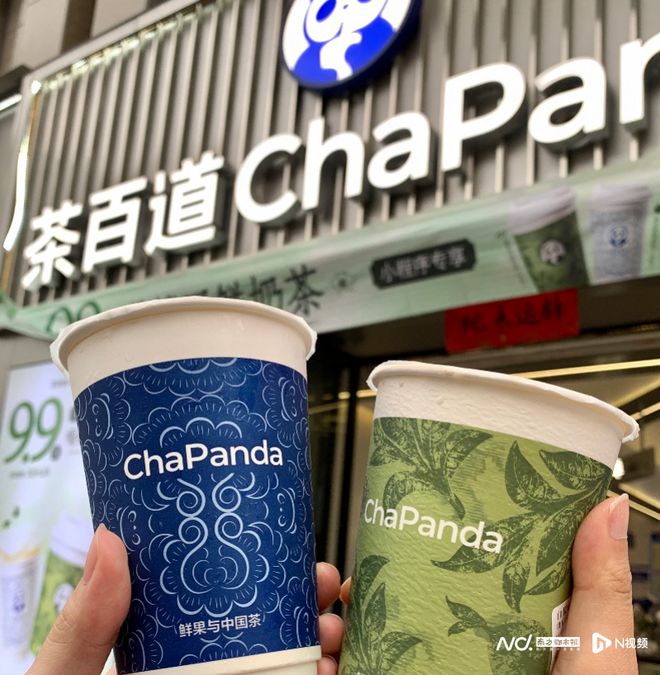
Core Viewpoint - The entry of tea beverage companies into the coffee market has intensified the price war, with prices for coffee products being significantly lowered, indicating a shift in consumer perception of coffee from a premium product to an everyday beverage [1][3][14] Group 1: Market Dynamics - Tea beverage companies like Cha Bai Dao and Gu Ming have launched coffee products at prices as low as 4.9 yuan, breaking the previous price floor of 9.9 yuan [1][3] - The coffee market is experiencing a price war as major brands adopt aggressive pricing strategies to capture market share [3][14] - The introduction of coffee by tea brands is seen as a response to declining profit margins in the tea beverage sector, with companies seeking new growth avenues [11][12] Group 2: Pricing Strategies - Cha Bai Dao's coffee products are priced at a minimum of 6.9 yuan, while Gu Ming offers coffee starting at 4.9 yuan, showcasing a significant reduction in prices [1][7] - The pricing strategies of both companies are supported by substantial promotional discounts, with Cha Bai Dao offering 19.1 billion yuan in limited-time coupons [4][12] - The competitive pricing is further enhanced by external factors such as delivery platform subsidies, making coffee even more accessible to consumers [13][14] Group 3: Industry Trends - The rapid expansion of coffee offerings by tea brands is part of a broader trend where companies are diversifying their product lines to include coffee, driven by the need to adapt to changing consumer preferences [11][12] - The coffee market in China is still growing, with per capita coffee consumption increasing from 7 cups five years ago to approximately 22 cups currently, indicating significant potential for further growth [12] - The entry of tea brands into the coffee market is expected to reshape consumer expectations and redefine the acceptable price range for coffee products [14][15]

海底捞才是星巴克的soulmate
3 6 Ke· 2025-09-18 09:17
Group 1: Starbucks China Business Sale - The sale of Starbucks' China business is nearing completion, with potential bidders including Boyu Capital, Carlyle Group, EQT, and Sequoia China, with a decision expected by the end of October [1] - The bidders are all financial investors, following the precedent set by McDonald's China sale, but local consumer giants may have better operational experience and financial strength [1] - The potential for local consumer giants, such as Alibaba, Meituan, Tencent, and Haidilao, to take over Starbucks China is highlighted, suggesting they could be more suitable buyers [1] Group 2: Haidilao's Position - Haidilao, despite being a hotpot chain, shares a similar business core with Starbucks as both operate social spaces rather than just food service [2] - Haidilao's recent business expansion efforts, including selling bread and launching community stores, indicate its evolution into a "startup incubator" [3] - The need for growth is pressing for Haidilao, as its revenue and net profit declined in the first half of 2025, with a revenue of 20.703 billion yuan, down 3.7% year-on-year [5] Group 3: Market Dynamics - The overall restaurant consumption market is experiencing a downturn, affecting high-ticket items like hotpot, while new tea drinks are thriving [6] - New tea drink brands have seen significant growth, with companies like Gu Ming and Mi Xue Ice City going public and achieving high stock price increases [6] - Haidilao's attempts to create new brands have not yet achieved significant scale, with other restaurant income only contributing 2.9% to total revenue [6] Group 4: Strategic Opportunities - The sale of Starbucks presents Haidilao with an opportunity to quickly enter the tea drink market, leveraging Starbucks' established brand and store network [12] - Haidilao's strengths in local innovation and commercial real estate negotiations could address Starbucks' current challenges, such as rising rental costs and competition [4] - The combination of Haidilao and Starbucks could enhance negotiation power in commercial real estate, potentially leading to better lease terms and store placements [15] Group 5: Challenges in Acquisition - The estimated valuation for Starbucks' China business is between $5 billion and $6 billion, which poses a significant financial challenge for Haidilao [16] - Haidilao would likely need to form a consortium with financial investors to complete the acquisition, complicating decision-making due to a fragmented ownership structure [17] - Starbucks' management desires to retain brand control while selling a majority stake, which may conflict with Haidilao's operational ambitions [17][18]

促服务消费措施出台,巩固板块信心
HTSC· 2025-09-17 06:32
Investment Rating - The report maintains a "Buy" rating for several companies in the service consumption sector, including Gu Ming, Mi Xue, Cha Bai Dao, Xiao Cai Yuan, Da Shi, and others [7][8]. Core Insights - The recent policy measures aimed at expanding service consumption are expected to boost the service sector, particularly in areas such as cultural tourism, IP consumption, and elderly care [1][2]. - The report highlights the potential for significant growth in China's service consumption, with the current contribution of service industry value added to GDP at 57%, compared to around 70% in developed countries, indicating room for expansion [1][2]. - The report emphasizes the importance of high-quality service supply and the integration of new technologies and business models to enhance the service sector [1][4]. Summary by Sections Policy Measures - The report outlines five key areas with 19 specific measures to promote service consumption, including the cultivation of service consumption platforms and the enhancement of high-quality service supply [3][4]. - Specific initiatives include optimizing cultural product offerings, extending operating hours for tourist attractions, and promoting long-term care insurance [3]. Market Performance - As of August 2025, retail and catering revenue reached 449.6 billion yuan, showing a year-on-year growth of 2.1%, indicating a recovery from previous lows [4]. - Domestic travel during the first half of 2025 saw 3.285 billion trips, a 20.6% increase year-on-year, with spending reaching 3.15 trillion yuan, up 15.2% [4]. Company Recommendations - The report suggests focusing on leading companies with growth potential and strong market positions, such as Gu Ming, Mi Xue, and others, which are expected to benefit from policy support and industry consolidation [5][8]. - Specific companies highlighted for their growth potential include Gu Ming (1364 HK), Mi Xue Group (2097 HK), and others, with target prices set for each [8][12]. Financial Performance - Gu Ming reported a 34.4% year-on-year increase in GMV to 14.1 billion yuan in the first half of 2025, with a net profit of 1.625 billion yuan, reflecting a 121.5% increase [13]. - Mi Xue Group's revenue for the first half of 2025 was 14.87 billion yuan, a 39.3% increase year-on-year, with a net profit of 2.69 billion yuan, up 42.9% [15]. Growth Outlook - The report anticipates that as the new measures are implemented, the service sector will experience a surge in high-quality supply and innovative business models, driving domestic demand growth [4][5].




六大新茶饮巨头半年“捞金”超55亿,靠外卖撑起“半边天”?
Xin Lang Cai Jing· 2025-09-16 08:20
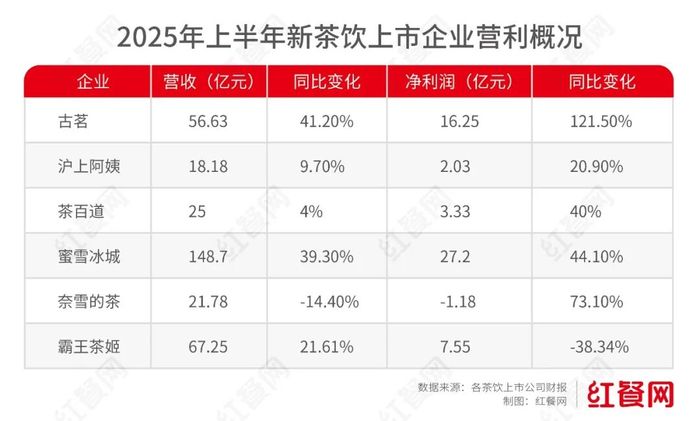
Group 1 - The core viewpoint of the article highlights the strong performance of major tea beverage brands in the first half of 2025, with total revenue exceeding 33 billion yuan and net profits surpassing 5.5 billion yuan despite a challenging market environment [1][2] - Six major tea brands reported significant revenue growth, with Mixue Ice City achieving 14.87 billion yuan in revenue and 2.72 billion yuan in net profit, reflecting year-on-year increases of 39.3% and 44.1% respectively [2][3] - The takeaway from the performance indicates that delivery services have become a crucial driver for revenue growth among tea brands, with platforms like JD.com reporting over 100 million orders for brands like Mixue Ice City within four months of launching [5][6] Group 2 - The industry is witnessing a trend of closing unprofitable stores, with over 2,500 franchise locations shut down by leading tea brands in the first half of the year, as companies shift focus from expansion to improving profitability [9][11] - Companies like Nayuki Tea and Guming have adopted strategies to enhance operational efficiency by closing underperforming stores while focusing on direct-operated models, resulting in improved sales performance [11][12] - The strategy of targeting lower-tier markets remains a priority, with brands like Guming increasing their store presence in second-tier and below cities, which now account for 81% of their total stores [12][13] Group 3 - Major tea brands are diversifying their product offerings, with coffee becoming a common strategic choice, as seen with Guming and others integrating coffee into their existing store formats [13][15] - Nayuki Tea has launched a new light food and beverage concept, expanding its product range to include healthy options and all-day dining, thereby broadening its consumer appeal [18] - The exploration of new store formats and product lines is seen as a key strategy for brands to capture additional market share and adapt to varying consumer needs across different city tiers [17][18]
外卖补贴大战埋下隐忧?新茶饮留客出新招
Zheng Quan Shi Bao Wang· 2025-09-16 05:05
Core Insights - The takeaway from the article is that while the recent food delivery subsidy war has led to short-term sales growth for new tea beverage brands, it has also created long-term concerns regarding pricing dependency and profitability for franchisees [1][5][6]. Group 1: Impact of Delivery Subsidies - Brands actively participating in the subsidy war have seen significant short-term sales increases, with companies like Mixue Group reporting a revenue of 14.875 billion yuan, a year-on-year growth of 39.3% [2]. - The average single-store sales revenue for Mixue Group reached 278,000 yuan, up 13.2% year-on-year, benefiting from the increased order volume due to the subsidy war [2]. - Other companies like Nayuki Tea reported that third-party delivery platforms contributed approximately 44.2% to their direct store revenue, with a year-on-year increase in delivery revenue of 7.5% [2]. Group 2: Concerns and Challenges - The subsidy war has led to a "price dependency" among consumers, which could disrupt the pricing structure of brands in the long run [1][5][6]. - Franchisees are facing a dilemma where they must share the costs of subsidies, leading to a situation where revenue increases do not translate into profit, thus affecting long-term stability [1][6]. - Companies like Bawang Chaji, which chose not to participate in the subsidy war, reported a significant decline in single-store performance, with a 25% year-on-year drop in average monthly GMV [3][7]. Group 3: Strategic Responses - As subsidies are expected to decrease, leading brands are focusing on product differentiation and optimizing store operations to retain consumers [1][8]. - Companies are increasing their investment in product innovation and digital tools to enhance operational efficiency and reduce costs [8][9]. - Bawang Chaji plans to introduce a new menu and automation equipment to improve operational efficiency and reduce labor costs by the end of the year [9].
文轩指数| 2025上半年上市新茶饮企业活力排名
Sou Hu Cai Jing· 2025-09-16 04:54
Core Insights - The new tea beverage industry is experiencing significant growth, with six listed companies reporting total revenue exceeding 33 billion yuan and profits over 5 billion yuan in the first half of the year [2] - The competitive landscape is shifting due to aggressive price wars on delivery platforms, impacting the market dynamics of new tea beverages [2] - The performance of listed companies varies widely, indicating a divergence in market vitality and operational strategies [2][9] Group 1: Industry Performance - In the first half of 2025, six listed new tea beverage companies achieved a total revenue of over 33 billion yuan, with profits exceeding 5 billion yuan, reflecting ongoing industry growth [2] - The competitive environment has intensified, with major platforms like Meituan, JD, and Ele.me engaging in subsidy wars, leading to a test of supply chain resilience and brand loyalty among new tea companies [2] - The market is transitioning from rapid expansion to a focus on quality and efficiency, as companies adapt to changing consumer preferences and competitive pressures [9] Group 2: Company Rankings and Financials - The vitality ranking of listed new tea beverage companies for the first half of 2025 shows that Mixue Ice City leads with a revenue of 14.875 billion yuan, a 139.3% increase, and a net profit of 2.718 billion yuan, up 144.1% [3] - Other notable companies include Guo Mei with 5.663 billion yuan in revenue (up 141.2%) and Hu Shang A Yi with 1.818 billion yuan (up 19.7%) [3] - Naixue's Tea reported a revenue decline of 14.4% to 2.178 billion yuan, with a significant net loss reduction of 73.1% to 118 million yuan, indicating ongoing challenges despite operational adjustments [15] Group 3: Market Dynamics and Strategic Shifts - The new tea beverage sector is witnessing a shift from aggressive store expansion to a more measured approach, with companies like Guo Mei slowing their growth rate while focusing on product development and marketing [10] - Mixue Ice City continues to expand rapidly, adding nearly 9,796 stores in the first half of the year, while Cha Bai Dao has significantly slowed its growth, adding only 59 stores [12] - The competitive landscape is increasingly characterized by a divide between strong and weak players, with predictions of a more pronounced market consolidation by 2025 [15]

瑞幸×崩铁: 买够周边要花近四百,预存十杯须15天喝完被吐槽
Xin Jing Bao· 2025-09-16 04:00
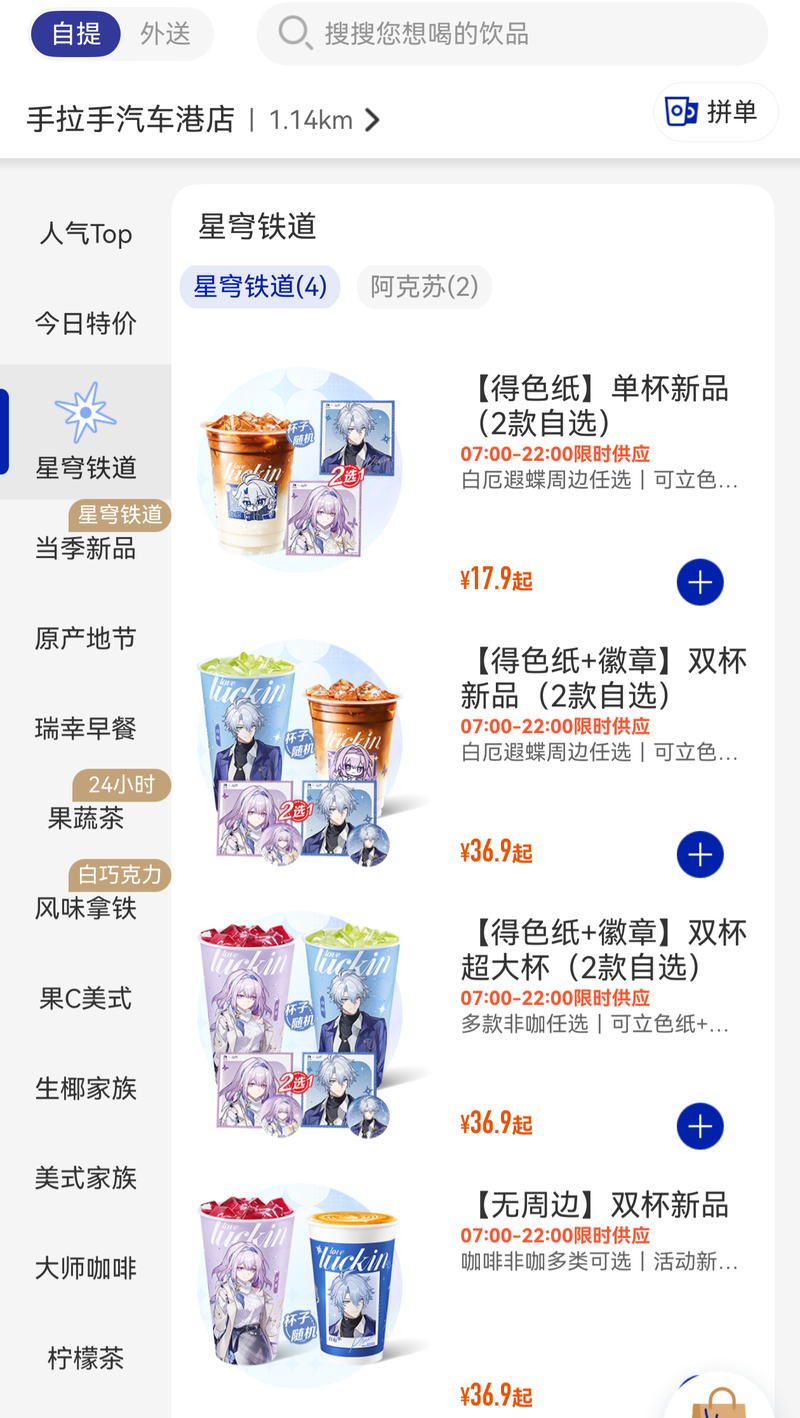
Core Viewpoint - Luckin Coffee has launched a collaboration with the game "Honkai: Star Rail," offering exclusive merchandise to consumers who purchase specific drink packages, raising questions about the appropriateness of such marketing strategies targeting underage fans [1][5][14]. Group 1: Collaboration Details - The collaboration consists of two phases, starting on September 15 and September 22, featuring popular characters "Xia Die" and "Bai E" from the game [1][4]. - Consumers can obtain merchandise such as acrylic stands, badges, and themed cups by purchasing drink packages, with a total cost of approximately 384.2 yuan required to collect all items [5][12]. Group 2: Consumer Reactions - Many consumers have expressed dissatisfaction with the high cost of obtaining the merchandise, particularly criticizing the marketing strategy as being exploitative towards underage fans [5][12]. - Parents have reported feeling pressured to assist their children in acquiring the merchandise, indicating a significant demand among younger demographics [5][12]. Group 3: Sales and Marketing Insights - Luckin Coffee's sales and marketing expenses have increased significantly, with first-quarter expenses rising by 52.4% year-over-year, attributed to higher advertising and promotional costs [15]. - The company has expanded its store count to 26,206, reflecting an 8.8% increase compared to the previous year, indicating robust growth in its operational footprint [15]. Group 4: Market Context - The game "Honkai: Star Rail" boasts a large player base of 50 million monthly active users, with over 60% of users aged 18-24, highlighting the potential market for such collaborations [14]. - Previous collaborations in the beverage sector, such as with the tea brand Gu Ming, have resulted in overwhelming consumer interest, leading to significant sales spikes and even system overloads on launch days [13][14].

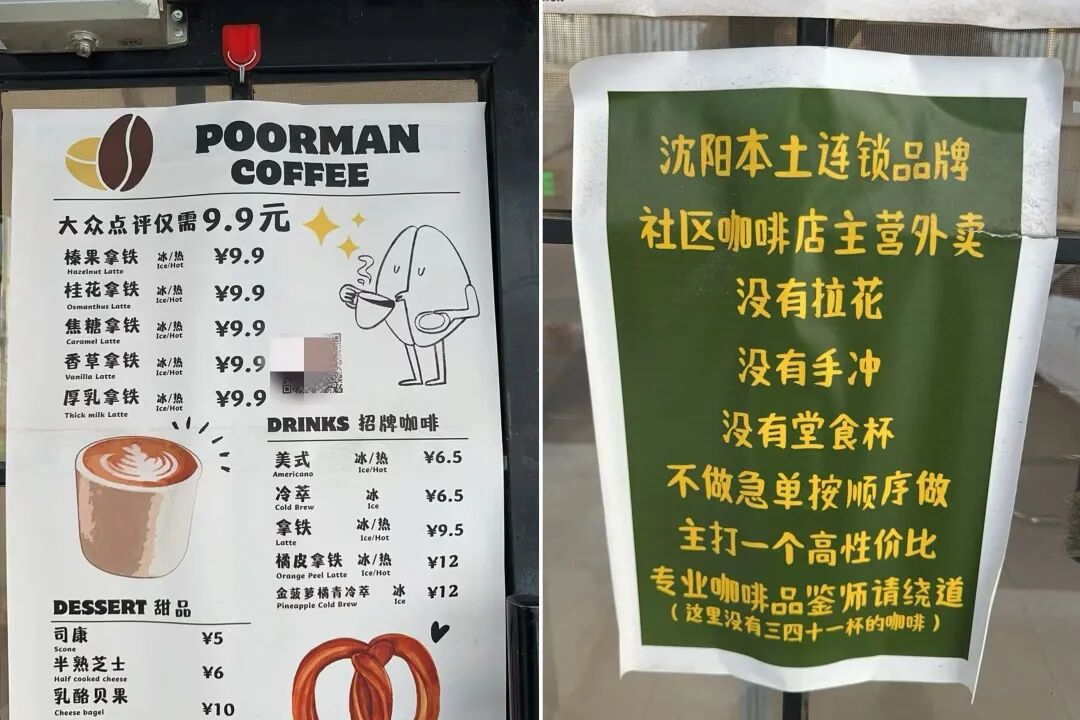
东北版Manner火了,最高日出千杯,主打“不骗穷人”
3 6 Ke· 2025-09-16 02:10
Core Insights - The article discusses the emergence of low-priced coffee brands in China, particularly focusing on "Poor Man Coffee" in Shenyang and "W Coffee" in Zhanjiang, which have gained popularity for their affordability and high sales volume [1][2][8]. Group 1: Business Model and Strategy - "Poor Man Coffee" offers coffee at an average price below 10 yuan, with a daily sales volume exceeding 500 cups and a repurchase rate close to 50% [1][6]. - The brand emphasizes simplicity, avoiding complex coffee-making techniques and targeting cost-conscious consumers, as indicated by their slogan "good coffee, not expensive" [4][2]. - The menu includes over 60 products, with the lowest-priced Americano at 6.5 yuan per cup, allowing customers to enjoy a meal and drink for under 10 yuan [4][6]. Group 2: Market Position and Performance - "Poor Man Coffee" has opened 21 stores, with daily revenues ranging from 2,000 to 8,000 yuan, and all locations are profitable due to low rent and renovation costs [6][19]. - The brand's founder noted that over 70% of orders come from delivery services, highlighting the importance of this channel in their business model [6][19]. - "W Coffee" in Zhanjiang, despite its humble appearance, has also achieved high customer traffic, demonstrating the viability of low-cost coffee shops in less affluent areas [8][12]. Group 3: Industry Trends - The coffee market in China is experiencing a price war, with prices dropping below 10 yuan, which is attracting a broader consumer base and increasing purchase frequency [17][15]. - The success of low-priced coffee brands indicates a shift in consumer preferences towards value and taste over brand prestige, suggesting a potential for new entrants in the market [17][19]. - The article suggests that the current environment is favorable for individual entrepreneurs looking to establish small coffee shops, as demonstrated by the success of "Poor Man Coffee" and similar brands [19].
外卖补贴退坡 新茶饮如何留住消费者?
Zheng Quan Shi Bao· 2025-09-15 22:33
Core Insights - The takeaway from the recent news is that the takeaway subsidy war has significantly impacted the new tea beverage industry, with both positive short-term sales growth for participating brands and long-term concerns regarding pricing and profitability [1][5][8] Group 1: Impact of Subsidy War - Brands actively participating in the subsidy war have seen a notable increase in sales, while those not participating have experienced a decline in same-store data [1][2] - For instance, Mixue Group reported a revenue of 14.875 billion yuan, a year-on-year increase of 39.3%, with net profit rising 44.1% to 2.718 billion yuan, leading the industry [2] - Naixue's Tea indicated that third-party delivery platforms contributed approximately 44.2% to direct store revenue, with a year-on-year increase in delivery revenue of 7.5% [2] Group 2: Concerns and Challenges - The subsidy war has raised concerns about long-term sustainability, as it may lead to consumer price dependency and affect the pricing structure of brands [1][5][6] - Companies like Bawang Chaji, which chose not to participate in the subsidy war, reported a significant decline in same-store performance, with a 25% drop in average monthly GMV [3][7] - The pressure on franchisees to share subsidy costs has created a situation where increased revenue does not translate into increased profits, leading to operational challenges [5][6] Group 3: Future Strategies - As the subsidy war cools down, brands are focusing on product innovation and operational efficiency to retain consumers and stabilize pricing [8][9] - Companies are investing in new product development, with Tea Baidao reporting that new product sales accounted for 28% of total sales in the second quarter [8] - The industry is shifting from rapid expansion to quality improvement, with a focus on optimizing store models and controlling costs for sustainable growth [9]
外卖补贴退坡新茶饮如何留住消费者?
Zheng Quan Shi Bao· 2025-09-15 18:34
Core Insights - The takeaway from the recent news is that the takeaway subsidy war has significantly impacted the new tea beverage industry, with both positive short-term sales growth for participating brands and long-term concerns regarding pricing and profitability for franchisees [1][5][6]. Group 1: Impact of Subsidy War - Brands actively participating in the subsidy war have seen a notable increase in sales, while those not participating have experienced a decline in same-store performance [1][2]. - For instance, Mixue Group reported a revenue of 14.875 billion yuan, a year-on-year increase of 39.3%, with net profit rising 44.1% to 2.718 billion yuan, leading the industry [2]. - Naixue's Tea indicated that third-party delivery platforms contributed approximately 44.2% to direct store revenue, with a year-on-year increase in delivery revenue of 7.5% [2]. Group 2: Concerns and Challenges - The subsidy war has raised concerns about consumer price sensitivity, leading to a potential dependency on discounts, which could harm brand pricing structures in the long run [5][6]. - Franchisees face challenges as they must share the burden of subsidy costs, leading to a situation where revenue increases do not translate into profit [5][6]. - Companies like Bawang Chaji, which chose not to participate in the subsidy war, reported a significant decline in same-store performance, with a 25% drop in average monthly GMV per store in the Greater China region [3][7]. Group 3: Future Strategies - As the subsidy war cools down, brands are focusing on product innovation and operational efficiency to retain consumers and stabilize pricing [8][9]. - Companies are increasing their R&D efforts to launch differentiated products and leveraging digital tools to optimize operations and reduce costs [8][9]. - For example, Bawang Chaji plans to introduce a new menu and automation equipment to enhance operational efficiency and reduce labor costs [9].