
洽洽食品

Search documents
各大品牌,患上山姆依赖症?丨消费参考
2 1 Shi Ji Jing Ji Bao Dao· 2025-07-15 00:53
Group 1: Sam's Club Controversy - Sam's Club faces backlash from members due to the introduction of "Holly Friend Pie," which has led to dissatisfaction over recent product adjustments [1] - The selection strategy has shifted, with popular items being removed while new products from brands like Holly Friend, Wei Long, and Xu Fu Ji are added [1][2] - Quality control issues have compounded the controversy, as consumers express concerns over the taste of new products [1] Group 2: Strategic Importance of Sam's Club - Sam's Club has become a significant revenue source for Walmart, with net sales in China reaching $6.7 billion (approximately 48.02 billion RMB), a year-on-year increase of 22.5% [2] - Comparable sales grew by 16.8%, and e-commerce sales surged by 34%, indicating strong growth momentum for Sam's Club and its online business [2] - Over the past 12 months, Sam's Club has opened 7 new stores, highlighting its role as a rare growth channel amid market fluctuations [2] Group 3: Brand Dynamics with Sam's Club - Brands are increasingly reliant on Sam's Club's supply chain and quality control, which gives Sam's Club significant influence over product offerings [3] - There is a risk for brands to become mere outsourcing partners, losing pricing power as they collaborate exclusively with Sam's Club [3] - However, some brands assert they maintain a degree of control in partnerships, leveraging insights from social media platforms for consumer understanding [4][5] Group 4: Market Performance Indicators - The Shanghai Consumer 80 Index closed at 4756.53 points, with a gain of 0.44% on July 14 [7]
洽洽食品(002557) - 2025 Q2 - 季度业绩预告
2025-07-14 09:10
[ChaCha Food Co., Ltd. 2025 Semi-Annual Performance Forecast](index=1&type=section&id=ChaCha%20Food%20Co.%2C%20Ltd.%202025%20Semi-Annual%20Performance%20Forecast) ChaCha Food Co., Ltd. provides its 2025 semi-annual performance forecast, anticipating a significant decline in net profit primarily due to increased raw material costs [Core Performance Forecast Data](index=1&type=section&id=II.%20Performance%20Forecast%20Overview) The company anticipates a significant year-over-year decline in its 2025 first-half performance, with net profit attributable to shareholders projected to be between 80 million and 97.5 million Yuan, a decrease of 71.05% to 76.25%, and non-recurring net profit expected to fall by 79.85% to 85.86% Key Performance Indicators for 2025 Semi-Annual Performance Forecast | Item | Current Period Forecast (Jan 1 - Jun 30, 2025) | Prior Period (Same Period Last Year) | | :--- | :--- | :--- | | **Net Profit Attributable to Shareholders** | Profit: 80.00 million – 97.50 million Yuan | Profit: 336.81 million Yuan | | Year-over-Year Change | **Decline: 71.05% - 76.25%** | - | | **Net Profit After Non-Recurring Items** | Profit: 40.00 million - 57.00 million Yuan | Profit: 282.86 million Yuan | | Year-over-Year Change | **Decline: 79.85% - 85.86%** | - | | **Basic Earnings Per Share** | Profit: 0.158 - 0.192 Yuan/share | Profit: 0.663 Yuan/share | [Analysis of Performance Change Reasons](index=1&type=section&id=IV.%20Explanation%20of%20Performance%20Change) The company attributes the significant decline in 2025 first-half net profit primarily to a substantial increase in raw material procurement prices, which directly eroded the company's gross profit margin - The company explicitly states that the primary reason for the year-over-year decline in net profit is a significant increase in raw material procurement prices, leading to a substantial decrease in gross profit margin[3](index=3&type=chunk) [Other Explanations and Risk Warnings](index=1&type=section&id=III.%20Communication%20with%20Accounting%20Firm) The company emphasizes that this performance forecast is based on preliminary financial department calculations and has not been audited by a certified public accountant, advising investors that final accurate financial data will be subject to the official 2025 semi-annual report and to exercise caution regarding investment risks - This performance forecast represents preliminary data from the company's finance department and has not been pre-audited by a certified public accountant[3](index=3&type=chunk) - The company reminds investors that specific financial data will be based on the 2025 semi-annual report to be disclosed by the company, and investment decisions should be made with caution[3](index=3&type=chunk)[4](index=4&type=chunk)

洽洽食品:预计2025年上半年净利润同比下降71.05%-76.25%
news flash· 2025-07-14 09:08
洽洽食品:预计2025年上半年净利润同比下降71.05%-76.25% 金十数据7月14日讯,洽洽食品公告,预计2025年1月1日至2025年6月30日归属于上市公司股东的净利润 为8000万元–9750万元,比上年同期下降71.05%-76.25%。 ...
可选消费W28周度趋势解析:临近业绩披露期,基于预期差股价波动加剧-20250713
Haitong Securities International· 2025-07-13 14:45
Investment Rating - The report assigns an "Outperform" rating to multiple companies including Nike, Midea Group, JD Group, Gree Electric, Anta Sports, Haier Smart Home, and others, while Lulu Lemon is rated as "Neutral" [1]. Core Insights - The report highlights that as the earnings season approaches, stock price volatility is expected to increase due to expectation gaps [4][21]. - The gambling sector has shown strong performance, driven by higher-than-expected visitor numbers in Macau, leading to upward revisions in market expectations for monthly GGR and EBITDA [5][12]. - The report notes that most sectors are currently valued below their historical averages over the past five years, indicating potential investment opportunities [8][16]. Sector Performance Review - Weekly performance rankings show Gambling > Luxury Goods > U.S. Hotel > Domestic Sportswear > Domestic Cosmetics > Daily Necessities > Overseas Sportswear > Overseas Cosmetics > Credit Card > Snacks > Gold Jewelry > Pet, with the Gambling sector outperforming the MSCI China index [10][21]. - Monthly performance also favors the Gambling sector, followed by U.S. Hotel and Luxury Goods, while Domestic Cosmetics and Pet sectors experienced negative growth [22]. - Year-to-date performance indicates Gold Jewelry leading, followed by Domestic Cosmetics and Overseas Cosmetics, with the Overseas Sportswear sector showing negative growth [23]. Valuation Analysis - The report provides a detailed valuation analysis, indicating that many sectors, including Overseas Sportswear and Domestic Sportswear, are trading below their historical PE averages, suggesting potential upside [8][16]. - Specific expected PE ratios for 2025 are provided, with Overseas Sportswear at 34.4x (55% of its 5-year average), Domestic Sportswear at 12.6x (72%), and Gambling at 17.6x (26%) [16].
2025年中国开心果行业市场政策、产业链图谱、供需现状、进出口贸易、竞争格局及发展趋势研判:线上销售渠道占比逐年攀升,达38.3%[图]
Chan Ye Xin Xi Wang· 2025-07-10 01:52
Overview - The demand for pistachios in China is increasing due to rising living standards and changing consumer preferences towards healthy snacks. In 2024, the demand for pistachios is projected to reach 235,100 tons, with a market size of 22.711 billion yuan, while the domestic production is only 81,100 tons, necessitating significant imports each year [1][10]. Market Policy - China has implemented a series of stringent food safety policies to regulate the production of pistachios, ensuring product quality and promoting the industry's development towards standardization and high quality. Key policies include guidelines for traditional food production, food safety assessment methods, and measures to enhance food enterprise standard management [4][6]. Industry Chain - The pistachio industry chain includes upstream cultivation, processing equipment, flavoring, and packaging materials. The main cultivation areas are in Xinjiang and Gansu, where the climate is suitable for pistachio growth. Due to insufficient domestic production, China heavily relies on imports. The midstream involves processing, while the downstream includes sales channels such as supermarkets, convenience stores, and e-commerce platforms [8][10]. Development Status - The market for pistachios is experiencing continuous growth, with a projected import volume of 133,700 tons and an import value of approximately 86.9 million USD in 2024. The average import price is 6.50 USD per kilogram, with major suppliers being the United States, Iran, Australia, and Turkey [12][10]. Competitive Landscape - The pistachio industry in China is characterized by a fragmented competitive landscape with numerous participants. Key players include Three Squirrels, Qiaqia Food, and Good Products, among others, with operations spread across various provinces [14][16]. Company Analysis - Three Squirrels has achieved significant sales, with total revenue reaching 10.62 billion yuan in 2024, of which the nut business accounted for 5.366 billion yuan, representing 50.5% of total revenue [16]. Good Products, established in 2006, reported total revenue of 7.159 billion yuan in 2024, with the nut business contributing 1.138 billion yuan, or 15.9% of total revenue [18]. Development Trends - The future demand for pistachios is expected to grow as consumer health awareness increases, leading to a shift towards low-fat, high-protein, and nutrient-rich products. Companies are likely to invest in product diversification and innovation, including new flavors and functional products, as well as deep-processing products like pistachio butter and oil [20].




齐云山食品赴港上市:品类天花板下估值瓶颈难破 量贩零食驱动增长成色几何?
Xin Lang Zheng Quan· 2025-07-09 08:45
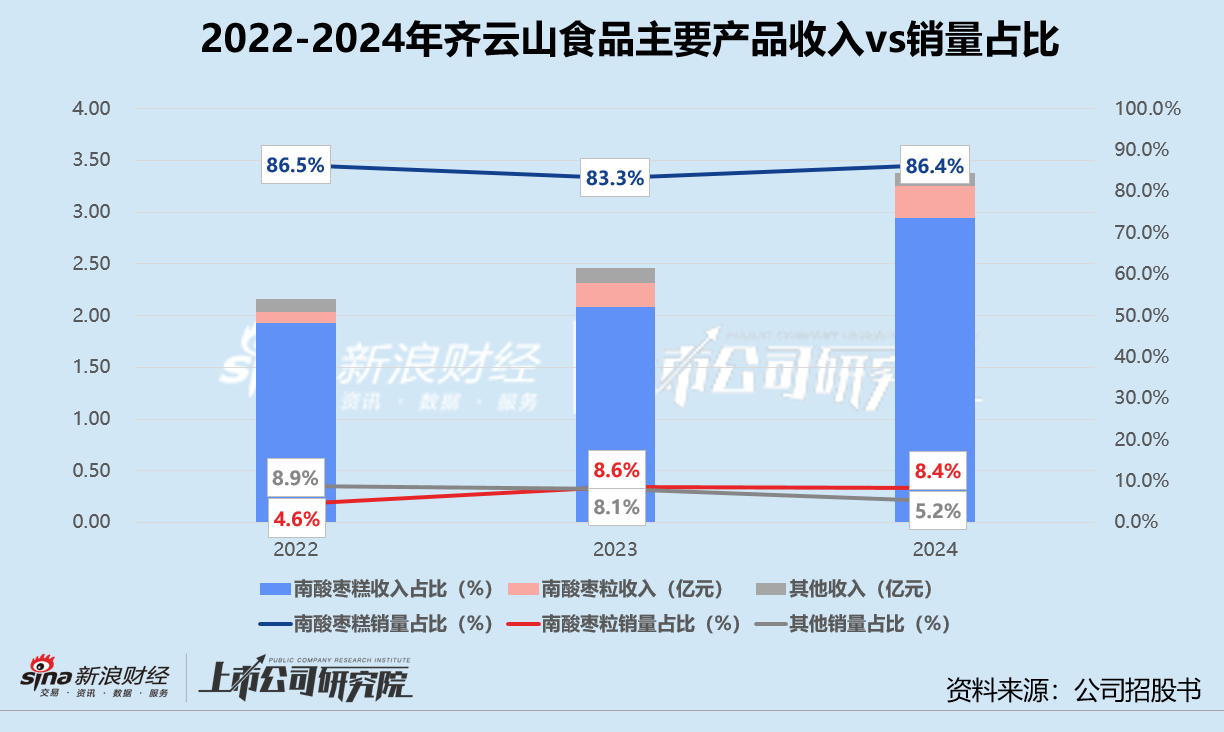
Core Viewpoint - The snack company Qiyunshan Food Co., Ltd. is set to go public on the Hong Kong Stock Exchange, following the footsteps of other snack companies, but faces challenges due to its limited market share and product diversity [1][5]. Financial Performance - Qiyunshan Food's revenue for 2022-2024 is projected to be CNY 217 million, CNY 247 million, and CNY 339 million, with net profits of CNY 25.6 million, CNY 23.7 million, and CNY 53.2 million respectively [1]. - The company's flagship product, the South Jujube Cake, accounts for approximately 86.5% of total sales in 2022, with sales volumes of 4,677.7 tons, 5,160.2 tons, and 7,485.8 tons for the years 2022-2024 [2]. Market Position - Qiyunshan Food holds a market share of about 0.63% in the fruit snack sector, significantly lower than competitors like Liuliu Fruit Garden, which has a market share of 2.61% [1]. - The overall snack market in China is expected to grow from CNY 1,344 billion in 2024 to CNY 1,755.8 billion by 2029, with the fruit snack market growing at a rate of 8.7% [5]. Product and Sales Channels - The company relies heavily on its main product, the South Jujube Cake, which contributes 88.7% to total revenue in 2022 [2]. - Offline sales through distributors account for 86.2% of total revenue in 2022, with a significant increase in revenue from major clients [6][8]. Regional Sales - Approximately one-third of Qiyunshan Food's revenue comes from its home province of Jiangxi, with neighboring provinces contributing significantly to sales growth [4]. - The company has limited geographical reach, with no presence in major northern cities [4]. Pricing and Profitability - The average selling price of the South Jujube Cake has decreased from CNY 41.2 per kg in 2022 to CNY 39.3 per kg in 2024, while procurement costs have risen [8]. - The overall gross margin for the company has declined to 48.6% in 2024, indicating pressure on profitability [8]. Management and Shareholder Structure - The core management team, consisting of six individuals, controls approximately 68.67% of Qiyunshan Food's shares and has received significant dividends, amounting to over CNY 30 million [9].
2025Q2线下零售速报
3 6 Ke· 2025-07-08 08:17
Overall Summary - The offline retail consumption situation for Q2 2025 shows a general decline in sales across major categories such as food, beverages, alcohol, and daily chemicals, although the rate of decline has narrowed compared to previous quarters [2][4][6]. Group 1: Retail Performance Overview - The analysis is based on data from the "Shangma Ying Brand CT," which monitors offline retail across various city levels and includes over 30,000 brands and 14 million product barcodes [2]. - The overall sales revenue for Q2 2025 is down approximately 7% year-on-year, with a better performance in order volume compared to average spending, indicating consumer pressure on budgets and prices [4][6]. - The price index for food, beverages, alcohol, and daily chemicals shows a gradual recovery, but remains under pressure, with most categories below the baseline index of 100 [4][6]. Group 2: Key Category Insights - In the food category, frozen products like frozen sausages have shown significant market share growth, while dairy products are stabilizing after previous declines [13][22]. - The beverage category has seen strong growth in sports and plant-based drinks, with some products exceeding 30% year-on-year growth, although the overall market remains competitive [17][29]. - The snack category is experiencing a decline in market share due to health trends and new retail formats, with significant drops in sales for various subcategories [14][22]. Group 3: Consumer Behavior and Trends - The average spending per order has increased for certain categories like ready-to-drink juices and plant-based beverages, indicating a shift in consumer preferences towards higher-quality products [34][35]. - The average purchase quantity per order has decreased across all selected categories, suggesting a trend towards larger packaging or a focus on value [40]. - The competitive landscape is intensifying, particularly in the frozen food and beverage sectors, with numerous brands vying for market share [46][47].


喜茶纤体瓶杀进山姆,从“被嫌弃”到品牌疯抢,食品圈都在赌下一个超级食材?
3 6 Ke· 2025-07-08 03:25
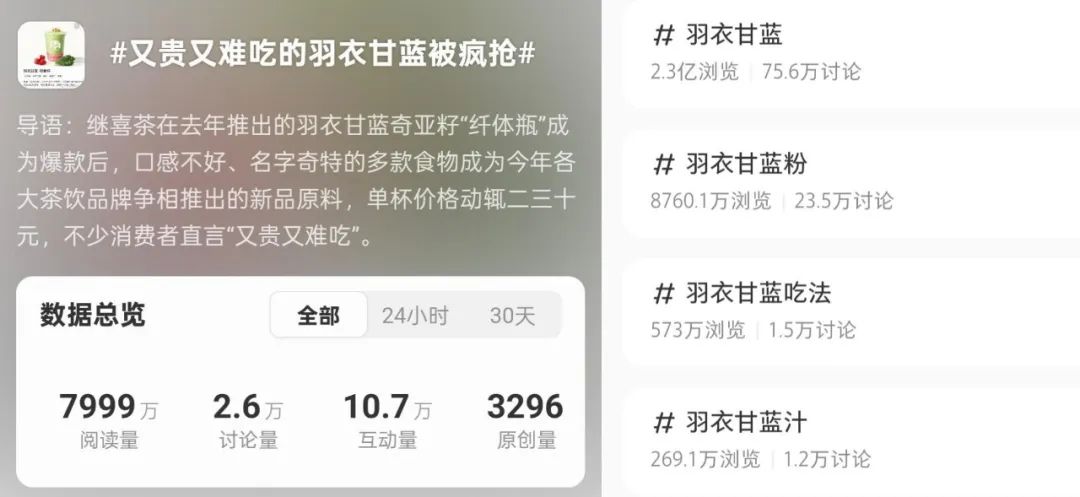
Core Insights - Kale has transitioned from being an unpopular vegetable in China to a trendy health food, driven by consumer demand for health-conscious products and effective marketing strategies by brands like Heytea [2][3][5] - The introduction of kale-based drinks by Heytea, particularly the "Super Plant Tea," has significantly increased kale consumption, with over 100,000 pounds consumed within a month of launch [5][6] - The rise of kale reflects a broader trend in the food industry towards health-oriented products, with various brands innovating around kale to meet consumer health concerns [8][10] Group 1: Market Dynamics - Heytea's marketing strategy effectively addressed the taste issues associated with kale by incorporating it into familiar beverage formats, thus enhancing consumer acceptance [3][5] - The health trend in China has been amplified by the association of kale with fitness and weight management, appealing to consumers' health anxieties [3][8] - The kale market has seen a significant increase in product offerings, with various brands launching kale-infused beverages and snacks, indicating a shift towards a more diverse product range [10][11] Group 2: Industry Innovations - The introduction of pre-packaged kale products, such as those using NFC technology, has expanded the market beyond fresh beverages, allowing for greater accessibility [6][10] - Innovations in kale cultivation and processing have improved its taste and marketability, with brands investing in quality control and new varieties to enhance consumer experience [13][15] - The success of kale in the beverage sector has led to its application in various food products, indicating a shift from immediate health benefits to regular dietary inclusion [11][26] Group 3: Global Comparisons - The rise of kale in China mirrors its earlier success in Western markets, where it became popular through culinary innovation and celebrity endorsements [15][19] - The commercial trajectory of kale in the U.S. involved a combination of taste improvement, marketing, and scientific validation, which is now being replicated in China [21][25] - The kale trend in China is part of a larger movement towards "superfoods," reflecting changing consumer preferences for health and wellness products [26][27]
食品饮料行业:24年报及25年一季报总结:休闲食品仍有机会,乳制品迎来拐点
Dongxing Securities· 2025-07-07 08:49
Investment Rating - The report maintains a "Positive" outlook for the food and beverage industry [2] Core Insights - The food and beverage sector is experiencing a weak recovery, with structural opportunities dominating. Focus on "category innovation + channel efficiency" is essential for capturing profit recovery and differentiation opportunities [4][6][37] Summary by Sections Industry Overview - In 2024, the food and beverage industry achieved a total revenue of CNY 1,091.58 billion, a year-on-year increase of 3.92%, while net profit attributable to shareholders grew by 5.51% to CNY 217.11 billion. The first quarter of 2025 saw revenue growth of 2.54% and a slight net profit increase of 0.27% [4][23] Alcoholic Beverages - The wine sector is facing a weak macro environment, with revenue growth slowing to 1.68% in Q1 2025. The sector is under pressure from inventory levels and a recent ban on alcohol, which is expected to suppress demand in the short term [5][24][26] Snack Foods - The snack food sector is projected to grow by 12.74% in 2024, but growth slowed to 0.29% in Q1 2025. Despite challenges, there are opportunities in specific categories like konjac products, which have seen growth rates exceeding 70% [6][39][54] Condiments - The condiment sector is benefiting from cost reductions due to falling raw material prices, with gross margins improving to 36.38% in Q1 2025. However, demand is showing signs of divergence between B2B and B2C segments [7][14] Frozen Foods - The frozen food sector is under pressure, with revenue and profit declining further in Q1 2025. However, the baking segment is experiencing significant growth due to new retail formats and consumer demand [8][19] Dairy Products - The dairy sector is witnessing a recovery in profitability as raw milk prices stabilize. In Q1 2025, major companies like Yili and Bright Dairy reported net profit increases of 24.19% and 2.45%, respectively [9][20] Key Companies and Forecasts - Key companies such as Kweichow Moutai and Three Squirrels are expected to maintain strong performance, with Moutai projected to achieve a revenue growth of around 9% in 2025 [12][35][58]

食品饮料行业周报:成长为先,阿洛酮糖获批-20250706
GUOTAI HAITONG SECURITIES· 2025-07-06 12:42
成长为先,阿洛酮糖获批 [Table_Industry] 食品饮料 股票研究 /[Table_Date] 2025.07.06 [Table_Invest] 评级: 增持 ——食品饮料行业周报 | | | | [table_Authors] 訾猛(分析师) | 颜慧菁(分析师) | 陈力宇(分析师) | | --- | --- | --- | | 021-38676666 | 021-38676666 | 021-38676666 | | 登记编号 S0880513120002 | S0880525040022 | S0880522090005 | 行 业 双 周 证 券 研 究 报 告 请务必阅读正文之后的免责条款部分 股 票 本报告导读: 消费行业产品焕新加速,重点配置持续创新的企业,零食、饮料等品类创新相对较 快、结构性成长红利持续,白酒产业风险加速释放。 投资要点: 研 究 报 [Table_Summary] 投资建议:饮料、啤酒迈入旺季,结构性成长持续,阿洛酮糖在国 内获批有望释放潜力,白酒产业风险加速释放。1)白酒建议增持: 动销较好标的山西汾酒、贵州茅台、今世缘,及相对稳健标的:五 粮液、迎驾贡 ...