
格力电器

Search documents
家电行业2026年1月投资策略:2026年家电国补政策延续,有望拉动内销需求企稳回升
Guoxin Securities· 2026-01-05 13:58
Core Insights - The 2026 home appliance national subsidy policy is expected to stimulate domestic demand and stabilize retail sales, particularly in the white goods sector [2][3][20] - The policy continues to support the replacement of old appliances with new ones, focusing on six major categories, including refrigerators, washing machines, and air conditioners, with a subsidy of 15% of the product price, capped at 1500 yuan per item [3][21][22] - The white goods production in January showed a positive trend, with a total output of 34.53 million units, representing a 6% year-on-year increase, driven by the national subsidy policy [4][24] Monthly Research Tracking and Investment Thoughts - The national subsidy policy for 2026 aims to boost the replacement demand for home appliances, which is expected to support domestic sales [20][21] - January's white goods production saw a recovery, with air conditioner production increasing by 11% year-on-year, indicating a potential stabilization in demand [4][24] - In November, the domestic sales of major appliances faced pressure due to high base effects from the previous year, but exports of refrigerators and washing machines showed good growth [5][32] Key Data Tracking - In December, the home appliance sector experienced a relative return of -1.06% compared to the Shanghai Composite Index, which rose by 2.28% [34] - The prices of raw materials such as copper and aluminum increased by 13.5% and 4.8% respectively in December, while cold-rolled steel prices decreased by 3.2% [36] - The shipping index for major routes showed a mixed performance, with the West America route down by 6.4% and the Europe route up by 4.8% [45] Key Company Announcements and Industry Dynamics - The report highlights key companies such as Midea Group, Haier Smart Home, TCL, and Gree Electric as strong performers in the white goods sector, with recommendations for investment based on their resilience and growth potential [14][15][54] - The home appliance industry is expected to face challenges due to high inflation in overseas markets and geopolitical tensions, but leading companies are adapting by enhancing local production capabilities [50][51]





从宏微观维度观测市场节奏:春潮涌动,万木争春
Soochow Securities· 2026-01-05 13:52
证券研究报告 从宏微观维度观测市场节奏 春潮涌动,万木争春 证券分析师 :芦哲 执业证书编号:S0600524110003 联系邮箱:luzhe@dwzq.com.cn 证券分析师 :唐遥衎 执业证书编号:S0600524120016 联系邮箱:tangyk@dwzq.com.cn 2026年1月5日 请务必阅读正文之后的免责声明部分 ✓ 2026年1月市场行情展望 ✓ 基金配置建议: 风险提示:发生预期外重大宏观事件;宏观数据不及预期;市场环境变化时,模型存在失效风险。 2 摘要 ✓ 观点:1月宏微观模型结果,呈现开门红评分 ➢ 1月整体走势判断:2026年1月,宏观择时模型的月度评分是0分,历史上该分数万得全A指数全月上涨概率为76.92%,平均涨幅为 3.18%。叠加日历效应中春季躁动的提前启动,我们对后续1月A股权益整体走势持非常乐观的观点。如果后续出现调整,温和调整的 概率偏高,不必过于担忧。结构上依旧推荐关注我们报告中的ETF组合。 ➢ 2025年最后一周大盘指数的日均成交量突破两万亿元,说明交易情绪逐步回暖。ETF资金流向中,本周机器人、工业有色、卫星通信 等方向的ETF净流入金额排名靠前,可以 ...
马杜罗抵达纽约联邦法院
21世纪经济报道· 2026-01-05 13:50
据新华社援引美国媒体5日报道,委内瑞拉总统马杜罗已抵达纽约联邦法庭。 更多详情点击进入专题 ↓ 来源丨新华社 编辑丨张嘉钰 最高预增超360%!44家A股公司披露2025年度业绩预告 美国闪击全球最大石油储量国,全球油市会否变天 铜价狂飙36%,格力回应空调涨价问题 SFC 21君荐读 ...


流动性&交易拥挤度&投资者温度计周报:杠杆资金&股票型ETF净流入大幅收缩-20260105
Huachuang Securities· 2026-01-05 13:12
Report Industry Investment Rating - Not provided in the report Core Viewpoints of the Report - **Funding liquidity**: Both the supply and demand sides have contracted. On the supply side, the new issuance scale of equity - focused public funds has declined, margin trading funds and stock - type ETFs have shown a significant contraction and turned into net outflows, and the repurchase amount remains at a historical low. On the demand side, equity financing and net industrial capital reduction have contracted to historical median levels, and south - bound funds have turned into net outflows [2][6] - **Trading congestion**: Using the ratio of the trading volume in the past four weeks to the market value (compared to the whole A - share market) as an indicator, the trading heat percentile of central state - owned enterprises, home appliances, and photovoltaic industries has increased, while that of machinery, banking, and medical services has decreased [2] - **Investor sentiment thermometer**: The market rebounded last week with the Shanghai Composite Index achieving an 11 - day consecutive increase and a moderate increase in trading volume. Affected by holidays, the self - media search popularity of A - shares decreased. The trend of public fund clustering has weakened, with a preference for value - style and financial and consumer industries. The net inflow of retail funds in the Shanghai and Shenzhen A - share markets has decreased [2] Summary by Relevant Catalogs 1. Funding liquidity 1.1 Public equity new issuance scale - The newly established share of public equity funds last week was 57.9 billion shares, a decrease from the previous value of 94.4 billion shares. Among them, actively managed funds issued 13.9 billion shares, and passive index funds issued 44.0 billion shares [8] 1.2 Margin trading funds - **Overall situation**: The latest margin trading balance decreased, with the balance accounting for 2.58% of the market value of tradable shares, at the 96% percentile in the past three years. The net inflow of margin trading funds last week was about - 19.7 billion yuan, a significant decrease from the previous value, at the 35% percentile in the past three years. The trading volume accounted for 10.6% of the total A - share trading volume, a 0.5 - percentage - point decrease from the previous value, with the participation rate at the 88% percentile in the past three years. The turnover rate of margin trading decreased, while the number of individual investors participating in margin trading increased [12][13] - **Industry situation**: The net inflow was mainly in the military industry (51.8 billion yuan), home appliances (12.3 billion yuan), and public utilities (12.2 billion yuan), while the net outflow was in electronics (- 29.1 billion yuan), non - banking finance (- 23.4 billion yuan), and power equipment (- 15.6 billion yuan) [16][17] 1.3 Stock - type ETFs - The net inflow of stock - type ETFs last week was - 39.5 billion yuan, a decrease from the previous value, at the 31.1% percentile in the past three years [18] 1.4 Listed company repurchases - The repurchase amount of listed companies last week was 5.2 billion yuan, a decrease from the previous value, at the 6% percentile in the past three years [21] 1.5 Equity financing - The equity financing amount last week was 143.1 billion yuan, at the 63% percentile in the past three years, including 64.5 billion yuan from IPOs and 78.6 billion yuan from refinancing [23] 1.6 Industrial capital - **Overall situation**: The net reduction of industrial capital last week was - 49.4 billion yuan, a decrease in scale compared to the previous value, at the 59% percentile in the past three years [25] - **Industry situation**: The net increase was mainly in the petrochemical (2.6 billion yuan) and food and beverage (0.1 billion yuan) industries, while the net reduction was in the military industry (- 9.1 billion yuan), electronics (- 7.3 billion yuan), and machinery (- 7.1 billion yuan) industries [28][29] 1.7 Restricted - share lifting - The market value of restricted shares lifted last week was 571.7 billion yuan, a decrease from the previous value, at the 53% percentile in the past three years. The expected market value of restricted shares to be lifted this week is 1632.8 billion yuan [31] 1.8 South - bound and north - bound funds - The net inflow of south - bound funds last week was - 34.3 billion yuan, a decrease from the previous week, at the 5% percentile in the past three years. The trading volume of north - bound funds accounted for 6.0% of the Shanghai and Shenzhen A - share trading volume, a 3.0 - percentage - point increase from the previous value affected by seasonality, with the participation rate at the 14% percentile in the past three years [34][37] 2. Trading congestion 2.1 Growth - themed industries - The trading heat percentile of the medical service industry decreased by 6 percentage points to 32% [42] 2.2 Value - themed industries - The trading heat percentile of central state - owned enterprises increased by 18 percentage points to 57%, and that of the home appliance industry increased by 7 percentage points to 52% [47] 2.3 Cyclical - themed industries - The trading heat percentile of the non - ferrous metals industry increased by 4 percentage points to 27%, while that of the machinery industry decreased by 10 percentage points to 7% [52][55] 2.4 TMT - themed industries - The trading heat percentile of the media industry decreased by 5 percentage points to 31%, and that of the electronics industry decreased by 4 percentage points to 40% [60] 3. Investor sentiment thermometer 3.1 Self - media - Affected by holidays, the self - media search popularity of A - shares decreased despite the market's rebound and the Shanghai Composite Index's 11 - day consecutive increase [65] 3.2 Douyin users - The proportion of users in high - level cities watching "A - share" content on Douyin decreased, while the proportion of young people under 23 years old increased [67] 3.3 Kuaishou - The number of "A - share" works on Kuaishou decreased by 89, the playback volume increased by 44,000 times, and the interaction volume decreased by 10,000 times compared to the previous period [71] 3.4 Weibo sentiment - The overall sentiment on Weibo was stable last week. The 11 - day consecutive increase of the Shanghai Composite Index led to a significant increase in positive and surprised emotions [73] 3.5 Fund style - The clustering trend of public funds weakened last week, with a preference for value - style and financial and consumer industries [76] 3.6 Retail funds - The net inflow of retail funds in the Shanghai and Shenzhen A - share markets was 91.61 billion yuan, a decrease of 11.82 billion yuan from the previous value, at the 42.3% percentile in the past five years [82] 3.7 Retail entry channels - The cumulative download volume of Flush reached 168,000 times, an increase of 34,000 times from the previous value, while the download volume of Eastmoney was 74,000 times, a decrease of 4,000 times from the previous value. The number of five - star reviews of Flush decreased by 1,510 times [84]
铜价狂飙36%,格力回应空调涨价问题
Xin Lang Cai Jing· 2026-01-05 12:57
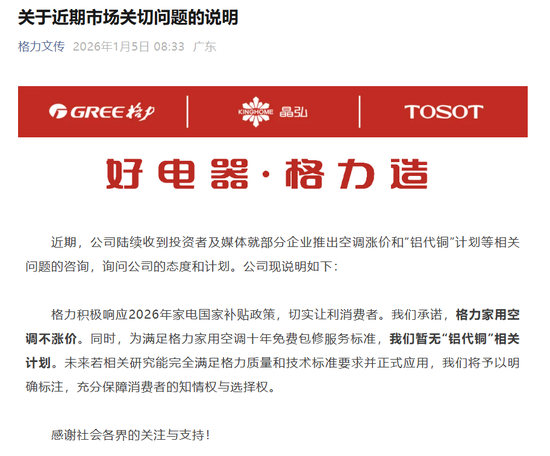
炒股就看金麒麟分析师研报,权威,专业,及时,全面,助您挖掘潜力主题机会! 记者丨翁榕涛 编辑丨骆一帆 近期,格力电器(000651.SZ)陆续收到投资者及媒体就部分企业推出空调涨价和"铝代铜"计划等相关 问题的咨询,询问公司的态度和计划。 1月5日,格力电器官方微信号发布通知表示,格力家用空调不涨价。同时,为满足格力家用空调十年免 费包修服务标准,暂无"铝代铜"相关计划。未来若相关研究能完全满足格力质量和技术标准要求并正式 应用,格力将予以明确标注,充分保障消费者的知情权与选择权。 2025年12月23日,格力电器也曾于投资者互动平台表示,铜是空调的核心原材料,占空调成本的20%左 右,尽管同等情况下,铝材成本约为铜材的1/12(价格约为1/4,密度约为1/3),但其在熔点、热传导 系数、电阻率、耐腐蚀等参数以及长期可靠性等方面,与铜存在较大差距,在其性能、质量和可靠性不 能完全保证的情况下,公司暂时没有"铝代铜"计划。公司重视"铝代铜"技术研究,并将持续关注行业动 态。 Wind数据显示,铜价在近日首次突破10万元关口,2026年1月5日,现货铜价报100620元/吨,这一价格 较2025年初的73830元 ...
铜价狂飙36%,格力回应空调涨价问题
21世纪经济报道· 2026-01-05 12:52
Core Viewpoint - Gree Electric Appliances has decided not to raise prices for its home air conditioners despite rising copper prices, emphasizing its commitment to consumer rights and maintaining the benefits of national subsidies [1][5]. Group 1: Price Strategy and Market Position - Gree Electric announced that it will not increase the price of its home air conditioners, aiming to ensure that the benefits of national subsidies reach consumers fully [1][5]. - The company highlighted that copper constitutes about 20% of the cost of air conditioners, and the recent surge in copper prices has led to a cost increase of approximately 7.26% per unit [4]. - Gree's market director stated that transferring cost pressures to consumers undermines the effectiveness of national subsidy policies [5]. Group 2: Aluminum vs. Copper Debate - Gree Electric has no current plans to adopt "aluminum instead of copper" technology, citing significant performance and reliability differences between the two materials [4][6]. - The company has been actively researching aluminum technology but insists that it will only switch to aluminum when it meets the same technical standards as copper [6]. - Other companies in the industry, such as Midea and Haier, have signed a self-regulatory agreement to accelerate the adoption of aluminum, while Gree has opted out of this initiative [6][7]. Group 3: Industry Trends and Future Outlook - The air conditioning industry is seeing a push towards aluminum use, with expectations that aluminum replacement rates could reach 60% for heat exchangers and 90% for connecting pipes by 2030 [7]. - Analysts predict that the air conditioning sector, due to its high copper intensity and cost sensitivity, will be a leading area for aluminum adoption, potentially increasing annual aluminum demand by 200,000 to 500,000 tons [7].
格力称空调不涨价、暂无铝代铜计划,中国空调业以铝节铜为何遇阻?
第一财经· 2026-01-05 12:37
Core Viewpoint - Gree Electric Appliances announced that it will not raise air conditioner prices despite rising copper prices, indicating a strategic decision to maintain market competitiveness while the industry explores aluminum as a substitute for copper in air conditioning systems [3][4]. Group 1: Impact of Rising Copper Prices - The price of copper futures has exceeded $10,000 per ton, leading to increased costs for air conditioning units, where copper constitutes about 40% of the bill of materials (BOM) [5][6]. - Some air conditioning companies have already raised prices due to the surge in copper prices, with one company increasing prices by 5% and another by 2% to 4% [5]. - Gree's decision to keep prices stable is seen as a strategy to enhance its market share and competitiveness amid rising costs [5][6]. Group 2: Aluminum as a Substitute for Copper - The Chinese government has initiated policies to promote the use of aluminum in place of copper, particularly in air conditioning heat exchangers [5][8]. - Gree Electric has been researching aluminum technology for years but has not yet found it to meet the same technical standards as copper, leading to a cautious approach regarding aluminum adoption [3][8]. - Other companies, such as Wanbao, have begun to introduce aluminum-based air conditioners at lower prices compared to traditional copper models, indicating a shift in the market [8]. Group 3: Technical and Market Challenges - The performance standards for aluminum alloy pipes in air conditioning systems are still under development, with ongoing research needed to ensure reliability and efficiency comparable to copper [10][11]. - The industry faces challenges in convincing consumers of the corrosion resistance and overall reliability of aluminum compared to copper, necessitating extensive testing and validation [11][12]. - The transition to aluminum may require significant investment in new manufacturing processes and equipment, as the production techniques for aluminum differ from those for copper [12].

铜价一年涨超36%!格力坚持空调不涨价,不用“铝代铜”
2 1 Shi Ji Jing Ji Bao Dao· 2026-01-05 12:00
2025年12月23日,格力电器也曾于投资者互动平台表示,铜是空调的核心原材料,占空调成本的20%左 右,尽管同等情况下,铝材成本约为铜材的1/12(价格约为1/4,密度约为1/3),但其在熔点、热传导 系数、电阻率、耐腐蚀等参数以及长期可靠性等方面,与铜存在较大差距,在其性能、质量和可靠性不 能完全保证的情况下,公司暂时没有"铝代铜"计划。公司重视"铝代铜"技术研究,并将持续关注行业动 态。 近期,格力电器(000651)(000651.SZ)陆续收到投资者及媒体就部分企业推出空调涨价和"铝代 铜"计划等相关问题的咨询,询问公司的态度和计划。 1月5日,格力电器官方微信号发布通知表示,格力家用空调不涨价。同时,为满足格力家用空调十年免 费包修服务标准,暂无"铝代铜"相关计划。未来若相关研究能完全满足格力质量和技术标准要求并正式 应用,格力将予以明确标注,充分保障消费者的知情权与选择权。 数据显示,铜价在近日首次突破10万元关口,2026年1月5日,现货铜价报100620元/吨,这一价格较 2025年初的73830元/吨上涨36.28%,较2015年的周期低点涨幅接近2倍。 若以铜原材料占据空调成本的20%计 ...
空调“铝代铜”,这次董明珠和雷军终于一致了
Xin Lang Cai Jing· 2026-01-05 11:45
Core Viewpoint - The rising copper prices have led to discussions about the potential for aluminum to replace copper in air conditioning units, with major manufacturers like Gree and Midea currently not planning to adopt aluminum alternatives [1][2][3] Group 1: Copper Price Impact - Copper prices have reached historical highs, with LME copper exceeding $11,870 per ton and domestic prices surpassing 90,000 and 100,000 yuan per ton [2][7] - The air conditioning industry is feeling pressure to raise prices due to high copper costs, but the 2026 appliance replacement subsidy policy may mitigate this pressure [2][7] - Gree Electric has committed to not raising prices for household air conditioners to align with the 2026 subsidy policy, aiming to boost consumer spending [2][7] Group 2: Market Reactions - There were rumors of Midea increasing prices by over 6%, but these were clarified as misinterpretations, with only minor adjustments to specific models [3][8] - Gree's decision to maintain prices reflects its strategy of emphasizing quality and brand value, while Midea's approach shows flexibility in response to cost pressures [3][8] - Gree's air conditioning units reportedly have a gross margin that is over 5 percentage points higher than Midea's, which may explain its ability to avoid price increases [3][8] Group 3: Aluminum as a Substitute - The air conditioning sector is highly sensitive to copper prices, with approximately 85,000 tons of copper consumed annually, accounting for 21% of national demand [4][9] - Some manufacturers, like Wanbao, are exploring aluminum alternatives, with their new series priced significantly lower than traditional models after subsidies [4][9] - Cost savings from switching to aluminum can range from 70 to 80 yuan per unit for evaporators, and up to 300 to 500 yuan for comprehensive replacements [5][9] Group 4: Future Price Trends - The introduction of aluminum may not necessarily lead to lower retail prices, as the market dynamics could result in stable high-end prices and increased competition in the mid-range segment [10][11] - Analysts suggest that if raw material prices do not continue to rise and considering the impact of subsidies, air conditioning prices may remain low in 2026 [11]
格力电器:自2021年以来,公司累计推出三期员工持股计划
Zheng Quan Ri Bao Wang· 2026-01-05 11:13
Core Viewpoint - Gree Electric Appliances emphasizes the importance of sharing business development results with employees to enhance their motivation and creativity, thereby facilitating the achievement of strategic and operational goals [1] Employee Incentive Programs - Since 2021, the company has launched three phases of employee stock ownership plans, covering over 12,000 employees and involving more than 180 million shares [1] - The incentive programs aim to establish a mechanism for shared interests and risk between shareholders, management, and key employees [1] - The company plans to continuously optimize its incentive system based on actual conditions to promote mutual growth between employees and the enterprise [1]