宝马

Search documents
2026格局与趋势 |(上):天黑请睁眼
3 6 Ke· 2026-02-10 01:20
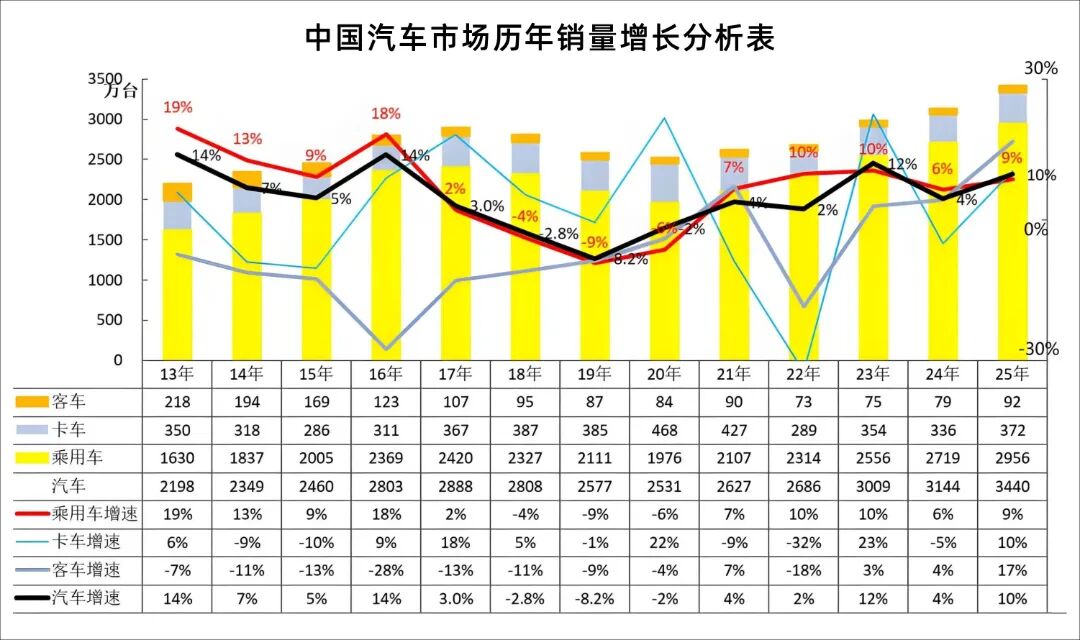
Core Viewpoint - The Chinese automotive market is facing significant challenges in 2026, with predictions of a decline in sales due to economic pressures and changing consumer behavior, despite some optimistic forecasts for growth in exports and specific segments like new energy vehicles [1][3][4]. Group 1: Market Trends and Predictions - In 2026, the overall automotive sales in China are expected to range between 34.5 million to 35 million units, with a potential decline in domestic retail sales by over 5% if no significant policy changes occur [3][7]. - January 2026 data shows a dramatic decline in retail sales, with a 28% year-on-year drop, indicating a challenging start to the year [6]. - Various institutions predict a range of outcomes for 2026, with the most pessimistic forecasts suggesting a 7% decline in sales, while the most optimistic predict only a 1% increase [4][7][8]. Group 2: Policy and Economic Influences - Key factors affecting the market include adjustments to subsidy policies for new energy vehicles, which have shifted from full exemptions to partial reductions, impacting consumer purchasing behavior [6][9]. - The decline in consumer confidence and shrinking middle-class income due to economic downturns are expected to further suppress automotive sales [6][9]. Group 3: Competitive Landscape - The automotive industry is experiencing intense competition, with a shift from price wars to a focus on technological advancements and value creation as companies seek to stabilize their market positions [12][16]. - Major players are adjusting their sales targets, with some aiming for significant growth while others adopt more conservative strategies in response to market conditions [18][19]. Group 4: Export Opportunities - Exports are projected to be a key growth area, with expectations of a 12-15% increase, potentially reaching 8 million units, which could help offset domestic market declines [22][26]. - The global supply chain dynamics are pushing Chinese automotive companies to enhance their international presence, with a focus on building global production and R&D capabilities [26][28]. Group 5: Segment-Specific Insights - The new energy vehicle segment is anticipated to grow, with retail sales expected to increase by 12-15%, driven by favorable policies for mid-range models [9][10]. - The large six-seat SUV market is projected to maintain strong growth, with expectations of a 30-50% increase in sales, despite overall market challenges [31][32].





美印贸易协议落地,特斯拉印度无关税减免
Sou Hu Cai Jing· 2026-02-10 00:21
Core Viewpoint - The recent temporary trade agreement between the US and India has not provided the expected tariff reductions for Tesla, significantly hindering the company's plans to enter the Indian market, which is the world's third-largest passenger car market [2][4]. Group 1: Trade Agreement Details - The US and India have reached a temporary trade agreement that reduces tariffs on Indian goods from 50% to 18%, in exchange for India halting purchases of Russian oil [2]. - As part of the agreement, India has agreed to significantly lower tariffs on certain high-end American products, including reducing tariffs on high-end American cars (mainly large internal combustion engine models) from a maximum of 110% to 30% and eliminating tariffs on Harley-Davidson motorcycles [2][5]. Group 2: Impact on Tesla - Electric vehicles have been explicitly excluded from the tariff reductions, leaving Tesla without the anticipated benefits [4]. - Currently, India imposes high tariffs on imported electric vehicles, typically ranging from 70% to 100%, which severely limits Tesla's market penetration and pricing competitiveness [4]. - Tesla's performance in India has been disappointing, with only 227 vehicles registered in 2025, failing to sell even one-third of imported vehicles, leading to cancellations of early orders due to high prices [4]. Group 3: Competitive Landscape - The trade agreement favors traditional fuel high-end vehicles, particularly those with engine displacements over 3000cc, which will see tariffs gradually reduced to 30% over the next decade [5]. - In contrast, Tesla faces increasing pressure globally, with its sales declining for the second consecutive year in 2025, and BYD has overtaken it as the global leader in electric vehicle sales [7]. - The lack of tariff support in India suggests that Tesla will struggle to achieve scale through imports and may need to consider local production or alternative strategies to overcome barriers [7].
固德电材(301680):注册制新股纵览 20260209 :动力电池热失控领先企业,铜铝符合材料增长可期
Shenwan Hongyuan Securities· 2026-02-09 14:38
Investment Rating - The report assigns a rating of "middle to upper level" based on the AHP score of 2.24, which places the company in the 30.4% percentile of the non-technology innovation system AHP model [5][10]. Core Insights - The company is positioned as a leader in the thermal runaway protection for power batteries, with a diversified business structure that supports stable growth. It has established itself as a primary supplier to major global automotive manufacturers and battery producers, capturing a market share of 15%-20% in the global battery system mica material safety protection market, ranking second [5][12]. - The company has successfully entered the supply chain of CATL and achieved scale production in its copper-aluminum composite materials business, which is expected to see significant revenue growth in the coming years [5][14]. - The company anticipates a revenue of 1.08998 billion yuan for 2025, representing a year-on-year growth of 20.05%, with a net profit forecast of 177.47 million yuan, up 3.32% year-on-year [5][18]. Summary by Sections AHP Score and Expected Allocation Ratio - The AHP score for the company is calculated at 2.24, with an expected allocation ratio of 0.0226% for Class A and 0.0194% for Class B investors under a neutral scenario [10][11]. Fundamental Highlights and Features - The company focuses on thermal runaway protection for power batteries and has a stable business in electrical insulation, while also accelerating the development of new products like copper-aluminum composites [12][20]. - The company has diversified its operations to reduce reliance on any single business or customer, enhancing its overall risk resilience [12][20]. Financial Comparison with Peers - The company has shown significant revenue growth from 475 million yuan in 2022 to 908 million yuan in 2024, with a compound annual growth rate (CAGR) of 38.24% to 63.75%, outperforming comparable companies [25][26]. - The gross margin has increased from 28.40% in 2022 to 37.02% in 2024, although it experienced a decline to 33.92% in the first half of 2025 due to changes in sales mix and external factors [30][31]. Fundraising Projects and Development Vision - The company plans to raise funds through the issuance of up to 20.7 million new shares, with proceeds allocated to the production of 7.25 million sets of new thermal runaway protection components and the construction of a new production base [35][36].
固德电材(301680):动力电池热失控领先企业,铜铝符合材料增长可期
Shenwan Hongyuan Securities· 2026-02-09 14:32
Investment Rating - The report assigns a rating based on the AHP score of 2.24, placing the company in the 30.4% percentile, indicating a mid-to-upper tier position in the market [10]. Core Insights - The company is positioned as a leader in thermal runaway protection for power batteries, with a diversified business structure that supports stable growth. It has established itself as a primary supplier to major global automotive manufacturers and battery producers, capturing a 15%-20% market share in the global battery system mica material safety protection market, ranking second [5][12]. - The company is expanding its production capacity in Mexico to mitigate the impact of U.S. tariff policies and is expected to see significant revenue growth from new projects and a robust order backlog [17][18]. - The company anticipates a revenue of 1.08998 billion yuan for 2025, reflecting a year-on-year growth of 20.05%, with a net profit forecast of 177.47 million yuan, up 3.32% year-on-year [18]. Summary by Sections AHP Score and Expected Allocation - The AHP score for the company is calculated at 2.24, with expected allocation ratios for different investor categories being 0.0226% for category A and 0.0194% for category B under a neutral scenario [10][11]. Fundamental Highlights and Features - The company focuses on thermal runaway protection for electric vehicle batteries and has a stable market presence in electrical insulation products. It is also accelerating the development of copper-aluminum composite materials, contributing to a second growth curve [5][12]. - The company has diversified its business to reduce reliance on any single sector, enhancing its resilience against market fluctuations [12]. - The company has established a strong global presence, with production capabilities in Mexico and partnerships with major automotive and battery manufacturers [12][14]. Comparable Company Financial Metrics - The company has shown significant revenue growth compared to peers, with revenues of 475 million, 651 million, and 908 million yuan from 2022 to 2024, reflecting compound growth rates of 38.24% and 63.75% [25]. - The gross margin has increased from 28.40% in 2022 to 37.02% in 2024, although it experienced a decline to 33.92% in the first half of 2025 due to changes in sales dynamics [30]. Fundraising Projects and Development Vision - The company plans to raise funds through the issuance of up to 20.7 million new shares, with proceeds allocated to the production of 7.25 million sets of new thermal runaway protection components and the establishment of a new production base [35][36]. - The expected internal rate of return for the new projects is 27.33% and 15.67% for the thermal runaway protection components and the new production base, respectively [36].
二手车交易量创新高背后
第一财经· 2026-02-09 12:09
Core Viewpoint - The second-hand car market in China is experiencing significant growth, with transaction volumes reaching 20.1 million units in 2025, but profit margins are declining, leading to a challenging environment for dealers [3][12]. Group 1: Market Growth and Trends - In 2025, the second-hand car transaction volume reached 20.1 million units, marking a new peak, with used new energy vehicles (NEVs) accounting for over 1.6 million units, a year-on-year growth of over 40% [3][10]. - The average transaction price of second-hand cars decreased from 66,700 yuan in March 2025 to 61,600 yuan in September 2025, indicating a price drop in the market [3][7]. - The average profit margin in the second-hand car industry is approximately 4%, reflecting a significant decline compared to previous years [3][9]. Group 2: Profitability Challenges - The average profit margin for second-hand car dealers has decreased, with individual dealers like Wang Yang reporting a drop in profit from 15,000 yuan to 10,000 yuan for a 100,000 yuan vehicle over five years [7][9]. - Factors contributing to declining profits include increased competition, price transparency, and fluctuations in new car prices, which directly affect second-hand car pricing [7][9]. - Major dealer groups are also facing similar challenges, with companies like Yongda Automotive reporting a 60.2% decline in comprehensive profits from their second-hand car business [9][12]. Group 3: New Energy Vehicles as a Growth Opportunity - The penetration rate of second-hand NEVs increased from 3.6% at the end of 2022 to 12% by December 2025, indicating a growing market segment [10][11]. - The average three-year depreciation rate for NEVs is significantly higher than that of traditional fuel vehicles, with NEVs averaging a 43% retention rate compared to 62% for fuel vehicles [11][12]. - Despite the challenges, NEVs are seen as a new growth opportunity for second-hand car dealers, with companies like Yongda Automotive planning to accelerate their focus on this segment [11][12].

2000万辆二手车交易新高背后:车商利润触底,行业洗牌在即
Di Yi Cai Jing· 2026-02-09 11:08
Core Insights - The second-hand car market in China is projected to reach a transaction volume of 20.1 million units by 2025, with used new energy vehicles (NEVs) expected to exceed 1.6 million units, marking a year-on-year growth of over 40% [1] - The average growth rate of second-hand car sales has slowed down to 5.8% over the past five years, compared to an average of 10.3% in the previous decade, while the average profit margin in the industry has dropped to around 4% [1][3] - The average transaction price of second-hand cars has decreased from 66,700 yuan in March 2025 to 61,600 yuan in September 2025 [1] Market Trends - The proportion of registered second-hand car dealers increased to 73.2% in the first half of 2025, with 96 out of the top 100 companies being second-hand dealers [1] - The revenue from second-hand car sales for dealer groups has risen by 124% compared to 2024 [1] - The competition among second-hand car dealers is intensifying, with many individual operators exiting the market due to declining profits [2] Profitability Challenges - The average profit margin for second-hand cars is approximately 4%, with significant declines in profit per vehicle sold, from around 15,000 yuan five years ago to about 10,000 yuan currently [3] - Factors contributing to profit decline include price volatility of new cars, increased transparency in the market, and intensified competition [3] - The average transaction price for second-hand cars in 2025 is reported to be 64,100 yuan, a decrease of 140 yuan from 2024 [3] Impact of New Energy Vehicles - The penetration rate of second-hand NEVs has increased from 3.6% at the end of 2022 to 12% by December 2025 [6] - The transaction price distribution for second-hand NEVs shows an increase in the share of vehicles priced between 30,000 to 80,000 yuan, while the share of vehicles priced below 30,000 yuan has decreased [6] - The average three-year depreciation rate for NEVs is significantly higher than that of traditional fuel vehicles, with NEVs averaging a 43% retention rate compared to 62% for fuel vehicles [7] Strategic Shifts - Companies are exploring new growth avenues such as NEVs and second-hand car exports to adapt to market changes [5] - The overall second-hand car market is expected to grow by nearly 3% in 2025, while NEV transactions are projected to increase by approximately 50% year-on-year [7] - Major players like Yongda Automotive and Zhongsheng Automotive are shifting focus towards NEV channels and online sales models for second-hand vehicles [6][7]
崔东树:1月的新车推出伴随新价格 部分车型的价格下探力度较大
智通财经网· 2026-02-09 10:58
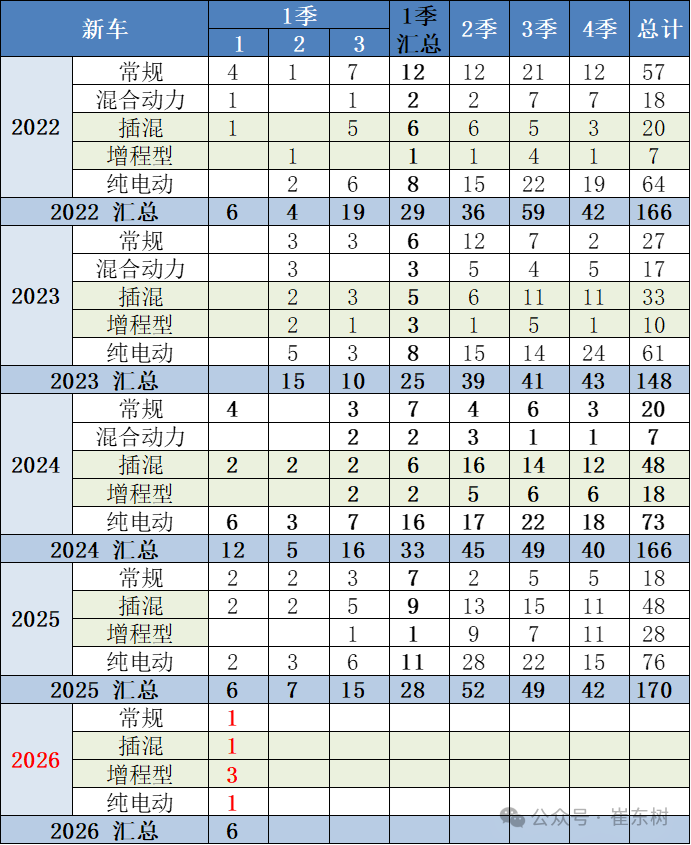
Core Viewpoint - The passenger car market is experiencing a slowdown in new traditional vehicle launches while there is a significant increase in new energy vehicle (NEV) introductions, indicating a shift in market dynamics and consumer preferences [1][2]. New Vehicle Launches - In January, the number of new vehicles launched was consistent with the previous year, with 6 new models introduced, including 1 pure electric, 1 plug-in hybrid, and 3 range-extended models. Only 1 new fuel vehicle was launched, highlighting a significant concern for the industry [1][3]. - The trend shows a shift from high-end to smaller vehicles, with many new models being compact cars, reflecting changing consumer preferences and the impact of trade-in policies [1][10]. Market Competition - The automotive industry is facing intense price competition, particularly among traditional and new energy vehicles, as manufacturers strive to capture market share in a rapidly evolving landscape [1][2]. - The classification of new models is crucial, with various manufacturers adopting different grading systems, although the industry commonly references the German Volkswagen classification system [1][7]. Future Market Potential - The domestic car market has significant potential for growth, particularly in the small car segment, which is essential for increasing private car ownership and facilitating the export of NEVs [2][3]. - The introduction of new tariffs and international trade dynamics will impact the export strategies of NEVs, particularly in targeting less developed markets before approaching developed ones [2]. Pricing Trends - The minimum prices for new models are gradually returning to market levels, with some new energy vehicle brands successfully expanding their product lines into lower price segments, which is expected to drive incremental sales [6][10]. - The pricing strategy for new models indicates a downward trend, with several models breaking previous price barriers for the years 2023-2025 [6]. Vehicle Classification and Standards - The classification of new energy vehicles is complex and requires careful consideration of various factors, including vehicle length and wheelbase, to establish industry standards [7][9]. - The current classification system is still under discussion, with industry experts encouraged to provide feedback to refine the grading of new models [16].
奥迪只要10万了
36氪· 2026-02-09 10:45
Core Viewpoint - The article discusses the significant price drop of the Audi A3, questioning whether it can still be considered a luxury car when its price has fallen to the level of more affordable models [4][46]. Group 1: Price and Sales Trends - The Audi A3, which previously had a starting price of around 19 million yuan, is now available for as low as 11.5 million yuan, with some dealers offering it for as low as 9.9 million yuan [13][15]. - Sales of the Audi A3 have drastically declined, with only 54,700 units sold in 2024, marking a five-year low, and a 22% increase in sales expected in 2025 due to aggressive pricing strategies [13][21]. - The overall luxury car market in China is experiencing a downturn, with a 9.6% decline in sales for luxury brands in 2025, and Audi's total sales in China fell by 5% to 617,500 units [21][22]. Group 2: Competitive Landscape - The price drop of the Audi A3 has led to increased competition with models like the Volkswagen Golf, which shares the same platform and engine but is priced lower [24][31]. - Other competitors in the same price range, such as the BYD Qin PLUS and Nissan Sylphy, offer better space and practicality, making them more appealing to family-oriented consumers [31][32]. - The Audi A3's lack of advanced technology and higher maintenance costs compared to competitors are significant drawbacks that affect its market position [31][32]. Group 3: Consumer Sentiment - Consumers like the A3 for its aesthetic appeal and driving experience, but many do not view it as a luxury vehicle anymore, focusing instead on practicality and personal preference [46][47]. - The emotional value associated with owning an Audi is still present, but the perception of luxury has diminished as the price has dropped significantly [30][46].
兴瑞科技(002937):兴瑞科技首次覆盖报告:精密嵌塑翘楚,战略拓展新兴行业
GUOTAI HAITONG SECURITIES· 2026-02-09 01:22
Investment Rating - The report initiates coverage with an "Accumulate" rating for the company [1][4][23]. Core Views - The company is a leading precision manufacturing enterprise in China, focusing on automotive electronics and actively expanding into emerging businesses, indicating significant growth potential [1][10]. - Revenue projections for 2025-2027 are estimated at 1.626 billion, 1.980 billion, and 2.482 billion yuan, respectively, with year-on-year growth rates of -14.5%, 21.7%, and 25.3% [14][18]. - The target price for 2026 is set at 32.11 yuan, based on a comprehensive valuation using PE and PB methods [14][23]. Financial Summary - Total revenue for 2023 is projected at 2,006 million yuan, with a net profit of 267 million yuan, translating to an EPS of 0.90 yuan [3][11]. - The company expects a decline in revenue in 2024 to 1,902 million yuan, followed by a recovery in subsequent years [3][14]. - The net profit margin is projected to decrease in 2024 but is expected to improve in the following years, with net profit reaching 282 million yuan by 2027 [3][11]. Business Segments - The company has a diverse product matrix, including electronic connectors, structural components, and embedded injection parts, widely used in new energy vehicle electrical systems, smart terminals, and consumer electronics [10][24]. - The automotive electronics segment is anticipated to generate revenues of 7.29 billion, 10.20 billion, and 14.29 billion yuan from 2025 to 2027, with a significant focus on new energy vehicles [15][18]. - The smart terminal segment is expected to achieve revenues of 4.63 billion, 5.09 billion, and 5.85 billion yuan during the same period, reflecting steady growth [16][18]. - The consumer electronics segment is projected to generate revenues of 1.33 billion, 1.40 billion, and 1.47 billion yuan, with a focus on higher-margin products [17][18]. Strategic Initiatives - The company is expanding its global footprint with factories in various locations, including Ningbo, Suzhou, and overseas in Vietnam and Indonesia, to support its international business [10][24]. - A strategic partnership with Green Cloud is aimed at developing the liquid cooling industry, enhancing the company's technological capabilities and market position [10][24]. - The company is actively investing in R&D to drive innovation and maintain competitive advantages in precision manufacturing [35][36].

蔚来实现单季盈利,1亿次换电达成!比亚迪发布新品牌“领汇”!多款新车登陆工信部!加拿大将大幅降低中国电动车关税!丨一周大事件
电动车公社· 2026-02-08 16:06
New Car Launches - The new BMW i5 was launched with a price range of 368,000 to 458,000 yuan, featuring upgrades in comfort and battery optimization for improved range [3][8] - The all-new Li Auto L9 was revealed, with the top version "Li L9 Livis" priced at 559,800 yuan, showcasing significant design and technology enhancements [9][11][13] - Chery's new QQ3 has opened for blind orders, featuring a compact design and advanced driver assistance systems [14][17][21] Company Developments - NIO achieved its first quarterly profit, projecting an operating profit of approximately 290 million to 1 billion yuan for Q4 2025, and reached a milestone of 100 million battery swaps [51][54] - BYD announced its fifth sub-brand "Linghui Auto," targeting the B-end market with customized vehicles [55][57] - SAIC-GM-Wuling reported global sales of 105,792 units in January [58] Battery Market Insights - CATL maintained a dominant market share of 39.2% in the global battery market, with a projected global installation volume of 464.7 GWh for 2025 [61][62] - Changan announced the upcoming mass production of the world's first sodium battery passenger vehicle, indicating advancements in battery technology [64][67] International News - Canada announced a significant reduction in import tariffs on Chinese electric vehicles from 106.1% to 6.1%, facilitating easier market access for Chinese automakers [68][71]