
东鹏饮料

Search documents
ETF盘中资讯|政策暖风频吹,食品ETF(515710)盘中翻红!机构:建议把握节前白酒修复行情
Sou Hu Cai Jing· 2025-12-17 03:27
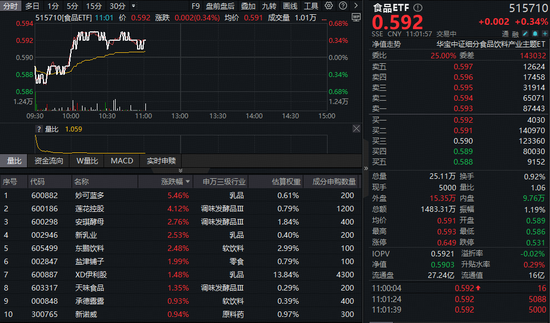
Group 1 - The food and beverage sector is experiencing fluctuations, with the Food ETF (515710) showing a slight increase of 0.34% as of the latest report [1] - Major stocks in the sector are performing well, with Miaokelan increasing over 5%, Lianhua Holdings up over 4%, and several others like Angel Yeast, New Dairy, and Dongpeng Beverage rising over 2% [1][2] - The sector is considered a crucial part of the broader consumer market, and ongoing policies aimed at expanding domestic demand are expected to benefit the food and beverage sector significantly [3] Group 2 - The valuation of the food and beverage sector is currently at a historical low, making it an attractive time for potential investments. The food ETF's underlying index has a price-to-earnings ratio of 20.21, which is at the 6.46% percentile of the last decade [3] - There are positive signals from both supply and demand sides in the liquor sector, indicating potential for growth. The current market conditions suggest that high-quality companies with pricing power may see significant growth opportunities [3] - The Food ETF (515710) tracks the CSI segmented food and beverage industry index, with approximately 60% of its holdings in leading high-end and mid-range liquor stocks, and nearly 40% in beverage, dairy, and seasoning stocks [4]


政策暖风频吹,食品ETF(515710)盘中翻红!机构:建议把握节前白酒修复行情
Xin Lang Ji Jin· 2025-12-17 03:11
Group 1 - The food and beverage sector is experiencing fluctuations, with the Food ETF (515710) showing a slight increase of 0.34% as of the latest update [1][2] - Major stocks in the sector are performing well, with Miaokelan Duo rising over 5%, Lianhua Holdings increasing over 4%, and several others like Angel Yeast, New Hope Dairy, and Dongpeng Beverage gaining over 2% [1][2] - The central government's focus on expanding domestic demand is expected to benefit the food and beverage sector significantly, as it is a crucial part of the consumer market [3][4] Group 2 - The food and beverage sector is currently at a historical low in terms of valuation, making it an attractive opportunity for investment [3] - As of December 16, the price-to-earnings ratio of the Food ETF's underlying index is 20.21, which is at the 6.46% percentile of the past decade, indicating a favorable long-term investment scenario [3] - The white liquor sector is also seen as entering a phase of potential recovery, with positive signals from both supply and demand sides expected to catalyze growth [4] Group 3 - The Food ETF (515710) tracks the CSI sub-index for the food and beverage industry, with approximately 60% of its holdings in leading high-end and mid-range liquor stocks, and nearly 40% in other segments like beverages and dairy [5] - Key stocks in the ETF include major brands such as Moutai, Wuliangye, Yili, and Haitian Flavoring, which are positioned to benefit from the anticipated recovery in consumer demand [5]
“提振、细化、聚焦”——从中央经济工作会议及11月经济指标明确消费主线
2025-12-17 02:27
Summary of Conference Call Records Industry and Company Overview - The conference call discusses the overall economic environment in China, focusing on domestic demand and various sectors including retail, education, textiles, jewelry, and home appliances. [1][2][3] Key Points and Arguments Economic Policy and Domestic Demand - The central economic work conference emphasizes the importance of domestic demand, with a focus on detailed policy implementation to enhance consumer sentiment and valuation rather than merely increasing financial input [2][3] - The expectation for service consumption policies to intensify in 2026 and 2027, with specific attention to holiday promotions and paid leave policies that will benefit sectors like tourism and online travel agencies (OTA) [1][5][6] Sector-Specific Insights - **Retail Sector**: - Retail is expected to benefit from domestic demand policies and an extended Spring Festival holiday, with CPI improvements likely boosting supermarket revenues [1][10][11] - Key retail companies to watch include Chongqing Department Store, Bubugao, and Guijia Times [11] - **Education Sector**: - Vocational education institutions are anticipated to benefit from service-oriented consumption policies aimed at improving employment [7] - **Textile and Apparel Industry**: - The industry is experiencing a slowdown, but winter inventory clearance is expected to improve. Key players include home textile leaders like Luolai and sports brands with international multi-brand strategies [8] - **Jewelry Sector**: - The industry faces challenges from high gold prices, but companies with brand differentiation, such as Cao Hongji, are performing well. Potential turnaround stocks include Lao Fengxiang and Zhou Daxing [9] - **Home Appliance Industry**: - The market is stabilizing after a decline due to subsidy reductions, with a focus on product structure upgrades. Key players include Midea and Haier, as well as emerging smart hardware companies [14][16] Economic Data and Trends - Recent economic data shows a mixed performance, with social retail sales growth at 1.3%, indicating various underlying issues such as the weakening of trade-in effects and the impact of promotional events [4] - The focus should shift from short-term data fluctuations to the long-term effects of policy on sentiment and valuation [4][3] Investment Opportunities - **Tourism Stocks**: - OTA companies are highlighted as strong investment opportunities due to their profitability and the increasing interest from state-owned and local industry funds in scenic area companies [6] - **Consumer Goods**: - Companies in the beauty sector, such as Lin Qingxuan, are positioned to benefit from domestic demand growth, with a notable performance in their core products [11][12] - **Agriculture Sector**: - The agricultural sector is currently in a pessimistic state, but there is potential for recovery as supply constraints stimulate hidden demand. Recommended stocks include Muyuan Foods and Wens Foodstuffs [17] Risks and Challenges - The video sector is still facing performance challenges, particularly in the liquor segment, with a focus on companies with low inventory and strong performance potential [18] Additional Important Content - The emphasis on policy detail and implementation reflects a shift towards more actionable economic strategies, which may lead to improved consumer sentiment and market performance in the long run [2][3]
7707亿元!上市公司也爱买理财
Shen Zhen Shang Bao· 2025-12-16 16:48
Core Insights - A total of 1,094 A-share listed companies have subscribed to financial products this year, with a cumulative investment amount of 770.72 billion yuan [1][2] - In December alone, 138 companies announced the use of idle funds for financial product purchases, totaling 15.61 billion yuan [1] Group 1: Company Actions - Dongpeng Beverage announced an investment of 1.252 billion yuan in financial products through six institutions, aiming to enhance fund efficiency and ensure safety [1] - Hisense Home Appliances reported a total investment of 1.76 billion yuan in financial products through its subsidiaries [2] - Wangfujing disclosed an investment of 850 million yuan in structured deposits and large-denomination certificates of deposit [2] Group 2: Investment Preferences - Companies primarily invest in structured deposits, large-denomination certificates of deposit, bank wealth management, and securities company products, focusing on low-risk and high-liquidity options [2] - Structured deposits are the most favored investment product among listed companies [2] Group 3: Analyst Recommendations - Analysts suggest that investors should rationally assess the nature and scale of the funds used by companies for financial management, particularly distinguishing between short-term idle funds and long-term investments [2]



A股公司今年以来斥资逾9440亿元购买理财产品
Zheng Quan Ri Bao· 2025-12-16 16:09
Core Viewpoint - The phenomenon of listed companies using idle funds to purchase financial products has sparked market discussions, emphasizing the need for careful planning based on the company's development stage and actual funding needs [1] Group 1: Financial Product Purchases - A total of 1,147 A-share listed companies purchased 15,000 financial products this year, with a total subscription amount of 944.099 billion yuan, a year-on-year decrease of 18.76% [1] - Among the various financial products, structured deposits were the most favored, with a subscription amount of 563.834 billion yuan, accounting for 59.72% of the total [1] - Bank financial products followed with a total subscription of 108.124 billion yuan, while deposit products and brokerage financial products had subscription amounts of 76.969 billion yuan and 65.807 billion yuan, respectively [1] Group 2: Factors Influencing Purchase Trends - The overall amount of financial products purchased by listed companies has decreased due to three main factors: lower market interest rates reducing the attractiveness of financial product yields, a policy shift encouraging companies to enhance returns to investors through cash dividends and share buybacks, and a favorable capital market encouraging companies to invest in primary and secondary markets [2] - Despite the decline in enthusiasm for purchasing financial products, the subscription amount for brokerage financial products remained stable, with their proportion of total subscriptions rising from 5.76% last year to 6.97% this year [2] Group 3: Company-Specific Purchases - Seven listed companies have subscribed to financial products exceeding 10 billion yuan this year, with the highest being Jiuzhoutong at 29.164 billion yuan, followed by Hisense Home Appliances at 22.933 billion yuan, and ZTE Corporation and Dongpeng Beverage at 18.512 billion yuan and 14.094 billion yuan, respectively [3] - The funding sources for purchasing financial products mainly include self-owned funds and self-raised funds, with 335.301 billion yuan from self-owned funds (35.52%) and 608.798 billion yuan from self-raised funds (64.48%) [3] Group 4: Investment Principles - Companies should prudently determine the scale and duration of their investments in financial products, adhering to the principle of safety and prioritizing the protection of principal and shareholder interests [4]
晨会聚焦:食饮、农业、传媒年度策略-20251216
ZHONGTAI SECURITIES· 2025-12-16 15:37
Group 1: Media and Internet Industry Strategy - The core viewpoint emphasizes the dual driving forces of AI and IP in the media sector, suggesting a focus on AI applications in various fields such as AI comics, games, marketing, education, and publishing [4][5] - AI comics are expected to enhance production efficiency by over 300% while reducing costs by more than 90%, supported by favorable platform policies [4] - The investment value of the IP industry is highlighted, with a shift from functional satisfaction to emotional resonance in consumer markets, indicating strong demand for domestic cultural products [5] Group 2: Beverage Industry Strategy - The energy drink market in China is projected to reach 62.785 billion yuan in 2025, with a year-on-year growth of 4.3%, driven by stable demand and competitive pricing strategies [14] - The industry is experiencing a shift towards health-oriented products, with 67.87% of consumers expressing a need for reduced sugar intake, prompting companies to innovate with sugar-free options [16] - The main raw materials, taurine and white sugar, are expected to maintain low prices due to oversupply and changing consumption patterns [15][16] Group 3: Agriculture and Fisheries Industry Strategy - The agricultural sector is facing challenges due to declining demand and efficiency improvements, with a lack of price imagination leading to a prolonged period of low prices [17] - The report suggests that the demand for agricultural products will gradually increase due to rising disposable incomes and government initiatives aimed at boosting consumption [18] - The pet industry is transitioning from high-speed growth to high-quality development, with increased competition and a focus on companies that excel in R&D and supply chain management [18]
食品饮料2026年度策略:大年起点,持旧迎新
2025-12-16 03:26
Summary of the Food and Beverage Industry Conference Call Industry Overview - The food and beverage industry is entering a pivotal year in 2026, characterized as a "starting point for a big year" with expectations for absolute returns across the sector [2][3] - The industry has seen a decline in valuations to reasonable levels, with performance being the core issue [3] Key Insights and Arguments - **Consumer Demand Trends**: Anticipated L-shaped recovery in consumer demand driven by the repair of household balance sheets and economic structural transformation [3] - **Traditional vs. New Consumption**: Both traditional and new consumption are expected to coexist, with traditional consumption showing signs of bottoming out and potential recovery [2][8] - **Investment Recommendations**: - Prioritize investments in frozen food companies, followed by the liquor sector [5] - Companies like Anjuke, Qianqianwei, and Sanquan in the frozen food sector are expected to optimize competition through B-end transformations [5] - High market share beer companies such as Yanjing and Zhujiang are seen as having good growth potential [5] New Consumption Opportunities - The new consumption sector is expected to benefit from structural dividends, with significant growth potential for companies like New Dairy and Yanjing Zhujiang [4][10] - New channels and product categories are anticipated to drive performance growth in beverages and snacks, even in the current economic environment [6][12] Liquor Industry Insights - The liquor sector, characterized by strong commercial barriers and high inventory accumulation, is expected to see improvements in Q1 2026 as inventory levels decrease [7] - The stability of liquor prices or an L-shaped trend is viewed as an attractive investment opportunity, with companies like Wuliangye, Yanghe, and Moutai being highlighted as good choices [7][9] Market Characteristics and Future Outlook - The future consumer market in China is expected to exhibit three main characteristics: large market size, high innovation in channels and categories, and a trend towards international expansion to address supply-demand imbalances [11] - Structural dividends are anticipated to arise from new channels, new product categories, and new markets [11] Specific Investment Targets - In the snack sector, companies with strong channel adjustment and category expansion capabilities, such as Weilong and Yanjin, are recommended [12] - In the beverage sector, functional drinks and sugar-free tea segments are highlighted, with companies like Dongpeng and Nongfu Spring expected to maintain leading growth [12] Strategic Recommendations - The investment strategy for 2026 emphasizes that the food and beverage sector is likely to rise, with a focus on performance recovery, particularly in the liquor sector [13] - The strategy includes holding traditional consumption while embracing new consumption, indicating a balanced approach to investment [14]
“两新”政策优化!资金关注消费防御板块,消费ETF(159928)大举“吸金”近1.3亿份!机构评白酒:茅五亮牌,剑向何方?
Sou Hu Cai Jing· 2025-12-16 03:24
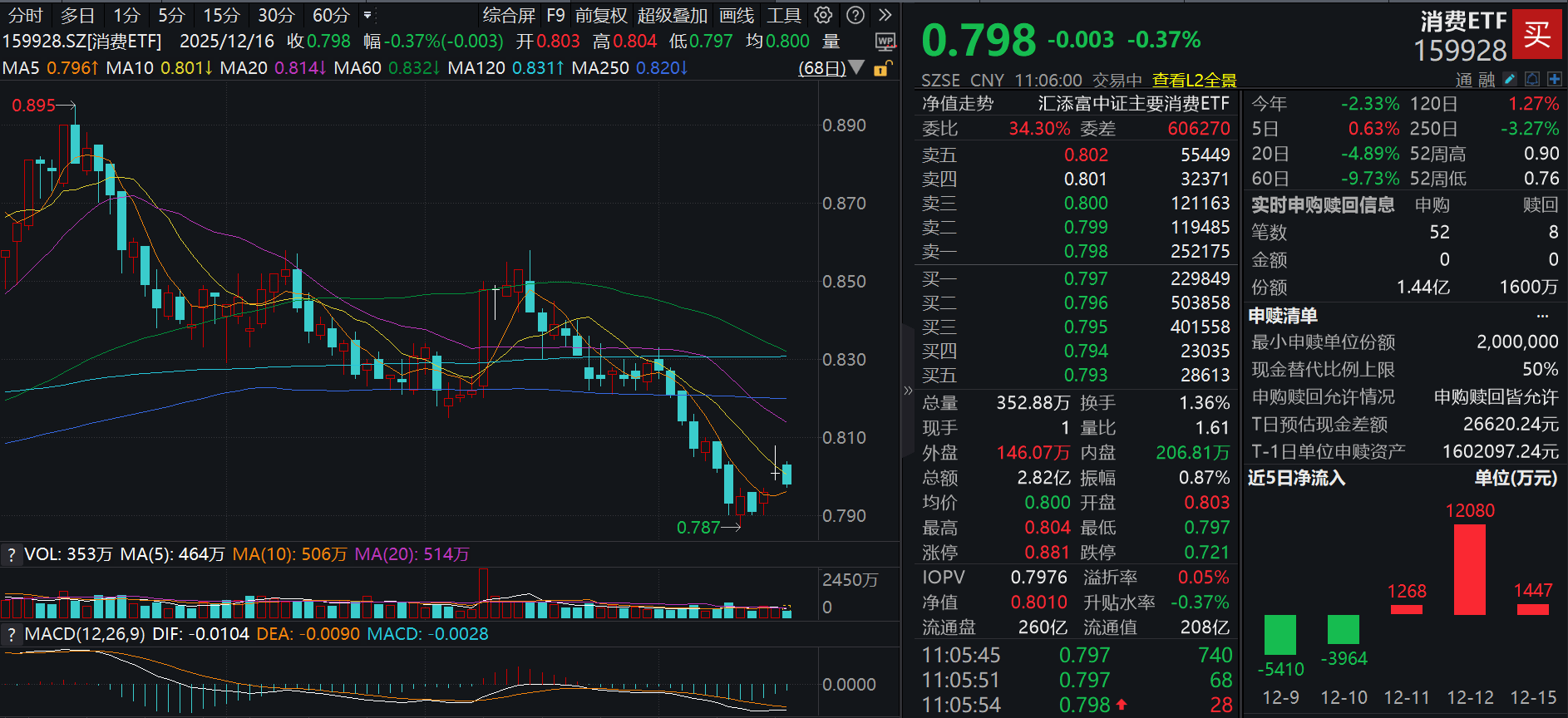
Group 1: Market Overview - The Shanghai Composite Index fell over 1%, but the consumer sector showed relative resilience with a smaller decline [1] - The Consumer ETF (159928) experienced a slight drop of 0.37%, with trading volume exceeding 300 million yuan and a net subscription of 12.8 million shares during the day [1] Group 2: Policy Impact on Consumer Sector - The "Two New" policy is expected to stimulate greater consumption potential in the home appliance sector, with a focus on domestic demand and a strong domestic market [3] - The high-level economic work conference emphasized the continuation of policies for large-scale equipment updates and trade facilitation, which is likely to benefit the export chain and cross-border channels [3] - Statistics indicate that from January to November 2025, over 12.84 million home appliances were replaced under the old-for-new policy, generating sales exceeding 2.5 trillion yuan and benefiting over 360 million people [3] Group 3: Valuation and Investment Sentiment - As of December 15, the TTM price-to-earnings ratio of the Consumer ETF (159928) was 19.42, placing it in the 3.21% percentile over the past decade, indicating high valuation attractiveness [5] - The market is expected to experience seasonal changes in investment styles, particularly in December, with a tendency towards undervalued sectors [5] Group 4: Focus on Defensive Consumption Sectors - China Galaxy Securities suggests focusing on defensive sectors with stable cash flows and high dividend yields, as well as service consumption as a new growth point [7] - The market may enter a wide fluctuation phase, with short-term attention on defensive and consumer sectors, while mid-term focus may shift to TMT and advanced manufacturing sectors [7] Group 5: Alcohol Industry Insights - Concerns have arisen regarding the high-end liquor market, with price declines prompting worries about channel stability [8] - Huachuang Securities anticipates that the liquor industry will see volume growth before price recovery, with key players like Moutai and Wuliangye influencing market dynamics [9][10] - Moutai is expected to stabilize prices through controlled supply, while Wuliangye is implementing subsidies to support channel turnover [11]


中国业绩大增,lululemon为何换帅?丨消费参考
2 1 Shi Ji Jing Ji Bao Dao· 2025-12-16 02:29
Core Viewpoint - Lululemon is undergoing significant adjustments, highlighted by the resignation of CEO Calvin McDonald amid criticism from founder Chip Wilson regarding poor decision-making and a substantial decline in brand value and stock price [1][2]. Financial Performance - In the latest fiscal quarter ending November 2, 2025, Lululemon's net revenue in the Americas decreased by 2% to $1.7 billion, accounting for 68% of total revenue, with comparable sales down by 5% [2]. - Conversely, Lululemon's revenue in the Chinese market grew by 46% to $465.4 million, representing 18% of total revenue, with comparable sales increasing by 24% [3]. - Other international markets also saw a revenue increase of 19% to $367.2 million, making up 14% of total revenue, with comparable sales up by 9% [3]. Market Challenges - The competitive landscape in the Chinese market is intensifying, as evidenced by Li Ning's retail revenue experiencing a mid-single-digit decline, and Nike's revenue in Greater China dropping by 10% to approximately $1.512 billion [4]. - The struggles in Lululemon's core Americas market raise concerns about potential brand perception issues in China [5]. Management and Strategic Direction - Chip Wilson emphasizes the need for Lululemon to accelerate its adjustments to address the challenges it faces [6].


中国业绩大增,lululemon为何换帅?
2 1 Shi Ji Jing Ji Bao Dao· 2025-12-16 02:26
Core Viewpoint - Lululemon is undergoing significant changes, including the resignation of CEO Calvin McDonald, amid criticism regarding brand value erosion and declining stock performance [1][2]. Financial Performance - In the latest fiscal quarter ending November 2, 2025, Lululemon's net revenue in the Americas decreased by 2% to $1.7 billion, accounting for 68% of total revenue, with comparable sales down by 5% [3]. - Conversely, Lululemon's revenue in China grew by 46% to $465.4 million, representing 18% of total revenue, with comparable sales increasing by 24% (25% growth in constant dollars) [4]. - Other international markets saw a 19% increase in revenue to $367.2 million, making up 14% of total revenue, with comparable sales up by 9% [4]. Market Competition - The competitive landscape in China is challenging, with Li Ning experiencing a mid-single-digit decline in retail sales, while Nike's revenue in Greater China fell by 10% to approximately $1.512 billion [5]. - The potential impact of Lululemon's struggles in its home market on its performance in China is a point of concern [6]. Management and Strategy - Chip Wilson, the founder of Lululemon, expressed dissatisfaction with the board's support for McDonald, citing a 62.8% drop in LULU's stock value over the past two years and a lack of accountability for product innovation [2]. - Wilson emphasized the need for accelerated adjustments within the company to regain shareholder value [7].