
华为

Search documents
“走进数智北京创新中心”之供需对接活动成功举办
Sou Hu Cai Jing· 2026-02-06 10:18
Group 1 - The event "Entering the Smart Beijing Innovation Center" was successfully held, aiming to deepen smart city construction and build a precise bridge for government-enterprise resource matching [1] - Over 150 representatives from more than 110 innovative technology companies, including Huawei, JD.com, and China Mobile, attended the event [1] - The event featured the release of six innovative demand lists for smart city scenarios by the municipal development and reform commission, the municipal government service and data bureau, and Tongzhou District, covering areas such as smart governance and public safety [3] Group 2 - The Beijing Economic and Technological Development Zone announced seven key directions for technological breakthroughs in the data field by 2026, focusing on addressing critical technical bottlenecks [3] - Participants had the opportunity to visit the Smart Beijing Innovation Center's exhibition center and innovation workshop, gaining insights into the achievements of Beijing's urban digital development [5] - The municipal government service and data bureau plans to regularly organize activities to promote precise matching of supply and demand in smart city initiatives, enhancing the ecosystem centered around the Smart Beijing Innovation Center [7]

手机厂商穿越周期的另一种活法
虎嗅APP· 2026-02-06 10:18
Core Viewpoint - The mobile phone industry is facing challenges such as rising component costs and prolonged replacement cycles, but these challenges also present opportunities for companies to innovate and grow [2][12]. Group 1: Market Performance - In 2025, vivo achieved a shipment volume of 105.3 million units, marking a 4% year-on-year growth and capturing 8% of the global market share, making it the only Chinese brand among the top five to experience positive growth [2][12]. - Vivo ranked first in China with an activation volume of 46.357 million units [2]. Group 2: User-Centric Approach - Vivo's CEO, Shen Wei, emphasized the importance of a "user-oriented" methodology, which was mentioned 38 times in his recent New Year address, indicating its central role in the company's strategy [6][10]. - The company has implemented a system where department heads analyze Net Promoter Score (NPS) data to address user feedback, ensuring a tighter feedback loop between users and decision-makers [7][11]. Group 3: Product Innovation - The success of the X series is attributed to its alignment with user needs, particularly in the imaging technology sector, leading to the launch of popular models like the X300 series [9][11]. - Vivo has developed products tailored to specific user groups, such as the Y300 series for delivery personnel and features for visually and hearing-impaired users [9][10]. Group 4: Strategic Philosophy - Shen Wei discussed the dialectical relationship between "choosing not to do" and "moving forward," reflecting an evolution in vivo's operational philosophy that balances core values with innovation [13][14]. - The company maintains its commitment to quality, avoiding hidden compromises even amid rising costs, and focuses on core competencies like imaging technology and system performance [13][14]. Group 5: Future Vision - Vivo aims to transition into an ecological technology platform, having already launched products like the vivo Vision mixed reality headset and established a robotics lab [15][17]. - The company's growth trajectory illustrates a shift from a leading mobile phone manufacturer to a broader technology ecosystem, underpinned by a consistent user-oriented philosophy [17][20].
爱立信和诺基亚在中国,销售额断崖式下跌
半导体芯闻· 2026-02-06 10:12
Core Viewpoint - The article discusses the significant decline in sales and market share of Ericsson and Nokia in the Chinese 5G market due to geopolitical tensions and shifts in customer spending patterns, highlighting the challenges faced by Western telecom suppliers in China [3][5][7]. Group 1: 5G Infrastructure in China - China has built 4.83 million 5G base stations by the end of November, with an increase of 579,000 from the previous year, surpassing the total number installed in Europe since the technology's inception [2]. - The expected explosive growth in 5G spending in China makes it an attractive market for companies like Ericsson and Nokia, especially compared to the more regulated European market [2]. Group 2: Sales Decline of Ericsson - Ericsson's revenue from Chinese customers fell sharply from nearly $1.8 billion in 2019 to approximately $0.798 billion in 2025, representing a decline of over 40% [3]. - The company's market share in China has significantly decreased, with its revenue from the region accounting for only 3% of total sales in the latest quarterly report [3]. - In 2021, Ericsson's sales in China nearly halved to about $1.1 billion, attributed to geopolitical actions against Huawei and ZTE [3]. Group 3: Nokia's Market Challenges - Nokia's market share in China is reported to be only 3% as of 2025, with a significant drop in revenue from nearly €2.2 billion ($2.6 billion) in 2019 to about €1.1 billion ($1.3 billion) in 2025 [4][5]. - The company has hinted at a complete exit from the Chinese mobile communications market, citing national security concerns [5]. - Nokia's revenue in the Greater China region is projected to decline by 19% to €913 million ($1.08 billion) by 2025, which is only 42% of the revenue from seven years ago [5]. Group 4: Strategic Moves and Workforce Reduction - Nokia's acquisition of its subsidiary Nokia Shanghai Bell for €501 million ($592 million) aims to simplify its operations in China while potentially reducing expenditures [6]. - Both Ericsson and Nokia have significantly reduced their workforce in China, with Ericsson's employee count dropping from approximately 14,000 in mid-2021 to about 9,500 by the end of the previous year [7]. - The anticipated exit of both companies from the Chinese market raises concerns about their future in the global 6G market, as Chinese operators invest rapidly in mobile network technology [7].



“非洲之王”利润腰斩!传音控股:成本暴涨,对手偷家,护城河见底
市值风云· 2026-02-06 10:09
Core Viewpoint - Transsion Holdings is facing significant challenges as its profitability declines sharply, with a projected net profit of 2.546 billion yuan for 2025, a year-on-year drop of 54.11%, alongside a slight revenue decrease of 4.58% [3][20][24]. Group 1: Company Overview - Transsion Holdings primarily operates in the mobile phone market, with nearly 94% of its 67.715 billion yuan revenue in 2024 coming from mobile phone sales [5][6]. - The company has established a strong presence in Africa, holding over 40% market share in the African smartphone market and ranking first in Pakistan and Bangladesh with market shares of over 40% and 29.2%, respectively [6][7]. - Transsion's success is attributed to its localized product offerings and extensive marketing network, which have created a strong customer base in Africa [9]. Group 2: Financial Performance - The company's gross margin has declined from 21.3% in 2024 to 18.59% in Q3 2025, marking a five-year low, with net profit margins dropping to 4.4% [11]. - The average gross margin for the first three quarters of 2025 was 19.5%, indicating that the company earns less than 50 yuan in net profit for each smartphone sold at around 1,000 yuan [11]. - Transsion's revenue for 2025 is expected to be 65.568 billion yuan, reflecting a 4.58% decline from the previous year, breaking its previous growth trend [20]. Group 3: Market Competition - The competitive landscape in Africa has intensified, with major Chinese brands like Xiaomi and Honor increasing their focus on the region, leading to a slowdown in Transsion's growth [13][15]. - In 2024, Transsion's shipment growth rate in Africa slowed to 10%, while competitors like Xiaomi and realme experienced growth rates of 38% and 89%, respectively [15]. - By 2025, Transsion's ranking in the global smartphone market has dropped, with the company no longer appearing in the top five, indicating increased competition and market share erosion [18]. Group 4: Strategic Initiatives - In response to declining performance, Transsion is pivoting towards AI technology, emphasizing its commitment to AI development in its recent IPO application, with plans to integrate AI features into its products [25][26]. - The company aims to create an AI ecosystem to enhance user engagement and generate continuous revenue, although its current AI capabilities are still in the early stages compared to competitors [30][31]. - Transsion is also diversifying its product offerings beyond smartphones, including tablets, TWS earbuds, and smart home devices, which generated 4.68 billion yuan in revenue in 2024, but still represent less than 10% of total revenue [31][32].

第一批卷低价的储能公司,已经被斩杀了
3 6 Ke· 2026-02-06 09:27
Core Insights - The energy storage industry has seen a dramatic decline, with 32,867 companies shutting down in the past three years, indicating a severe market contraction [7][12][48] - Jiangsu Beiren announced a strategic withdrawal from its energy storage business after three years of losses, citing intense competition, tightening policies, and declining market prices as key factors [2][10] - The once-promising commercial energy storage sector, referred to as the "trillion-dollar track," has transformed from a blue ocean to a red ocean, and now resembles a "dead sea" for many participants [4][12] Industry Overview - In 2023, the commercial energy storage sector experienced a surge, with installed capacity increasing more than threefold and 50,000 new companies entering the market, averaging 150 new entrants daily [4][10] - However, this growth was accompanied by a significant decline in equipment prices, leading to fierce price wars that have now subsided as many low-cost players face bankruptcy [6][9] Financial Challenges - Jiangsu Beiren's revenue from energy storage grew from 11.79 million to 87.72 million yuan, but its gross margin plummeted from 34.62% to 8.83%, indicating severe financial strain [20][21] - The industry is characterized by a "three-way death loop" of high fixed costs, thin profit margins, and weak bargaining power, making it difficult for small players to survive [14][16] Market Dynamics - The energy storage market is facing a cash flow crisis, with many companies struggling to collect payments from clients who are reluctant to share savings from energy costs [34][36] - The cancellation of time-of-use electricity pricing policies has undermined the economic viability of many projects, leading to a withdrawal of capital from the market [41][42] Competitive Landscape - The market is increasingly dominated by larger players who can leverage their scale and experience in energy management, leaving smaller companies at a disadvantage [45][46] - The shift in policy and capital dynamics has created a challenging environment for small and mid-sized energy storage firms, many of which lack the core competencies to compete effectively [44][48] Conclusion - The exit of Jiangsu Beiren symbolizes a broader trend of market consolidation, where only companies with strong core competencies and financial stability are likely to survive [48][50] - The energy storage sector is evolving into a more rational market, where competition will be based on comprehensive capabilities rather than just price [49][50]

东兴证券晨报-20260206
Dongxing Securities· 2026-02-06 09:09
Economic News - The Ministry of Finance, General Administration of Customs, and State Taxation Administration announced a "zero tariff" policy for imported goods purchased by residents of Hainan Free Trade Port, allowing an annual exemption limit of 10,000 yuan per person [1] - The Shanghai Futures Exchange will adjust the price fluctuation limits and trading margin ratios for gold and silver futures starting February 9, 2026, with gold futures' fluctuation limit increasing from 16% to 17% [2] - The Ministry of Industry and Information Technology and other departments released a plan for the high-quality development of traditional Chinese medicine, aiming to cultivate 60 high-standard raw material production bases by 2030 [3] - The Ministry of Commerce reported a 7.4% year-on-year growth in service trade in 2025, with knowledge-intensive service trade growing by 6.6% [4] - The National Internet Information Office and 11 other departments issued opinions to enhance digital services for foreign personnel entering China, aiming for a more interconnected digital service system by 2030 [5] Key Company Information - Meituan announced the acquisition of Dingdong Maicai's China business for approximately $717 million (about 5 billion yuan) [6] - Guoxuan High-Tech plans to raise 5 billion yuan through a private placement to expand its new energy battery production capacity [7] - Nanjing Mining Group intends to acquire a 10% stake in Eagle Valley Gold through a cash investment of $30 million [8] - Muyuan Foods reported a 2.73% year-on-year increase in the sale of live pigs in January 2026, with sales revenue declining by 11.93% [9] - Baidu announced a new stock repurchase plan of up to $5 billion, effective until December 31, 2028, to enhance long-term shareholder value [10] Industry Insights - The rubidium and cesium market is expected to enter a new structural expansion cycle driven by the penetration of perovskite solar cells and the development of space photovoltaics [11] - Perovskite solar cells are projected to have a market penetration rate of 30% by 2030, significantly increasing from 1.3% in 2025 [12] - The flexible structure of perovskite solar cells allows for applications in various fields, including building-integrated photovoltaics (BIPV), wearable devices, and vehicle power generation [13] - The global BIPV market is expected to grow from $16.66 billion to $47.02 billion between 2026 and 2031, with a CAGR of 23.06% [14] - The demand for rubidium is projected to grow at a CAGR of 115% from 2025 to 2030, driven by the increasing production of perovskite solar cells [15]
宁王与华为数能收购传闻生变,但对交流侧技术仍虎视眈眈
2 1 Shi Ji Jing Ji Bao Dao· 2026-02-06 08:42
Core Viewpoint - Recent rumors regarding CATL's acquisition of Huawei Digital Energy have shifted, with indications that CATL may seek to acquire a 20% stake rather than a full acquisition due to high overall costs and valuation disagreements [1] Group 1: Acquisition Rumors and Negotiations - Initial reports suggested that Huawei Digital Energy was valued at approximately 400 billion yuan, while CATL was only willing to offer 150 billion yuan, leading to significant valuation discrepancies [1] - Internal communications indicated that Huawei Digital Energy employees were informed on February 5 that the company would no longer pursue a sale [1] Group 2: Huawei Digital Energy's Performance - Huawei Digital Energy achieved a revenue growth of 24.4% in 2024, reaching 68.678 billion yuan, surpassing many independent energy companies [2] - The revenue of Huawei Digital Energy is compared to Sungrow Power, which reported a revenue of 77.857 billion yuan in 2024, reflecting a year-on-year growth of 7.76% [2] Group 3: CATL's Strategic Positioning - CATL aims to become a leader in the energy storage market, with a projected battery output of over 500 GWh by 2025, capturing more than 30% of the global market share [3] - The company faces intense competition in the battery sector and is exploring energy storage as a strategic growth avenue [3] - Despite advancements in battery cell production, CATL's energy storage systems have not yet ranked among the top ten globally, indicating challenges in the market [3] Group 4: Potential Benefits of Collaboration - A partnership between CATL and Huawei Digital Energy could enhance CATL's ability to provide comprehensive energy storage solutions, increasing product value and customer loyalty [4] - This collaboration would allow CATL to quickly enter high-value global energy storage markets, particularly in Europe and the U.S., while avoiding the lengthy development cycles and high R&D costs associated with building systems and software capabilities from scratch [4]

我省21地市去年经济数据出炉 深广佛莞惠总量居前五 多地增速实现“换挡” 产业发展成“胜负手”
Nan Fang Ri Bao Wang Luo Ban· 2026-02-06 08:31
Economic Overview - In 2025, the economic data of 21 cities in Guangdong was released, with Shenzhen, Guangzhou, Foshan, Dongguan, and Huizhou leading, accounting for over 70% of the province's total GDP. Shenzhen's GDP exceeded 3.8 trillion yuan, aiming to become the third city in China to reach 4 trillion yuan [1] - The cities of Meizhou (5.8%), Shenzhen (5.5%), and Chaozhou (4.7%) reported the highest growth rates, with ten cities surpassing the provincial average [1] Industrial Development - Shenzhen's GDP is projected to grow from 2.78 trillion yuan in 2020 to 3.87 trillion yuan by 2025, maintaining a leading position in the province with an average annual growth rate among the top tier cities. The city's strategic emerging industries have seen an annual growth of over 10%, contributing 42.3% to its GDP [2] - Guangzhou's strategic emerging industries are expected to exceed 1 trillion yuan in value by 2025, with a year-on-year growth of 4.2%, increasing its GDP share to 32.4%. The automotive sector, particularly in new energy vehicles, has shown significant growth, with local company XPeng delivering over 429,000 vehicles, a 126% increase year-on-year [3] Regional Highlights - Nanshan District in Shenzhen has become the first district in China to surpass 1 trillion yuan in GDP [5] - Boluo County in Huizhou has also crossed the 100 billion yuan mark, becoming the first county in Guangdong to achieve this milestone. Nanhai District's Guicheng Street in Foshan has surpassed 1 billion yuan, marking it as the first billion-yuan street in a prefecture-level city in Guangdong [6] Economic Strategies - Various cities are focusing on building modern industrial systems, with Guangzhou emphasizing a "12218" strategy to enhance traditional and emerging industries. Shenzhen aims to lead with technological innovation to boost productivity [8] - Investment in human capital is highlighted as a key strategy, with cities like Yunfu and Heyuan focusing on creating age-friendly cities and enhancing education and healthcare services to drive local development [9]
中端手机春节“生死战”:集体涨价,进退两难
3 6 Ke· 2026-02-06 08:23
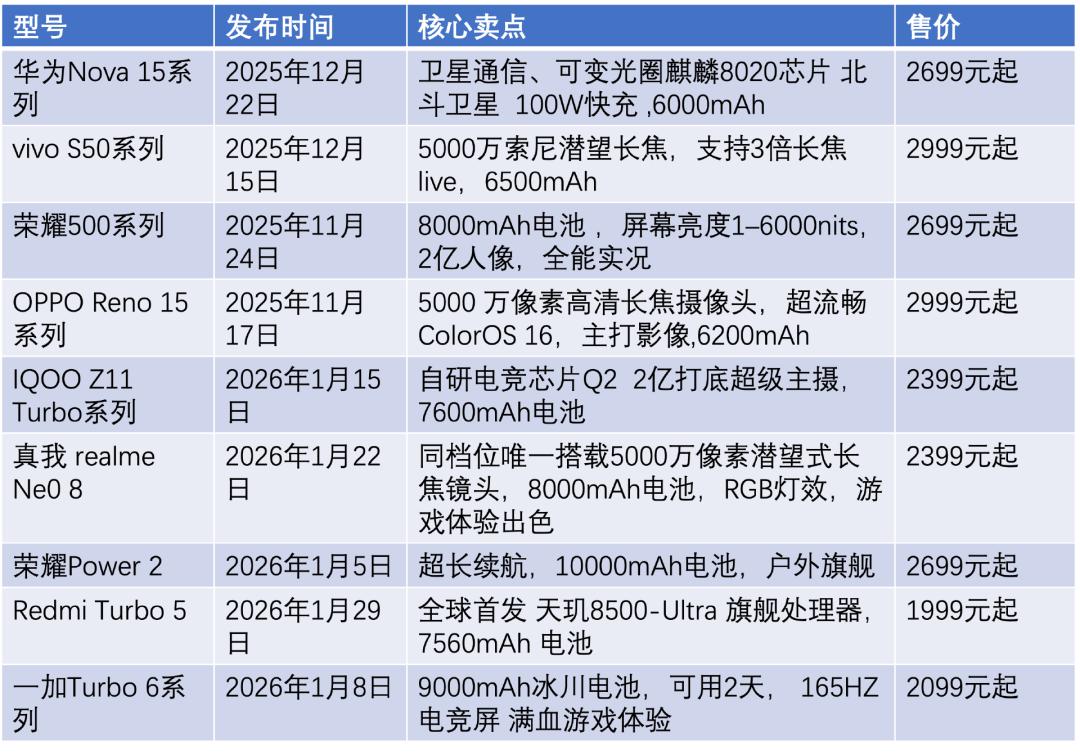
Core Viewpoint - The mid-range smartphone market is facing significant challenges due to rising memory prices, leading to increased prices or reduced specifications across brands, which undermines the value proposition of mid-range devices [1][11][12]. Group 1: Market Dynamics - The mid-range smartphone segment has seen its market share decline from 35% in 2021 to an expected 23% by 2027, while the entry-level market remains stable at 41%-45% [8]. - In January 2026 alone, Android manufacturers launched five mid-range models, indicating a crowded market despite declining demand [1][8]. - The mid-range segment, which once accounted for over half of the smartphone market, now serves around 500 million users in China, with a significant portion of sales concentrated in the 2000-4000 yuan price range [2][8]. Group 2: Product Features and Consumer Preferences - Recent mid-range models emphasize battery life, with all nine newly released models featuring batteries over 6000mAh, catering to the increasing reliance on smartphones [2][3]. - The focus has shifted from parameter competition to user experience, with brands prioritizing features like battery life and specific use-case enhancements [6][7]. - Notable models include the Honor Power 2 with a 10000mAh battery and the OnePlus Turbo 6 with a 9000mAh battery, highlighting the trend towards high-capacity batteries [4][5]. Group 3: Pricing Strategies and Profit Margins - Rising memory chip prices have led to increased costs for mid-range devices, with LPDDR4X prices rising nearly 80% and LPDDR5X prices more than doubling [11][12]. - Many manufacturers have opted to raise prices by 200-600 yuan for new models to maintain profit margins, with some models seeing price increases despite unchanged specifications [13][15]. - The profit margins for mid-range devices have significantly decreased, with some retailers reporting profits as low as 30 yuan for devices priced around 3000 yuan [10]. Group 4: Future Outlook - The smartphone market is expected to shift from growth to decline, with overall shipments projected to decrease by 3%-4% in 2026 [15]. - Companies are adjusting their strategies by reducing production orders and focusing on fewer, more standardized models to maintain competitiveness [15][16]. - The mid-range smartphone market is at a critical juncture, facing pressures from both rising component costs and changing consumer preferences [16].

开箱广货爆款!全球新能源汽车销冠在粤,力拼“智造”立潮头
Nan Fang Du Shi Bao· 2026-02-06 08:16
广东是全国新能源车渗透率最高的地区之一,也成为产业升级的示范者。2025年前11个月,广东省汽车 产量达271.96万辆,其中新能源汽车产量101.61万辆;新能源汽车销量达123.5万辆,同比增长15%,产 销规模稳居全国前列。销量端的表现,集中体现在头部企业的集体发力。比亚迪以460.2万辆的全年销 量问鼎全球新能源汽车销量冠军,其中海外销量首次突破100万辆,成为中国车企出海的标志性样本; 广汽集团全年终端销量181.35万辆,正加快在东南亚、美洲等市场布局;小鹏汽车全年交付42.9万辆, 并通过与大众集团的技术合作,实现智能电动车平台的反向输出。 "广东造"汽车驶向全球,并非孤军作战。从广州的整车制造基地,到深圳的芯片与软件研发,从佛山的 精密零部件生产,到东莞、惠州的动力电池集群,广东已形成覆盖"整车—电池—芯片—智能系统"的完 整新能源汽车产业链,核心部件自给率超过90%。在产业链细分环节,广东同样聚集了一批具备全球竞 争力的"隐形冠军":电池材料领域有贝特瑞、欣旺达,传感器领域有奥比中光、速腾聚创,智能驾驶解 决方案领域有元戎启行等企业协同发力,使广东具备"整车+核心零部件+技术服务"一体化出海 ...
