
纳芯微

Search documents
港股新股折价发行惯例已破 A股龙头企业赴港上市加速
Zheng Quan Ri Bao· 2025-07-28 17:07
Group 1: A-share Companies Going Public in Hong Kong - A-share companies are accelerating their listing process in Hong Kong, with 10 companies successfully listed this year, accounting for approximately 70% of the total fundraising in the Hong Kong IPO market [1] - A total of 78 A-share companies have either submitted applications to the Hong Kong Stock Exchange or announced plans to pursue listings, covering industries such as pharmaceuticals, power equipment, food and beverage, and finance [1] Group 2: Industry Leaders and Globalization Strategy - Industry leaders like Heng Rui Medicine, Ningde Times, and Hai Tian Flavoring have taken the lead in this wave of listings, indicating a strong trend among top companies [2] - Factors driving this trend include policy support, the companies' globalization strategies, and an expanding need for financing [2] - Semiconductor and consumer electronics companies are notably increasing their submissions for Hong Kong IPOs, with Suzhou Naxin Microelectronics aiming to enhance its competitiveness in the global automotive chip market [2] Group 3: Supportive Policies and Market Dynamics - The Hong Kong Stock Exchange has introduced new communication platforms to optimize interactions with listing companies, which is expected to facilitate the listing process [3] - The influx of foreign capital into Hong Kong IPOs has been significant, with international institutional investors showing strong interest, leading to a record high in cornerstone investments [4] Group 4: Changes in IPO Pricing Logic - The pricing logic for IPOs in Hong Kong has fundamentally changed, with the AH premium rate narrowing, and some stocks even showing sustained premiums [5] - Notably, companies like Ningde Times have achieved premium pricing for their Hong Kong listings, breaking the long-standing trend of discounted pricing [5] Group 5: Market Trends and Future Outlook - The market capitalization of the information technology sector in Hong Kong has surpassed that of traditional finance, indicating a rapid rise of new economy sectors [6] - UBS maintains a positive outlook on the Chinese capital market, particularly for AI-related technology stocks, which are expected to attract more foreign investment [6]
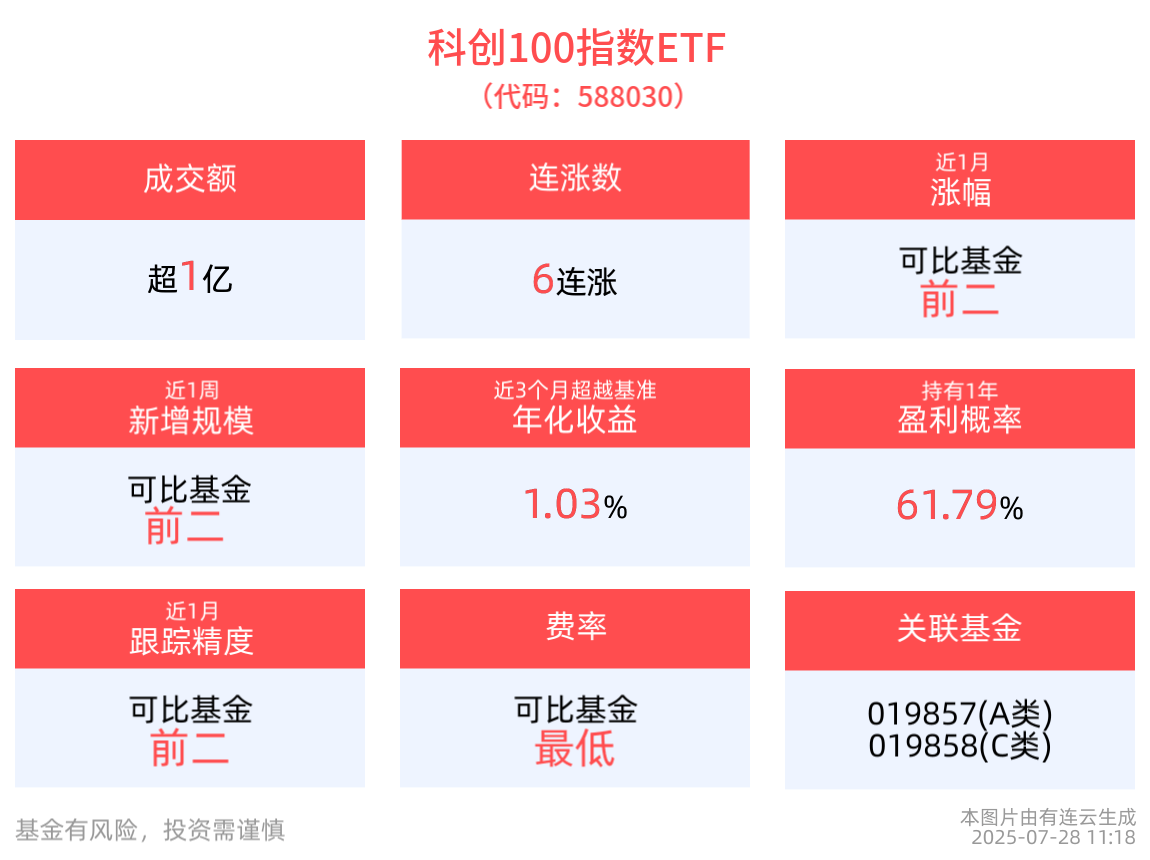
科创100指数ETF(588030)冲击6连涨,近1周规模增长显著,智元机器人发布首个动作驱动世界模型
Sou Hu Cai Jing· 2025-07-28 03:32
Core Insights - The Shanghai Stock Exchange Sci-Tech Innovation Board 100 Index (000698) has shown a positive trend, with a 0.66% increase as of July 28, 2025, and notable gains in constituent stocks such as Shengyi Electronics (688183) and Huafeng Technology (688629) [3] - The Sci-Tech 100 Index ETF (588030) has experienced a 3.82% increase over the past week, ranking 2nd among comparable funds [3] - The ETF has seen significant liquidity, with a turnover rate of 2.39% and a transaction volume of 1.54 billion yuan [3] Industry Developments - On July 27, 2025, Zhiyuan Robotics launched the "Genie Envisioner," the first open-source platform for action-driven world models in the industry, enhancing robotics capabilities [3] - Quark Health's large model has passed assessments for 12 core medical disciplines, marking a significant milestone in AI healthcare development in China [4] - The medical sector remains optimistic, with medical devices and services showing strong performance, suggesting a growing interest in AI healthcare and innovative medical devices [4] Fund Performance - The Sci-Tech 100 Index ETF has seen a net value increase of 57.22% over the past year, ranking in the top 10.96% among equity index funds [4] - The ETF's highest monthly return since inception was 27.67%, with an average monthly return of 8.57% during profitable months [4] - The ETF's management fee is 0.15%, and its tracking error is 0.013%, indicating high tracking precision compared to similar funds [5] Market Composition - As of June 30, 2025, the top ten weighted stocks in the Sci-Tech 100 Index accounted for 22.99% of the index, including companies like BeiGene (688235) and Huahong Semiconductor (688347) [6]


硬科技”持续进阶,创新“加速度
Xin Hua Ri Bao· 2025-07-28 00:40
Core Insights - The Sci-Tech Innovation Board (STAR Market) has raised over 1.1 trillion yuan in total IPO and refinancing funds in its six years, with Jiangsu enterprises leading the way [1] - The number of Jiangsu companies listed on the STAR Market has grown from 5 to 114, making it the largest group in the country, with a total market capitalization exceeding 1 trillion yuan and cumulative fundraising surpassing 189.8 billion yuan [1][10] - Strategic emerging industries such as biomedicine, integrated circuits, and new energy are advancing simultaneously, showcasing the strong synergy between capital and industry in Jiangsu [1] Fundraising and Corporate Growth - The STAR Market's efficient and transparent mechanisms align well with the innovative characteristics of companies like Suzhou Huaxing Yuan Chuang Technology Co., Ltd., which became the first listed company on the STAR Market [2][3] - Huaxing Yuan Chuang raised 880 million yuan for investments in flat panel display and semiconductor testing production lines, establishing itself as an industry leader [2] - Other companies, such as Suzhou Nano Micro Technology Co., Ltd., have also leveraged STAR Market fundraising to enhance their R&D capabilities and expand their business [3] R&D Investment and Patent Accumulation - Jiangsu STAR Market companies have invested over 20 billion yuan in R&D and hold more than 20,000 patents, indicating strong technological capabilities [5] - Companies like Nanjing Mailland Medical Technology Co., Ltd. have seen significant growth, with R&D expenditures consistently representing a substantial portion of their revenue [5] - Suzhou Naxin Microelectronics Co., Ltd. has focused on the automotive sensor and signal chain industries, achieving a high R&D investment ratio and accumulating numerous patents [6][7] Government Support and Ecosystem Development - The development of STAR Market companies in Jiangsu is supported by government policies that provide financial assistance and resources for high-tech enterprises [8][9] - Various cities in Jiangsu have implemented distinct support measures, such as Suzhou's comprehensive nurturing system for potential listed companies and Nanjing's innovative financial service stations [9][10] - As of June 30, 2023, Jiangsu has 251 companies in the IPO counseling stage, accounting for 16% of the national total, with a significant portion of these being STAR Market candidates [10] Future Outlook - The STAR Market "Jiangsu Legion" is poised for further growth, aiming to convert laboratory patents into market value and enhance its overall innovation capabilities [11]
一图看懂科创民企策略指数
中国基金报· 2025-07-25 11:14
Core Viewpoint - The article discusses the rapid development of the index system in China, highlighting the increasing market recognition and the accelerating trend of index-based investment, particularly focusing on the Shanghai Stock Exchange's initiatives to educate investors about index investment [8]. Group 1: Index Development and Market Trends - The index system in China has been rapidly improved, leading to a growing acceptance of index-based investment strategies among investors [8]. - The Shanghai Stock Exchange, in collaboration with China Fund News and China Securities Index Company, has launched educational initiatives to help investors understand the key aspects of index investment [8]. Group 2: Private Enterprises in the Sci-Tech Board - As of June 2025, there are 3,478 listed private enterprises on the A-share market, accounting for nearly two-thirds of all listed companies, with 422 of them on the Sci-Tech Board, representing over 70% [10]. - The total market capitalization of private enterprises on the Sci-Tech Board is 3.5 trillion yuan, with total revenue of 0.9 trillion yuan, constituting 58.2% and 68.0% of the total for the Sci-Tech Board, respectively [10][11]. Group 3: R&D Investment and Innovation - The Sci-Tech Board aims to support high-level technological self-reliance, focusing on "hard technology" enterprises, with private enterprises' R&D investment reaching nearly 80 billion yuan in 2024, resulting in an R&D intensity of 8.9% [12]. - The private enterprise strategy index on the Sci-Tech Board selects 50 companies based on their R&D investment and profitability, providing a tool for investors to access high-quality private enterprises [14][16]. Group 4: Index Sample Characteristics - The sample space for the private enterprise strategy index includes all private enterprises listed on the Sci-Tech Board, excluding ST and *ST securities, with a focus on liquidity and market capitalization [15][16]. - As of July 10, 2025, the total market capitalization of the index samples ranges from 2.3 billion to 50 billion yuan, covering 18% of the Sci-Tech Board [21]. Group 5: Industry Distribution - The private enterprise strategy index emphasizes support for technology enterprises, with the top three industries being new generation information technology (55.2%), biomedicine (23.6%), and high-end equipment (9.9%) [23][25]. - The average R&D investment ratio for the index samples is significantly higher than the overall A-share market, with a median of 21.4% compared to 4.3% for the A-share market [25].



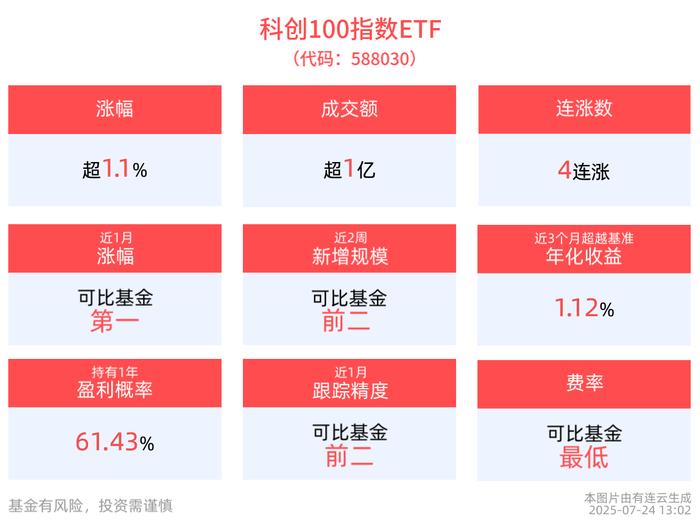
2025年以来AI推理景气度持续提升,科创100指数ETF(588030)上涨1.13%冲击4连涨
Xin Lang Cai Jing· 2025-07-24 05:32
Core Viewpoint - The Shanghai Stock Exchange's Sci-Tech Innovation Board 100 Index (000698) has shown strong performance, with significant increases in both the index and its constituent stocks, driven by the growth of the artificial intelligence (AI) sector in Shanghai [3][4]. Group 1: Index Performance - As of July 24, 2025, the Sci-Tech Innovation Board 100 Index rose by 1.56%, with notable gains from stocks such as Jinpan Technology (up 9.42%) and Sangfor Technologies (up 8.77%) [3]. - The Sci-Tech 100 Index ETF (588030) has experienced a 3.50% increase over the past week, ranking 1 out of 11 comparable funds [3]. - The ETF's trading volume reached 1.37 billion yuan, with a turnover rate of 2.14% [3]. Group 2: AI Sector Growth - Shanghai has integrated AI into its three leading industries, implementing policies to create a comprehensive ecosystem for AI development [3]. - The AI industry in Shanghai exceeded 118 billion yuan in scale in Q1 2025, marking a 29% year-on-year growth, with profits increasing by 65% [3]. Group 3: ASIC Market Insights - The development of AI Agent technology has led to a significant increase in AI inference volume, with Google's AI Token inference reaching 480 trillion in April 2025, a 50-fold increase year-on-year [4]. - ASIC chips are expected to dominate the market due to their lower power consumption and cost compared to GPUs, particularly in applications like search ranking and SaaS [4]. Group 4: ETF Financial Metrics - The Sci-Tech 100 Index ETF has achieved a 50.81% net value increase over the past year, ranking 346 out of 2936 in equity fund performance [5]. - The ETF's highest monthly return since inception was 27.67%, with an average monthly return of 8.57% [5]. - The ETF's Sharpe ratio was recorded at 1.30 as of July 18, 2025, indicating strong risk-adjusted returns [6]. Group 5: Fund Characteristics - The management fee for the Sci-Tech 100 Index ETF is 0.15%, and the custody fee is 0.05%, which are among the lowest in comparable funds [6]. - The ETF closely tracks the Sci-Tech Innovation Board 100 Index, which includes 100 securities selected for their market capitalization and liquidity [6]. Group 6: Top Holdings - As of June 30, 2025, the top ten weighted stocks in the Sci-Tech Innovation Board 100 Index accounted for 22.99% of the index, including companies like BeiGene and Ruichuang Micro [7].
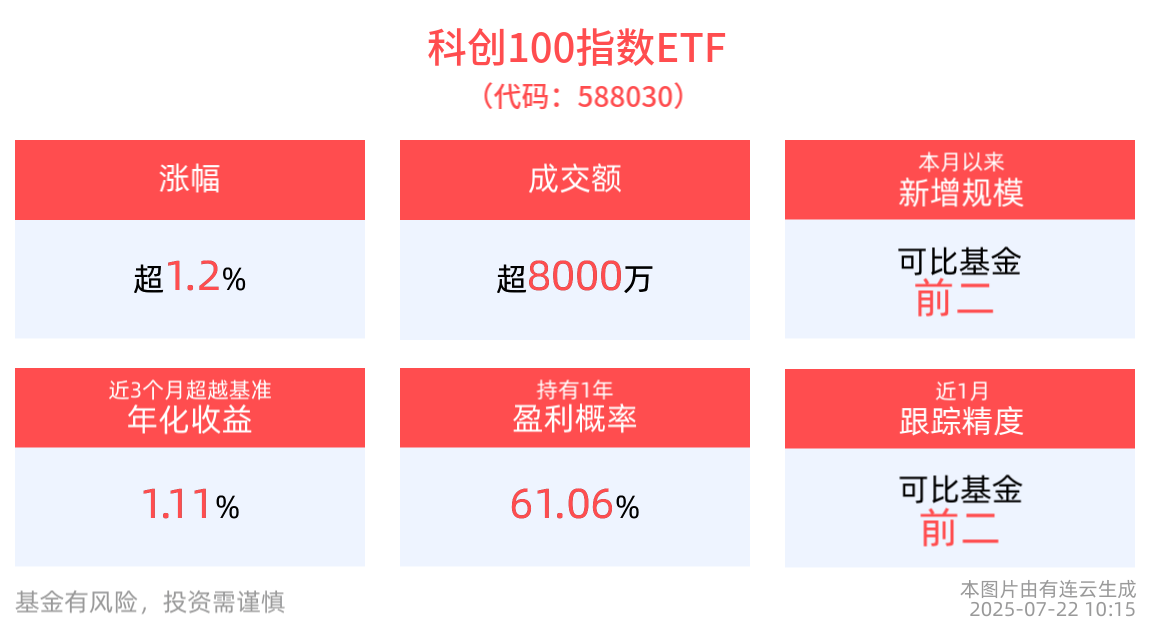
铁建重工再度涨停,科创100指数ETF(588030)上涨1.23%,本月以来规模增长显著
Sou Hu Cai Jing· 2025-07-22 02:37
Group 1 - The Shanghai Stock Exchange Sci-Tech Innovation Board 100 Index (000698) has shown a strong increase of 1.35% as of July 22, 2025, with notable gains in constituent stocks such as Iron Construction Heavy Industry (688425) up by 20.04% and Funeng Technology (688567) up by 8.39% [3] - The Sci-Tech 100 Index ETF (588030) has also risen by 1.23%, with a latest price of 1.07 yuan, and has accumulated a weekly increase of 3.44% as of July 21, 2025 [3] - A total of 127 public fund institutions participated in the research of 104 A-share companies last week, with a cumulative research count of 618 times, maintaining over 600 counts for two consecutive weeks [3] Group 2 - The engineering machinery industry is experiencing a cyclical recovery, with expectations for improved corporate profitability driven by both domestic and external demand [4] - The semiconductor equipment sector is anticipated to accelerate the validation of core domestic equipment, indicating a clear trend towards self-sufficiency [4] - The Sci-Tech 100 Index ETF has seen a significant growth in scale, increasing by 46.61 million yuan this month, ranking second among comparable funds [4] Group 3 - As of July 18, 2025, the Sci-Tech 100 Index ETF has a Sharpe ratio of 1.30 for the past year, indicating a favorable risk-adjusted return [5] - The ETF has a management fee rate of 0.15% and a custody fee rate of 0.05%, which are among the lowest in comparable funds [5] - The ETF closely tracks the Sci-Tech Innovation Board 100 Index, which selects 100 securities with medium market capitalization and good liquidity from the Sci-Tech Innovation Board [5] Group 4 - As of June 30, 2025, the top ten weighted stocks in the Sci-Tech 100 Index account for 22.99% of the index, with companies like BeiGene (688235) and Huahong Semiconductor (688347) among the leaders [6]

东兴蓝海财富混合A:2025年第二季度利润121.91万元 净值增长率6.42%
Sou Hu Cai Jing· 2025-07-21 10:29
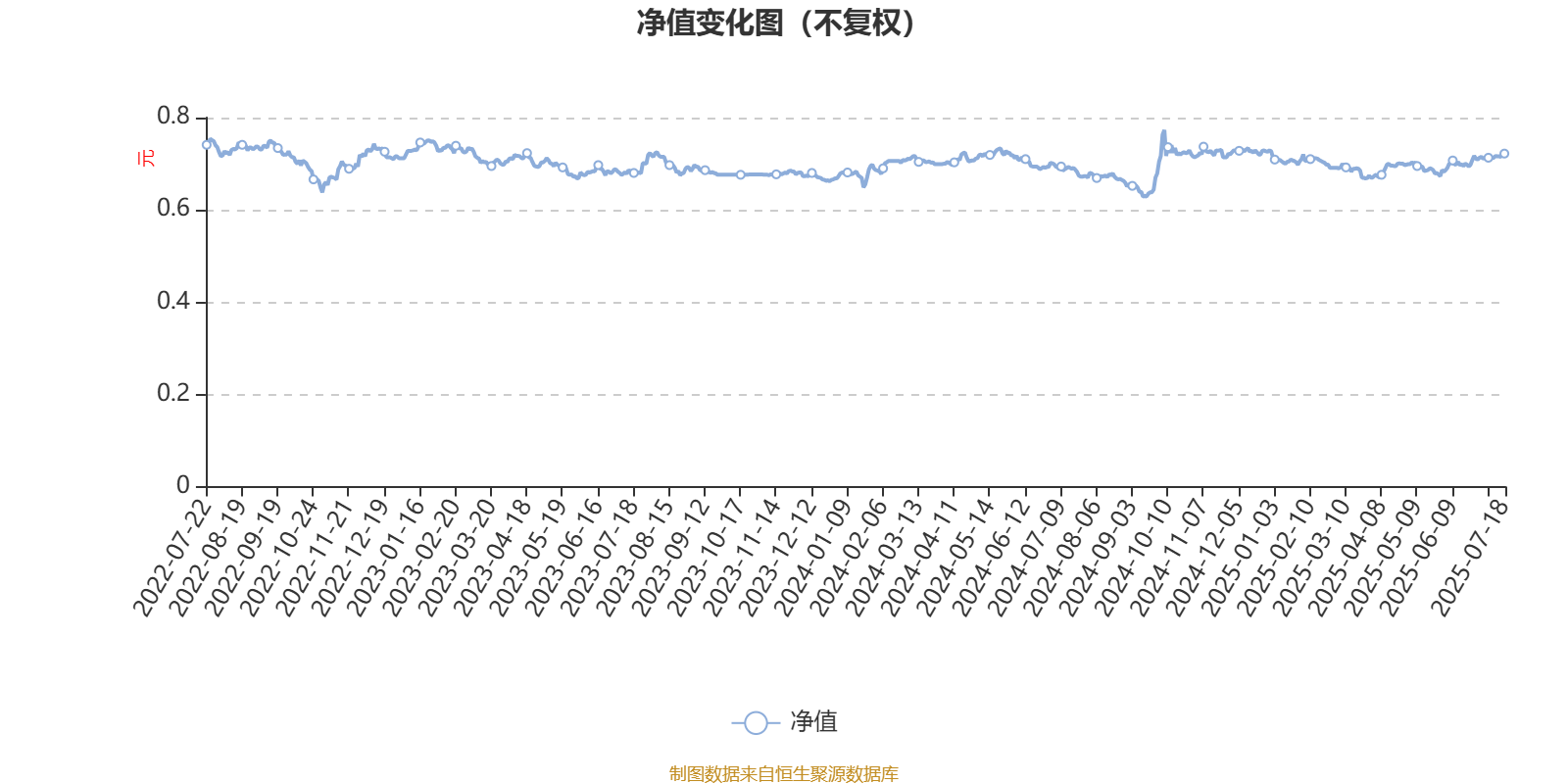
Core Viewpoint - The AI Fund Dongxing Blue Ocean Wealth Mixed A (002182) reported a profit of 1.2191 million yuan for Q2 2025, with a weighted average profit per fund share of 0.0426 yuan, and a net asset value growth rate of 6.42% during the period [3][15]. Fund Performance - As of July 18, the fund's unit net value was 0.722 yuan, with a three-month net value growth rate of 3.88%, ranking 52 out of 119 comparable funds [4]. - The fund's six-month net value growth rate was 2.12%, ranking 84 out of 119, while the one-year growth rate was 4.49%, ranking 89 out of 119 [4]. - Over the past three years, the fund's net value growth rate was -3.60%, ranking 69 out of 119 [4]. Risk and Return Metrics - The fund's Sharpe ratio over the past three years was 0.0621, ranking 57 out of 119 comparable funds [8]. - The maximum drawdown over the past three years was 16.58%, with the highest single-quarter drawdown occurring in Q1 2022 at 17.61% [10]. Asset Allocation - The average stock position over the past three years was 63.86%, compared to the industry average of 46.3% [13]. - The fund reached its highest stock position of 93.76% by the end of Q3 2024, while the lowest was 0.12% at the end of Q3 2023 [13]. Fund Holdings - As of the end of Q2 2025, the top ten holdings of the fund included Huahong Semiconductor, Naxin Micro, Sitaiwei, Hengxuan Technology, Ruichuang Micro, BeiGene, Hongsoft Technology, Zhongke Feimiao, Guodun Quantum, and CloudWalk Technology [18].
宇树上市辅导开启科技新篇章,科创100ETF华夏(588800)早盘上涨争新高
Mei Ri Jing Ji Xin Wen· 2025-07-21 02:48
Group 1 - The Shanghai Stock Exchange Sci-Tech Innovation Board 100 Index rose by 0.25% as of July 21, 2025, with notable increases in constituent stocks such as Tiedao Heavy Industry (+19.90%) and Lingyun Optics (+5.66%) [1] - The Huaxia Sci-Tech 100 ETF (588800) increased by 0.39%, with a latest price of 1.02 yuan and a trading volume of 23.5642 million yuan, indicating a turnover rate of 0.82% [1] - The latest scale of the Huaxia Sci-Tech 100 ETF reached 2.864 billion yuan [1] Group 2 - CITIC Securities highlighted that sectors with high earnings certainty are performing well, and the market is expected to continue focusing on trend certainty [2] - The market sentiment remains high, with new macro narratives and event catalysts developing, particularly in the second half of the year, which is typically a busy period for technology releases in the domestic tech industry [2] - The Sci-Tech Innovation Board's outlook is positive, with investment tools becoming increasingly diverse, including the active trading of the Huaxia Sci-Tech Index ETF (589000) [2]



本土自给率仍不足10%? 车企加码芯片自研
Zhong Guo Jing Ying Bao· 2025-07-18 20:48
Core Insights - The automotive chip market, previously heavily reliant on imports, is undergoing significant changes as companies like NIO develop their own chips, such as the "Shenji NX9031" [3][5] - The Chinese automotive industry is aiming to increase its domestic chip supply rate from under 10% to 30%-35%, driven by the need for self-sufficiency highlighted during the global chip shortage [4][5] - Companies are investing heavily in R&D for automotive chips, with NIO and other manufacturers pursuing self-developed solutions to enhance performance and reduce costs [7][10] Industry Trends - The automotive chip market is expected to grow rapidly, with the market size projected to expand from 37.1 billion yuan in 2024 to 85.8 billion yuan by 2029 [6] - The reliance on foreign chips remains high, with over 90% of automotive chips in China imported, and 99% for computing and control chips [4] - The shift towards domestic chip production is seen as a critical opportunity for local manufacturers, especially in high-end chips [5][6] Company Developments - NIO's self-developed chip "Shenji NX9031" is reported to outperform four NVIDIA Orin-X chips, significantly enhancing vehicle safety and user experience [7][10] - Naxin Microelectronics, a leading domestic analog chip manufacturer, has achieved a compound annual growth rate of 36.4% in automotive electronics revenue from 2022 to 2024 [5][6] - Traditional automakers like Geely and Dongfeng are focusing on partnerships and investments in chip companies to bolster their technological capabilities [8][9] Challenges and Opportunities - The automotive chip development process is lengthy and costly, often taking 2-4 years for certification, which poses challenges for companies like Intel, leading to a strategic retreat from the automotive sector [10][11] - The need for high reliability and safety standards in automotive chips complicates the development process, requiring extensive testing and validation [11] - Despite challenges, the push for self-sufficiency in chip production presents a significant opportunity for growth in the domestic semiconductor industry [4][5]


科创板专题系列:1+N新政助力科创板高质量发展
Tianfeng Securities· 2025-07-18 07:13
Group 1 - The report outlines a comprehensive policy framework for supporting the high-quality development of the Sci-Tech Innovation Board, including 15 reform measures that cover the entire lifecycle of fundraising, investment, lending, insurance, and exit [1][11][12] - The report highlights the introduction of the "1+6" policy measures aimed at enhancing the inclusiveness and adaptability of the Sci-Tech Innovation Board, including the reintroduction of the fifth listing standard for unprofitable companies [10][19][20] - The report indicates that the average liquidity ratio of Sci-Tech Innovation Board companies has significantly improved compared to 2019, demonstrating stronger short-term solvency compared to companies on the main board [28][29] Group 2 - The report reveals that the average asset turnover ratio for Sci-Tech Innovation Board companies has decreased more sharply than that of the main board, indicating a focus on long-term investments such as R&D and equipment acquisition [30][31] - The report notes that the overseas revenue of Sci-Tech Innovation Board companies has shown a consistent upward trend, with revenues reaching 418.22 billion yuan in 2024, highlighting the increasing internationalization of these companies [42][36] - The report emphasizes that the proportion of high-tech companies among newly listed firms on the Sci-Tech Innovation Board has exceeded 90%, reflecting the board's focus on strategic emerging industries [43]