
永兴材料

Search documents
有色金属大宗金属周报:232调查和降息预期交织催化,铜价震荡偏强-20250706
Hua Yuan Zheng Quan· 2025-07-06 08:19
Investment Rating - The investment rating for the non-ferrous metals industry is "Positive" (maintained) [4][106]. Core Views - The report highlights that copper prices are experiencing fluctuations due to the interplay of the 232 investigation and interest rate cut expectations, with recent price changes showing a mixed trend [5]. - The report emphasizes the importance of low inventory levels in supporting copper prices, while also noting the potential impact of the 232 copper import investigation and upcoming interest rate decisions by the Federal Reserve [5]. - The report suggests monitoring companies such as Zijin Mining, Luoyang Molybdenum, Jincheng Mining, and Western Mining for investment opportunities [5]. Summary by Sections 1. Industry Overview - The report provides insights into macroeconomic indicators, including U.S. employment data, which may influence market conditions [9]. - The non-ferrous metals sector's performance is analyzed, with the sector underperforming compared to the Shanghai Composite Index [11]. 2. Industrial Metals 2.1 Copper - Recent price movements show LME copper up by 0.25%, while SHFE copper is down by 0.24% [25]. - Inventory levels for copper have increased, indicating a potential shift in market dynamics [25]. 2.2 Aluminum - LME aluminum prices increased by 0.41%, with inventory levels also rising [35]. - The report notes a decrease in aluminum smelting profits, attributed to rising costs [35]. 2.3 Lead and Zinc - Lead prices have seen a slight increase, while zinc prices have decreased [48]. - Inventory levels for both metals are discussed, highlighting market supply conditions [48]. 2.4 Tin and Nickel - Tin prices have decreased slightly, while nickel prices have shown an upward trend [62]. - The report discusses profitability metrics for nickel producers in both domestic and international markets [62]. 3. Energy Metals 3.1 Lithium - Lithium prices have shown a slight rebound, with specific price changes noted for lithium carbonate and lithium spodumene [74]. - The report indicates that supply-side adjustments are anticipated, which may affect future pricing [74]. 3.2 Cobalt - Cobalt prices have increased domestically due to export bans from the Democratic Republic of Congo, which may create supply constraints [86]. - The report highlights the profitability of domestic cobalt refining operations [86].



有色能源金属行业周报:缅甸锡矿进口量连续多月低于1万吨警戒线,供应偏紧预期对锡价或有支撑-20250705
HUAXI Securities· 2025-07-05 15:03
Investment Rating - The industry rating is "Recommended" [4] Core Views - The report highlights that the import volume of tin from Myanmar has remained below the warning line of 10,000 tons for several months, leading to expectations of tight supply which may support tin prices [10][21] - Nickel prices have increased week-on-week, driven by traders' replenishment needs, with LME nickel spot settlement price reported at $15,120 per ton, up 0.6% from June 27 [21] - Cobalt prices have also risen, with electrolytic cobalt priced at 251,800 yuan per ton, up 0.6% from June 27, although downstream demand has not shown significant improvement [25][32] - The report notes a decrease in antimony ingot prices and production, with domestic antimony ingot average price at 192,500 yuan per ton, down 2.53% from June 26 [33][36] - Lithium carbonate prices have increased slightly, with the average market price at 62,300 yuan per ton, up 1.81% from June 27, but the market is expected to maintain a low-level fluctuation pattern [41][46] Summary by Sections Nickel Industry - Nickel prices have risen due to replenishment demand from traders, with LME nickel total inventory decreasing by 0.89% [21] - Domestic production costs for nickel smelters have increased significantly due to high CIF prices of Philippine nickel ore [21] - The report indicates that the suspension of production lines by Qingshan Holding Group may further impact local nickel mining in Indonesia [13][24] Cobalt Industry - Cobalt prices have increased, supported by the extension of a temporary export ban by the Democratic Republic of Congo, which accounts for about 75% of global electric vehicle battery supply [25][32] - Despite the price increase, downstream demand remains weak, with most manufacturers maintaining a just-in-time purchasing strategy [25][32] Antimony Industry - Antimony ingot prices have decreased, with a significant drop in production expected in July due to ongoing supply tightness [33][36] - The report suggests that domestic raw material supply remains tight, which may support future antimony prices [36] Lithium Industry - Lithium carbonate prices have seen a slight increase, but the market is still characterized by oversupply, with inventory pressures not effectively alleviated [41][46] - The report anticipates that lithium prices will continue to fluctuate at low levels due to ongoing supply-demand imbalances [41][46] Tin Industry - The report indicates that the import volume of tin from Myanmar is below the warning line, leading to expectations of tight supply which may support tin prices [10][21] - The overall supply situation is expected to remain tight due to slow recovery in Myanmar's tin mining operations [10][16] Rare Earth Industry - Following the recent US-China trade negotiations, China has partially relaxed its export controls on rare earths, which may alleviate some supply pressures for Western companies [15][19] - The report notes that the rare earth market is experiencing price increases driven by demand from major manufacturers, although actual transaction volumes remain low [9][15]

超4100只个股下跌
第一财经· 2025-07-04 07:52
Market Overview - The three major stock indices closed mixed, with the Shanghai Composite Index at 3472.32 points, up 0.32%, while the Shenzhen Component Index fell 0.25% to 10508.76 points, and the ChiNext Index decreased by 0.36% to 2156.23 points [1][2]. Stock Performance - Over 1100 stocks rose, while more than 4100 stocks declined, indicating a bearish market sentiment overall [2]. - The banking sector showed strong performance, with major banks like China CITIC Bank, Industrial Bank, and China Everbright Bank rising over 3% [5]. - The cross-border payment concept stocks were notably active, with Longbright Technology rising over 13% and Tianyang Technology increasing by over 10% [5]. Sector Analysis - The financial sector saw a midday surge, while sectors such as military, solid-state batteries, marine economy, and rare earth permanent magnets weakened [3]. - The energy metals sector faced significant declines, with YH Precision dropping nearly 10% and Tengyuan Cobalt falling over 4% [5]. Capital Flow - Main capital flows showed net inflows into banking, pharmaceutical, and computer sectors, while there were net outflows from power equipment and non-ferrous metals sectors [7]. - Specific stocks like Wolong Nuclear Materials, Xiexin Energy, and Data Port saw net inflows of 1.183 billion, 532 million, and 474 million respectively [8]. Institutional Insights - Jianghai Securities noted that a breakthrough of previous highs is imminent but requires support from the financial sector [11]. - Galaxy Securities suggested that the Shanghai Composite Index may continue to rise but needs volume support, while Guotai Junan Securities indicated a potential upward trend in the fourth quarter due to a weak dollar environment [12].


供给侧改革2.0启动,钢铁指数人气回升!相关ETF布局正当时?
Sou Hu Cai Jing· 2025-07-04 07:47
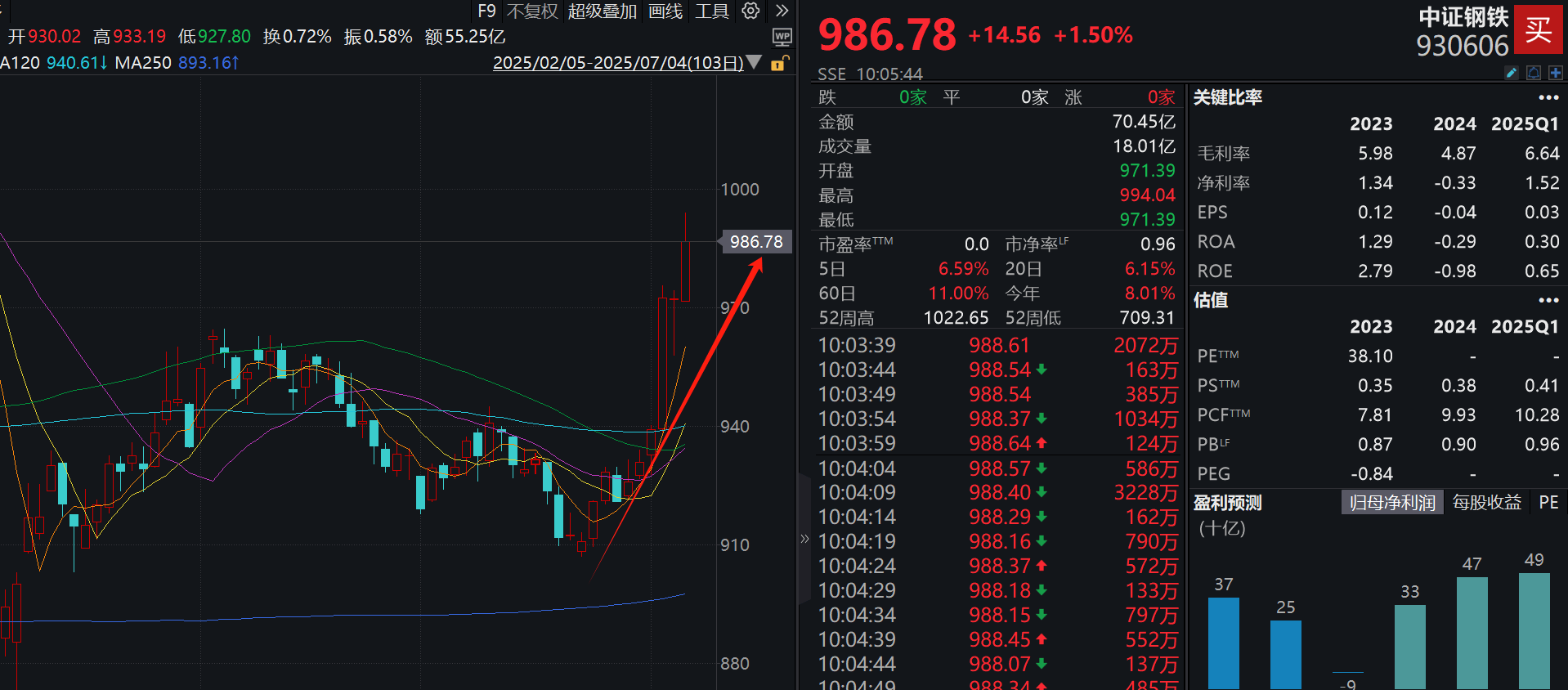
Group 1 - The core viewpoint of the article emphasizes the significance of the supply-side reform 2.0, which aims to eliminate backward production capacity and effectively address chaotic competition in the industry [1] - The supply-side reform initiated in 2015 led to substantial price increases in commodities, with rebar futures soaring from 843 yuan/ton to 3147 yuan/ton, a 273% increase, and coking coal prices rising from 203 yuan to 719 yuan, a 3.5-fold increase [1] - The recent performance of the steel industry, particularly the China Steel Index, has mirrored past trends, with a notable increase of over 3.5% in a single day, indicating a potential revival similar to the previous supply-side reform [1][4] Group 2 - The current supply-side reform is characterized by unprecedented policy strength, focusing on eliminating low-price competition and orderly phasing out of backward production capacity, suggesting a potential for significant market recovery [6] - The valuation of steel stocks should consider the cyclical nature of the industry, with many steel companies currently valued below their replacement cost by 0.35 times, indicating a sufficient margin of safety [6] - The comparison between the China Steel Index and the National Steel Industry Index shows a high degree of overlap, with both indices focusing on the steel industry, although the China Steel Index includes some coal companies [7] Group 3 - The performance of funds tracking the China Steel Index and the National Steel Industry Index has been similar, with differences in returns being minimal, generally within 0.1% [12] - Specific funds, such as the Guolian National Steel A and Penghua National Steel Industry A, have shown significant returns of 8.10% and 7.66% respectively, outperforming the CSI 300 index [14] - The article suggests that as the economy develops, steel consumption will stabilize, with a shift from rebar consumption in construction to sheet metal consumption in manufacturing, indicating a potential improvement in profitability for the steel sector [14]


锂行业专题报告解读
2025-07-03 15:28
锂行业专题报告解读 20250703 摘要 碳酸锂价格短期内或反弹至 6.7 万-7 万元/吨,若国内大型锂云母矿停产, 有望突破 7 万元。中长期看,价格中枢预计在 7 万元上下震荡,需求好 时或达 7-8 万元,需求弱时则为 6-7 万元。 当前碳酸锂价格已接近行业成本曲线的 70 分位线和现金成本曲线的 80 分位线,配置锂矿股性价比高。碳酸锂价格每上涨 1 万元,相关股票预 计平均涨幅约 30%。 澳洲部分锂矿因出口价下跌已停产,但未出现大规模停产信号。澳洲锂 辉石矿成本显著下降,但仍高于中国进口价,短期内难见新的停产迹象, 预计 2026 年可能出现更多产能出清。 南美盐湖开发进展缓慢,成本因海外通胀而显著提高,即使是最低成本 的阿卡塔玛盐湖也约为 4 万元/吨,部分项目成本更高,导致企业面临成 本压力。 非洲锂矿成为中资企业重点开发区域,成本已降至 6-7 万元/吨,现金成 本 5-6 万元/吨。尽管当前价格下多数矿山亏损,但头部厂商财务状况良 好,预计将继续投放产能并优化成本。 Q&A 最近碳酸锂期货主力合约价格出现明显反弹的原因是什么? 短期内碳酸锂价格可能达到多少? 短期内,碳酸锂价格可能上 ...
南华期货碳酸锂企业风险管理日报-20250703
Nan Hua Qi Huo· 2025-07-03 12:28
Report Summary 1. Report Industry Investment Rating No investment rating information is provided in the report. 2. Core Viewpoints - The lithium ore, lithium salt, and battery cell markets are under significant inventory pressure, and the de - stocking process is slow. The medium - to - long - term supply - demand imbalance has not been substantially alleviated [3]. - There are two short - term logics in the market. In the price - downward cycle, there is a negative feedback loop of "lithium salt price decline - ore price loosening - lithium salt price decline again". When the futures rebound, there is a step - by - step upward chain of "futures price increase - capacity release - increased ore consumption - ore price hike", but it will eventually return to the oversupply fundamentals and the price will fall again [3]. - The futures market in the second half of the year is expected to be divided into two phases: the futures price will rise in a volatile manner at the beginning of the third quarter due to improved macro - sentiment, supply disruptions, and better - than - expected demand in the off - season; the futures price will decline in a volatile manner in the fourth quarter due to the end of technical reforms and increased production [3]. - Strategy recommendations: LC09 - 11 positive spread arbitrage; short LC2511 contracts at high prices; sell call options at high prices [3]. 3. Summary by Related Content Futures Price and Strategy - **Futures Price Forecast**: The price of the lithium carbonate main contract is expected to fluctuate between 59,000 - 62,000 yuan/ton, with a current 20 - day rolling volatility of 20.5% and a 3 - year historical percentile of 23.3% [2]. - **Enterprise Risk Management Strategy**: - **Inventory Management**: For enterprises with high product inventory and risk of impairment, 70% of the inventory can be hedged by short - selling LC2509 lithium carbonate futures, 30% by selling call options, and buying out - of - the - money put options [2]. - **Procurement Management**: For enterprises with future procurement plans, they can buy long - term lithium carbonate contracts according to the procurement plan, sell put options, and buy out - of - the - money call options to lock in procurement costs [2]. Market Analysis - **Lithium Market Core Contradiction**: The lithium market is facing inventory pressure, slow de - stocking, and a medium - to - long - term supply - demand imbalance. There are two short - term price - movement logics [3]. - **Lithium Market利多因素**: Improved macro - sentiment, supply - side disruptions, and the market trading of the contradiction between high open interest and low warehouse receipts will boost the futures market price [6]. - **Lithium Market利空因素**: High future lithium ore production expectations, inventory pressure on ore prices, continuous inventory accumulation of lithium ore and lithium salt, and postponed capacity clearance due to technological upgrades [5][7]. Market Data - **Futures Market Data**: - The closing price of the lithium carbonate main contract is 64,080 yuan/ton, up 120 yuan or 0.19% from the previous day; the trading volume is 420,967 lots, down 119,468 lots or 22.11%; the open interest is 334,057 lots, up 8,483 lots or 2.61% [9]. - The closing price of the LC2511 contract is 63,720 yuan/ton, up 160 yuan or 0.25%; the trading volume is 36,817 lots, down 10,160 lots or 21.63%; the open interest is 98,399 lots, up 4,871 lots or 5.21% [9]. - **Lithium Ore Market Data**: The prices of various types of lithium ore, such as lithium mica, lithium spodumene, and amblygonite, have increased to varying degrees. For example, the average price of lithium mica (Li2O: 2 - 2.5%) is 1,315 yuan/ton, up 40 yuan or 3.14% [18]. - **Lithium Salt Market Data**: The prices of industrial - grade and battery - grade lithium carbonate have increased, while the prices of industrial - grade and battery - grade lithium hydroxide have decreased slightly. For example, the average price of industrial - grade lithium carbonate is 60,500 yuan/ton, up 450 yuan or 0.75% [21]. - **Lithium Industry Chain Spread Data**: The spread between battery - grade and industrial - grade lithium carbonate remains unchanged; the spread between battery - grade lithium hydroxide and battery - grade lithium carbonate has decreased; the spread between battery - grade lithium hydroxide CIF in Japan, South Korea and the domestic market has increased [23]. - **Lithium Carbonate Warehouse Receipt Data**: The total number of lithium carbonate warehouse receipts is 22,880, a decrease of 300 from the previous day [36]. Downstream Market Data - The prices of downstream products such as lithium iron phosphate, lithium manganese iron phosphate, ternary materials, and electrolyte have changed to varying degrees. For example, the price of lithium iron phosphate (power type) is 30,660 yuan/ton, up 110 yuan or 0.36% [33].
“反内卷”政策下,能源与材料有哪些投资机会?
2025-07-02 15:49
"反内卷"政策下,能源与材料有哪些投资机会? 20250702 摘要 国家层面反内卷政策升级,旨在解决低价竞争和产能过剩问题,尤其针 对地方政府不规范行为,以提振工业企业盈利能力,截至 2025 年 6 月 PPI 已连续 33 个月负增长。 光伏产业面临严重产能过剩,需通过供给侧改革盘活市场,并作为中美 关税谈判筹码,通过价格调整避免低价倾销指控,改善产业链盈利状况, 关注硅料价格和股价变化。 光伏行业供给侧改革分两步走:划定落后产能并约束开工率,通过收储 或成立基金消化多晶硅库存,优先关注上游原材料如通威股份,下游组 建环节如晶澳科技、晶科能源。 建材领域反内卷政策执行效果显著,水泥行业预计有 3-4 亿吨熟料厂退 出市场,推荐海螺水泥、华新水泥等;玻璃行业头部企业减产,关注浮 法玻璃及光伏玻璃投资机会。 钢铁行业通过环保限产和落后产能退出优化供给,企业主动调节产量, 利润有望走阔,关注新钢股份、华菱钢铁等估值较低的板材类标的,以 及宝钢股份。 Q&A 反内卷政策的演化脉络是什么? 反内卷政策最早在 2024 年 7 月 30 日的中央政治局会议上提出,当时强调行 业自律,防止内卷式恶性竞争,并畅通低效产 ...
海外锂矿近况交流
2025-07-02 15:49
Summary of Key Points from Conference Call Records Industry Overview - The conference call primarily discusses the lithium mining industry, focusing on developments in Australia and Zimbabwe, as well as challenges and opportunities in other regions such as South America and Africa [1][3][10]. Key Insights and Arguments - **Declining Lithium Grades and Mine Closures**: Australia is experiencing a decline in lithium ore grades and mine closures, aligning with global trends. New projects like Mountain Holland and Castle in Valley are expected to release 160,000 to 200,000 tons of lithium ore, while older mines are optimizing recovery rates [1][4]. - **Challenges in Zimbabwe**: Zimbabwe's lithium production faces significant challenges, including lower ore quality compared to Australia, political risks associated with the BOT model, and issues with electricity and sulfuric acid supply for lithium sulfate production [1][5][6]. - **Investment and Taxation Issues**: The Zimbabwean government imposes a 5% export tax on lithium, which Chinese companies are negotiating to delay until 2027, when a sulfuric acid plant is expected to be operational [1][9][6]. - **High Transportation Costs**: Transportation costs for lithium from Mali are high, making profitability difficult. The Democratic Republic of Congo faces legal disputes that hinder development, while South American salt lakes present rich resources but have unfavorable investment environments [1][10][12]. - **Long-term Prospects in South America**: Companies with strong capabilities and professional teams are expected to benefit from long-term investments in South American salt lakes, despite the high initial capital expenditures and infrastructure challenges [1][18]. Additional Important Content - **Production Costs and Pricing Dynamics**: The average production cost for Australian lithium mines is approximately 62,000 CNY per ton, while Zimbabwe's costs are close to 70,000 CNY per ton. Current market conditions show a negative feedback loop between spot prices and production costs, leading to further price declines [3][21][22]. - **Market Overcapacity**: The lithium market is currently in a state of oversupply, with an average excess of 200,000 tons per year, which may take two to five years to absorb [3][32]. - **Future Price Expectations**: Short-term expectations for lithium carbonate prices are projected to remain between 70,000 and 80,000 CNY, with long-term forecasts suggesting similar levels unless significant changes in demand or supply occur [34]. - **Emerging Technologies**: The development of solid-state batteries may influence lithium demand, but the impact is expected to be limited in the short term due to slower-than-anticipated technological advancements [38][41]. Conclusion The lithium mining industry is facing a complex landscape characterized by declining ore grades, high production costs, and significant geopolitical risks, particularly in Zimbabwe. While there are opportunities for growth in South America, the current market is oversupplied, leading to price pressures. Companies must navigate these challenges while considering the potential impact of emerging technologies on future demand.


午后爆拉!发生了什么?
Feng Huang Wang Cai Jing· 2025-07-02 13:38
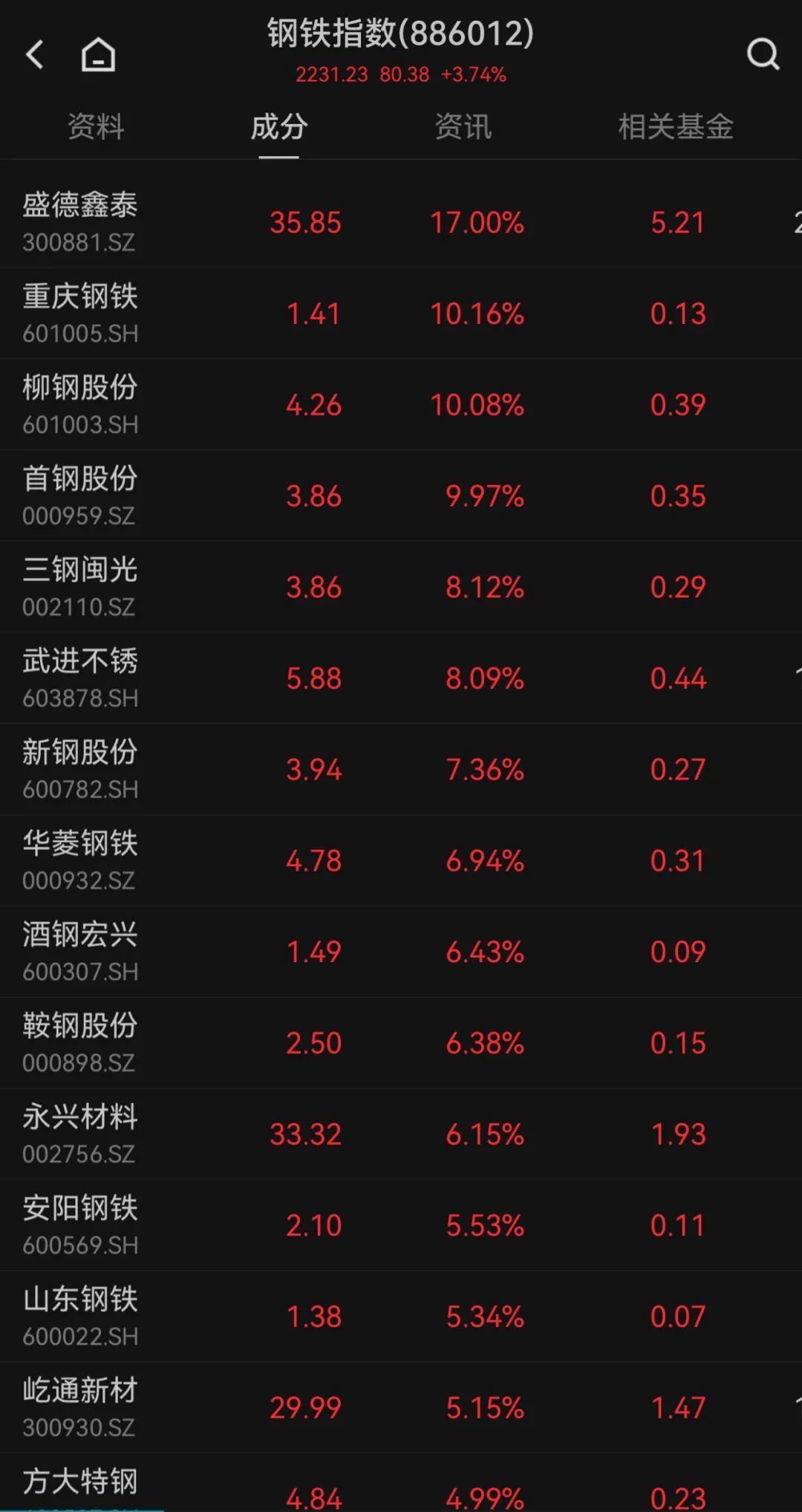
Group 1: Steel Industry Performance - The steel sector experienced significant gains, with the steel index rising by 3.74% to 2231.23 points [2] - Notable stocks included 盛德鑫泰, which surged by 17%, and 重庆钢铁, 柳钢股份, and others reaching their daily limit [3] - The market saw a strong correlation between the A-share market and commodity markets, with polysilicon and glass futures leading the gains [1] Group 2: Environmental Regulations Impact - Increased environmental restrictions in Tangshan are expected to affect steel production, with about half of the steel mills reporting notifications of production cuts [4] - The China Iron and Steel Association is set to hold a meeting to discuss the industry's progress and challenges, indicating a focus on future development strategies [4] Group 3: Marine Economy Development - The central government is promoting high-quality development of the marine economy, with policies encouraging social capital participation and innovation in marine technology [8] - The marine economy is expected to accelerate, supported by various regional policies aimed at optimizing and upgrading the marine industry structure [8] Group 4: Marine Economy Industry Chain - The marine economy industry chain is categorized into three levels: infrastructure, equipment technology, and resource development [9] - Key areas of focus include deep-sea technology, offshore wind power, and marine biological medicine, with significant investment opportunities identified [10]
南华期货碳酸锂企业风险管理日报-20250702
Nan Hua Qi Huo· 2025-07-02 09:50
南华期货碳酸锂企业风险管理日报 2025年07月02日 夏莹莹(投资咨询证书:Z0016569) 余维函 (期货从业证号:F03144703) 投资咨询业务资格:证监许可【2011】1290号 期货价格区间预测 | 品种 | 价格区间预测 | 当前波动率(20日滚动) | 当前波动率历史百分位(3年) | | --- | --- | --- | --- | | 碳酸锂主力合约 | 震荡区间59000-62000 | 21.4% | 26.4% | source: 南华研究,同花顺 碳酸锂企业风险管理策略建议 | 行为 导向 | 情景分析 | 策略推荐 | 套保工具 | 买卖方向 | 推荐比例 | | --- | --- | --- | --- | --- | --- | | 库存 | 产品库存偏高,担心库存 | 为防止库存减值,可以根据库存情况,做空碳酸锂 期货来锁定成品利润 | LC2509 | 卖出 | 70% | | 管理 | 有减值风险 | 卖出看涨期权 | 场外/场内期权 | 卖出 | 30% | | | | 买入虚值看跌期权 | 场内/场外期权 | 买入 | | | 采购 管理 | 未来有采购计划 ...