卫龙

Search documents
山姆上架好丽友,中产不干了
Hu Xiu· 2025-07-12 08:18
Core Insights - The article discusses the changing product selection at Sam's Club and its implications for consumer behavior and brand perception [1][8][18] Group 1: Product Selection and Consumer Behavior - The author notes that certain products, once praised by consumers, are often removed from shelves, leading to a more aggressive purchasing behavior among shoppers [2][6] - The introduction of new products, such as a low-sugar snack, has faced backlash due to ingredient concerns and perceived quality issues, highlighting the challenge of meeting middle-class consumer expectations [10][11][13] - The shift towards more familiar domestic brands raises questions about whether these selections align with the expectations of middle-class consumers who pay a premium membership fee [15][18][19] Group 2: Sales Performance and Market Position - Sam's Club in China achieved sales exceeding 100.5 billion yuan in 2024, marking a significant milestone in the retail sector [25] - The company is undergoing organizational changes to improve performance in densely populated areas like East China, where store management has become challenging [28] - Membership loyalty is a strong asset for Sam's Club, with over 5 million effective members and a high renewal rate for premium memberships, contributing significantly to revenue [39][40] Group 3: Strategic Adjustments - The company is adjusting its product offerings by replacing international brands with domestic alternatives to enhance supply chain efficiency and cost-effectiveness [29][30] - The management is aware of the need to cater to the evolving preferences of middle-class consumers, which can be difficult to define and meet [20][21][24] - The article suggests that the recent changes in product selection may be influenced by internal management shifts, although no concrete evidence supports this theory [33][35]
CEO辞任三个多月后,卫龙美味CFO辞任
第一财经· 2025-07-11 13:22
Core Viewpoint - The recent executive changes at Weilong Delicious (09985.HK) indicate a shift back to family leadership, with the appointment of Yu Feng as CFO following the resignation of Peng Hongzhi, amidst a backdrop of significant company growth in revenue and profit [1][3]. Group 1: Executive Changes - Peng Hongzhi resigned as CFO for personal career development, effective September 1, with Yu Feng taking over the role [1]. - Yu Feng has over 14 years of experience in the snack food industry and has held various significant positions within the company since joining in 2011 [2]. - This marks the second executive change at Weilong Delicious in the first half of the year, following the resignation of CEO Sun Yinan in March [2][3]. Group 2: Company Performance - For the fiscal year 2024, Weilong Delicious reported a revenue increase of 28.6% to 6.266 billion yuan and a net profit increase of 21.3% to 1.068 billion yuan, with basic earnings per share of approximately 0.46 yuan [3]. - The board proposed a final dividend of 0.11 yuan per share and a special dividend of 0.18 yuan per share, totaling approximately 423 million yuan in special dividends [3]. Group 3: Market Reaction - As of July 11, Weilong Delicious shares closed at 12.560 HKD, reflecting a decrease of 0.48% [4].


CEO辞任三个多月后,卫龙美味CFO辞任
Sou Hu Cai Jing· 2025-07-11 05:51
Core Viewpoint - The recent resignation of the CFO of Weilong, following the earlier departure of the CEO, indicates a significant shift in the company's leadership structure, which may reflect strategic concerns and a desire to stabilize management amidst challenges in the market [1][2][7]. Group 1: Executive Changes - CFO Peng Hongzhi has resigned due to personal career development plans, effective immediately [2]. - Yu Feng, currently an executive director, will take over as CFO starting September 1, 2023, bringing over 14 years of experience in the snack food industry [4]. - This marks the second high-level executive change at Weilong in the first half of the year, following the resignation of CEO Sun Yinong in March [4]. Group 2: Company Background and Family Ties - Weilong is a family-run business, with significant familial relationships among its executives, which may influence management dynamics [4]. - Peng Hongzhi is a cousin of Liu Zhongsi, while Yu Feng is a cousin of Liu Fuping, the new CEO, indicating a strong family presence in key positions [4][6]. Group 3: Financial Performance - Weilong's latest financial report shows a revenue increase of 28.6% year-on-year to 6.266 billion yuan, with a profit increase of 21.1% to 1.068 billion yuan [8]. - Adjusted net profit rose by 13.8% to 1.104 billion yuan, and the gross margin slightly increased from 47.7% in 2023 to 48.1% [8]. Group 4: Market Challenges - The company faces challenges such as declining sales of its core product, spicy strips, and increasing competition from imitators [7]. - Analysts suggest that the recent personnel changes may be aimed at enhancing the company's stock value [7].
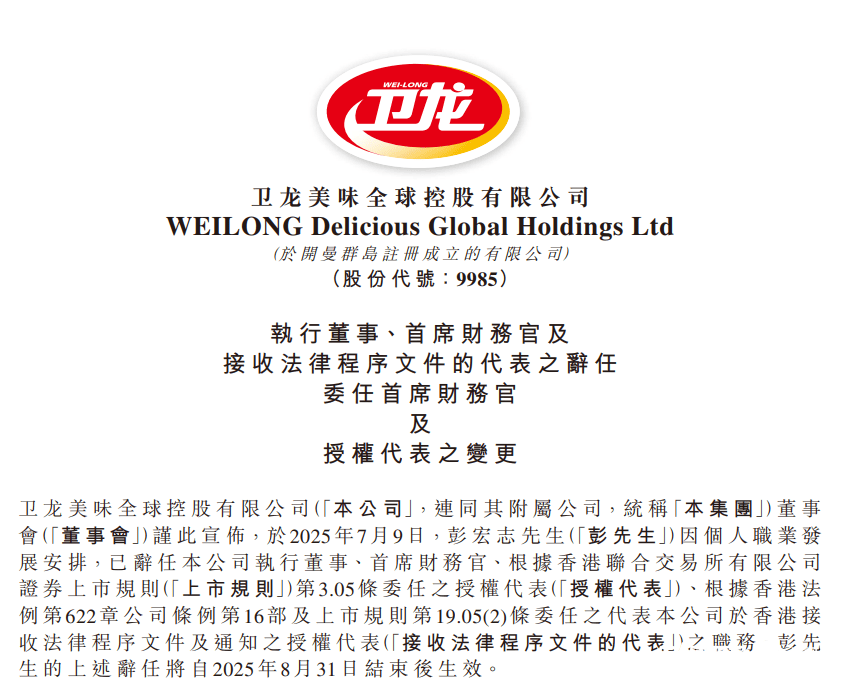
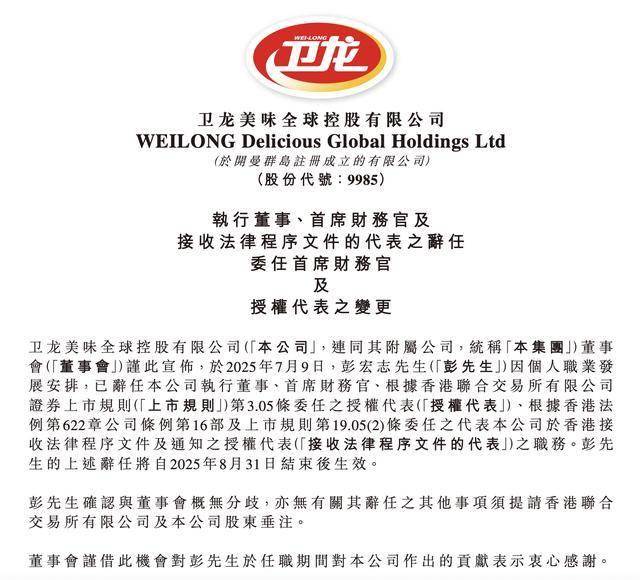
卫龙美味高层再洗牌:CEO离任3个月后,年薪1822万CFO辞职
Sou Hu Cai Jing· 2025-07-11 05:16
Core Viewpoint - Wei Long Delicious Global Holdings Ltd is experiencing significant management changes, with both the CEO and CFO resigning in a short period, which may impact investor confidence and company operations [1][10][12]. Management Changes - CFO Peng Hongzhi has resigned for personal career development reasons, effective from August 31, 2025 [1][5]. - Yu Feng, currently an executive director, will take over as CFO starting September 1, 2025 [4]. - CEO Sun Yinong resigned due to personal matters, with his departure effective from April 30, 2025, and he will continue as an advisor [10][12]. Company Background - Wei Long Delicious was established in March 2021 in the Cayman Islands and is headquartered in Luohe, Henan Province. The company went public on the Hong Kong Stock Exchange in December 2022 [8]. - The company specializes in various food products, including flavored noodle products, vegetable products, and bean products [8]. Financial Performance - As of July 10, the company's stock price was HKD 12.62, reflecting a decline of 12.97%, with a total market capitalization of approximately HKD 30.681 billion [13][14]. - The company reported an earnings per share of 0.47 and a price-to-earnings ratio of 27.00 [14].
咖啡大战生变:瑞幸大股东或竞购星巴克中国股权丨消费参考
2 1 Shi Ji Jing Ji Bao Dao· 2025-07-11 01:36
Group 1: Starbucks China Stake Sale - Starbucks is progressing with the sale of its China business, having received multiple acquisition proposals, with most investors aiming for a controlling stake [1] - The company is likely to retain 30% of its stake, with the remaining shares distributed among several buyers, each holding less than 30% [1] - The estimated valuation of Starbucks' China business is approximately $9 billion (around 64.6 billion RMB) [1] Group 2: Luckin Coffee's Growth - Luckin Coffee reported a 41.2% year-on-year revenue growth in Q1, reaching 8.87 billion RMB, with self-operated store revenue growing by 42.2% [2] - As of the end of March, Luckin had a total of 24,097 stores [2] - Starbucks China reported a revenue of $739.7 million (approximately 5.32 billion RMB) in the same period, with a year-on-year growth of 5% [2] Group 3: Competitive Landscape - Starbucks is implementing price promotions, reducing prices on several products by an average of around 5 RMB [2] - The competitive dynamics suggest that Luckin Coffee may benefit from collaboration and differentiated competition with Starbucks to maintain growth and potentially improve profit margins [2] - Currently, the negotiation power appears to remain with Starbucks [2]
首席联合电话会 - 消费专场
2025-12-04 15:36
Summary of Conference Call Records Industry Overview - **Home Appliance Industry**: The home appliance industry is experiencing a shift in production to Vietnam due to tariff advantages and the U.S. imposing tariffs on Chinese goods. Companies like Ecovacs, Roborock, and Dechang have established factories in Vietnam, while Midea and Zhaochi are expanding their production lines there [1][3]. - **Pharmaceutical Industry**: The innovative drug sector is a focal point, with business development (BD) generating significant cash flow, which is being reinvested into research and development. Companies like Baicheng Pharmaceutical and Tigermed are highlighted for their potential in this area [1][5]. Key Insights - **Tariff Impact**: The U.S. has a 20% tariff agreement with Vietnam, while other Southeast Asian countries face tariffs above 30%. This makes Vietnam an attractive location for production, allowing companies to benefit from lower tariffs when exporting to the U.S. [2]. - **Domestic Market Strength**: The domestic home appliance market remains robust, with strong growth post-618 promotion. The air conditioning sector is seeing high e-commerce growth rates, supported by national subsidy policies [1][4]. - **Expected Performance**: Companies in the export chain, particularly leading firms, are expected to see clear performance growth as the second quarter may represent a bottom for these companies [3]. Additional Observations - **Consumer Electronics**: Companies like Ecovacs and Roborock are well-positioned due to their production capabilities and supply chain stability in Vietnam. The upcoming Black Friday and Christmas shopping seasons are expected to boost demand [3]. - **Two-Wheeler Market**: The two-wheeler market is projected to see significant growth, with Yadea expected to achieve a 50-60% increase in July. The market is benefiting from low base effects and policies encouraging trade-in and replenishment [10]. - **Pork Farming Sector**: The pork farming sector is currently in a cyclical downturn, with recommendations for companies with cost advantages like Muyuan Foods and Wen's Foodstuffs. Supply pressures are expected to increase in the second half of the year [12][13]. - **Pet Food Sector**: The pet food sector has seen growth in domestic sales, driven by local brands innovating and expanding their channels. Despite challenges from trade conflicts, companies are adapting by relocating production [11]. Recommendations - **Investment Focus**: Investors are advised to focus on companies with strong domestic performance and export potential, such as Ecovacs, Roborock, Hisense, TCL, and Haier [1][4]. - **Emerging Opportunities**: Companies like Jeya and Yuanfei Pet are expected to outperform due to market share gains and replenishment cycles in the third quarter [8][9]. This summary encapsulates the key points from the conference call records, highlighting the dynamics within the home appliance and pharmaceutical industries, as well as other relevant sectors.
中流击水,革故鼎新——食品行业2025年度中期投资策略
2025-07-11 01:05
Summary of the Conference Call Records Industry Overview - The food and beverage industry is facing a dual impact of oversupply and insufficient demand in 2025, leading to a restructuring of the pricing and competition systems [2] - The white liquor industry is undergoing significant adjustments, with both upgrades and downgrades in demand, and companies are actively adjusting supply to match new market conditions [3][4] Key Insights and Arguments - **White Liquor Industry**: - Currently in a phase of active destocking, with revenue growth slowing down due to weak demand [6] - High-end liquor prices are under pressure, while mid-range products maintain a state of consumption upgrade [6] - Recommended to focus on companies with balanced product structures and healthy inventories, such as Moutai and Wuliangye [4][6] - **Consumer Goods Sector**: - The sector has returned to a "channel is king" era, with new channels like membership supermarkets and live e-commerce disrupting traditional channels [1][5] - New products in niche markets, such as leisure snacks, are experiencing rapid growth [5] - Investment logic should focus on channel enterprises and related manufacturing companies that have capacity and raw material advantages [7] - **Snack Retail Channels**: - Emerging channels like membership supermarkets and discount retail are rapidly expanding, with significant growth in the number of snack retail stores [8] - Companies like Wanchen and Yuyou are benefiting from industry growth, with innovative product offerings driving revenue [9] - **Food Chain Enterprises**: - Companies are increasing efforts in business transformation and exploring new business models, leading to growth despite overall market challenges [10] - **New Product Trends**: - Innovations in product categories such as sugar-free tea and health water are gaining traction, with significant growth potential for domestic whiskey brands [11] - Traditional brands are also innovating to capture new growth spaces [11] Other Important Insights - The dairy and beer industries are experiencing increased concentration post-adjustment, with profitability improving as cost advantages materialize [12] - The supply-demand balance in the dairy sector is expected to reach a turning point, with potential for value enhancement in new milk [13] - The beer sector remains highly concentrated, with top brands maintaining a market share of over 90% [12]
食品品牌喜欢怪味营销 如何不止于“一时之鲜”
Mei Ri Shang Bao· 2025-07-10 22:18
Core Insights - The rise of "strange flavor" snacks is driven by brands seeking to create buzz and increase sales through unconventional taste combinations [1][2] - The success of these products often relies on effective marketing strategies and the ability to generate social media discussions [2][3] - Consumer curiosity is a primary motivator for initial purchases, but repeat purchases depend on the product's quality [2][3] Group 1: Market Trends - Various brands are launching unique snacks, such as durian-flavored sunflower seeds and spicy noodle dishes, which have gained significant attention on social media platforms [1][2] - Sales data indicates strong market potential for "strange flavor" snacks, with specific products achieving high sales volumes, such as over 600,000 units for the coriander-flavored noodles [2] Group 2: Consumer Behavior - Young consumers are eager to try new flavors, driven by a desire for personal expression and unique experiences [3] - The initial appeal of "strange flavor" snacks often stems from their novelty, but long-term success requires a deeper connection to consumer needs [4] Group 3: Marketing Strategies - Many brands fail to understand the core consumer demands when replicating "strange flavor" marketing strategies, focusing too much on novelty rather than substance [4] - Effective product development for "strange flavor" snacks requires a nuanced understanding of diverse consumer preferences and market dynamics [4]
半年两次高管变动,卫龙美味在焦虑什么
Bei Jing Shang Bao· 2025-07-10 13:49
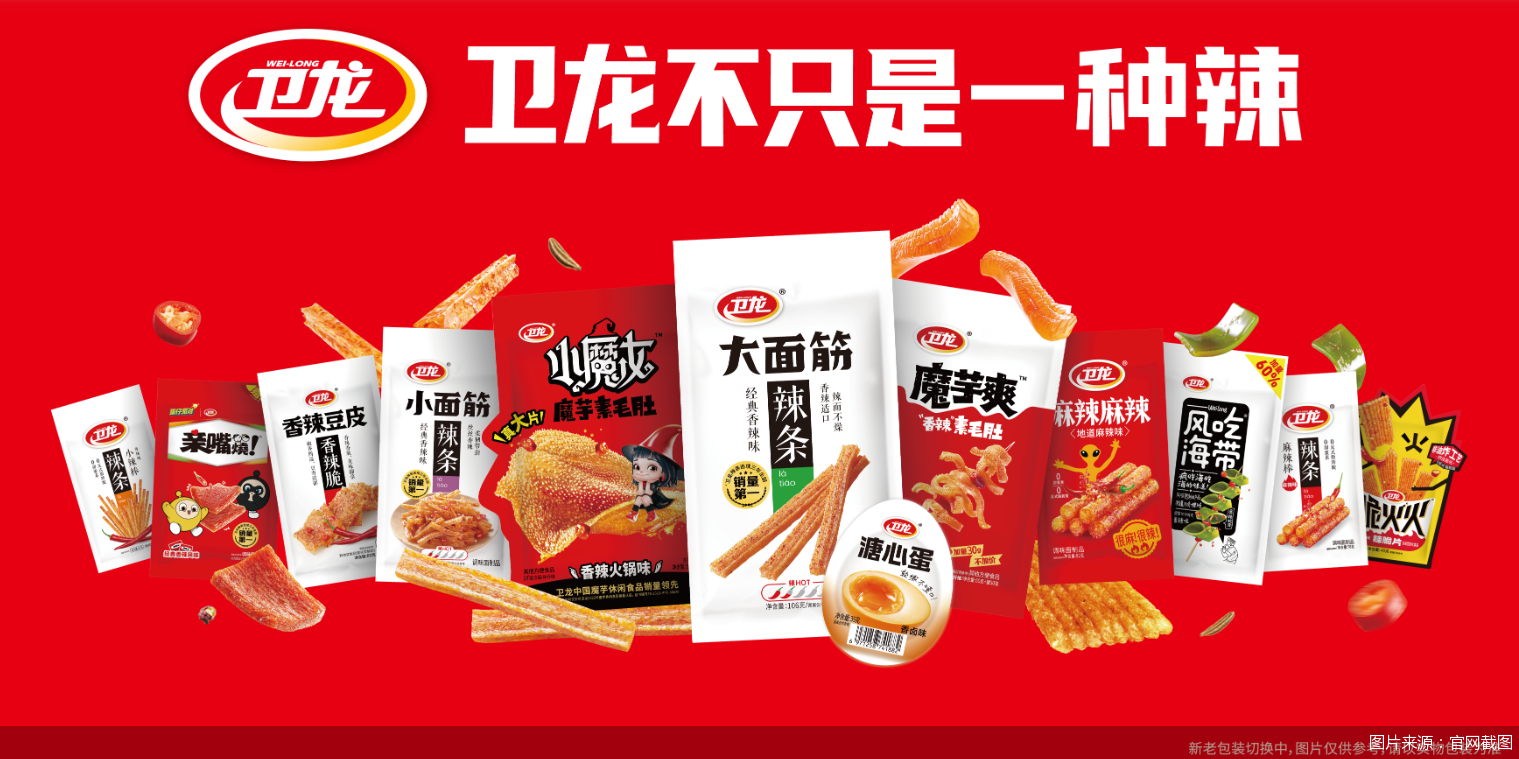
Core Viewpoint - Recent management changes at Weilong Delicious, including the resignation of CFO Peng Hongzhi and the appointment of Yu Feng, reflect potential challenges the company faces in product and market areas [2][3][4] Management Changes - CFO Peng Hongzhi will resign on August 31, with Executive Director Yu Feng taking over from September 1 [3] - This marks the second management change within six months, following the appointment of a new CEO in April [3] - The current executive directors are all members of the Liu family, indicating a strong family control over the company [3] Industry Challenges - The snack food industry is becoming increasingly competitive, prompting the Liu family to regain control of key positions to ensure consistent strategic direction [4] - The traditional "spicy strips" product line is losing popularity among mainstream consumers due to health concerns, impacting sales [5][7] - Sales of spicy strips have declined from 193,600 tons in 2021 to 124,400 tons in 2023 [5] Financial Performance - In 2024, Weilong Delicious reported revenue of 6.266 billion yuan, a year-on-year increase of 28.63%, and a net profit of 1.069 billion yuan, up 21.37% [6] - Revenue from vegetable products reached 3.371 billion yuan, growing 59.1% and surpassing the revenue from spicy strips [6] Product Development - The company is shifting towards healthier product offerings, increasing the sales of vegetable products like konjac snacks [6][7] - However, the konjac products have faced quality control issues, leading to consumer complaints [7] - The market for konjac snacks is becoming crowded, with competitors like Salted Fish and Three Squirrels entering the space [7]
沪指盘中重回3500点!这一板块,突然大涨!
证券时报· 2025-07-10 03:54
Core Viewpoint - The A-share market experienced a narrow fluctuation on July 10, with the Shanghai Composite Index returning to the 3500-point mark, driven by a surge in photovoltaic concept stocks, many of which hit the daily limit [1][3][11]. A-share Market Summary - The Shanghai Composite Index fluctuated and returned to the 3500-point threshold, while the North Star 50 Index and the ChiNext Index declined during the session [5]. - The real estate sector led the gains, with a rise of over 1%, featuring stocks like Greenland Holdings and Chongqing Development hitting the daily limit [6]. - The banking sector also performed well, with an increase exceeding 1%, highlighted by Minsheng Bank's rise of over 6% [7]. - Non-bank financials showed significant upward movement, with the sector rising over 1%, including a nearly 9% increase for Bank of China Securities [8]. - Other sectors such as steel, pharmaceuticals, and non-ferrous metals also saw strong performance, while sectors like defense, automotive, and textiles lagged [9][10]. Photovoltaic Sector Summary - The photovoltaic concept stocks experienced a substantial rise, with companies like Tuori New Energy and Jingyun Tong hitting the daily limit, and others like Ainuo Ju and Jingao Technology showing significant gains [11]. - The recent surge in polysilicon futures, which rose over 6% during the session, contributed to the strong performance of the photovoltaic sector [12]. Rare Earth Sector Summary - The rare earth permanent magnet sector also saw a notable increase, with Northern Rare Earth rising over 9%, alongside gains in stocks like Ningbo Yunsheng and China Rare Earth [13]. New Stock Summary - A new stock, Tongyu New Materials, debuted with a remarkable rise of nearly 180% during the morning session [15]. - The company specializes in the research, production, and sales of electronic resins, which are crucial for the production of copper-clad laminates [16]. - Electronic resins are one of the three main raw materials for copper-clad laminates, essential for printed circuit boards (PCBs), which are widely used in various industries including smart appliances and automotive electronics [17][18].