
雀巢

Search documents
OpenAI预计四年内收入增长33倍;Gucci一季度营收下降25%;快消巨头发财报,预警关税影响丨百亿美元公司动向
晚点LatePost· 2025-04-25 11:01
OpenAI 预计四年内收入增长 33 倍。 据媒体报道,OpenAI 向投资者透露,预计到 2029 年,公司年营收将达到 1250 亿美元,2030 年进 一步增长至 1740 亿美元——接近现在英伟达或 Meta 的收入水平。OpenAI 去年年底的收入达到 37 亿美元,相当于增长 33 倍。 OpenAI 预计,今年推理成本增长两倍到 60 亿美元,并在五年后攀升到 470 亿美元;到 2029 年, 公司的毛利润率将从去年的 40% 升至近 70%——略低于美国的云软件服务。OpenAI 计划在未来四 年投入 460 亿美元用于数据中心和基础设施建设,到 2029 年实现现金流为正。 Gucci 第一季度营收下降 25%。 开云集团 2025 年第一季度销售收入 38.8 亿欧元,同比下降 14%。其中,Gucci 第一季度销售收入 下降 25%,Saint Laurent 销售额同比下降 9%,Balenciaga 和 Alexander McQueen 一起下滑 11%。按 地域来看,开云集团在西欧、北美、日本以及其他亚太地区的营收都有两位数的下滑,除日本外的 亚太地区营收下滑最严重,为 25 ...



爆改设计就能多卖5%临期食品,日本全家想用一张标签减少3000吨浪费
FBIF食品饮料创新· 2025-04-25 00:21
作者:橙子 编辑: Panda 只靠一张贴纸,减少3000吨的食物浪费?近期,全家便利店给自己定下了这样一个"小目标"。 目前,全家"泪目贴纸"的使用范围,主要是饭团、便当、三明治等即食商品。全家总部建议,各门店在 产品保质期前四小时贴上标签,并提供约20%的折扣。 从3月11日开始,日本各地的全家门店,陆续上线了一款画风清奇的折扣标签:"涙目シール"(泪目贴 纸)。 图片来源:Adver Times 走近全家的临期货架,你可能会看到这样的场景:醒目的黄色背景上,红色的折扣数字旁,"たすけて ください"(请救救我)的日文下,一只饭团泪眼汪汪。 在本次全国推广之前,全家已经做过小范围的测试——2024年10月30日到11月26日,他们在东京 都、神奈川县的6家门店,进行了一项对比实验。实验结果证明,相比中规中矩的原版标签, "泪目贴 纸"让临期食品的购买率高了5% 。[1] 这个数据给了全家信心。据全家统计,旗下所有门店每年产生约6万吨食物垃圾,如果全面铺开泪目贴 纸, 预计每年可减少约3000吨浪费 。[1] 为什么一张小小的标签,可以提高临期食品的购买率?为了减少食物浪费,标签还可以有哪些创新的玩 法? 给 ...
入围揭晓 | 卖得好,更要讲得妙!Wow Food 2025营销赛道入围名单公布!
FBIF食品饮料创新· 2025-04-25 00:21
在全球化与数字化交织的当下,食品营销已成为品牌破局突围的核心引擎。它既是突围破局的试金石, 更是品牌跃升的跳板。 FBIF Wow食品创新奖,自2017年在上海发起,致力于发现、展示、表彰食品饮料各个类别的卓越创 新。 营销 赛道细分整合营销、品牌建设、内容营销、事件营销、跨界营销、数字营销等 6个细分赛道 。自开赛以来,组委会共收到超过 60+ 件提报案例,经来自头部食品企业、一线广告/代理/技术公司 的专业评审们严谨缜密的评审,共有 42件 作品入围决赛。 Wow Food 2025营销赛道作品精选 图片来源:Wow Food赛事组委会 卓越的食品营销案例不仅是颠覆式创新的典范,更为品牌提供精准突围路径,为品牌破局,为行业定 标,推动行业迈向营销高地。接下来,镜头回放!让我们一起揭晓入围作品名单~ 目录: 01 初赛回顾 初赛回顾 【入围名单】整合营销 【入围名单】品牌建设 【入围名单】内容营销 【入围名单】数字营销 【入围名单】跨界营销 【入围名单】事件营销 02 Wow Food赛事 03 联系我们 FBIF Wow 食品创新奖 决赛入围名单 整合营销 天津海河乳品 上海江崎格力高 壹捌零创意集团 有 ...

涨价潮来袭!多家企业CEO警告:关税和原材料成本将转嫁给消费者
智通财经网· 2025-04-24 22:28
Group 1 - Multiple CEOs from global companies have warned of price increases across various consumer goods, including chocolate, diapers, and automobiles, due to high tariffs and raw material costs, which will impact global consumer demand and inflation risks [1][2] - Procter & Gamble estimates that current and upcoming tariffs will increase its annual costs by $1 billion to $1.5 billion, with plans to raise product prices to offset this cost pressure [1] - Morgan Stanley analysts suggest that Procter & Gamble may need to raise prices by 1% to 2% on average to cope with tariff impacts, although the specific increase will vary by product type and region [1] Group 2 - Unilever and Nestlé have already begun raising prices on some products in response to rising raw material costs, with Nestlé's CEO indicating further price hikes may occur if tariffs continue to push costs up [2] - PepsiCo has opted for a different strategy by introducing "value versions" of popular products to attract consumers, although this often results in reduced product specifications while effectively increasing unit prices [2] - Ford has announced plans to raise new car prices if tariff relief is not provided, while Hyundai is taking a cautious approach, willing to absorb some tariff costs to maintain or expand market share [2] Group 3 - Some companies, like Tractor Supply, are delaying price increases despite suppliers raising costs, aiming to avoid dampening consumer demand amid uncertainty [3] - Economists expect that the tariffs imposed by the Trump administration will lead to renewed inflationary pressures, with the Federal Reserve closely monitoring price trends to prevent short-term shocks from becoming long-term inflation [3] - Consumer confidence in the U.S. has been affected, with surveys indicating rising inflation expectations among consumers, despite some spending increases in March due to preemptive purchases [3] Group 4 - Despite warnings from businesses and consumers about economic challenges, Trump has attempted to downplay the negative impacts, claiming significant decreases in gas and grocery prices [4] - The reality of corporate actions and market feedback suggests a more pessimistic outlook, with a new wave of price increases indicating that consumers may face a more expensive lifestyle ahead [4]


贸易战冲击消费需求,宝洁大幅下调全年业绩指引
Hua Er Jie Jian Wen· 2025-04-24 12:16
Core Viewpoint - Procter & Gamble (P&G) has significantly lowered its sales and profit forecasts for the year amid increasing uncertainty in tariff policies, reporting a larger-than-expected decline in net sales for the third quarter [1][2]. Group 1: Financial Performance - For the fiscal year 2025, P&G expects total net sales to remain roughly flat compared to the previous fiscal year, a significant reduction from the earlier growth target of 2% to 4% [2]. - In the third quarter, net sales decreased by 2% to $19.78 billion, which was notably below analysts' expectations of $20.11 billion, with the market initially predicting only a 0.44% decline [6]. - The core earnings per share for the third quarter were reported at $1.54, slightly above the market estimate of $1.53 [6]. - The adjusted free cash flow for the third quarter was $2.85 billion, falling short of the market expectation of $3.69 billion [6]. Group 2: Market and Economic Conditions - The uncertainty surrounding tariff policies, particularly the comprehensive import tariffs under the Trump administration, has led to concerns about a potential recession in the U.S. economy, which is P&G's largest market [2]. - Consumer sentiment in the U.S. has noticeably deteriorated, with P&G observing a significant reduction in consumer spending during February and March [3][2]. - P&G raised prices by 1% in the third quarter, but this was accompanied by a 1% decline in sales volume, indicating challenges in relying on price increases for sales growth [3]. Group 3: Competitive Landscape - P&G is not the only consumer goods giant facing challenges; competitors like Reckitt and Kimberly-Clark have also reported declines in sales and lowered profit forecasts due to trade tariffs [4]. - In contrast, companies like Nestlé and Unilever have exceeded market expectations in quarterly sales, benefiting from strong performance in their respective product lines [4].

美元贬值冲击波下 企业盈利警报频频拉响
智通财经网· 2025-04-24 09:23
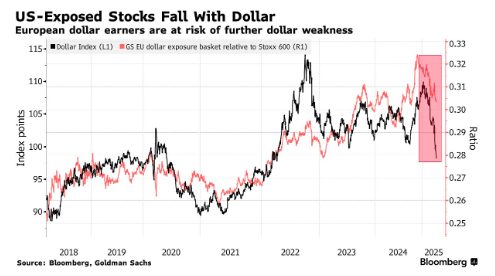
智通财经APP获悉,当前财报季中,关税上涨与美元疲软正为企业盈利预期蒙上阴影,分析师预计未来 几个季度负面影响还将持续扩大。 随着美元兑欧元汇率跌至三年低点、兑瑞士法郎创十年新低,欧洲企业已纷纷拉响警报。这令本已因特 朗普贸易政策导致经济放缓风险而承压的股市雪上加霜。 鉴于斯托克600指数成分股企业60%的营收来自海外,美元大幅贬值将显著降低其以欧洲本土货币计值 的美国市场收益。受此影响,欧洲市场中对美业务敞口较大的股票随美元同步下挫,众多投资者正转向 以内需为导向的企业寻求避险。 欧洲市值最高的企业SAP SE(SAP.US)率先预警汇率风险。这家软件巨头首席财务官向投资者表示,美 元走弱将在中期形成盈利阻力,随着外汇对冲合约陆续到期,负面影响将在明年集中显现。 与此同时,荷兰啤酒巨头喜力集团(HEINY.US)预计,欧元走强将导致今年营收减少17.2亿欧元(20亿美 元)。法国医疗诊断公司BioMerieux和英国零售商WH Smith Plc在财报中也强调了汇率风险。 Lombard Odier Investment Managers宏观研究主管Florian Ielpo表示:"欧洲企业必须清醒认识到, ...
雀巢第一季度内生性收入增长2.8%,市场预估增长2.57%。第一季度实际内部增长率增长0.7%,市场预估增长0.91%。第一季度销售额226.0亿瑞士法郎,同比增长2.3%,市场预估224.4亿瑞士法郎。
news flash· 2025-04-24 05:09
Group 1 - The core viewpoint of the article highlights Nestlé's first-quarter performance, showing an organic revenue growth of 2.8%, surpassing market expectations of 2.57% [1] - The actual internal growth rate for the first quarter increased by 0.7%, which is below the market forecast of 0.91% [1] - Nestlé's sales for the first quarter reached 22.6 billion Swiss francs, reflecting a year-on-year growth of 2.3%, slightly above the market estimate of 22.44 billion Swiss francs [1]
这2个律师贷款创业卖冰淇淋,却走红美国,销售额一度暴涨2500%
FBIF食品饮料创新· 2025-04-24 00:33
作者: Sage 编辑: Panda 今年年初,美国冰淇淋品牌Halo Top发起了一场"冰淇淋平反运动"。它在美国送出了80000份免费冰 淇淋,只为证明一件事——比普通冰淇淋更低卡的 light ice cream(直译为轻冰淇淋,下文均称轻冰 淇淋)也能很美味。 这是一个差点被创始人放弃的品牌,用5年时间改写美国冰淇淋行业游戏规则的故事。 Halo Top冰淇淋 图片来源:Halo Top 2011年,律师出身的Justin Woolverton在自家厨房里捣鼓甜品时,没人能想到,这个因个人需求而诞 生的实验品,会在短短几年后成为搅动冰淇淋行业的新产品。Halo Top不仅成功让消费者相信"轻冰淇 淋≠难吃",积累多年后品牌甚至以2500%的增速震撼市场。 [1] 2016年,男性时尚杂志GQ的编辑做了一个试验,尝试10天内只吃Halo Top的产品,看看一切会发生 什么变化。这位编辑写下了文章 What It's Like to Eat Nothing but This Magical, Healthy Ice Cream for 10 Days 后,Halo Top的销售额一度暴增2500%,成为全 ...
全球消费巨头向“AI+自动化”要效益,中国物流企业迎千亿美金新风口?
IPO早知道· 2025-04-23 10:25
菜鸟拿下数亿美元全球科技合作订单。 本文为IPO早知道原创 作者| MD 微信公众号|ipozaozhidao 近日有消息称,菜鸟与全球知名跨境集团达成数亿美元的全球科技合作。对此,菜鸟回应称,菜鸟 物流科技出海 持续取得进展, "近日 与 全球多家消费、电商和快递等领域的头部企业, 达成全球 科技 合作, 为 他们在 欧洲、亚洲和美洲等多 地的仓储 和分拨 自动化升级 提供从设计到施工的全 链路解决方案 "。 这可以说是中国物流科技企业在进军海外市场上取得的重要进展 ,或也说明随着全球快消、电商和 快递企业向自动化、数字化要效益, 物流科技行业正在迎来一个全球性的新风口,数据显示这一行 业的市场规模超过千亿美元。而以菜鸟为代表的创新性物流科技企业,则具备先发优势。 IPO早知道查阅全球快消头部企业的年报发现,联合利华、雀巢、宝洁等头部快消企业都在年报中多 次提及了物流领域的数字化对于公司"降本增效"的价值,并将进一步加速提升数字化科技在战略中的 应用和布局。 以联合利华( UL.US ) 为例,公司在 2024年财报中提及, 将利用先进的自动化设施和 AI来提升 公司的运营效率、驱动业务和需求增长。 另一快 ...
全球及中国婴幼儿辅食行业蓝皮书
Zhuo Shi Zi Xun· 2025-04-23 09:27
Investment Rating - The report does not explicitly state an investment rating for the infant complementary food industry Core Insights - The global infant complementary food market is expected to grow from RMB 225.71 billion in 2024 to RMB 292.13 billion by 2029, with a CAGR of 5.3% from 2024 to 2029 [8] - The Chinese infant complementary food market is projected to reach RMB 81.75 billion by 2029, growing from RMB 55.91 billion in 2024, with a CAGR of 7.9% from 2024 to 2029 [9][10] - The penetration rate of infant complementary food products globally is expected to increase from 20.1% in 2024 to 25.3% by 2029 [8] - The Chinese market's share of the global infant complementary food market is anticipated to rise from 24.8% in 2024 to 28.0% by 2029 [14] Summary by Sections Global Infant Complementary Food Development and Policy Standards - The global infant complementary food industry has a history of over 150 years, evolving from homemade to industrial production, driven by economic development and consumer awareness [8] - The market size is influenced by the increasing consumer willingness to pay and the rising nutritional requirements for infants [8] Global Infant Complementary Food Key Market Analysis - The market size is projected to grow significantly, with the global market expected to reach RMB 292.13 billion by 2029 [8] - The penetration rate in developed regions is higher compared to developing regions, indicating growth potential in the latter [8] Chinese Infant Complementary Food Market Size - The Chinese market is in a rapid growth phase, with a projected market size of RMB 81.75 billion by 2029, driven by rising consumer awareness and policy support [9][10] - The penetration rate of infant complementary food in China is expected to increase significantly, indicating a shift towards more packaged products [10] Sales Channel Analysis - The online sales channel for infant complementary food in China is expected to grow from RMB 10.98 billion in 2019 to RMB 22.64 billion by 2024, with a CAGR of 15.6% [11] - Offline channels remain significant, but online sales are projected to surpass offline sales by 2029 [11] Regulatory and Standard Development - China's infant complementary food regulations are evolving, with ongoing improvements to align with international standards, enhancing industry quality and market growth [15][18] - The report highlights the need for clearer definitions and standards in the Chinese market to support growth and consumer education [18][20] Consumer Trends and Preferences - Chinese consumers are increasingly favoring organic and convenient infant complementary food products, aligning with trends seen in developed markets [22] - The demand for diverse and balanced food structures is growing, with parents showing interest in customized products to meet specific dietary needs [22]