
华泰证券

Search documents
韬盛科技完成上市辅导 深耕半导体测试接口领域
Ju Chao Zi Xun· 2025-12-28 13:27
Group 1 - The core viewpoint of the news is that Huatai United Securities has completed the guidance work for the initial public offering (IPO) of Shanghai Taosheng Electronic Technology Co., Ltd, indicating that the company is ready for listing with a solid governance and operational foundation [1] - Huatai United Securities and Taosheng Technology signed a guidance agreement on June 27, 2023, and completed the filing with the Shanghai Securities Regulatory Bureau on July 3, 2023, leading to a total of nine guidance sessions [1] - The guidance has helped Taosheng Technology establish a governance structure, accounting foundation, and internal control system that meet the requirements for listed companies, with key stakeholders fully understanding their responsibilities in the capital market [1] Group 2 - Taosheng Technology, founded in 2006, is one of the earliest providers of testing interface products and solutions in China's semiconductor industry, focusing on semiconductor testing solutions for nearly two decades [2] - The company has accumulated nearly 300 clients globally, establishing a strong market reputation and becoming a trusted supplier and partner in the industry [2] - In March 2025, Taosheng Technology announced the completion of a C-round financing of several hundred million RMB, led by state-owned enterprise mixed reform funds and local industry funds, reflecting strong confidence in the company's strategic value and development prospects [2] Group 3 - The funds raised in the latest financing round will be primarily used to expand the production capacity of existing mature products such as large-size semiconductor test sockets and MEMS probe cards to meet growing market demand [3] - Significant investments will also be directed towards the research and production of new products like 2.5D/3D DRAM MEMS probe cards and LTCC large ceramic substrates, representing the company's strategic layout in the next-generation testing interface field [3]
与上轮财富管理发展期的比较分析:l本轮财富管理特点与金融机构:分化、分层与匹配
ZHONGTAI SECURITIES· 2025-12-28 12:56
Investment Rating - The report maintains an "Overweight" rating for the industry [2] Core Insights - The current wealth management market (2025-2026) shows increased differentiation and stratification compared to the previous cycle (2020-2021), with a focus on matching client needs [5][10] - Financial institutions are transitioning from a "sell-side" sales model to a "buy-side" advisory model, emphasizing long-term service capabilities and precise matching of client needs [5][10] - Investment opportunities are expected to favor financial institutions with a strong middle-to-high value client base, comprehensive services, and innovative product offerings [5][10] Summary by Sections Common Logic of Two Cycles - Both cycles are characterized by ample liquidity supporting asset prices, with the previous cycle driven by aggressive monetary and fiscal policies, while the current cycle is marked by low interest rates and excess precautionary savings [9][16] - Clear industry trends guide capital flows, with the previous cycle dominated by consumption and new energy, while the current cycle is led by AI and hard technology [9][22] - The trend of asset migration from real estate to financial assets is irreversible, continuing the financialization process [9][25] Core Differences of Two Cycles - The macro environment has shifted from "strong stimulus expansion" to "weak recovery defense," with a focus on stabilizing growth and managing risks [25][27] - There is a notable change in resident expectations and risk preferences, with a shift from broad income growth to increased differentiation among income groups [35][38] - Asset allocation logic has evolved from a singular offensive strategy to a diversified and balanced approach, incorporating defensive assets alongside growth opportunities [46][50] Characteristics of the Previous Cycle - The previous cycle was driven by strong stimulus measures, resulting in a significant recovery in GDP and a structural bull market in equities, particularly in high-growth sectors [3][9] - The investment behavior was aggressive, with high turnover and a focus on chasing high-performing assets, leading to a "star chasing" phenomenon among investors [3][9] Current Cycle and Future Characteristics - The current cycle is characterized by low interest rates and a new normal of asset revaluation, with a gradual but steady migration of assets [10][25] - The asset side is moving towards a balanced approach, with a mix of high-dividend and growth assets, and an increasing preference for alternative investments as risk hedges [10][50] - Financial institutions are expected to focus on client segmentation, asset allocation capabilities, and long-term service value, with a shift towards a "buy-side" advisory model [10][55]
文本选股策略超额收益收窄
HTSC· 2025-12-28 11:32
Group 1 - The LLM-FADT text stock selection strategy has underperformed relative to the CSI 500 index by -1.5% this month, with a year-to-date excess return of 2.9% [1][18] - The LLM-FADT strategy has an annualized return of 29.05% since January 2017, with an excess annualized return of 26.56% relative to the CSI 500 index, and a Sharpe ratio of 1.13 [1][20] - The AI industry rotation model recommends holding non-bank financials, petrochemicals, beverages, steel, and utilities for the upcoming week, with an annualized return of 26.49% since 2017 [3][41] Group 2 - The AI theme index rotation model suggests holding petrochemical industry, 300 non-bank, Shenzhen dividend, and China construction indices for the next week, with an annualized return of 16.58% since 2018 [4][28] - The AI concept index rotation model has an annualized return of 22.29% since 2018, with a maximum drawdown of 19.19% [33][34] - The AI industry rotation model has a year-to-date excess return of 29.13% and an annualized excess return of 19.53% [39][41] Group 3 - The AI-enhanced stock selection strategy based on full-frequency fusion factors has achieved a year-to-date excess return of 19.98% relative to the all-A equal-weight benchmark [2][6] - The AI-enhanced CSI 1000 strategy has a year-to-date excess return of 24.24%, with an annualized excess return of 21.89% since 2017 [2][10] - The LLM-FADT strategy has shown more stability and smaller excess drawdowns compared to the BERT-FADT strategy since October 2024 [18][21]

非银金融行业周报(2025/12/22-2025/12/26):IFRS17 切换后所得税处理方式进一步明确,为新准则全面落地奠定坚实基础-20251228
Shenwan Hongyuan Securities· 2025-12-28 11:09
Investment Rating - The report maintains a positive outlook on the insurance and brokerage sectors, indicating an "Overweight" rating for the industry [1]. Core Insights - The report highlights the expected improvement in the performance of the securities industry in December 2025, with a projected increase in investment returns and a significant rise in equity financing [3]. - The insurance sector is anticipated to undergo a systematic value reassessment, with specific recommendations for leading companies such as China Life, Ping An, and China Pacific Insurance [3]. - The report emphasizes the potential for cross-border investment opportunities due to the appreciation of the RMB against the USD, which could benefit brokerage firms [3]. Summary by Sections Market Review - The Shanghai Composite Index closed at 4,657.24, with a weekly increase of 1.95%. The non-bank index rose by 2.09%, while the brokerage, insurance, and diversified finance sectors reported increases of 1.58%, 2.97%, and 2.66%, respectively [6]. Non-Bank Industry Key Data - As of December 26, 2025, the average daily trading volume in the A-share market was 18,437.18 billion RMB, reflecting a month-on-month decrease of 5.10% [17]. - The margin financing and securities lending balance reached 25,454.30 billion RMB, up 36.5% from the end of 2024 [17]. - The report notes that the total equity financing in December 2025 was 508.4 billion RMB, a 72% increase month-on-month [3]. Non-Bank Industry News and Key Announcements - The Financial Regulatory Bureau released a plan for the high-quality development of digital finance in the banking and insurance sectors, outlining 33 tasks [18]. - The People's Bank of China published the "China Financial Stability Report (2025)," emphasizing the need for policies that support long-term investments in the A-share market [19]. - The National Development and Reform Commission initiated a venture capital guidance fund expected to reach a scale of one trillion RMB, aimed at supporting strategic emerging industries [21]. Individual Stock Highlights - In the insurance sector, notable A-share performances included Ping An (3.51%) and China Pacific Insurance (3.14%) [8]. - In the brokerage sector, the top performers included Zhongyin Securities (9.96%) and Industrial Securities (5.96%) [8].





非银金融行业周报:IFRS17切换后所得税处理方式进一步明确,为新准则全面落地奠定坚实基础-20251228
Shenwan Hongyuan Securities· 2025-12-28 07:56
Investment Rating - The report maintains a "Positive" outlook on the non-bank financial industry [3] Core Insights - The report highlights the recovery in the securities sector, with a projected increase in December performance driven by improved investment returns and a rise in equity financing [4][7] - The insurance sector is expected to benefit from the clarification of income tax treatment under IFRS17, enhancing profit predictability for insurers [4][11] - The report emphasizes the growth of ETFs, which have surpassed 6 trillion yuan in total assets, indicating a strong trend in the investment landscape [4] Summary by Sections Market Performance - The Shanghai Composite Index closed at 4,657.24, with a weekly increase of 1.95%, while the non-bank index rose by 2.09% [7] - The securities, insurance, and diversified financial sectors reported increases of 1.58%, 2.97%, and 2.66% respectively [7] Securities Industry Insights - The average daily trading volume in the A-share market for December is estimated at 1.84 trillion yuan, with a 5% decrease month-on-month [4] - The margin financing balance reached 2.5 trillion yuan, reflecting a 3% increase [4] - Equity financing in December totaled 508.4 billion yuan, a 72% increase from the previous month [4] Insurance Industry Insights - The report notes that the implementation of IFRS17 will standardize income tax calculations for insurers starting in 2026, which is expected to improve profit visibility [4][11] - The insurance sector index rose by 2.97%, outperforming the Shanghai Composite Index by 1.02 percentage points [4] Investment Recommendations - For the securities sector, the report recommends focusing on leading firms with strong competitive positions, such as Guotai Junan and CITIC Securities, as well as firms with significant earnings elasticity like Huatai Securities [4] - In the insurance sector, the report suggests investing in major players like China Life and Ping An, highlighting their systemic value re-evaluation opportunities [4]


收官之年,券商IT“成色”几何?
中国基金报· 2025-12-28 06:50
Core Viewpoint - The article emphasizes the rapid digital transformation and AI integration within the securities industry, highlighting the need for compliance amidst increasing regulatory scrutiny and the importance of balancing technology investment with governance [2][4]. Group 1: Digital Transformation and Investment - The securities industry has significantly increased its focus on information technology, with 44 firms reporting a total IT investment of 28.11 billion yuan in 2023, where 14 firms invested over 1 billion yuan, accounting for 70.46% of total investments [4]. - In 2024, a growth trend in IT investment is expected, with 30 firms planning to increase their spending, shifting focus from quantity to quality in technology investments [4]. - The introduction of domestic AI models like DeepSeek has accelerated the localization of AI deployment, with firms exploring AI applications across various business scenarios [4]. Group 2: Role of Chief Information Officer (CIO) - The role of the Chief Information Officer (CIO) has become increasingly critical, with over 10 firms appointing new CIOs who possess strong backgrounds in both IT and securities management, reflecting a commitment to digital transformation [5]. - CIOs are seen as key figures in steering digital transformation, responsible for coordinating IT strategy, governance, and risk management within firms [5]. Group 3: Regulatory Environment and Compliance - The regulatory landscape has tightened, with multiple firms receiving penalties for inadequate IT risk management, emphasizing the importance of system security and compliance [8][9]. - Regulatory focus includes zero tolerance for system failures affecting investor rights, strict measures against IT-related misconduct, and accountability extending to individual CIOs [9]. - The need for enhanced compliance management is underscored, with firms required to adapt to regulatory demands and improve their governance capabilities [12]. Group 4: IT Governance and Risk Management - Firms are urged to enhance their IT governance capabilities by establishing comprehensive systems and adhering to regulations to mitigate risks associated with information technology [12]. - Continuous improvement in IT service continuity and proactive defense against information security risks are essential for maintaining operational integrity [12]. - A robust framework for IT personnel conduct and compliance is necessary to prevent conflicts of interest and ensure ethical behavior within the industry [12].


收官之年,券商IT“成色”几何?
Zhong Guo Ji Jin Bao· 2025-12-28 06:05
Core Viewpoint - The securities industry is undergoing a digital transformation driven by technology and AI, with increasing regulatory scrutiny on compliance in IT operations [1][4]. Group 1: Digital Transformation and Investment - The securities industry has significantly increased its investment in information technology, with 44 firms disclosing a total expenditure of 28.11 billion yuan in 2023, where 14 firms invested over 1 billion yuan, accounting for 70.46% of total investments [2]. - The focus of IT investment is shifting from quantity to quality, emphasizing optimization and application rather than mere expansion, with efficiency and output becoming key metrics [2]. - The introduction of domestic AI models like DeepSeek has accelerated the localization of AI deployment in the financial sector, with firms exploring AI applications across various business scenarios [2]. Group 2: Role of Chief Information Officers (CIOs) - The role of Chief Information Officers (CIOs) has become increasingly critical in securities firms, with many firms appointing new CIOs who possess strong backgrounds in both IT and securities management [3]. - CIOs are seen as key figures in driving digital transformation, responsible for coordinating IT strategy, governance, and risk management within the firm [3]. Group 3: Regulatory Environment and Compliance - Regulatory scrutiny in the IT sector has intensified, with several firms receiving penalties for inadequate risk management and compliance failures, highlighting the importance of system security and data compliance [4][5]. - The regulatory focus includes zero tolerance for system failures that affect investor rights, strict penalties for IT-related misconduct, and accountability measures extending to individual CIOs [5]. - The need for enhanced compliance management is emphasized, with firms required to adapt their IT departments from a purely operational role to one that integrates business management and compliance [6][7]. Group 4: Upgrading Compliance Management - The rapid development of financial technology necessitates a stronger emphasis on data permissions and compliance, with regulatory bodies stressing the importance of information isolation and monitoring [6]. - Firms are encouraged to improve their IT governance capabilities, enhance service continuity, and strengthen defenses against information security risks [7].
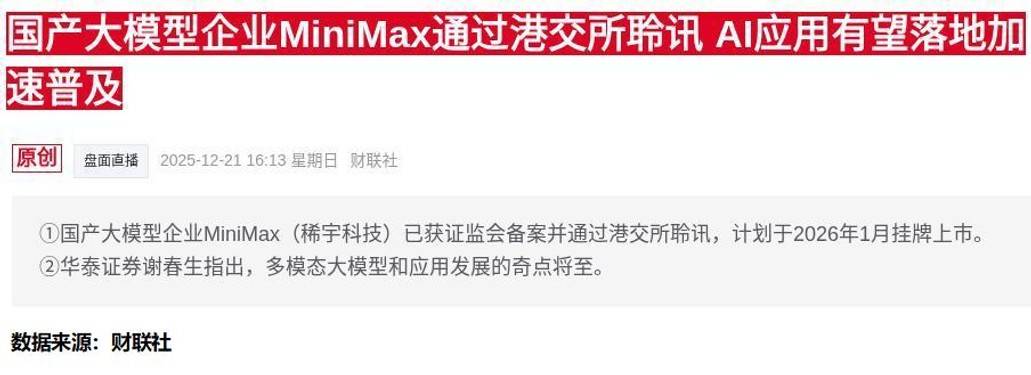
AI巨头上市在即,散户却集体踏空?
Sou Hu Cai Jing· 2025-12-27 23:17
Group 1 - MiniMax, a domestic AI company, is set to go public and has served 212 million users across over 200 countries in just four years [1] - The stock market reacted positively to the news, with related concept stocks experiencing significant movements [1] Group 2 - There is a notable phenomenon where some AI concept stocks have doubled in value while others remain stagnant, highlighting the "expectation gap" between institutional and retail investors [2] - Institutional investors often have an information advantage and can price in good news before it is publicly available, leading to a disconnect in stock performance post-announcement [2][12] Group 3 - The performance of stocks like Cuiwei Co. and Neusoft Group illustrates the importance of institutional activity prior to market movements, with Cuiwei seeing significant gains while Neusoft lagged [5][6] - The contrasting trajectories of Runhe Software and Zhongke Jiangnan further emphasize the role of institutional investment in stock performance [10] Group 4 - The rise of AI necessitates a quantitative approach to investing, as retail investors often react too late to news [12] - Emphasizing the importance of data, the article suggests that understanding fund flows and maintaining a data-driven mindset can provide a competitive edge in the market [14]
华泰证券:钢铁债配置建议以规模、资金优势较明显的央国企配置为主,适度挖掘3年内永续债机会
Ge Long Hui A P P· 2025-12-27 06:31
Core Viewpoint - The steel industry has adjusted its product structure and increased exports since 2021, but prices remain under pressure. Recent anti-involution policies have alleviated supply-demand conflicts, leading to a recovery in corporate profits. However, this round of anti-involution differs from the supply-side reforms of 2015, as the current supply relies more on self-discipline mechanisms and demand remains differentiated [1] Group 1 - Since 2021, steel companies have focused on adjusting product structures and increasing exports, but they face price pressures [1] - The implementation of anti-involution policies this year has marginally eased supply-demand conflicts, resulting in a recovery in corporate profits [1] - The current supply-side adjustments depend more on self-discipline mechanisms, while demand continues to show differentiation [1] Group 2 - The industry is expected to continue improving in supply-demand dynamics under the influence of anti-involution policies, although the extent of improvement may be limited [1] - The overall low level of industry bond spreads indicates ongoing differentiation in the fundamental conditions of companies [1] - Investment recommendations suggest focusing on central state-owned enterprises with significant scale and funding advantages, while also exploring opportunities in perpetual bonds within three years [1]
华泰证券:看股做债的背后是大类资产配置方向切换
Xin Lang Cai Jing· 2025-12-27 06:18
Core Viewpoint - The bond market in 2025 is characterized as a "non-bull, non-bear volatile market," with interest rates ending a four-year downward trend and the ten-year government bond fluctuating within a narrow range of 1.6% to 1.9% [1] Summary by Themes Market Characteristics - The market is showing new characteristics such as desensitization to macroeconomic factors, increased volatility, and a seesaw effect between stocks and bonds [1] Investor Experience - This year has been particularly impactful for investors in a "low interest rate" environment, with significant reductions in coupon returns and challenges in capital gains, as well as rapid shifts in market trends [1] Key Themes in the Bond Market - Important themes for the bond market this year include: 1. Respecting trends while also trusting common sense 2. The difficulty of executing wave trading strategies 3. The presence of structural opportunities even in a volatile market 4. Profound changes in the bond market ecosystem 5. A shift in asset allocation direction, indicated by the trend of looking at stocks while investing in bonds [1]