
博时基金

Search documents
黄金大消息!最新解读来了
中国基金报· 2025-11-10 02:46
Core Viewpoint - The new tax policy for gold aims to reshape the industry ecosystem, promote the maturity and internationalization of the gold market, and enhance market transparency and compliance [2][9][10]. Group 1: Background and Impact of the New Tax Policy - The new tax policy is a response to the increasing investment enthusiasm in gold, driven by rising gold prices, and aims to address accumulated tax issues within the gold industry [9]. - The policy encourages trading around exchanges, strengthens the position of member units, and aims to eliminate non-compliant small enterprises, thereby enhancing overall market efficiency [9][10]. - The long-term effect of the policy is expected to attract more compliant capital into the market, supporting healthy growth in the gold market [9][10]. Group 2: Specific Provisions and Their Effects on the Industry Chain - The new policy introduces three main provisions: adjustments to input tax deduction ratios, detailed rules for invoice issuance, and differential treatment between member and non-member units, leading to differentiated impacts on the industry chain [13][15]. - Upstream mining companies are largely unaffected, while member units enjoy more tax deductions on investment gold, allowing them to expand and consolidate their market position [13][18]. - Non-member units may face increased costs and compliance pressures, potentially leading to a market exit for some non-compliant enterprises [16][20]. Group 3: Changes in Different Segments of the Gold Sector - The new policy is expected to benefit leading mining companies, as they will not face additional tax burdens, while processing and retail segments may see increased market concentration towards larger companies [18][20]. - Retail companies that are members of the exchange may experience increased tax costs, but their core competitiveness in product and service quality will help maintain stable profits [18][20]. - The policy is likely to lead to price increases for gold jewelry, as companies may pass on cost pressures to consumers [16][20]. Group 4: Compliance and Transparency in the Industry - The new policy is designed to close long-standing tax loopholes and promote fair taxation, thereby increasing market transparency and compliance [11][22]. - The elimination of "offshore tax evasion" practices is expected to enhance the competitive advantage of compliant enterprises, leading to a more transparent and stable market environment [22][23]. - The policy is anticipated to improve the profitability and market share of quality enterprises, as the competitive landscape shifts towards product and channel strength [22][23]. Group 5: Attraction of Gold ETFs - Gold ETFs and other financial derivatives are expected to gain attractiveness due to their tax advantages, as they are not affected by the new VAT adjustments [26][30]. - Ordinary investors may find the appeal of physical gold investments declining, while gold ETFs will become more attractive due to lower investment thresholds and operational simplicity [26][30]. - The new policy is likely to lead to increased inflows into gold ETFs, helping investors balance convenience and tax burdens [26][30]. Group 6: Future Price Trends of Gold - The long-term outlook for gold prices remains positive, supported by factors such as inflation, central bank policies, and geopolitical tensions [30][32]. - Short-term fluctuations may occur, but the structural demand for gold, particularly from emerging market central banks, is expected to provide solid support for prices [32][30]. - The anticipated monetary easing in the coming years is likely to benefit gold assets, making significant declines in gold prices unlikely [32][30].


两市ETF两融余额减少26.7亿元丨ETF融资融券日报
2 1 Shi Ji Jing Ji Bao Dao· 2025-11-10 02:22
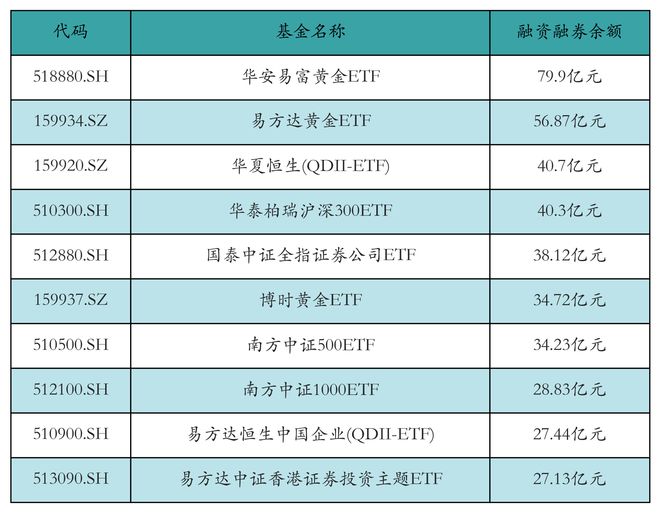
Market Overview - As of November 7, the total ETF margin balance in the two markets is 118.109 billion, a decrease of 2.67 billion from the previous trading day [1] - The financing balance is 109.725 billion, down by 2.626 billion, while the securities lending balance is 8.384 billion, a decrease of 43.779 million [1] - In the Shanghai market, the ETF margin balance is 82.395 billion, down by 2.291 billion, with a financing balance of 74.998 billion, decreasing by 2.25 billion [1] - In the Shenzhen market, the ETF margin balance is 35.714 billion, down by 379 million, with a financing balance of 34.727 billion, decreasing by 376 million [1] ETF Margin Balance - The top three ETFs by margin balance on November 7 are: - Huaan Yifu Gold ETF (7.99 billion) - E Fund Gold ETF (5.687 billion) - Huaxia Hang Seng (QDII-ETF) (4.07 billion) [2] - The detailed top 10 ETFs by margin balance include various funds, with the Huaan Yifu Gold ETF leading [2] ETF Financing Buy Amount - The top three ETFs by financing buy amount on November 7 are: - Haifutong CSI Short Bond ETF (1.147 billion) - Bosera CSI Convertible Bonds and Exchangeable Bonds ETF (920 million) - Huatai-PineBridge Southbound Hang Seng Technology Index (QDII-ETF) (875 million) [3][4] ETF Financing Net Buy Amount - The top three ETFs by financing net buy amount on November 7 are: - Huaxia Hang Seng Internet Technology Industry (QDII-ETF) (87.3478 million) - Penghua CSI Subdivided Chemical Industry Theme ETF (72.7372 million) - Dacheng Hang Seng Technology (QDII-ETF) (60.0607 million) [5][6] ETF Securities Lending Sell Amount - The top three ETFs by securities lending sell amount on November 7 are: - Huatai-PineBridge CSI 300 ETF (30.8381 million) - Southern CSI 1000 ETF (16.3727 million) - Southern CSI 500 ETF (12.1994 million) [7][8]
波动市场下的“攻守”智慧:博时固收+三季度业绩规模双爆发
Zheng Quan Shi Bao Wang· 2025-11-10 02:13
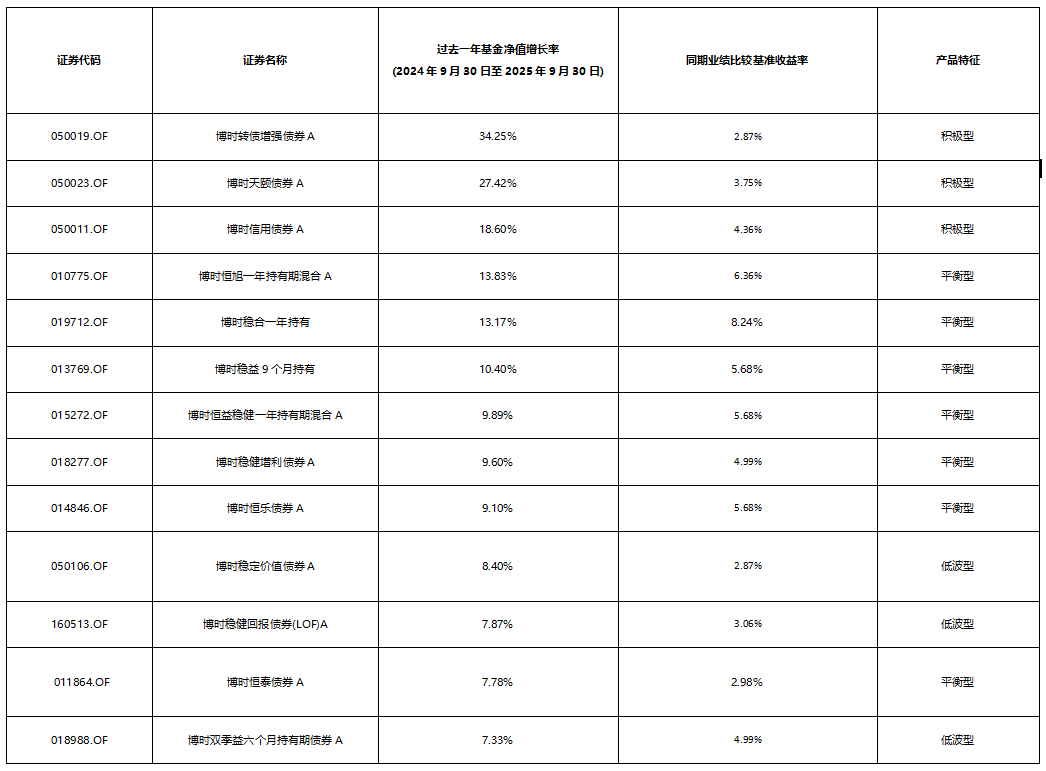
Core Viewpoint - The A-share market has seen a strong rise in the technology sector led by AI and self-sufficiency, while the bond market continues to adjust due to multiple factors, prompting investors to shift towards "fixed income +" strategies for risk-return balance [1][2]. Group 1: Market Overview - As of the end of Q3, the total scale of "fixed income +" funds reached 2.44 trillion yuan, an increase of 513.997 billion yuan from the end of Q2, becoming the main growth driver in the public fund market [2]. - The bond market is experiencing adjustments due to the "stock-bond seesaw" effect, the implementation of "anti-involution" policies, and tight liquidity at the end of the quarter [1][2]. Group 2: Company Performance -博时基金's "fixed income +" segment has shown remarkable performance, achieving both scale and performance growth, with its fixed income + funds exceeding 52 billion yuan by the end of Q3 [2][3]. - Several博时基金 products demonstrated strong capital-raising capabilities, with博时恒乐债券 reaching 18.924 billion yuan, a 259% increase from Q2, and博时稳健增利债券 growing from 39.3 million yuan to 1.0575 billion yuan, a staggering increase of 2590.84% [2]. Group 3: Fund Performance -博时基金's fixed income + products have shown strong performance, with six products achieving over 10% returns in the past year [2]. -博时转债增强债券 A achieved a return of 34.25%, significantly outperforming its benchmark return of 2.87%, resulting in an excess return of 31.38% [2]. Group 4: Investment Strategies -博时基金 employs a comprehensive product matrix covering various risk profiles, including aggressive, balanced, and low-volatility strategies, to match different investor risk-return preferences [3]. - The aggressive strategy focuses on high-growth sectors such as technology and defense, while the balanced strategy aims for optimal risk-return through dynamic equity and bond allocation [4][5]. Group 5: Market Outlook - The global economic slowdown and challenges in the Chinese economy, including real estate adjustments and fluctuating consumer confidence, are expected to impact market dynamics [7]. -博时基金 managers anticipate continued market differentiation, with a focus on sectors with reasonable valuations and growth potential in the upcoming quarter [8].
上金所:博时黄金ETF调整黄金现货合约申购赎回对价、最小申购赎回单位及暂停申购赎回业务
Xin Hua Cai Jing· 2025-11-10 01:52
Core Points - Starting from November 17, 2025, the BoSheng Gold ETF will only include Au99.99 contracts for gold spot contract subscriptions and redemptions, excluding Au99.95 contracts [1] - The minimum subscription and redemption unit for the BoSheng Gold ETF will be adjusted from 300,000 shares to 100,000 shares, corresponding to a change in the minimum weight of gold spot contracts from 3,000 grams to 1,000 grams [1] - To ensure a smooth transition for the adjustments in subscription and redemption, the gold spot contract operations will be suspended for one day on November 14, 2025, and will resume on November 17, 2025 [1]
债券ETF规模突破7000亿元 短期回调带来配置机会
Zhong Guo Zheng Quan Bao· 2025-11-09 20:08
Core Insights - The total market ETF size reached 5.74 trillion yuan as of November 9, with bond ETFs surpassing 700 billion yuan, indicating significant growth in the bond ETF sector [1][2] - Despite bond ETFs accounting for less than 13% of the total ETF market, they have experienced explosive growth, particularly in 2024, with a notable increase in new products like credit bond ETFs and sci-tech bond ETFs contributing over 330 billion yuan to the market [2][4] ETF Market Overview - As of November 9, the total number of ETFs is 1,060, with stock ETFs totaling 3.73 trillion yuan and bond ETFs totaling 706.12 billion yuan, where stock ETFs represent nearly 65% of the total market [2] - Bond ETFs have seen a rapid increase in size, crossing the 1 billion yuan mark in May 2024 and reaching over 5 billion yuan by July 2025, with the latest figure at 700.44 billion yuan [2] Investor Composition - Approximately 85% of bond ETFs are held by institutional investors, with funds being the largest group, followed by brokerages, repo accounts, insurance companies, and banks [3] Growth Drivers - The net inflow of funds into bond ETFs exceeded 420 billion yuan this year, with specific products like the Hai Fu Tong Short-term Bond ETF and the 30-year Treasury Bond ETF seeing significant inflows [4] - New products such as credit bond ETFs and sci-tech bond ETFs have contributed over 330 billion yuan to the overall growth, with many individual ETFs exceeding 100 billion yuan in size [4][5] Market Outlook - Analysts suggest that the recent resumption of government bond trading by the central bank has improved liquidity expectations and reduced interest rate risks, encouraging investors to consider bond allocation opportunities [6][7] - The sci-tech bond ETF market is expected to grow due to its underlying assets having high credit quality, making it suitable for stable portfolio configurations amid declining yields in traditional fixed-income products [5][7]
黄金类ETF连续反弹4000美元关口资金逢低流入
Shang Hai Zheng Quan Bao· 2025-11-09 17:28
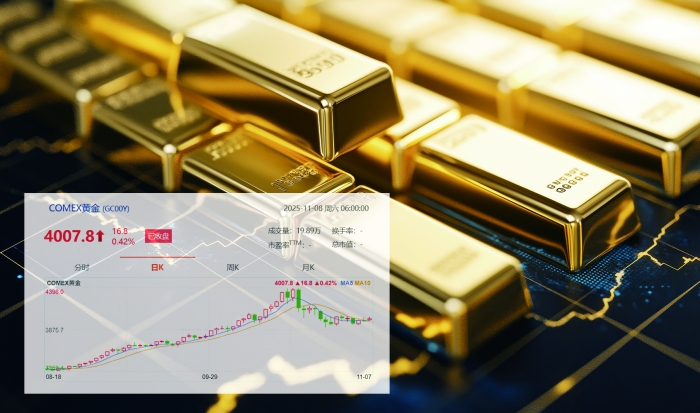
Core Viewpoint - The recent adjustments in gold and gold stocks are primarily due to a temporary easing of risk aversion, leading to some profit-taking, but the long-term bullish logic for gold remains unchanged [2][4] Group 1: Market Performance - After a significant rise since August, COMEX gold peaked at $4,398 per ounce in late October and has since consolidated around the $4,000 mark, closing at $4,007.8 on November 7, with a slight increase of 0.42% [2] - As of November 7, domestic gold ETFs have seen a total net subscription of 27.3 million shares in November, with the largest being Huaan Gold ETF, which gained 6.97 million shares [3] Group 2: Investment Trends - Several funds have begun recommending gold ETFs, with a notable allocation of 15% to Huaan Gold ETF by a wealth management product, reflecting a strategic shift towards gold amid increased market volatility [4] - The fund managers believe that the recent gold price adjustments are indicative of a temporary easing of geopolitical risks, and they anticipate a new cycle for gold driven by its monetary attributes in response to dollar credit issues [4] Group 3: Tax Implications and Investment Strategy - The recent tax changes on gold do not directly affect gold prices but increase the transaction costs for physical gold, while gold ETFs remain unaffected as they do not involve physical delivery [5] - It is recommended to adopt a dollar-cost averaging strategy for long-term investments in gold ETFs, with a suggested allocation of 5% to 15% of total assets [5]
ETF年内扩容逼近2万亿元 其中一类规模已连增14周
Sou Hu Cai Jing· 2025-11-09 13:45
Market Overview - A-shares experienced fluctuations with the Shanghai Composite Index stabilizing around 4000 points, while the CSI 300 Index rose by 0.82% and the ChiNext Index increased by 0.65% [1] - The Hong Kong tech stocks continued to adjust, with the Hang Seng Tech Index declining by 1.20% [1] ETF Market Performance - As of November 7, the total scale of ETFs in the market reached 5.73 trillion yuan, with an increase of nearly 30 billion yuan last week and an annual increase approaching 2 trillion yuan [4] - Two Brazilian ETFs attracted significant investment, each raising over 2.5 billion yuan, but only allocated at less than 12% [1] - The total number of listed ETFs reached 1343, with 6 new ETFs launched last week, including 4 stock ETFs and 2 cross-border ETFs [4] ETF Category Breakdown - Stock ETFs saw an increase of 8.79 billion yuan, while bond ETFs rose by 6.08 billion yuan, commodity ETFs increased by 1.08 billion yuan, and money market ETFs grew by 5.95 billion yuan [4] - Cross-border ETFs performed well, with a scale increase of 7.94 billion yuan despite general adjustments in overseas indices [4] Notable ETF Inflows - The securities company index-linked ETFs continued to grow, adding 3.57 billion yuan last week and maintaining a 14-week streak of increases [6] - The Hang Seng Tech Index-linked ETFs saw a significant increase of 5.12 billion yuan last week, surpassing 100 billion yuan in annual growth [5] Management and Rankings - The top 20 ETF managers saw an overall increase in management scale, with notable growth from Huaxia, E Fund, and Haitong Securities [7] - E Fund's ETF scale increased by over 260 billion yuan this year, indicating strong performance [7] - Some funds, such as Fuguo Fund and Southern Fund, experienced a decrease in ETF scale, losing 4.15 billion yuan and 1.28 billion yuan respectively [8]
首批表现亮眼,最高赚超160%
Zhong Guo Ji Jin Bao· 2025-11-09 13:10
Core Insights - The Beijing Stock Exchange (BSE) has achieved significant results in its four years of operation, establishing itself as a key platform for innovative small and medium-sized enterprises (SMEs) in China [1][4][6] - The first batch of BSE-themed funds has reported impressive performance, with an average net asset value growth rate exceeding 80%, and some funds surpassing 160% [9][10][11] Group 1: Achievements and Developments - The BSE has implemented four sets of inclusive listing standards and established a "small and fast" review mechanism, enhancing its ability to attract and nurture high-quality SMEs [1][3][5] - The number of listed companies on the BSE has increased from 81 to 281, with market capitalization growing from hundreds of billions to trillions, indicating strong investor recognition [3][4] - The BSE has successfully gathered over 200 innovative SMEs, with a significant portion of IPO applications in the A-share market coming from the BSE [4][5] Group 2: Market Structure and Investment Opportunities - The BSE's market structure is characterized by over 80% of listed companies being SMEs and more than 85% being private enterprises, showcasing its inclusivity [5][6] - High-tech enterprises account for over 90% of listed companies, with more than 50% recognized as national-level "little giant" enterprises, indicating a strong focus on innovation [5][6] - The BSE is seen as a fertile ground for nurturing "little giants" in specialized fields, with companies experiencing faster growth compared to those on the main board [6][7] Group 3: Future Outlook and Strategic Vision - The BSE aims to enhance market attractiveness and service capabilities by optimizing listing mechanisms and exploring diversified financing systems tailored to innovative SMEs [7][8] - The introduction of the North China 50 ETF is expected to broaden the investment landscape and attract more long-term capital, enhancing market liquidity [13][14] - The BSE is positioned to become a global leader in serving SMEs, with a focus on building a comprehensive and impactful trading platform [8][19]
公募基金周报:两只巴西ETF获资金抢购-20251109
CAITONG SECURITIES· 2025-11-09 11:25
Report Industry Investment Rating - No information provided in the content Core Views - Important news: A database for performance comparison benchmarks of public funds is coming; the scale of bond ETFs has exceeded 70 billion yuan; the MSCI index has been adjusted, with 26 Chinese stocks newly included [3] - Market review: During the week of 20251103 - 20251107, major broad - based A - share indices showed an upward trend, while most overseas indices showed a downward trend [3][17] - Fund market review: Half of the active equity funds achieved positive returns this week, with the median interval return of active equity funds at 0.19%. Cyclical and financial real - estate themed funds performed prominently [3] - ETF fund statistics: The top three ETF categories in terms of performance this week were H - share broad - based, manufacturing, and cyclical themed ETFs. There were 490 ETFs with net capital inflows and 516 with net outflows [3] - Fund market dynamics: 52 public funds had new fund manager appointments, 48 new public funds were established, 44 public funds started their initial issuance, and 56 public funds were waiting to be issued [3] - Equity fund issuance tracking: The issuance scale of equity funds this week was 21.836 billion yuan, a decrease of 1.759 billion yuan from last week. There are still 276 newly issued funds in the position - building period [3] Summary by Relevant Catalogs 1. Important News 1.1 Market Dynamics - A database for performance comparison benchmarks of public funds is coming. The draft for soliciting opinions on the operation of the benchmark element library has been issued. The benchmark library mainly includes stock indices, divided into two categories, with 69 in the first category and 72 in the second [8] - The number of newly issued funds this year has reached a new high in the past three years. As of November 3, more than 1300 new funds have been issued this year, with over 700 new stock - type funds [9] - The ETF product of Jiaoyin Schroeder Fund has been approved and is expected to start issuing in December. It is the first time in 14 years that the company has restarted the layout of the ETF product line [10][11] 1.2 Product Hotspots - The scale of bond ETFs has exceeded 70 billion yuan. As of October 31, the scale reached 70.0044 billion yuan. The scale of single - product and the management scale of some fund companies have also increased significantly [11][12] - The compilation of the China Cheng Tong Brand Value Index has been launched, aiming to guide capital to state - owned central enterprises and benchmark private enterprises with core brand advantages [12] - New pharmaceutical indices have been frequently launched, such as the China Securities Science and Technology Innovation and Entrepreneurship Innovative Drug Index and the China Securities Science and Technology Innovation and Entrepreneurship Medical Device Index [12] 1.3 Overseas/Offshore Markets - The MSCI index has been adjusted, with 69 new inclusions and 64 exclusions in the MSCI Global Standard Index. In the MSCI China Index, 26 Chinese stocks were newly included and 20 were excluded [14] - Two Brazilian ETFs were snapped up by funds. They reached their fundraising scale limits on the first day of issuance, with the confirmed ratio of Huaxia Fund's Brazilian ETF at about 11.5% and that of E Fund at about 11.8% [15][16] - Public QDII funds are gradually replenishing their positions in US stocks, which has reduced the drawdown risk of some funds during the recent adjustment of the Hong Kong stock market [17] 2. Market Review - A - share market: Major broad - based indices showed an upward trend. The Shanghai Composite Index rose 1.08% to 3997.56, the CSI 300 Index rose 0.82% to 4678.79, etc. [17] - Overseas indices: Most showed a downward trend. The Nikkei 225 index fell 4.07%, the South Korean Composite Index fell 3.74%, and the Nasdaq index fell 3.04% [17] - Industry performance: The power equipment and new energy, and steel industries led the gains. The top five industries in the CITIC First - level Industry Index were power equipment and new energy (5.10%), steel (4.57%), etc. [21] 3. Fund Market Review 3.1 Active Equity Fund Performance - In the recent week, cyclical and financial real - estate themed funds performed prominently, with average interval returns of 1.55% and 0.78% respectively. In the recent three months, technology and cyclical themed funds led, with average interval returns of 25.67% and 21.54% respectively [24] - Half of the active equity funds achieved positive returns this week, with the median interval return at 0.19%. Cyclical and financial real - estate themed funds had median interval returns of 1.62% and 1.19% respectively [27] 3.2 High - performing Fund Performance Statistics - The Galaxy Core Advantage A (011629.OF) performed outstandingly this week, with an interval return of 11.65%. The report also listed the top five funds in each industry theme [29][30] 4. ETF Fund Statistics 4.1 ETF Fund Performance - In terms of the average interval return this week, the top three ETF categories were H - share broad - based (1.77%), manufacturing (1.62%), and cyclical themed ETFs (1.48%). In the recent month, the top three were international broad - based (7.11%), cyclical (5.51%), and commodity futures themed ETFs (4.49%) [31] 4.2 ETF Fund Capital Flow Statistics - In terms of net capital inflows this week, the top categories were technology (9.242 billion yuan), pharmaceuticals (9.059 billion yuan), and financial real - estate (7.223 billion yuan). The category with the largest net outflows was A - share broad - based (18.939 billion yuan) [34] - There were 490 ETFs with net capital inflows and 516 with net outflows. The top three ETFs with net inflows were Guotai CSI All - Index Securities Company ETF, Haifutong CSI Short - Term Financing ETF, etc. The top three with net outflows were Huatai - Peregrine CSI 300 ETF, Huaxia SSE 50 ETF, etc. [37] 4.3 ETF Fund Premium and Discount Statistics - As of November 7, 2025, the top three ETFs in terms of premium rate were Huatai - Peregrine China Securities Korea Exchange China - South Korea Semiconductor ETF, Huaan Mitsubishi UFJ Nikkei 225 ETF, etc. The top three in terms of discount rate were E Fund CSI Hong Kong Stock Connect China 100 ETF, Huaxia SSE Smart - Selection Science and Technology Innovation Value 50 Strategy ETF, etc. [39] 5. Fund Market Dynamics 5.1 Fund Manager Changes - 52 public funds had new fund manager appointments, involving 46 fund managers from 35 fund management companies. The top three fund management companies in terms of the number of affected funds were Fullgoal Fund, Bosera Fund, etc. [41] - 57 public funds had fund manager departures, involving 35 fund managers from 28 fund management companies. The top three fund management companies in terms of the number of affected funds were Yongying Fund, Dacheng Fund, etc. [42] 5.2 Newly Established Funds This Week - A total of 48 new public funds were established this week, with a combined issuance share of 26.5 billion [3] 5.3 Funds with Initial Issuance This Week - 44 public funds started their initial issuance this week, with the largest number being passive index funds (14) [3] 5.4 Funds Waiting to be Issued - As of November 9, 2025, there were 56 public funds waiting to be issued [3] 5.5 Equity Fund Issuance Tracking - The issuance scale of equity funds this week was 21.836 billion yuan, a decrease of 1.759 billion yuan from last week. There are still 276 newly issued funds in the position - building period, with an estimated 29.71% having a position - building ratio of less than 5% and an estimated 82.761 billion yuan of funds yet to be invested [3]
基金经理操作现分化,“科技牛”谁在乐观,谁在谨慎?
Zheng Quan Shi Bao· 2025-11-09 05:40
Core Insights - Public funds have shown an overall trend of increasing positions in equity assets during the third quarter, particularly in the TMT and power equipment sectors, amidst a rising technology stock bull market [1][3] - There is a notable divergence in the strategies of active equity funds, with some aggressively increasing their positions to capitalize on the bull market, while others have opted to reduce their holdings after achieving certain gains [1][3] Fund Positioning - As of the end of the third quarter, the average stock position of all public funds was 83.28%, an increase of 2.13 percentage points from the end of the second quarter. Mixed open-end funds had an average position of 82.15%, up 1.24 percentage points, while stock open-end funds averaged 90.14%, up 2.26 percentage points [3] - The concentration of holdings among public funds has increased, with stock open-end funds and mixed open-end funds seeing concentration levels rise by 0.94 percentage points and 2.1 percentage points to 56.81% and 57.72%, respectively [3] - By the end of the third quarter, 27 fund companies had products with an average stock position exceeding 90%, with Allianz Fund, Zhuque Fund, and Fidelity Fund having stock positions over 94% [3] Investment Style and Sector Allocation - According to a report by CICC, the market capitalization and growth style preferences of active equity funds have risen in tandem, while value style has seen a significant decline. The concentration of holdings has increased, indicating a more unified market perspective [4] - The TMT sector received an overall increase in allocation during the third quarter, with power equipment, new energy, and non-ferrous metals also seeing significant increases, while reductions were mainly in consumer, financial real estate, and manufacturing sectors [4] Notable Fund Performance - Several funds have significantly increased their positions, with some exceeding 99% stock allocation, including Huaxia Panyi One-Year Mixed Fund and CITIC Construction Investment North Exchange Selected Two-Year Mixed Fund [6] - Funds like Wanji New Opportunities Value-Driven Fund adjusted their holdings from consumer and financial stocks to defensive dividend stocks and domestic technology manufacturing companies, resulting in a stock position increase to 93% by the end of the third quarter [7] - Other funds, such as GF Industry Selection and Jin Xin Quality Growth, also made bold increases in their positions, achieving over 20% gains during the third quarter [8] Cautionary Strategies - Some active equity products have chosen to lock in profits by reducing their positions at high levels, with examples including Huashang Fund's products, which saw a stock position drop to 51% after a significant quarterly gain of approximately 48% [10] - Fund managers have expressed cautious views regarding high valuations in growth sectors, leading to a temporary reduction in positions to manage portfolio volatility, with plans to optimize once market styles shift [10]