国际货币体系重构

Search documents
市场共识与分歧-国际货币秩序重构视角
2026-03-22 14:35
Summary of Conference Call Notes Industry or Company Involved - The discussion revolves around the **international monetary order** and its implications for various asset classes, particularly focusing on **A-shares**, **Hong Kong stocks**, **U.S. stocks**, and **gold**. Core Points and Arguments 1. **Shift in Asset Allocation Strategy**: The core logic has shifted from "policy-driven" to "restructuring of the international monetary system," leading to a reallocation of global funds towards gold and Chinese assets. Recommendations for 2026 include overweighting gold, A-shares, and Hong Kong stocks, while maintaining a neutral position on U.S. stocks and underweighting bonds due to a favorable stock market outlook [1][2][3]. 2. **A-share Market Dynamics**: The A-share market is expected to experience a "slow bull" market driven by continuous inflow of international capital, significant contributions from AI and overseas profits (nearly 60%), and a new ecosystem where dividends exceed financing [1][2][15]. 3. **Performance Review of 2025**: The total return of the Wind All A index increased by nearly 30%, primarily due to valuation recovery. Gold achieved a return rate of 67%, marking a 40-year high, while emerging markets outperformed U.S. stocks for the first time in five years [1][5][6]. 4. **Market Consensus and Divergences for 2026**: There are three main consensus points: A-shares and Hong Kong stocks are likely to continue their bull market, gold may remain in a bull market, and U.S. stocks may underperform Chinese assets. Corresponding divergences include the pace of the A-share bull market, the impact of geopolitical tensions on U.S. monetary policy, and whether AI represents a bubble or a genuine technological revolution [2][3]. 5. **Gold's Investment Logic**: The demand for gold is driven by emerging market central banks hedging against risks in the dollar system, moving away from traditional frameworks of real interest rate hedging [1][19]. 6. **AI Sector Outlook**: The AI sector is expected to enhance productivity significantly, with valuations in the Hang Seng Technology Index being relatively low (below 18 times), indicating that a bubble is not yet apparent [1][19]. 7. **Geopolitical Risks**: Ongoing geopolitical conflicts may have dual effects on the A-share market. While high oil prices could delay U.S. Federal Reserve rate cuts and impact corporate earnings negatively, these conflicts may also accelerate the restructuring of the international monetary order, benefiting China [17][18]. 8. **U.S. Debt and Monetary Policy**: The high level of U.S. debt (over 120% of GDP) is a significant factor in the declining status of U.S. Treasuries as a safe asset. The U.S. government's lack of intent to control debt growth further complicates the situation [8][10]. 9. **Trends in International Monetary Order**: The restructuring is characterized by fragmentation and diversification, with funds returning to their respective regions and a shift away from concentrated investments in U.S. assets [11][12]. 10. **Investment Recommendations for 2026**: The overall recommendation is to overweight gold, A-shares, and Hong Kong stocks, maintain a neutral stance on U.S. stocks, and adopt a conservative approach towards bonds. The focus should be on emerging growth sectors, particularly AI, and addressing domestic overcapacity issues [20]. Other Important but Possibly Overlooked Content - The discussion highlights the importance of understanding the underlying factors driving market trends, such as the structural changes in the international monetary system and the resilience of the Chinese economy, which are pivotal in shaping future investment strategies [10][12]. - The potential for a "slow bull" market in A-shares is supported by a combination of new order dynamics, new growth drivers, and an improved market ecosystem [15]. - The analysis of historical data indicates that a declining dollar typically correlates with underperformance in U.S. stocks compared to non-U.S. stocks, suggesting a cautious outlook for U.S. equities in 2026 [13].
4天连破6道整百关口!现货黄金涨破5500美元,市场紧盯“特朗普因素”
Ge Long Hui· 2026-01-29 06:14
Group 1 - The core viewpoint is that gold is currently in a significant bull market, influenced by multiple long-term trends such as the restructuring of the international monetary system and rising macro leverage ratios in major economies [2] - The World Gold Council indicates that future policy risks, inflation expectations, and investor positions will shape the direction of gold prices, with geopolitical events benefiting gold [2] - The recent surge in gold prices is attributed to the weakening of the US dollar following comments made by Trump, indicating a shift in how the market prices risks, now considering geopolitical and credit risks as structural variables [3] Group 2 - Industry experts believe that the logic for rising gold prices will continue in the long term, with potential for prices to reach $6,000 per ounce, although short-term volatility is expected [4] - Jefferies Group predicts that gold prices could reach $6,600 per ounce by 2026, while Huaxi Securities forecasts a price increase of 10% to 35% in the same timeframe [4] - Experts advise investors to focus on the strategic role of gold in asset allocation rather than engaging in short-term speculative trading [4]
国际金价破5000美元!怎么看?
Jin Rong Shi Bao· 2026-01-26 04:55
Group 1 - International spot gold prices have continued a strong upward trend, reaching a new historical high of $5085 per ounce, with a year-to-date increase of over 17% as of January 26 [1] - Accumulated gold prices have also risen, with some banks reporting real-time trading prices exceeding 1140 yuan per gram [1] - Domestic physical gold jewelry prices have adjusted upwards in line with international gold prices, with major brands updating their prices to between 1570 yuan and 1580 yuan per gram [1] Group 2 - The rise in gold prices is influenced by multiple long-term factors, including the restructuring of the international monetary system and rising macro leverage ratios in major economies [2] - Increased global geopolitical risks and concerns over the credibility of the US dollar have driven up demand for gold as a safe-haven asset [2] - The recent significant decline in the US dollar index has made gold cheaper for holders of other currencies, further boosting demand and prices [2] Group 3 - Future trends indicate that the investment value of gold may rise due to the nearing end of the US debt cycle and the declining status of the dollar as a reserve currency [3] - Short-term market sentiment and geopolitical developments are expected to cause significant volatility in gold prices, with potential for technical corrections [3] - Long-term structural factors supporting international gold prices remain intact, as concerns over the US dollar's credibility persist [3]
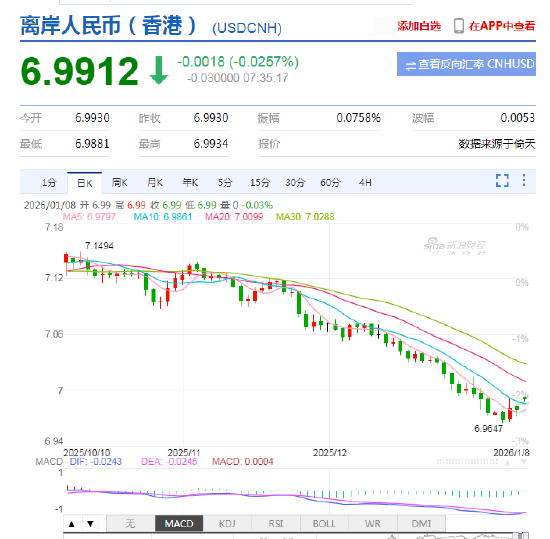
以破“7”收官2025,2026年人民币汇率将何去何从?
Xin Hua Cai Jing· 2026-01-08 08:36
Core Viewpoint - In 2025, the RMB exchange rate experienced significant appreciation against the USD, influenced by tariff expectations, fluctuations in the USD, and improvements in the domestic environment, with onshore and offshore RMB appreciating approximately 4.27% and 4.93% respectively [1][2][3] Group 1: RMB Exchange Rate Trends in 2025 - The RMB exchange rate reached its highest levels since May 2023, closing at 6.9879 for onshore and 6.9697 for offshore [2] - The year can be divided into two phases: the first phase saw a depreciation of about 0.65% until early April due to rising global tariff risks, while the second phase from mid-April to year-end saw a cumulative appreciation of approximately 4.9% as external economic conditions improved [2][3] - The depreciation of the USD, driven by various factors including the Federal Reserve's shift to a loose monetary policy, contributed to the RMB's strength [3] Group 2: Internal and External Factors Supporting RMB Appreciation - Strong export performance supported the RMB's appreciation, with a trade surplus exceeding $1 trillion for the first 11 months of 2025 [3] - The Chinese capital market showed resilience, with the Shanghai Composite Index rising 18.41%, the Shenzhen Component Index increasing by 29.87%, and the ChiNext Index up by 49.57%, providing solid support for the RMB [3] - The implementation of stable exchange rate policies helped to smooth fluctuations and maintain market expectations [3][4] Group 3: Outlook for 2026 - The RMB is expected to continue a gradual appreciation against the USD in 2026, influenced by the USD's potential depreciation and narrowing interest rate differentials between China and the US [6][7] - The external economic environment's impact on the RMB may lessen, with improved resilience in China's economy and financial markets [6][7] - Despite potential short-term fluctuations, the RMB is projected to maintain a range of 6.9 to 7.3 against the USD, with a focus on balanced exchange rate management [7][8]
【2026年汇市展望】以破“7”收官2025 2026年人民币汇率将何去何从?
Xin Hua Cai Jing· 2026-01-08 05:44
Core Viewpoint - The RMB exchange rate experienced significant appreciation in 2025, influenced by various factors including tariff expectations, fluctuations in the USD, and improvements in the domestic environment, with the onshore and offshore RMB appreciating approximately 4.27% and 4.93% respectively [1][2]. Group 1: RMB Exchange Rate Performance - In 2025, the RMB exchange rate reached its highest levels since May 2023, closing at 6.9879 for onshore and 6.9697 for offshore RMB against the USD [2]. - The year can be divided into two phases: the first phase saw a depreciation of the RMB due to rising global tariff risks, while the second phase experienced a gradual appreciation as external economic conditions improved [2][3]. - The RMB's appreciation was supported by a resilient export performance, with trade surplus exceeding $1 trillion for the first time in 2025 [3][4]. Group 2: External and Internal Factors - The depreciation of the USD was driven by various factors including the Federal Reserve's shift to a loose monetary policy and high fiscal deficits, leading to a cumulative decline of approximately 9.37% for the year [3][5]. - The internal economic resilience, particularly in exports, played a crucial role in supporting the RMB's appreciation, with significant inflows of foreign capital into the domestic market [3][4]. - The stable exchange rate policies implemented by the government helped to smooth fluctuations and maintain market expectations [3][4]. Group 3: Outlook for 2026 - Moving into 2026, the RMB is expected to continue a trend of gradual appreciation against the USD, influenced by the USD's potential depreciation and narrowing interest rate differentials between China and the US [6][7]. - The external economic environment is anticipated to remain favorable, with the RMB's asset attractiveness likely to draw in cross-border capital flows [7][8]. - However, there are cautions regarding the potential for rapid appreciation and the need for risk management strategies among enterprises and financial institutions [9].
以破“7”收官2025 2026年人民币汇率将何去何从?
Xin Lang Cai Jing· 2026-01-07 23:37
Core Viewpoint - The Chinese yuan (RMB) is expected to experience a significant appreciation in 2025, influenced by various factors including tariff expectations, fluctuations in the US dollar, and improvements in the domestic economic environment, with the onshore and offshore RMB appreciating approximately 4.27% and 4.93% respectively by year-end [1][3]. Group 1: 2025 RMB Exchange Rate Performance - The RMB exchange rate showed a notable recovery in 2025, marking the largest increase in five years, with the onshore and offshore RMB closing at 6.9879 and 6.9697 against the USD, respectively, both reaching new highs since May 2023 [3][4]. - The year can be divided into two phases: the first phase from early January to early April saw the RMB depreciate approximately 0.65% due to rising global tariff risks, while the second phase from mid-April to year-end witnessed a cumulative appreciation of about 4.9% as external economic conditions improved [4][5]. Group 2: External and Internal Factors Influencing RMB - Externally, the RMB's appreciation was supported by a warming external economic environment following agreements between China and the US, alongside a depreciation of the USD due to various pressures, including the Federal Reserve's shift to a loose monetary policy [5][6]. - Internally, strong export performance and resilience in the financial market contributed to the RMB's strength, with exports showing unexpected rebounds and a trade surplus exceeding 1 trillion USD for the first time in 2025 [5][6]. Group 3: Future Outlook for 2026 - Moving into 2026, the RMB is expected to continue a gradual appreciation against the USD, supported by a favorable external environment and a potential narrowing of interest rate differentials between China and the US [8][9]. - The RMB's asset attractiveness is anticipated to rise, attracting cross-border capital inflows, although there may be a decline in export growth, which could weaken the trade surplus's support for the exchange rate [9][10]. - Analysts predict that the RMB will likely fluctuate within the 6.9 to 7.3 range against the USD throughout 2026, with the potential for a mild appreciation against a basket of currencies [10][11].

「改革创新」陈文玲:国际金价为何一路狂飙?
Sou Hu Cai Jing· 2026-01-07 16:35
Core Insights - The international gold prices are expected to reach historical highs by the end of 2025, with a cumulative increase of over 70% throughout the year, driven by geopolitical tensions, market supply-demand issues, and safe-haven demand [1][2][3] Market Performance - Gold prices surged from $2,600 per ounce at the beginning of 2025 to $4,500 per ounce by the end of the year, marking a 163% increase over three years and the strongest annual performance since 1979 [2][3] - The price fluctuations in 2025 can be divided into several phases: - January to April saw a rise from $2,900 to $3,500 due to tariff fears - April to August experienced a stabilization between $3,200 and $3,500 as trade negotiations progressed - August to October saw prices exceed $3,800, reaching a peak of $4,200 - October to mid-December involved a technical correction due to profit-taking - Mid-December to year-end saw prices break through $4,500 [3] Factors Driving Gold Prices - The rise in gold prices is characterized by "multiple logical resonances," including the long-term upward trend post-Bretton Woods, traditional geopolitical risks, inflation hedging, and the impact of "de-dollarization" [3][7] - Geopolitical instability, particularly involving the U.S., Venezuela, and the ongoing Russia-Ukraine conflict, has significantly increased gold's appeal as a safe-haven asset [7][6] - Central banks, especially in emerging markets like China, India, and Russia, are increasing their gold reserves as part of a broader strategy to diversify away from the dollar [5][7] Future Outlook - Analysts predict that gold prices may continue to rise, potentially reaching $5,000 per ounce by 2026, driven by ongoing geopolitical tensions and central bank demand [8][9] - The dollar's dominance is expected to weaken gradually, leading to a multi-polar reserve currency system, although this process will be slow and complex [10][11]
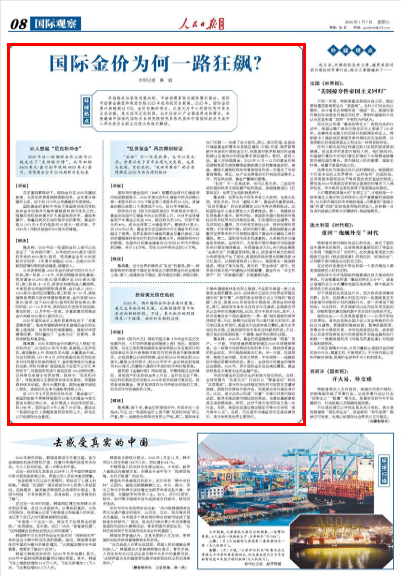
国际金价为何一路狂飙?(环球热点)
Ren Min Ri Bao Hai Wai Ban· 2026-01-06 22:59
Core Insights - The international gold prices are expected to reach historical highs by the end of 2025, driven by geopolitical tensions, market supply-demand imbalances, and increased safe-haven demand, with a cumulative increase of over 70% throughout the year [1][2]. Market Performance - Gold prices surged from $2,600 per ounce at the beginning of 2025 to $4,500 per ounce by the end of the year, marking a record-breaking 50 instances of new highs [2][3]. - The price fluctuations in 2025 can be categorized into several phases: 1. January to April saw a spike from $2,900 to $3,500 due to tariff fears. 2. April to August experienced a stabilization between $3,200 and $3,500 amid trade negotiations. 3. August to October saw prices exceed $3,800, reaching a peak of $4,200. 4. October to mid-December involved a technical correction due to profit-taking. 5. Mid-December to year-end saw prices surpass $4,500 due to multiple factors [3]. Geopolitical and Economic Factors - The rise in gold prices reflects a "multi-logical resonance," influenced by the long-term upward trend post-Bretton Woods collapse, traditional geopolitical risks, inflation hedging, and the impact of "de-dollarization" [3][8]. - The decline of the dollar's dominance is evident, with its share in global foreign exchange reserves dropping from 57.79% to 56.32% in 2025, marking a 30-year low [6]. Central Bank Actions - Central banks, particularly in emerging markets like China, India, and Russia, are increasing their gold reserves, indicating a shift towards diversification away from the dollar [8][12]. - Gold's share in global reserves reached 20% in 2024, surpassing the euro's 16%, and the total gold reserves held by central banks are nearing post-World War II highs [6]. Future Outlook - Analysts predict that gold prices may continue to rise, potentially reaching $5,000 per ounce by 2026, driven by ongoing geopolitical tensions and central bank demand [9][12]. - The anticipated continuation of low interest rates by the Federal Reserve in 2026 is expected to lower the opportunity cost of holding gold, further supporting its price [12].
两大因素共振 支持A股新年表现
Zheng Quan Shi Bao· 2026-01-04 17:30
Group 1 - The core viewpoint is that the restructuring of international order and China's industrial innovation will support A-share performance in 2026, with a market trend of initial growth followed by stability [1] - The market is expected to see increased volatility and valuation uplift, with a focus on sectors that align with fundamental performance [1] - Three main investment themes are identified: 1) Growth sectors such as AI, which is entering an application phase, with opportunities in computing power, optical modules, and cloud computing infrastructure, particularly in domestic markets; application areas include robotics, consumer electronics, intelligent driving, and software applications [1] 2) External demand breakout, focusing on sectors like home appliances, construction machinery, commercial buses, power grid equipment, gaming, and globally priced resources like non-ferrous metals [1] 3) Cyclical reversal, with attention to sectors nearing improvement in supply-demand dynamics or receiving policy support, such as chemicals, aquaculture, and new energy [1] Group 2 - There is an expectation for capital market policies to further promote a "long-term" and "steady" market environment, which could enhance capital market openness in the context of international monetary system restructuring and global capital reallocation [2] - The company aims to support financing for innovative enterprises and improve market inclusivity while optimizing mechanisms for long-term capital entry, thereby increasing market stability and resilience [2]

各国央行纷纷抢购黄金的底层逻辑是什么?
Sou Hu Cai Jing· 2025-10-29 04:11
Core Insights - Global official gold reserves increased by 166 tons in Q2 2023, reaching historical highs, with central banks expected to continue purchasing over 1000 tons annually from 2022 to 2024 [2][3] - 95% of surveyed central banks anticipate an increase in global official gold reserves in the next 12 months, with 43% planning to increase their own gold holdings [2] - The freezing of Russian foreign exchange reserves by the US and its allies has triggered a crisis of trust in the US dollar-based international monetary system, leading to a surge in gold purchases by central banks [3][5] Gold as an Alternative to the Dollar - Gold is a non-nominal asset with physical form, immune to political interference, and can be stored under national control, making it a secure option in the current geopolitical climate [4] - Gold possesses unique attributes as a commodity, currency, and financial asset, independent of any nation's credit, thus serving as a hedge against currency devaluation and high debt levels [4] - The global daily trading volume of gold exceeds $100 billion, providing the liquidity that central banks require for reserve assets [4] Shift Towards Diversification - Central banks are adjusting asset allocation strategies, with a notable trend of "de-dollarization" emerging, particularly among emerging market countries like China, Russia, and India, as well as others like Turkey and Kazakhstan [5] - There is a clear trend towards diversifying international trade settlement currencies, with more countries opting for local currency settlements to reduce reliance on the US dollar [5] - The erosion of trust in the dollar's dominance is a gradual process, and while the dollar remains a key player in global finance, the shift towards a more diversified international monetary system is underway [5][6] Future Financial Landscape - The increasing demand for gold reflects a broader desire for a more equitable and diversified international monetary system, with gold playing a crucial role as a store of value and a symbol of financial sovereignty [5][6] - The development of digital currencies may further alter the existing financial landscape, potentially reducing dependence on traditional reserve currencies [6] - The ongoing transformation in the global financial system is complex and will involve market fluctuations and geopolitical tensions, as countries seek to balance security, liquidity, and profitability in their reserve strategies [6]