资金空转

Search documents
11家银行因虚增存贷款被罚、规模增7.5倍,违规考核问题突出
2 1 Shi Ji Jing Ji Bao Dao· 2026-02-06 10:36
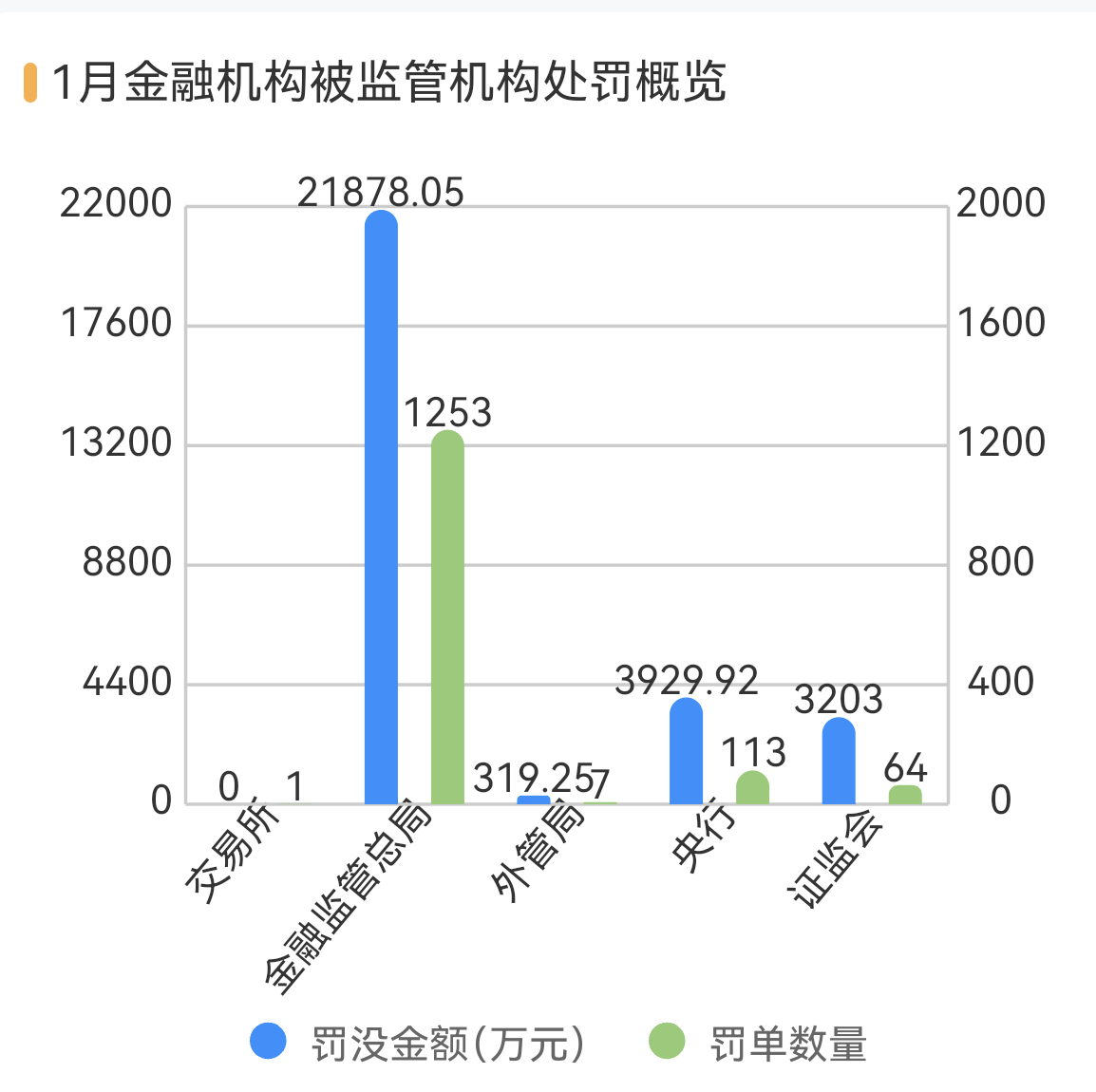
Core Insights - In January, the number of fines imposed on financial institutions increased significantly year-on-year, while the total amount of fines decreased [1][3] Group 1: Overview of Penalties - A total of 1,438 fines were issued to financial institutions in January, representing a year-on-year increase of 54.13%, with a total penalty amount of 29.3 million yuan, down 20.16% from the previous year [1] - The Financial Regulatory Bureau issued 1,253 fines, an increase of 83.19% year-on-year, with a total penalty amount of 21.9 million yuan, up 15.87% [3] - The People's Bank of China issued 113 fines, a decrease of 38.59% year-on-year, while the China Securities Regulatory Commission issued 64 fines, an increase of 18.52% [3] Group 2: Penalties by Financial Institution Type - Banks received 830 fines, an increase of 41.88% year-on-year, with a total penalty amount of 21.4 million yuan, down 25.95% [6] - The insurance sector faced 532 fines, a year-on-year increase of 84.08%, with a slight decrease in total penalty amounts [6] - Securities firms received 12 fines, and futures companies received 9 fines, while private equity firms faced 44 fines [6] Group 3: Major Penalties - Shanghai Riyi Equity Investment Fund Co., Ltd. was fined 14 million yuan for failing to operate investments as per contractual agreements [9] - The actual controller of Shanghai Riyi, Sun, received a fine of 11.9 million yuan for similar violations, including misleading investors about capital safety [9] - Zhejiang Min Tai Commercial Bank was fined 7.15 million yuan for serious violations of prudent management rules [9] Group 4: Compliance Trends - The number of fines related to inflated loan and deposit figures increased 7.5 times month-on-month, with 34 fines issued in January compared to only 4 in December [11] - Misleading sales and promotional practices resulted in 34 fines, doubling from the previous month, primarily affecting insurance companies and banks [12] Group 5: Penalty Rankings - In January, non-bank institutions, particularly insurance companies, dominated the list of penalties, with Shanghai Riyi Equity Investment Fund being the highest fined non-bank entity [17] - China Ping An Property Insurance and China People's Property Insurance ranked second and third in total penalty amounts [17]







中信证券:资金利率继续下探的空间有限
Xin Lang Cai Jing· 2025-12-29 00:22
Core Insights - The recent trend of DR001 gradually declining indicates that there is limited room for further decreases in funding rates before the next interest rate cut [1] - The central bank's statement from the fourth quarter monetary policy meeting in 2025 suggests that the emphasis on "preventing fund idling" is temporarily downplayed, indicating a low probability of funding rate increases [1] - It is expected that funding rates will maintain a low level in the future [1]

深圳房抵经营贷利率低至2.35%,资金空转等风险需关注
Nan Fang Du Shi Bao· 2025-12-24 13:43
Core Viewpoint - The personal housing mortgage business loan market in Shenzhen is experiencing a resurgence of low interest rates, with the minimum rate dropping to 2.35%, which is 65 basis points lower than the current one-year LPR of 3% [2][3]. Group 1: Interest Rates and Loan Conditions - The minimum interest rate for personal housing mortgage business loans has reached 2.35% across multiple banks in Shenzhen, including Zhuhai Huaren Bank, Zhejiang Commercial Bank, and CITIC Bank [2]. - Different banks have established varying thresholds for loan amounts, loan-to-value ratios, and eligibility criteria, leading to a competitive landscape [3][4]. - The maximum loan amount varies significantly among banks, with CITIC Bank and China Merchants Bank offering up to 30 million yuan, while Zhejiang Commercial Bank and Industrial and Commercial Bank of China have a cap of 20 million yuan [3][4]. Group 2: Risk Factors and Regulatory Concerns - Experts have raised concerns about potential risks associated with low interest rates, including the risk of fund misallocation and regulatory loopholes that could allow funds to flow into the real estate market [4][6]. - The banking sector faces increased pressure on profitability due to declining interest rates, which could impact asset quality and operational stability, particularly for smaller banks [6]. - Regulatory measures have been introduced to guide the industry towards standardized development, emphasizing the need for compliance and risk management [6][7]. Group 3: Economic Implications - The reduction in personal housing mortgage business loan rates is seen as a necessary response to current economic conditions, aimed at supporting small and micro enterprises and stabilizing economic growth [5]. - Lower interest rates are expected to stimulate credit demand, enhance loan willingness among enterprises, and promote the rational flow and optimization of funds [5]. - Banks are encouraged to innovate and develop more financial products tailored to small and micro enterprises to enhance their market share and service capabilities [5].



基金经理投资笔记 | 流动性充裕局面的改变
Sou Hu Cai Jing· 2025-11-27 05:57
Core Viewpoint - The article discusses the current economic cycle and the challenges faced by investors, emphasizing the need for strategic patience amid market fluctuations and policy adjustments [1] Group 1: Economic Conditions - The transition from "money shortage" to "asset shortage" reflects a shift in market dynamics, with liquidity excess not translating effectively into real economic growth [2] - The reluctance of producers to expand credit is attributed to a lack of consumer demand, despite the availability of low-cost funds [3] Group 2: Consumer Behavior - Consumer spending is constrained by budget limitations, primarily driven by income levels, which are influenced by immediate, stored, and future income [4] - Policies aimed at redistributing wealth may not yield desired effects; instead, increasing production and income is suggested as a more effective approach [5] Group 3: Policy Recommendations - Effective policies should focus on increasing production to enhance immediate income and stimulate consumer spending [5] - Measures such as fiscal subsidies to encourage consumer spending from savings and breaking the expectation of precautionary savings are proposed [6] - The creation of new public works and ensuring asset appreciation are highlighted as potential strategies to boost economic activity [7][8] Group 4: Financial Dynamics - The demand for funds varies across different industries, with traditional industries facing pressures for transformation and new industries requiring long-term investments [11] - The phenomenon of "funds idling" is identified as a critical issue, necessitating regulatory measures to ensure that financial resources effectively support the real economy [12] Group 5: Monetary Policy Outlook - The liquidity situation in 2026 is expected to be less favorable than in 2025, with a greater reliance on structural debt increases for liquidity creation [15]
创金合信基金魏凤春:流动性充裕局面的改变
Xin Lang Ji Jin· 2025-11-26 02:17
Core Viewpoint - The article discusses the current investment climate, highlighting the shift from liquidity abundance to an "asset shortage" as a result of changing global economic conditions and the impact of monetary policies [2][17]. Group 1: Market Sentiment and Policy Implications - Investor sentiment is adjusting as the year-end approaches, with a mix of optimism regarding global AI competition and pessimism about domestic demand [1]. - The Chinese central bank's decision not to lower reserve requirements or interest rates contrasts with aggressive expectations from investors, reflecting a cautious policy approach [1][17]. Group 2: Liquidity and Credit Expansion - The transition from "money shortage" to "asset shortage" indicates a surplus of liquidity that is not effectively penetrating the real economy [2]. - Producers are reluctant to expand credit despite the availability of funds, primarily due to concerns about consumer demand and external risks [3]. Group 3: Consumer Behavior and Economic Constraints - Consumer spending is constrained by budget limitations, which stem from income sources such as current earnings, savings, and future income expectations [4]. - Policies aimed at redistributing wealth may not yield desired effects; instead, increasing production and income is suggested as a more effective approach to stimulate consumption [5][6]. Group 4: Future Economic Strategies - Various strategies are proposed to enhance consumer spending, including direct cash transfers, breaking the expectation of precautionary savings, and creating new public works projects [6][7][8]. - The article emphasizes the importance of maintaining asset value and encouraging consumption in the real estate and service sectors to drive economic growth [9][10][11]. Group 5: Regulatory Perspectives - Regulatory authorities are focused on addressing issues of capital inefficiency and ensuring that financial activities support the real economy [14]. - The government aims to stabilize the currency and refine monetary policy frameworks to enhance the effectiveness of interest rate adjustments [15][16]. Group 6: Future Liquidity Outlook - The analysis suggests that liquidity in 2026 may be less abundant than in 2025, with a greater reliance on structural debt increases to create liquidity [17].
买断式逆回购中标利率反映了什么?
Xinda Securities· 2025-11-23 06:06
Report Industry Investment Rating No information about the industry investment rating is provided in the report. Core Viewpoints - The central bank's current policy attitude is similar to that in Q4 2023, with a reduced desire to promote the growth of M2 and social financing. However, the current situation is due to the decline in government bond net financing, and the central bank has no intention to tighten liquidity actively but lacks the willingness to relax it. With the approaching of year - end important meetings, the policy's demand for stable growth may become clearer, and attention should be paid to whether the monetary policy attitude will change [24]. - The funds rate center this week was higher than expected. If the central bank's policy framework remains unchanged, the funds price may loosen marginally at the end of November and next week [28][49]. - The market's attention to the winning bid rate of the repurchase - type reverse repurchase has increased. The central bank may not intentionally raise the winning bid rate, but a significant decline may still require a policy rate cut [20][21]. Summary by Relevant Catalogs I. Money Market 1.1 This Week's Funds Review - The central bank's 7 - day reverse repurchase had a net injection of 554 billion yuan this week, and an 80 - billion - yuan 6 - month repurchase - type reverse repurchase operation was carried out on Monday. The monthly net injection of the repurchase - type reverse repurchase increased by 100 billion yuan to 500 billion yuan compared with October. Affected by tax payments and government bond payments, the funds tightened in the first half of the week and then loosened. DR001 reached 1.53% at one point and fell to 1.32% on Friday [3][7]. - The trading volume of pledged repurchase first decreased and then increased, with the average daily trading volume decreasing by 0.15 trillion yuan to 7.29 trillion yuan compared with last week. The net lending of large - scale banks first decreased and then increased, returning to 4 trillion yuan on Friday. The net lending of joint - stock banks and city commercial banks increased after Tuesday, but the net lending of joint - stock banks decreased again on Friday. The new - caliber funds gap index reached - 398 on Tuesday and then fell to - 4117 on Friday, lower than - 1918 last Friday [14]. - As of Friday, the cross - month progress of inter - bank institutions was at the lowest level in recent years, and the cross - month progress of the exchange was only higher than that in 2024. The overall cross - month progress of the market was 9.6%, 4.4 percentage points lower than the average from 2020 - 2024 [18]. - After the "Financial Times" mentioned "fund idling", the market's attention to the winning bid rate of the repurchase - type reverse repurchase increased. The 6 - month repurchase - type reverse repurchase injection in November reached 800 billion yuan, with a net injection of 500 billion yuan, reflecting the central bank's intention to maintain sufficient liquidity. However, due to the large maturity of certificates of deposit and banks' high demand for medium - term liquidity across the Spring Festival, the winning bid rate may be affected. The central bank may not intentionally raise the winning bid rate, but a significant decline may require a policy rate cut [20][21]. 1.2 Next Week's Funds Outlook - The expected government bond payment scale next week is 557.3 billion yuan, with a net payment of 308.8 billion yuan, a decrease from this week. It is estimated that the government bond issuance scale in November is 1.94 trillion yuan, with a net financing of 1.25 trillion yuan, an increase of about 720 billion yuan compared with October. It is estimated that the government bond issuance scale in December is about 2.28 trillion yuan, with a net financing of about 670 billion yuan [31][38][40]. - The maturity scale of the 7 - day reverse repurchase next week will increase from 1.122 trillion yuan to 1.676 trillion yuan, and there will also be a 900 - billion - yuan MLF maturity on Tuesday. Although the increase in reverse repurchase maturity, government bond payment pressure, and institutions' cross - month funds demand may disturb the funds, the central bank's MLF is expected to be renewed in excess, and the year - end fiscal expenditure may hedge the impact. If the central bank's policy framework remains unchanged, the funds rate may decline next week [49]. II. Inter - bank Certificates of Deposit - The 1 - year Shibor rate remained unchanged at 1.65% this week. The net repayment scale of inter - bank certificates of deposit increased by 36.97 billion yuan to 38.71 billion yuan compared with last week. The net financing scales of state - owned banks, joint - stock banks, city commercial banks, and rural commercial banks were - 195.9 billion yuan, - 162.7 billion yuan, - 26.7 billion yuan, and - 13.7 billion yuan respectively. The issuance proportion of 1 - year certificates of deposit increased to 39%. The maturity scale of certificates of deposit next week is about 775.2 billion yuan, a decrease of 145.8 billion yuan compared with this week [50][52]. - The issuance success rates of rural commercial banks, joint - stock banks, and city commercial banks decreased compared with last week, while that of state - owned banks increased. The issuance spread between city commercial banks and joint - stock banks for 1 - year certificates of deposit narrowed. Affected by the increased funds fluctuations, fund companies tended to reduce their holdings of certificates of deposit, the willingness of money market funds to increase their holdings declined significantly, the demand of wealth management products and other products was relatively stable, and joint - stock banks tended to increase their holdings. The relative strength index of supply and demand for certificates of deposit continued to decline, falling by 4.1 percentage points to 37.7% on Friday, still in a relatively strong range. The supply - demand index of 6 - month certificates of deposit increased, while that of other maturities decreased slightly [53][65]. III. Bill Market - The bill rate continued to rise after Tuesday this week. The 3 - month and 6 - month national bill rates increased by 18BP and 14BP respectively compared with November 14th, reaching 0.58% and 0.77% [70]. IV. Bond Trading Sentiment Tracking - The bond market continued to fluctuate narrowly this week, and the credit and secondary - tier perpetual bond spreads were relatively stable. The willingness of large - scale banks to increase their bond holdings decreased slightly, mainly due to the significant weakening of the willingness to increase their holdings of certificates of deposit, a slight decrease in the willingness to increase their holdings of short - term treasury bonds, and an increase in the willingness to reduce their holdings of medium - term notes. Trading - type institutions' willingness to increase their bond holdings increased slightly, while allocation - type institutions' willingness to increase their bond holdings decreased [73].
潘功胜:持续整治金融业“内卷式”竞争、资金空转
Zheng Quan Shi Bao Wang· 2025-10-31 05:16
Core Viewpoint - The article emphasizes the need for a scientific and robust monetary policy system and a comprehensive macro-prudential management system in China, as articulated by the Governor of the People's Bank of China, Pan Gongsheng [1] Group 1: Monetary Policy - The article highlights the importance of maintaining a smooth transmission mechanism for monetary policy [1] - It calls for enhanced evaluation of monetary policy execution to guide financial institutions in improving the effectiveness of monetary policy, particularly interest rate policies [1] - There is a focus on addressing "involution" competition and capital idling within the financial industry [1] Group 2: Coordination with Other Policies - The article stresses the need for better coordination between monetary policy and fiscal, industrial, and other policies in terms of demand management and structural adjustments [1]
2025年9月金融数据点评:“防空转”下,信贷同比回落趋势或将延续
Changjiang Securities· 2025-10-16 15:39
Report Summary 1. Report Industry Investment Rating No relevant content provided. 2. Core Viewpoints of the Report - In the context of preventing capital idling and optimizing credit structure, the year - on - year decline trend of monthly credit increments is likely to continue. The year - on - year growth rate of the stock of social financing at the end of September 2025 was +8.7%, with the growth rate decreasing by 0.1 percentage points month - on - month. It is expected that the year - on - year growth rate of the stock of social financing in the fourth quarter will continue to decline [2][8]. - In the fourth quarter of this year, the bond market is expected to perform better than the third quarter, but there will still be policy reform disturbances. It is recommended to actively allocate when the yield of the active 10 - year Treasury bond is above 1.75%, and the yield of the active 10 - year Treasury bond in the fourth quarter is expected to fall to around 1.7% [8]. 3. Summary by Relevant Catalogs Credit - Under the background of preventing capital idling and optimizing credit structure, the monthly credit increment continued to be less than the same period last year. In September 2025, the new credit was about 1.29 trillion yuan, 300 billion yuan less than the same period last year and 700 billion yuan more than the previous month. The credit structure was optimized, with the medium - and long - term loans of residents and short - term loans of enterprises increasing year - on - year, and bill discounting decreasing year - on - year. As of the end of September 2025, the balance of RMB loans had reached 270 trillion yuan, and the weighted average interest rate of new enterprise loans (domestic and foreign currencies) in September 2025 was 3.1% [8]. - Promoting credit structure optimization is the policy focus of the regulatory authorities, and a slight year - on - year weakening of credit increments is unlikely to trigger a quantitative loose monetary policy. The optimization of credit structure is reflected in the fact that the credit increments in each month of the third quarter were less than the same period last year, while the loan growth rates in key policy - supported areas were relatively high, and the bill - padding situation was weakened [8]. Social Financing - In September 2025, the increment of social financing was about 3.53 trillion yuan, lower than 3.76 trillion yuan in the same period last year. On - balance - sheet financing and government bonds were the main contributors to the increment of social financing. Corporate bonds and undiscounted bank acceptance bills increased significantly year - on - year [8]. - In the first three quarters of this year, government bonds provided trend support for the growth of social financing. As of September 28, the issuance progress of national bonds and new local government bonds in 2025 had reached 81.4%, faster than the scheduled progress. It is expected that the issuance scale of government bonds will decline in the fourth quarter, and the year - on - year growth rate of the stock of social financing in the fourth quarter will continue to decline. However, if part of the new local government debt quota for 2026 is issued in the fourth quarter of this year, it may support the year - end social financing growth rate [8]. Money - In September, the year - on - year growth rate of M1 continued to rise, mainly due to the increase in fiscal expenditure at the end of the quarter, the interaction between wealth management and deposit business, and the relatively prominent credit increment at the end of the quarter. The year - on - year growth rate of M2 decreased, partly because of the marginal increase in the M2 base in the same period last year [8]. Outlook for Financial Data and the Bond Market - Without considering the impact of the early release of the local government debt quota, it is expected that the year - on - year growth rate of the stock of social financing in each month of the fourth quarter will continue to decline. The bond market in the fourth quarter of this year is expected to perform better than that in the third quarter, and it is recommended to actively allocate when the yield of the active 10 - year Treasury bond is above 1.75%, with the yield expected to fall to around 1.7% [8].
10 月债市展望
2025-10-09 14:47
Summary of Key Points from the Conference Call Industry Overview - The conference call primarily discusses the bond market outlook for October 2025, with a focus on credit bonds and interest rate bonds [2][7][12]. Core Insights and Arguments - **Travel Data and Real Estate Sales**: Strong travel data during the National Day holiday indicates robust activity, but real estate sales were slightly weaker than the previous year, leading to a neutral impact on the bond market [2][5]. - **U.S. Economic Indicators**: The U.S. government shutdown has resulted in the absence of key non-farm payroll data, while the ADP employment report showed a decrease of 32,000 jobs, raising expectations for a potential interest rate cut by the Federal Reserve in October [2][6]. - **Monetary Policy Outlook**: The central bank is expected to maintain a supportive monetary policy stance, utilizing various tools to ensure liquidity, while being cautious of risks associated with fund idling [2][7]. - **Interest Rate Trends**: The overall low interest rate environment is leading to a decline in the profitability of pure bond assets, making it difficult for long-term rates to decrease significantly in October [2][7]. - **Credit Bond Market Performance**: The credit bond market experienced volatility in September, with a steepening yield curve and fluctuating credit spreads. A defensive strategy focusing on short-duration bonds is recommended for October [2][8][12]. Important but Overlooked Content - **Impact of Regulatory Changes**: The introduction of new public fund sales regulations in early September caused significant market disruptions, leading to a sell-off of government bonds to maintain liquidity, which resulted in a passive narrowing of credit spreads [2][10]. - **Seasonal Factors**: Concerns over institutional redemptions at the end of September led to a significant rise in credit bond yields and widening credit spreads [2][11]. - **Investment Recommendations**: - For institutions with moderate stability, focus on 2-3 year credit varieties, particularly 3-year bank subordinated capital instruments, while being cautious of liquidity risks [3][14]. - For stable institutions, consider participating in 4-5 year bank subordinated capital instruments, but be aware of potential volatility [3][14]. - Avoid excessive participation in ultra-long-term non-financial bonds due to their lower liquidity and potential for significant price adjustments [3][14].
“特朗普关税+美联储降息”让全球资金空转
日经中文网· 2025-09-19 08:00
Group 1 - The world economy is facing a complex situation with "Trump tariffs" acting as a brake and major countries' monetary easing serving as an accelerator [2][9] - The Federal Reserve has restarted interest rate cuts after nine months, indicating a shift in monetary policy [2][5] - Major central banks, except for the Bank of Japan, are lowering interest rates, with the average policy rate in developed countries dropping from 4.2% to 3% [5][7] Group 2 - The number of corporate bankruptcies in the U.S. has reached the highest level since 2010, with 446 large enterprise bankruptcies reported from January to July 2025 [3] - Employment market is slowing down, prompting the Federal Reserve to cut rates by 0.25% on September 17 [3][7] - Despite the influx of monetary easing, funds are not flowing into the real economy, leading to a distortion in financial markets [2][8] Group 3 - Investment in equipment is stagnating, with U.S. equipment investment expected to increase by only 0.8% in 2025 and 0.5% in 2026 [7][8] - Companies are diverting funds from equipment investment to financial markets, with a significant increase in Bitcoin holdings among global listed companies [8][9] - The average tariff rate has increased from 2.4% to 16.4%, adding an estimated $450 billion burden annually on imports [8][9] Group 4 - If monetary easing does not stimulate the real economy, investment returns in financial markets may decline, posing a risk of cooling down [9] - The Trump administration aims to attract $550 billion from Japan and $600 billion from Europe to revitalize domestic industries [9]