
风险调整后收益

Search documents
沙特资金上演“向西迁徙”! 沙特国内股市失色 资金向美股狂奔
Zhi Tong Cai Jing· 2026-02-27 13:03
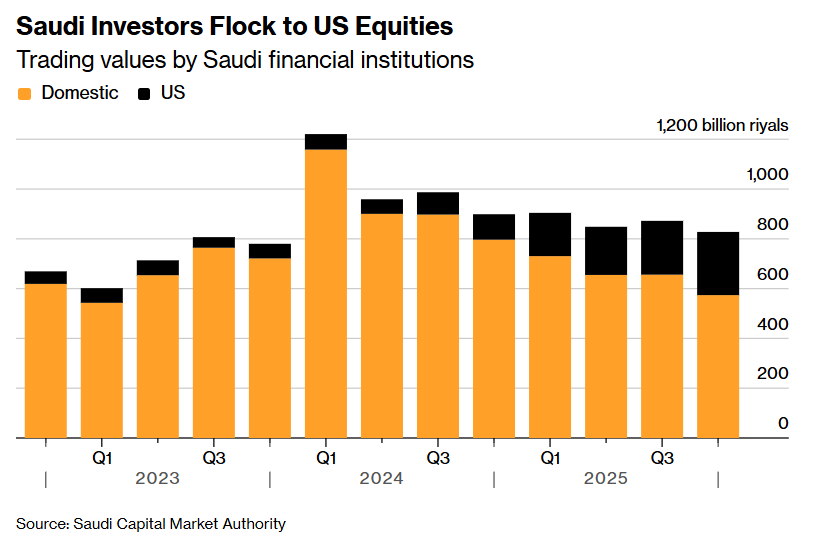
Core Insights - Saudi Arabian investors significantly increased their trading activities in the US stock market in 2025, reallocating funds from a domestic market that ranked among the worst globally [1][4][6] - The Saudi stock market experienced a notable decline, with the Tadawul All Share Index dropping 9% in Q4 and a total annual decline of 13%, while the US market, particularly the S&P 500, rose over 16% [4][6] Group 1: Trading Activities - In Q4 2025, Saudi financial institutions' trading volume in US stocks reached approximately 254 billion riyals (about 68 billion USD), doubling compared to the same period last year [1] - The total trading volume in the Saudi stock market fell sharply from over 1.1 trillion riyals at the beginning of 2024 to about 574 billion riyals by the end of 2025 [1] Group 2: Market Performance - The decline in the Saudi stock market is attributed to expectations of oversupply in oil, fiscal pressures, and regional tensions, contrasting sharply with the performance of the US market driven by major tech companies and enthusiasm for AI [4][6] - Despite the Public Investment Fund (PIF) reducing its holdings in US-listed stocks, it still invested heavily in significant acquisitions, including a 55 billion USD purchase of Electronic Arts and a 3 billion USD investment in xAI [4] Group 3: IPO Market Dynamics - The Saudi IPO market has cooled significantly, with a series of underperforming new listings and a slow start to new offerings this year [5] - In contrast, US companies are preparing for a new wave of large IPOs, including SpaceX, which could surpass Saudi Aramco's IPO as the largest globally [5] Group 4: Investment Strategy - Saudi investors are actively reallocating to the US market due to a significant relative return gap, with the US market offering asset supplies that the local market cannot match [6] - The Saudi government's investment commitments to the US have increased, with potential investments reaching close to 1 trillion USD across various strategic sectors [7]

全球资产配置每周聚焦(20260116-20260123):人民币升值期间大类资产复盘-20260125
Shenwan Hongyuan Securities· 2026-01-25 13:28
Global Market Overview - During the period from January 16 to January 23, 2026, geopolitical conflicts intensified, leading to an increase in precious metals, with gold rising by 8.3%[6] - The 10-year U.S. Treasury yield remained at 4.2%, while the U.S. dollar index decreased by 1.88%[6] Asset Performance During RMB Appreciation - Since 2000, the RMB has experienced 6 rounds of appreciation and 4 rounds of depreciation, influenced by currency reforms and global trade cycles[8] - During RMB appreciation, stocks generally showed higher stability, with the ChiNext outperforming the CSI 300, except in 2017[10] - In the bond market, the national debt index recorded negative returns during appreciation periods in 2017, 2023, and 2025, while other periods showed positive returns[10] Fund Flows - As of January 21, 2026, both domestic and foreign capital flowed into the Chinese stock market, with foreign active funds inflowing $3.38 billion and passive funds inflowing $16.65 billion[3] - Domestic capital saw an outflow of $493.17 billion, while foreign capital inflow totaled $20.03 billion in the same week[3] Valuation Metrics - As of January 23, 2026, the Shanghai Composite Index's valuation exceeded that of the KOSPI 200, CAC 40, and S&P 500, reaching 92.9% of its 10-year historical average[3] - The equity risk premium (ERP) for the CSI 300 and Shanghai Composite remains relatively high, indicating good allocation value compared to global markets[3] Economic Indicators - The U.S. inflation rate, as measured by the PCE index, has remained low, indicating economic cooling[5] - The probability of the Federal Reserve maintaining interest rates between 3.5% and 3.75% is 95.60%, stable compared to the previous week[5]
全力营造“长钱长投”生态 公募基金改革新年再吹号角
Zheng Quan Shi Bao· 2026-01-18 18:17
Core Viewpoint - The public fund industry in China is set to deepen reforms in 2026, focusing on stabilizing the market and promoting long-term investments through various product offerings and risk management tools [1][5]. Group 1: Market Environment and Fund Role - The A-share market has shown a continuous upward trend, with the Shanghai Composite Index surpassing 4100 points and several equity funds achieving over 30% returns in just half a month [2]. - Amidst this market prosperity, irrational tendencies are emerging, particularly in sectors like commercial aerospace and AI applications, leading to inflated valuations [2]. - Public funds are urged to act as "stabilizers" in the market, maintaining professionalism and guiding rational investments rather than fueling speculative behavior [2][3]. Group 2: Reform Directions and Suggestions - The current assessment system encourages fund managers to chase hot trends for quick scale gains, which can amplify systemic risks and lead to significant market volatility [3]. - It is recommended that the public fund industry reform its evaluation metrics to focus on risk-adjusted returns, incorporating measures like the Sharpe ratio and maximum drawdown [3][6]. - Fund companies should diversify their product offerings to include stable value-oriented funds and absolute return strategies, especially during market exuberance [4][6]. Group 3: Long-term Investment Ecosystem - The China Securities Regulatory Commission emphasizes the need to broaden channels for long-term capital and develop products suitable for long-term investments [5][6]. - There is a call to enhance the inflow of long-term funds, such as pensions and insurance capital, into the market while creating products that meet their needs [6][7]. - Fund companies are encouraged to develop products that focus on absolute returns and risk management tools to cater to the lower risk appetite of long-term investors [7]. Group 4: Investor Experience and Transparency - Improving investor experience is crucial, with a shift needed from focusing solely on fund performance to also considering investor profitability [8][9]. - There is a proposal to include investor profit and loss data in fund disclosures to enhance transparency and accountability [8][9]. - Fund companies should prioritize customer-centric management, ensuring that the right products are matched with the appropriate investors and providing ongoing support [9][11]. Group 5: Sales Practices and Accountability - The sales practices within the public fund industry have been criticized for prioritizing asset management scale over responsible selling [11]. - A shift in the incentive structure is necessary, focusing on long-term client benefits rather than short-term sales metrics [11][12]. - Regulatory bodies are urged to enforce stricter penalties for misleading sales practices to protect investors and ensure ethical conduct in the industry [11][12].
中金:“赚过”,是波动送给我们的一场幻觉
Ge Long Hui· 2026-01-13 08:47
Core Viewpoint - High volatility in investments can significantly erode long-term compound growth, creating a "volatility tax" that impacts returns despite short-term gains [1] Group 1: Impact of Volatility - Investors often experience fleeting moments of profit, but high volatility can lead to actual losses due to emotional trading behaviors like "buy high, sell low" [1] - Under equal simple return conditions, higher asset volatility results in lower compound returns, with a trend of accelerated decline [1] Group 2: Recommendations for Investors - Diversification is the most fundamental and effective method to manage volatility [1] - Investors should assess their tolerance for net value fluctuations when allocating assets [1] - Building a "anti-fragile" system is essential, emphasizing the use of idle funds for investment [1] - Focus on risk-adjusted returns rather than just yield rankings, learning to evaluate metrics like the Sharpe ratio [1] - Embrace the philosophy that "slow is fast" in investing, as remaining invested allows time to work in favor of the investor [1]
全球资产配置每周聚焦(20251226-20260102):CME交易所提保背景下贵金属大幅调整-20260104
Shenwan Hongyuan Securities· 2026-01-04 12:45
Market Overview - The significant drop in precious metals was driven by the Federal Reserve's internal disagreements on interest rate cuts for 2026 and the CME's increase in futures margin requirements[3] - Gold prices fell by 4.79% during the week, while the 10-year U.S. Treasury yield rose to 4.19%, an increase of 5 basis points[3][15] Capital Flows - Domestic capital inflow into the Chinese stock market was $4.99 million, while foreign capital outflow amounted to $0.65 million in the past week[3] - Global funds saw inflows into money market funds, with U.S. equity markets receiving $11.6 million in inflows[20] Valuation Metrics - The A-share equity risk premium (ERP) slightly decreased but remains at a historically neutral level, with the Shanghai Composite Index's valuation at the 87.8 percentile over the past decade[3][19] - The risk-adjusted return percentile for the Shanghai Composite Index increased from 92% to 94%[3] Risk Sentiment - The VIX index for U.S. stocks showed a slight decrease, indicating a marginally improved risk sentiment, while the Chinese options market displayed increasing divergence in capital positioning[3][19] - The S&P 500 closed at 6858, below the 20-day moving average, with an implied volatility trend on the rise[3] Economic Data - The U.S. unemployment claims significantly dropped, indicating a potential cooling in the economy, while inflation expectations for the U.S. are trending downward[3][19] - The probability of maintaining the current interest rate range of 3.5%-3.75% increased to 83.40% as of January 3, 2026, up from 82.30% the previous week[3]
全球资产配置每周聚焦(20251219-20251226):沪深300隐含波动率低位回升-20251228
Shenwan Hongyuan Securities· 2025-12-28 08:15
Market Overview - The US 10-year Treasury yield decreased to 4.14%, down 2 basis points, while the US dollar index fell by 0.69% to 98.0[3] - The A-share market saw all indices rise, with the ChiNext Index, CSI 1000, and STAR 50 leading the gains[3] - Gold prices increased by 4.24% this week, driven by a short squeeze in silver, leading precious metals to outperform global assets[3] Capital Flows - In the week ending December 24, 2025, foreign capital inflows into the Chinese stock market totaled $12.6 billion, while domestic capital inflows reached $71.32 billion[3] - The US stock market saw a significant inflow of $222.6 billion into fixed income funds, while Chinese equity markets attracted $83.9 billion[16] Valuation Metrics - The Shanghai Composite Index's valuation is at the 87.5th percentile over the past decade, trailing only the S&P 500 and CAC 40[3] - The equity risk premium (ERP) for A-shares slightly decreased but remains at a historically neutral level[15] Risk Sentiment - The implied volatility of the CSI 300 index has shown a low recovery, indicating a more optimistic pricing of volatility compared to the previous week[3] - The put-call ratio for the S&P 500 increased to 1.08, reflecting a slight rise in bearish sentiment[3] Economic Data - The US consumer confidence index fell significantly to 51.0, indicating a cooling economy[3] - The probability of a Fed rate cut in January 2026 increased to 82.3%, up from 77.9% the previous week[3]
湘财证券晨会纪要-20251218
Xiangcai Securities· 2025-12-18 00:50
Financial Engineering - The report emphasizes a risk-based asset allocation strategy, contrasting it with traditional methods that focus on expected returns. This approach quantifies the investor's risk tolerance and sets a clear risk budget, aiming for a diversified risk contribution from various assets to achieve better risk-adjusted returns over the long term [2][3]. Risk Parity Model - The risk parity model is highlighted as a key strategy, optimizing asset contributions to total portfolio risk equally, thus avoiding the dominance of equities in traditional stock-bond portfolios. Backtesting results show an annualized return of 6.1% with a maximum drawdown of 3.4% and a Sharpe ratio of 3.62, indicating strong robustness [3][4]. Asset Allocation Insights - The report notes a persistent higher allocation to corporate bonds over government bonds since 2017, attributed to increased interest rate volatility in government bonds post "financial deleveraging" in China. This reflects the model's disciplined dynamic adjustment to real market risk structures [3][4]. Enhanced Strategy for Returns - A target volatility strategy is proposed, which dynamically adjusts portfolio leverage to maintain a preset volatility level. This strategy shows high sensitivity to financing costs of leveraged funds and is practical for investors with flexible capital. It aims for a higher Sharpe ratio by setting a target slightly above the full allocation portfolio volatility [5]. - Additionally, a risk budgeting strategy based on Sharpe squared is introduced, focusing on efficient risk allocation to assets with historically higher Sharpe ratios. While it achieves similar absolute returns to risk parity, it offers lower volatility and the highest Sharpe ratio among strategies, though it is dependent on the continuation of historical patterns [5].
润达基金王维:主观与量化结合 创造稳健收益
Zhong Guo Zheng Quan Bao· 2025-11-23 20:06
Core Insights - Guangdong Rundar Private Equity Fund Management Co., Ltd. has established a unique investment research framework combining top-down and bottom-up approaches, aiming to optimize risk-adjusted returns for investors [1][2] Investment Strategy - The company employs a dual selection method for stock picking, leveraging both subjective and quantitative analysis to enhance investment decision-making [1][2] - The investment team consists of experienced professionals from leading fund companies, contributing to a robust investment framework [1] Research Framework - The top-down research framework focuses on macro policies, industry trends, and micro fundamentals to identify investment opportunities [2] - Quantitative analysis is utilized to assess price-volume relationships, cash flow inertia, momentum strength, and market correlation, aiding in the valuation of investment portfolios [2] Quantitative Strategies - Rundar Fund has developed a "neural network model" for quantitative trading strategies, including timing strategies, index enhancement strategies, and subjective stock selection strategies [2][3] - The company has diversified its quantitative strategies to cover a broader range of market indices and self-developed indices [3] Risk Management - The firm emphasizes risk control through scientific methods to optimize risk-adjusted returns, particularly in quantitative timing strategies [3][4] - Subjective investment risk management involves adjusting asset allocation and utilizing derivatives for hedging purposes [4] Market Outlook - The A-share market is expected to experience a gradual upward shift in its volatility center, driven by economic transformation and capital market reforms [4][5] - The company identifies structural opportunities in sectors supported by the "14th Five-Year Plan," particularly in technology innovation, high-end manufacturing, and green low-carbon initiatives [5] Investment Focus - Specific investment opportunities include artificial intelligence, quantum technology, integrated circuits, new energy, military industry, energy storage, and new transportation equipment [5] - The company believes that the valuation of technology stocks should consider future growth potential rather than solely relying on current price-to-earnings ratios [5]
申万宏源策略:降息预期波动加大,美元走强使全球权益回调
Xin Lang Cai Jing· 2025-11-23 13:48
Global Capital Market Overview - The U.S. added 119,000 non-farm jobs in September, significantly exceeding the expected 51,000, but the unemployment rate rose to 4.4%, increasing market volatility regarding the Federal Reserve's interest rate cuts [1][5] - The U.S. dollar index increased by 0.87%, reaching a current level of 100.2, indicating the end of a weak dollar phase [1][5] - Global risk assets mostly declined, with equity markets experiencing significant drops, particularly in A-shares, Northbound 50, and Hang Seng Technology indices [1][5] Fund Flows - As of November 19, 2025, both domestic and foreign capital flowed into the Chinese stock market, with foreign capital inflows of $318 million and domestic inflows of $3.677 billion [2][10] - Overseas active funds saw an outflow of $301 million, while passive funds experienced an inflow of $619 million [2][10] - The U.S. equity market saw substantial inflows, particularly in technology and healthcare sectors, with a total of $11.8 billion entering the equity market [2][10] Valuation Metrics - As of November 21, 2025, the Shanghai Composite Index's valuation is at the 81.9 percentile over the past decade, second only to the S&P 500 and France's CAC40, but remains significantly lower than U.S. stocks in absolute terms [3][10] - The risk-adjusted return percentile for the S&P 500 decreased from 47% to 39%, while the Nasdaq's dropped from 46% to 35% [3][10] Market Sentiment Indicators - The S&P 500 closed at 6602.99, below the 20-day moving average, with an increase in implied volatility [4][10] - The put-call ratio for the S&P 500 decreased to 1.03 from 1.14, indicating a marginally more optimistic sentiment among investors [4][10] - In the A-share market, there was a significant increase in the open interest for call options on the CSI 300 index, reflecting high optimism for future market performance [4][10] Economic Data - The U.S. non-farm payrolls and unemployment rate data suggest a robust labor market, which may influence the Federal Reserve's interest rate decisions [5][10] - The probability of a 25 basis point rate cut in December rose to 71% from 44.4% the previous week, indicating increasing market expectations for monetary easing [5][10] - China's economic indicators show a weakening investment trend, but CPI and PPI are showing signs of marginal recovery, confirming further recovery signals [5][10]

全球资产配置每周聚焦(20251114-20251121):降息预期波动加大,美元走强使全球权益回调-20251123
Shenwan Hongyuan Securities· 2025-11-23 11:42
Market Overview - The US added 119,000 non-farm jobs in September, significantly exceeding the expected 51,000, while the unemployment rate rose to 4.4%[3] - The US dollar index increased by 0.87% to 100.2, indicating the end of a weak dollar environment[3] - Global risk assets mostly declined, with significant drops in equity markets, particularly in A-shares and the Hang Seng Tech Index[3] Fund Flows - In the week ending November 19, 2025, foreign capital inflows into the Chinese stock market totaled $318 million, while domestic capital inflows reached $3.677 billion[3] - The US equity market saw a substantial inflow of $11.8 billion, while fixed income funds in the US attracted $10.99 billion[15] Valuation Metrics - As of November 21, 2025, the Shanghai Composite Index's valuation percentile was at 81.9%, second only to the S&P 500 and France's CAC40, but still significantly lower than US equities[3] - The risk-adjusted return percentile for the S&P 500 decreased from 47% to 39%, while the Nasdaq's dropped from 46% to 35%[3] Risk Sentiment - The S&P 500 closed at 6,602.99, below the 20-day moving average, with an implied volatility trend on the rise[3] - The put-call ratio for the S&P 500 decreased to 1.03 from 1.14, indicating a marginal increase in market optimism[3] Economic Data - The probability of a 25 basis point rate cut by the Federal Reserve in December rose to 71% from 44.4% the previous week, with an 80% chance of rates falling to 3.5%-3.75% by January 2026[3]