
中美利差

Search documents
2025年8月银行间外汇市场运行报告
Sou Hu Cai Jing· 2025-09-18 02:42
Summary of Key Points Core Viewpoint The foreign exchange market in August 2025 showed stable trading conditions, with a slight year-on-year decline in average daily trading volume. The US dollar index weakened, while the Chinese yuan accelerated its appreciation. The domestic foreign exchange differential turned positive, indicating strong selling pressure towards the end of the month. The options market reflected a rising short-term appreciation expectation for the yuan, and the narrowing of the US-China interest rate differential led to a significant increase in long-term swap points. Group 1: Foreign Exchange Market Performance - The average daily trading volume in the interbank foreign exchange market was $191.86 billion, a year-on-year decrease of 1.3% and a month-on-month decrease of 7.1% [2] - The average daily trading volume for the yuan was $136.03 billion, down 9.3% year-on-year and 7.7% month-on-month [2] Group 2: US Dollar and Yuan Exchange Rates - The US dollar index fell from around 100.25 to 98.72, closing at 97.7710, marking a 2.29% depreciation for the month [3] - The yuan's central parity rate appreciated significantly, reaching 7.1030 by the end of the month, the highest since November 2024, with an onshore yuan closing at 7.1330, appreciating 0.83% for the month [4] Group 3: Foreign Exchange Differential - The domestic foreign exchange differential shifted from negative to positive, with the average differential for the month at -28 basis points, and the maximum differential recorded at -97 basis points [5] - The onshore yuan appreciated by 1.02% against the offshore yuan by the end of the month [5] Group 4: Options Market Activity - The average daily trading volume in the yuan foreign exchange options market was $5.83 billion, down 22.5% month-on-month [6] - The implied volatility for the yuan showed signs of rising short-term appreciation expectations, with the 1-month ATM implied volatility rebounding to 2.86% by month-end [6] Group 5: Interest Rate Differentials and Swap Points - The 10-year US Treasury yield decreased to 4.23%, leading to a narrowing of the US-China interest rate differential to -239 basis points, a reduction of 32 basis points from the previous month [7] - The 1-year swap points rose significantly to -1583 basis points, marking a 232 basis point increase, the highest since March 2023 [8] Group 6: Dollar Liquidity and Interest Rates - The dollar liquidity remained loose, with the SOFR fluctuating around 4.34% throughout the month [9] - The domestic dollar borrowing rates showed a slight upward trend, with the overnight borrowing rate ending at 4.28% [10]


人民币大消息,专家:后续有望破“7”,“外资加速流入中国股市”
Mei Ri Jing Ji Xin Wen· 2025-09-17 08:24
Group 1 - The offshore RMB against the US dollar broke the 7.10 mark for the first time since November last year on September 17 [1] - The onshore RMB closed at 7.1163 against the US dollar on September 16, up 65 basis points from the previous trading day, marking the highest closing price since November 6 of last year [4] - Hong Kong is positioned as the largest offshore RMB business hub globally, with plans to enhance market liquidity and global reach through new funding arrangements [4] Group 2 - The US Consumer Price Index (CPI) for August increased by 0.4% month-on-month, with a year-on-year increase of 2.9%, indicating stable inflation [4] - Initial jobless claims in the US rose by 27,000 to 263,000, the highest level since October 2021, leading to increased expectations for interest rate cuts by the Federal Reserve [5] - Economists predict that the RMB will continue to appreciate against the US dollar due to several factors, including expectations of US rate cuts and ongoing support from China's exports [5][6] Group 3 - The RMB is expected to potentially break the 7 mark against the US dollar, influenced by changes in US Federal Reserve policies and cross-border capital flows [6] - The recent appreciation of the RMB is attributed to the approaching Fed rate cuts and increased foreign capital inflows into China's capital markets [6]
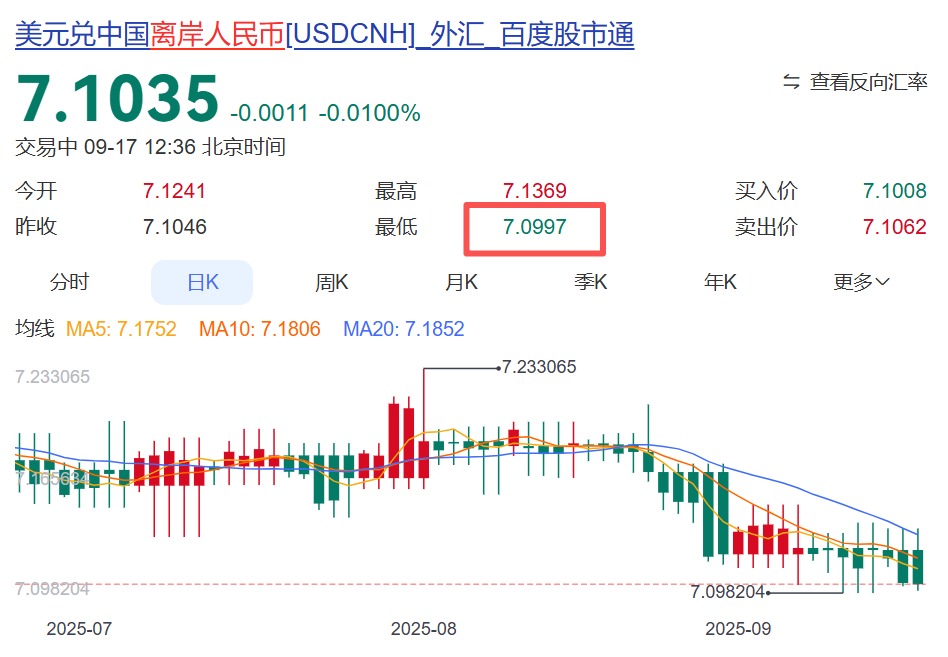
又升值了!人民币,大消息!专家:后续有望破“7”,“外资加速流入中国股市”
Mei Ri Jing Ji Xin Wen· 2025-09-17 07:41
目前,交易员已加大对美联储9月议息会议的降息押注,预期美联储本次会议至少降息25基点,并且年底前可能还会再降息两次。 "美联储观察"工具也显 示,本周FOMC有93.4%的概率将祭出25个基点的降息,将美国政策利率区间下降至4%-4.25%。还有极其微弱的可能性会降息50个基点。 展望未来走势,经济学家、新质未来研究院院长张奥平认为,从短中长期来看,人民币兑美元升值仍具一定动能。人民币升值动能来自三方面。短期来 看,美国连续降息预期不断升温,中美利差或将收窄;中期来看,中国对外出口仍有欧盟、东盟、非洲及其他新兴市场支撑;长期来看,7-8月多项经济 数据持续放缓,启动新一轮扩大内需增量政策的必要性升温,经济将逐步回稳向好。 每经编辑|段炼 9月17日,离岸人民币兑美元一度升破7.10关口,为去年11月以来首次。 9月16日,在岸人民币对美元即期汇率16时30分收盘报7.1163,较上一交易日上涨65个基点,创下去年11月6日以来的日间收盘价新高。相比在岸人民币对 美元汇率,离岸人民币兑美元更多反映国际投资者预期。 香港特区行政长官李家超今日(17日)在香港特区立法会发表新一份施政报告。李家超表示,香港是全球最大 ...
近七成纯债基金净值下跌
Bei Jing Shang Bao· 2025-09-15 16:14
Group 1: Market Overview - Since the third quarter, the A-share market has continued to rise, with the Shanghai Composite Index increasing by 12.08%, the Shenzhen Component Index by 24.28%, and the ChiNext Index by 42.41% as of September 15 [1] - In contrast, the bond market has experienced a significant adjustment, with the ten-year government bond yield rising from 1.6553% on June 30 to 1.8615% by September 15, an increase of over 20 basis points [1] Group 2: Fund Performance - Recent performance of pure bond funds has been disappointing, with nearly 70% of the 4,329 funds analyzed showing negative returns over the past month, and over 20% of funds reporting losses year-to-date [2] - The average returns for both medium- and short-term pure bond funds have also been negative during this period [2] Group 3: Future Outlook - Some analysts, such as Yin Hua Fund, suggest that if the Federal Reserve lowers interest rates, it could narrow the interest rate differential between China and the U.S., alleviating depreciation pressure on the RMB and creating favorable conditions for the People's Bank of China to implement looser monetary policies [3] - The market may see a technical rebound in bond prices due to reduced selling pressure and the upcoming "Double Festival," which typically leads to increased liquidity from the People's Bank of China [3][4] - However, other analysts, like Changcheng Fund, caution that the bond market remains in a weak phase driven by fragile sentiment, making it difficult to predict the trajectory of future market movements [4]
流动性跟踪周报-20250915
HTSC· 2025-09-15 12:58
1. Report Industry Investment Rating No information provided in the content. 2. Core View of the Report The report analyzes the liquidity situation from September 8 - 12, 2025, indicating that the capital market shows characteristics of tight - then - loose funds, rising interest rates in multiple areas, and changes in market trading volume and institutional behavior. It also points out the potential impacts and focuses of the capital market this week [1][2][3][4][5]. 3. Summary by Relevant Catalogs 3.1 Open Market Operations and Capital Availability - Last week, the open - market had 10684 billion yuan of reverse repurchase maturities and 12645 billion yuan of reverse repurchase injections, with a net injection of 1961 billion yuan. The central bank announced a 6000 - billion - yuan 6M buy - out reverse repurchase this week, and 3000 billion yuan of 6M buy - out reverse repurchases matured this month [1]. - This week, 13845 billion yuan of open - market funds are due, including 12645 billion yuan of reverse repurchases and 1200 billion yuan of treasury cash fixed - term deposits. Due to tax - period disturbances, government bond issuance, and other factors, the capital market may face pressure, but with the central bank's support, the capital situation is expected to remain stable [5]. 3.2 Interest Rate Changes - The average DR007 was 1.47%, up 3BP from the previous week; the average R007 was 1.48%, up 2BP. The average DR001 and R001 were 1.39% and 1.43% respectively. The exchange repurchase rate also increased, with the average GC007 at 1.47%, up 2BP [1]. - The 1 - year AAA certificate of deposit (CD) yield to maturity was 1.67% at the end of last week, showing an upward trend. The 1 - year FR007 interest rate swap average was 1.56%, also up from the previous week, indicating a marginally cautious market expectation for the capital situation [2]. - The 6M national stock bill transfer quote on the last Friday was 0.79%, up from the previous week [4]. 3.3 Repurchase Market Conditions - Last week, the pledged repurchase trading volume ranged from 7.3 to 7.7 trillion yuan, with the average R001 repurchase trading volume at 66263 billion yuan, an increase of 1630 billion yuan from the previous week. The outstanding repurchase balance at the end of last week was 11.7 trillion yuan, lower than the previous week [3]. - By institution, large banks' lending scale decreased, while money - market funds' lending scale increased. Securities firms' and funds' borrowing scales decreased, while wealth management's borrowing scale increased [3]. 3.4 Exchange Rate and International Situation - The US dollar - to - RMB exchange rate was 7.12 last Friday, down from the previous week, and the Sino - US interest rate spread narrowed. Given the US inflation data and employment data, the market has high expectations for the Fed to cut interest rates this week, with the main point of contention being between a 25BP and 50BP cut [4]. - From September 14th, China and the US held economic and trade talks in Spain on issues such as US unilateral tariff measures, export controls, and TikTok, and the progress of the talks should be monitored [4]. 3.5 This Week's Key Focus - This week, pay attention to stock market performance, redemption disturbances, the Fed's interest - rate decision on Thursday, and the Bank of Japan's interest - rate decision on Friday [5].

产业经济周观点:中美利差收敛有望推动美国科技股风险快速释放-20250914
Huafu Securities· 2025-09-14 09:54
Investment Insights - The convergence of the China-US interest rate differential is expected to lead to a rapid release of risks in US technology stocks [1][10][12] - The AI computing power penetration rate may suppress the capital expenditure expansion speed of US technology companies, while China's self-sufficiency could impact the US supply chain [10][12] - A potential US interest rate cut could open up policy easing space in China, accelerating price recovery and further boosting indices [10][12] Market Performance - The US CPI inflation rose to 2.9% year-on-year in August, driven mainly by commodity inflation, while core CPI remained stable at 3.1% [7][10] - China's PPI showed a year-on-year decline of -2.9% in August, but the rate of decline has narrowed, indicating price recovery in upstream mining sectors [14][15] - The Hong Kong stock market saw significant gains, with the Hang Seng Technology Index rising by 5.31% [17][20] - The A-share market also performed well, with the STAR 50 index leading the gains [21][34] Sector Analysis - The technology sector experienced substantial growth, with a rise of over 4%, while the pharmaceutical sector saw a slight decline [34][36] - High beta stocks, low-priced stocks, and high price-to-book ratio stocks led the market gains [29][34] - The commodity markets, particularly silver and crude oil, are expected to show significant elasticity in response to potential interest rate cuts [10][12]
美债收益率破5%引发抛售,人民币汇率承压,货币博弈加剧
Sou Hu Cai Jing· 2025-09-12 08:11
Group 1 - The recent surge in US Treasury yields, surpassing 5%, has triggered a sell-off in the bond market, affecting not only the US but also the UK, Italy, and France [3][4] - The influx of corporate bonds, with an expected issuance of $150 billion to $180 billion in September alone, has diverted investor funds away from US Treasuries, contributing to the sell-off [3] - Concerns over government fiscal health post-pandemic have intensified, leading investors to sell off government bonds, which in turn has driven bond prices down and yields up [4] Group 2 - The rise in US Treasury yields has put pressure on the Chinese yuan, as the interest rate differential between the US and China widens, making US assets more attractive [6] - The outflow of capital from China due to higher US yields reduces demand for the yuan, contributing to its depreciation against the dollar [6] - The yuan has recently approached the psychological level of 7.1 against the dollar, reflecting the impact of US Treasury yield fluctuations [6] Group 3 - The US dollar's dominance in the global financial system means that changes in the Federal Reserve's monetary policy have significant implications for other countries' monetary policies and exchange rates [7] - In response to the pressures from US monetary policy, the People's Bank of China is employing various strategies to stabilize the yuan, including market interventions and promoting the internationalization of the yuan [7] - Other countries, such as Japan and the Eurozone, are also adjusting their monetary policies in response to the US dollar's fluctuations, indicating a broader currency competition [7]

债市机构行为周报(9月第1周):利率波动“基金化”-20250907
Huaan Securities· 2025-09-07 13:18
1. Report Industry Investment Rating No information provided in the content. 2. Core View of the Report - The pricing power of funds in the bond market has further increased, and there are still short - term long - trading opportunities. The high correlation between funds and interest rate trends has been further strengthened this year, and low interest rate fluctuations imply the enhancement of funds' pricing power in the bond market. Some "unexplained" interest rate increases may be due to the lack of bond - receiving institutions. The impact of fund institutional behavior on interest rate fluctuations may further expand, and short - term redemption pressure is controllable [2][11][15] 3. Summary According to the Directory 3.1 This Week's Institutional Behavior Review - **Correlation between funds and interest rates**: The high correlation between funds and interest rate trends is not new. Since 2024, the behavior of funds and interest rate trends have shown high correlation, and this year, the low - level fluctuation of interest rates has implied the further improvement of funds' pricing power in the bond market, which may be related to bank wealth management outsourcing [2][11][12] - **"Unexplained" interest rate increases**: This phenomenon may be related to the lack of bond - receiving institutions. Insurance institutions have reduced their allocation of national bonds since 2024, and rural commercial banks' intention to buy more as the interest rate adjusts is gradually decreasing [15] 3.2 Yield Curve - **Treasury bonds**: Short - term yields increased, while medium - and long - term yields decreased. The 1Y yield increased by 3bp, the 3Y yield increased by 1bp, the 5Y yield decreased by 2bp, the 7Y yield decreased by 1bp, the 10Y yield decreased by 1bp, the 15Y yield increased by 3bp, and the 30Y yield decreased by 3bp [17] - **China Development Bank bonds**: Yields decreased overall. The 1Y yield increased by 1bp, the 3Y yield decreased by 1bp, the 5Y yield decreased by about 2bp, the 7Y yield decreased by 2bp, the 10Y yield decreased by about 1bp, the 15Y yield decreased by 2bp, and the 30Y yield decreased by 1bp [17] 3.3 Term Spread - **Treasury bonds**: The interest spread increased, and the short - term spread narrowed while the long - term spread was differentiated. The 1Y - DR001 interest spread remained flat overall, and the 1Y - DR007 interest spread increased by 10bp [20] - **China Development Bank bonds**: The interest spread increased, and the short - term spread narrowed while the long - term spread was differentiated. The 1Y - DR001 interest spread increased by 2bp, and the 1Y - DR007 interest spread increased by about 8bp [22] 3.4 Bond Market Leverage and Funding Situation - **Leverage ratio**: It decreased to 107.14%. From September 1st to September 5th, 2025, the leverage ratio fluctuated and increased within the week. As of September 5th, it was about 107.14%, up 0.30pct from last Friday and 0.07pct from Monday [25] - **Average daily trading volume of pledged repurchase**: From September 1st to September 5th, the average daily trading volume of pledged repurchase was about 7.3 trillion yuan, a decrease of 0.24 trillion yuan compared with last week. The average daily trading volume of overnight pledged repurchase was 7.6 trillion yuan, a decrease of 0.43 trillion yuan month - on - month. The average overnight trading volume accounted for 88.35%, an increase of 2.89pct month - on - month [28][33] - **Funding situation**: Bank - based fund outflows first increased and then decreased. The main fund inflow party was funds, and the outflows of money market funds first decreased and then increased. DR007 and R007 fluctuated and decreased [34] 3.5 Duration of Medium - and Long - Term Bond Funds - **Median duration**: The median duration of medium - and long - term bond funds decreased. As of September 5th, the median duration (de - leveraged) was 2.77 years, a decrease of 0.04 years from last Friday; the median duration (including leverage) was 2.95 years, a decrease of 0.16 years from last Friday [45] - **Duration of different types of bond funds**: The median duration (including leverage) of interest - rate bond funds decreased to 3.75 years, a decrease of 0.16 years from last Friday; the median duration (including leverage) of credit bond funds decreased to 2.72 years, a decrease of 0.12 years from last Friday [51] 3.6 Category Strategy Comparison - **Sino - US interest rate spread**: It widened overall. The 1Y spread widened by 23bp, the 2Y spread widened by about 12bp, the 3Y spread widened by 13bp, the 5Y spread widened by 8bp, the 7Y spread widened by 11bp, the 10Y spread widened by 11bp, and the 30Y spread widened by 7bp [55] - **Implied tax rate**: The short - term spread narrowed, and the long - term spread was differentiated. As of September 5th, the 1Y spread between China Development Bank bonds and treasury bonds narrowed by about 1bp, the 3Y spread narrowed by 2bp, the 5Y spread changed by less than 1bp, the 7Y spread narrowed by 1bp, the 10Y spread widened by 1bp, the 15Y spread narrowed by 5bp, and the 30Y spread widened by 2bp [56] 3.7 Bond Lending Balance Changes - On September 5th, the lending concentration of active 10Y treasury bonds, active 10Y China Development Bank bonds, and active 30Y treasury bonds increased; the lending concentration of the second - active 10Y China Development Bank bonds decreased, and the lending concentration of the second - active 10Y treasury bonds remained unchanged. In terms of institutions, the lending of large - scale banks and other institutions decreased, while that of small - and medium - sized banks and securities firms increased [57]
薛鹤翔:以史为鉴:美联储降息周期人民币怎么走?人民币系列报告
Sou Hu Cai Jing· 2025-09-05 10:45
Core Viewpoint - The article discusses the historical trends of the Chinese Yuan (RMB) exchange rate following the Federal Reserve's interest rate cuts, indicating that the RMB is expected to appreciate moderately in the current rate cut cycle due to various supportive factors [3][4][22]. Group 1: Historical Trends of RMB Exchange Rate - Since 1980, there have been eight rounds of Federal Reserve rate cuts, primarily aimed at preventing or responding to economic recessions and unexpected risk events [5]. - Historical data shows that the RMB's response to Fed rate cuts is influenced by the relative economic strength of China and the U.S., monetary policy differences, and the global financial environment [3][5]. - Specific periods of RMB performance include: - 1995-1996: RMB appreciated slightly during preemptive rate cuts [10]. - 1998: RMB remained stable around 8.28 during the Asian financial crisis [10]. - 2001-2003: RMB fluctuated narrowly between 8.27-8.28 during a period of economic weakness in the U.S. [12]. - 2007-2008: RMB accelerated in appreciation amid the subprime mortgage crisis [13]. - 2019: RMB faced depreciation pressures due to trade tensions but regained strength after subsequent Fed rate cuts [14]. - 2020: RMB appreciated again as the economy recovered post-COVID-19 [14]. Group 2: Current Factors Supporting RMB Appreciation - The RMB has recently appreciated due to several factors, including a weaker U.S. dollar, strengthened expectations of Fed rate cuts, increased attractiveness of RMB-denominated assets, and continuous adjustments in the RMB central parity rate [15][20]. - The U.S. dollar has been in a downtrend, influenced by rising fiscal deficits and concerns over debt sustainability, which has weakened dollar credibility [16]. - Expectations for Fed rate cuts have intensified, with market indicators suggesting a high probability of rate adjustments in the near future [18][19]. - The A-share market has seen significant rebounds, enhancing the attractiveness of RMB assets and increasing foreign investment interest [20]. - The RMB central parity rate has been adjusted upwards, signaling positive market sentiment and contributing to the currency's strength [20]. Group 3: Outlook for RMB in the Current Rate Cut Cycle - The RMB is expected to appreciate moderately in the current Fed rate cut cycle, supported by improving economic conditions in China and a narrowing interest rate differential between China and the U.S. [22][24]. - China's economy is gradually stabilizing, with strong export performance and supportive domestic policies aimed at boosting internal demand [23]. - The narrowing interest rate differential, as the Fed cuts rates while China's monetary policy remains relatively stable, is likely to enhance the attractiveness of RMB assets to foreign investors [24].

警惕人民币升值风险
Hua Tai Qi Huo· 2025-09-05 01:02
Report Information - Report Title: "Beware of the Risk of RMB Appreciation" - Research Institution: Huatai Futures Research Institute - Date of Publication: September 5, 2025 [1] Investment Rating - No investment rating for the industry is provided in the report. Core View - The report warns of the risk of RMB appreciation. The current economic expectation differential favors the RMB, the Sino-US interest rate differential is neutral, and trade policy uncertainty is also neutral. In the short term, the USD/CNY is expected to fluctuate between 7.1 - 7.2, while in the medium to long term, attention should be paid to the appreciation resistance range of 6.9 - 7.0 [32][35]. Summary by Directory 1. Quantity and Price Observation - The implied volatility curve of the 3-month USD/CNY option shows an appreciation trend of the RMB, with the put-side volatility higher than the call-side [4]. - The policy counter-cyclical factor has returned below 5%, and the 3-month CNH HIBOR - SHIBOR spread has fluctuated [10]. 2. Fundamental and View Macro - Interest Rate Cuts and Liquidity - There is a divergence in the pricing of interest rate cuts between the US and Europe. The TGA account had a balance of $595.7 billion on August 27, the Fed's reverse repurchase balance was $34.7 billion, and the reserve balance of depository institutions was $3.34 trillion (-$56.6 billion). Powell's speech at the global central bank annual meeting on August 22 turned dovish [17]. Core Chart - US Economy - US employment authority has declined, with a significant downward revision of non - farm payrolls in July. Inflation from tariffs is not significant, and economic expectations have been revised upwards, with fiscal spending rebounding and the August economic outlook showing resilience [19]. Tariff Events - In the trade negotiations between the US and 17 key countries and regions, there is a "gradient implementation." Some agreements have been reached, but many are still in the negotiation stage. The US has also adjusted tariff policies on various industries, and on August 29, the US Court of Appeals ruled that most of Trump's tariff policies were illegal [20][21]. China's Economy - In July, China's exports and consumption showed resilience, but inflation did not rebound, and fixed - asset investment faced pressure. In August, the national PMI was 49.4, with production, new orders, and other indicators showing different trends [22]. Macro - Scenario Deduction - Different time windows are affected by various factors such as domestic policies, Fed policies, inventory cycles, and tariff impacts [30][31]. 3. Overall View - The current economic expectation differential is favorable for the RMB, the Sino - US interest rate differential is neutral, and trade policy uncertainty is neutral. In the short term, the USD/CNY is expected to fluctuate between 7.1 - 7.2, and in the medium to long term, attention should be paid to the appreciation resistance range of 6.9 - 7.0 [35]. 4. Risk Assessment - The range of the basis fluctuation of the futures main contract from January 2022 to the present is between - 1100 and 900 [36].