新消费

Search documents
湖南商业持续孕育新业态 以“湖湘特色”打造消费新场景
Zhong Guo Xin Wen Wang· 2026-02-01 03:43
Core Insights - Hunan's commercial sector is evolving with diverse new business models, focusing on "new consumption, new scenarios, and new formats" to drive high-quality development [1][2][5] - The province aims to leverage its market potential of over 66 million people to enhance consumption quality and expand capacity, aligning with the "14th Five-Year Plan" [5] Group 1: New Business Models - Traditional enterprises in Hunan are innovating and integrating across sectors to explore new growth paths [1] - The Wanjiali business district exemplifies this trend, featuring a mix of dining, entertainment, and retail, attracting high-profile visitors and showcasing the city's commercial vitality [1] - New consumption models, such as the "home + automotive" integration, are being introduced to lead consumer trends [1] Group 2: Cultural and Entertainment Offerings - The Five-One business district in Changsha offers a variety of entertainment options, including escape rooms and live performances, enriching the nighttime cultural supply [2] - New consumption theaters are collaborating with local brands and accommodations to integrate cultural experiences into daily life [2] Group 3: Strategic Initiatives - The Hunan Provincial Commercial Association is committed to the "Strong Province" strategy, engaging with over 60 member enterprises and providing more than 200 strategic suggestions [3] - The association has organized numerous events to foster collaboration and enhance consumer engagement, contributing to a collective effort to boost consumption [3] Group 4: Future Development Plans - Hunan plans to innovate consumption models under the "Trendy and Fun" initiative, promoting the replacement of large consumer goods and expanding the supply of green and smart products [5] - The province aims to create high-quality commercial districts and night economy hubs that reflect local culture while attracting international events and brands [5] - The association will continue to focus on member needs, optimizing services and encouraging participation in emerging sectors like AI and low-altitude economy [5]


食品饮料行业行业动态更新:茅台飞天批价回暖,关注春节动销催化
Zhong Guo Yin He Zheng Quan· 2026-01-31 03:24
Investment Rating - The report maintains a positive outlook on the food and beverage industry, particularly highlighting the recovery of Moutai's pricing and the potential for demand growth during the upcoming Spring Festival [4][6]. Core Insights - Moutai's flying price has risen above 1600 yuan, attributed to the approaching Spring Festival and adjustments in product structure by the company [4][6]. - The listing of "Mingming Hen Mang" on the Hong Kong Stock Exchange is expected to enhance market attention on the snack sector, with a focus on investment opportunities arising from trends in both upstream and downstream sectors [4][6]. - The food and beverage index recorded a slight positive return of 3.0% as of January 29, 2026, although it underperformed compared to the Wind All A index [4][46]. Summary by Sections 1. Price Recovery of Moutai - As of January 29, 2026, Moutai's flying price reached 1610 yuan for whole boxes and 1570 yuan for individual bottles, showing an increase of 45 yuan and 15 yuan respectively from December 31, 2025, but a decrease of 645 yuan and 650 yuan compared to the same period last year [7][41]. 2. Data Tracking - Key raw material prices have shown mixed trends, with sugar down by 15.3% year-on-year, while quail eggs and palm oil have increased by 46.9% and 9.7% respectively [16][27]. - Packaging material prices have generally decreased, with glass prices down by 19.7% and paper box prices down by 4.8% year-on-year [16][19]. 3. Market Review - The food and beverage sector ranked 23rd among 31 sub-industries, with seven out of ten sub-sectors showing positive growth, particularly processed foods, beer, and liquor [46][48]. 4. Investment Recommendations - The report suggests focusing on companies in the consumer goods sector such as Dongpeng Beverage, Nongfu Spring, and others, as well as key players in the liquor market like Moutai and Shanxi Fenjiu [49].

建筑并购重组系列 2:深度探索建筑民企转型方向
Changjiang Securities· 2026-01-30 10:48
Investment Rating - The report maintains a "Positive" investment rating for the construction and engineering industry [10]. Core Insights - The construction industry is experiencing accelerated concentration, with state-owned enterprises leveraging scale, industrial chain advantages, and policy support to squeeze the survival space of small and medium-sized private enterprises [2][4]. - Sub-sectors like landscaping engineering are under dual pressure from declining demand and intensified competition, leading to weakened revenues, profit pressures, and deteriorating financial structures [2][4]. - Some companies are leveraging low-efficiency asset restructuring, financial endowments, and business associations to strategically transition towards new infrastructure sectors, guided by policy directions [2][4]. Summary by Sections Industry Concentration and Challenges - The concentration of the construction industry is continuously increasing, with the market share of state-owned construction enterprises rising from 46.9% in 2020 to 51.7% in 2024, while their output value share increased from 36.3% to 43.1% [4][15]. - The growth rate of infrastructure and fixed asset investment is declining, with a projected year-on-year decrease of -1.48% for infrastructure investment in 2025 [4][15]. - State-owned enterprises benefit from lower financing costs due to policy advantages and credit ratings, while private enterprises face high leverage and liquidity issues, necessitating a transformation [4][23]. Sub-sector Analysis and Transformation Factors - The report identifies sub-sectors with poor financial performance, particularly landscaping, building decoration, and engineering consulting, as having strong transformation needs [5][28]. - Landscaping and decoration sectors are experiencing declining revenues and high operational leverage, while the engineering consulting sector, despite slight revenue growth, shows high overall valuations indicating significant internal differentiation [5][28]. Transformation Directions and Methods - To achieve effective transformation, companies should align with national strategic directions, focusing on "hard technology" sectors like AI and blockchain, and "new consumption" sectors that cater to public demand [6][46]. - Common transformation methods include mergers and acquisitions, establishing subsidiaries for independent R&D, expanding existing qualifications and businesses, and forming strategic alliances [7][51]. Potential Transformation Targets - Companies with abundant cash flow, sufficient credit limits, and underperforming main businesses are identified as potential transformation targets, particularly in landscaping, building decoration, and engineering consulting sectors [8][46]. Key Support Factors for Transformation - Sufficient cash flow and credit limits are crucial for enabling potential transformations, allowing companies to quickly capture policy opportunities and reduce reliance on high-interest external financing [46][47]. Revitalizing Inefficient Assets - Inefficient assets can serve as low-cost entry points into new infrastructure sectors, with many old factories and idle warehouses meeting the requirements for transformation into data centers or energy storage bases [48][49]. New Shareholder Involvement - The introduction of new major shareholders is a focal point in the transformation of the construction industry, with examples of companies optimizing their ownership structures to leverage state resources and accelerate transitions into new sectors [51][52].

斥资近10亿港元!险资掘金港股IPO,看好哪些领域?
Guo Ji Jin Rong Bao· 2026-01-29 13:19
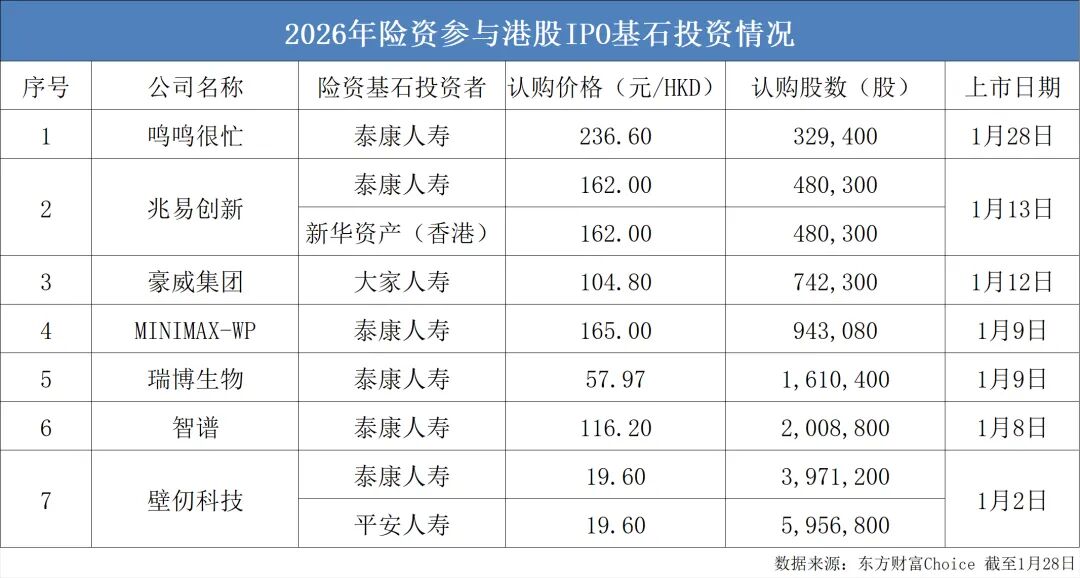
Core Viewpoint - Insurance capital is increasingly participating in Hong Kong IPOs as a response to low interest rates and asset allocation pressures, with significant investments from major insurance firms like Taikang Life and Ping An Life [1][4]. Group 1: Insurance Capital Participation - In 2026, four insurance institutions, including Taikang Life and Ping An Life, have participated in cornerstone investments for seven Hong Kong IPOs, totaling approximately 9.88 billion HKD [1][2]. - Taikang Life has invested a total of 716 million HKD across six IPOs, with individual investments in companies like Mingming Hen Mang and Wallen Technology [3][4]. - Other insurance firms, such as Ping An Life and Xinhua Asset (Hong Kong), have also engaged in cornerstone investments, indicating a broader trend among insurance capital [4]. Group 2: Market Dynamics and Investment Strategy - The shift in insurance capital's participation in Hong Kong IPOs is attributed to a combination of asset allocation pressures and changes in market conditions, with a focus on high-quality, growth-oriented companies [4][5]. - The current environment allows insurance capital to acquire long-term equity assets through IPO participation, which is seen as a more efficient method to gain exposure to the market [5]. - The focus of insurance capital is on sectors like hard technology and new consumption, aligning with national strategic directions and offering potential for long-term returns [6][7]. Group 3: Future Outlook - The trend of insurance capital participating in Hong Kong IPOs is expected to continue in 2026, driven by low interest rates and supportive policies for long-term capital inflow [9]. - Future participation is likely to become more selective, focusing on leading companies and verifiable profit paths, transitioning from broad participation to strategic allocation [9].
中国消费的新“老”温差
财富FORTUNE· 2026-01-29 13:10
Core Viewpoint - The article highlights a significant shift in China's consumer landscape, contrasting the performance of traditional consumer brands like Kweichow Moutai with new consumer brands like Pop Mart, indicating a transition towards "new" consumption driven by changing demographics, real estate cycles, and evolving consumer values [1][3]. Group 1: Company Performance - Kweichow Moutai announced a stock buyback plan of 1.5 to 3 billion yuan but saw its stock price decline after the initial buyback, reflecting a defensive market perception [1][3]. - In contrast, Pop Mart's stock buyback of 350 million HKD led to a market capitalization increase of nearly 60 billion HKD within a week, showcasing a strong growth narrative [1][3]. - On January 29, Kweichow Moutai's stock experienced a rare surge, recovering to over 1400 yuan, which also positively impacted other liquor stocks and the real estate sector [3]. Group 2: Market Dynamics - The article discusses the divergence in investment logic between traditional and new consumer brands, with the former viewed as defensive and the latter as growth-oriented [3][4]. - Traditional consumer stocks, particularly in the liquor sector, are closely tied to macroeconomic conditions and the real estate cycle, which has been under pressure, leading to a challenging environment for recovery [3][4]. - New consumer brands like Pop Mart, Anta, and Li Ning are not solely reliant on macroeconomic support but are leveraging innovation to create structural growth opportunities [4][5]. Group 3: Growth Drivers - The core driver for new consumption has shifted from "demographic dividends" to "emotional dividends," focusing on consumer identity and self-expression rather than basic material needs [4][5]. - The Hong Kong consumer index, which includes new consumption sectors, saw a cumulative increase of about 20% in 2025, while the Shanghai consumer index, dominated by traditional sectors, fell nearly 8% [4]. Group 4: International Expansion - Traditional consumer companies lacking international expansion capabilities face stagnation, while new consumer brands are showing strong growth overseas, with Pop Mart reporting a 3.7 times increase in overseas revenue by Q3 2025 [5]. - Successful international strategies are evident in brands like Anta and Li Ning, which are expanding rapidly in Southeast Asia, indicating a shift from "Made in China" to "Global Brands" [5]. Group 5: Valuation and Investment Considerations - Traditional consumer leaders like Kweichow Moutai still hold strong market positions and stable cash flows, with their valuations entering historically low ranges, appealing to risk-averse investors [6]. - New consumer brands face unique challenges, such as sustaining IP creation and managing acquisitions, with high valuations making them sensitive to any signs of growth slowdown [6][7]. - The sustainability of "self-indulgent" consumption is questioned, as it relies on consumer sentiment and disposable income, which may be the first to be scrutinized in uncertain economic times [8].


1月盘点丨成都新增一批创投基金,引入“国家队”,加强特色产业投资
Sou Hu Cai Jing· 2026-01-29 10:46
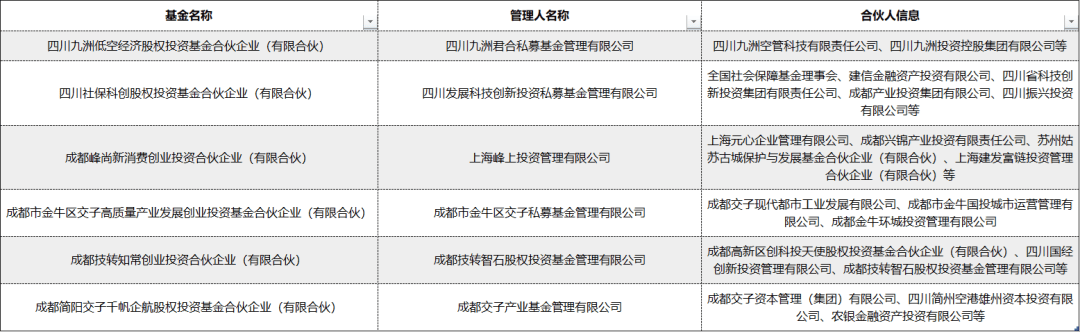
Core Insights - Multiple venture capital funds have been registered in Chengdu, indicating a strong push towards long-term capital investment in strategic emerging industries [1] Fund Registrations and Focus Areas - The Sichuan Social Security Science and Technology Innovation Equity Investment Fund, with a scale of 20 billion RMB, aims to support key industries such as artificial intelligence, low-altitude economy, and biomedicine [4] - The Sichuan Jiuzhou Low-altitude Economy Equity Investment Fund focuses on high-tech companies in the low-altitude economy sector, which includes drones and general aviation [3] - The Chengdu Peak尚 New Consumption Venture Capital Fund targets four core areas: consumer brand upgrades, consumption technology innovation, new supply chain models, and cultural creativity [5] - The Chengdu Jin Niu District Jiaozi High-Quality Industrial Development Fund aims to invest in aerospace, rail transportation, artificial intelligence, and other innovative enterprises [6] - The Chengdu Jianyang Jiaozi Qianfan Qihang Equity Investment Fund is focused on supporting emerging industries through long-term capital [7][8] - The Chengdu Jianyang Jiaozi Future Industry Development Fund has a target scale of 5 billion RMB, focusing on electronic information and advanced manufacturing [9] - The Sichuan Xing Shu Qi Hang Low-altitude Economy Equity Investment Fund has been established with a capital of 1.7 billion RMB, targeting investments in the low-altitude economy [10] - The Chengdu Xiongzhou Revitalization Industrial Development Fund has been set up with a capital of 1.5 billion RMB, focusing on various sectors including advanced manufacturing and biomedicine [11] Strategic Collaborations - The establishment of the first quantum technology industry fund in Sichuan, with a scale of 1 billion RMB, aims to fill the gap in this specialized sector and support innovative projects [11]
年货消费迎来线上线下齐涨 菜鸟联手百家品牌保障年货消费
Zheng Quan Ri Bao Zhi Sheng· 2026-01-29 09:40
Group 1 - The core viewpoint of the article highlights the explosive growth in consumer demand for traditional and new-style Chinese New Year goods, with a reported order volume increase of over 35% in the food sector of the global supply chain managed by Cainiao [1] - Major brands such as Want to Come Snacks, Meijian Qingmei Wine, and Lays are leading the surge in sales, with traditional snacks like nuts and chips also experiencing double-digit growth year-on-year [1] - Cainiao is enhancing its logistics capabilities through the establishment of front warehouses and automation upgrades to ensure rapid stocking, shipping, and delivery of goods during the festive season [1] Group 2 - The article notes that the Bottle Planet's Chongqing warehouse has seen a fourfold increase in order volume compared to normal days, with live-streaming sales during the New Year festival exceeding expectations [3] - The Wanchen Group, which owns multiple snack brands, reported a 30% increase in sales during the New Year festival, with high demand for nuts, meat, chocolates, and gift boxes [4] - Cainiao's supply chain management is leveraging its nationwide network and smart distribution capabilities to ensure timely delivery of goods, with enhancements in warehouse efficiency through the addition of automated packaging and sorting equipment [4]


POLYVOLY破产:情绪泡沫破裂与新消费生死劫
Xin Lang Cai Jing· 2026-01-29 08:54
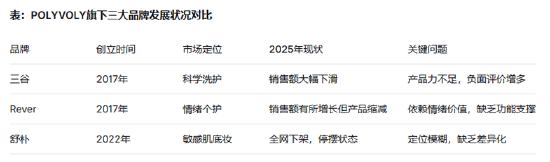
Core Viewpoint - POLYVOLY, once a leading brand in the emotional personal care sector, has filed for bankruptcy due to a combination of strategic misjudgments, product shortcomings, and a failure to adapt to changing consumer preferences [1][10][11] Group 1: Company Background and Initial Success - POLYVOLY achieved remarkable success with daily sales exceeding 600 million yuan and was the top seller during the 2019 Double Eleven shopping festival [1][2] - The brand was founded in 2016, capitalizing on the new consumption wave in China, leveraging platforms like Xiaohongshu and Douyin for growth [2][16] - The founding team, with backgrounds in Alibaba, effectively established a brand matrix with two major brands, "Sangu" and "Rever," targeting different market segments [2][16] Group 2: Strategic Missteps - From 2020 to 2022, POLYVOLY attempted aggressive offline expansion, aiming for a balanced online-offline sales ratio, which led to several issues [3][17] - The pricing strategy was misaligned with consumer expectations, as the brand's products were priced higher than what convenience store consumers preferred [3][17] - The brand's focus on offline channels contradicted industry trends, as competitors were moving online, leading to a misalignment with market dynamics [3][18] Group 3: Product Quality Issues - POLYVOLY's downfall was significantly attributed to a systemic lack of product quality, with increasing negative feedback on key products from 2022 onwards [4][5][19] - The emotional value that initially drove sales could not compensate for the poor performance of the products, which failed to meet consumer expectations [10][25] - The brand's inability to innovate and maintain product quality led to a decline in consumer trust and sales [20][21] Group 4: Financial and Legal Troubles - By the end of 2024, POLYVOLY's consolidated equity was reported at -8.7828 million yuan, indicating insolvency [1][24] - The company faced over 20 legal disputes, with multiple instances of being listed as a dishonest executor, reflecting severe financial distress [8][23] - The financial issues became apparent in April 2023, with ongoing lawsuits and a failure to meet contractual obligations due to a broken capital chain [22][24] Group 5: Industry Implications and Lessons - POLYVOLY's collapse highlights the need for new consumer brands to build emotional value on a solid product foundation, especially in the personal care sector [11][26] - The shift in consumer preferences towards value and functionality over mere emotional appeal indicates a changing landscape in the beauty and personal care market [11][26] - The case serves as a warning for other brands about the risks of rapid expansion without a strong product offering and the importance of strategic resource allocation [12][27]
温差之下,新火燎原:天猫开启新消费创业平权时代
Ge Long Hui· 2026-01-29 05:10
Core Insights - The new consumption landscape is not cooling down but rather evolving in strategy, with emerging brands successfully competing against global giants in various sectors [1][6][15] Group 1: Emerging Brands and Market Dynamics - New brands like Tongpin and Canban have achieved significant sales, with Tongpin becoming the top new brand in the Tmall essence market and Canban generating 2 billion yuan in sales [1][2] - Tmall has seen over 150,000 new quality merchants create brands in the past year, indicating a high growth potential for new entrants [2] - The number of brands achieving over 100 million yuan in sales within their first year has increased by over 40% year-on-year, showcasing a thriving entrepreneurial environment [2] Group 2: Consumer Insights and Product Development - CrzYoga and Tongpin have successfully identified and addressed consumer pain points, leading to their rapid growth in competitive markets [4][5] - CrzYoga tailored its products to fit the specific body types of Chinese women, while Tongpin capitalized on the growing demand for home skincare solutions [5][6] - Tmall's support in trend identification has been crucial for brands like CrzYoga, helping them align product development with market demands [5][6] Group 3: Tmall's Role as a Platform - Tmall acts as both an incubator and accelerator for new brands, providing significant sales contributions and growth opportunities [1][6][15] - The platform's 88VIP membership program enhances consumer purchasing power, with members spending 5-9 times more than regular users [11] - Tmall's "扶优" strategy focuses on supporting quality brands through various resources, enabling them to compete effectively against established players [13][14] Group 4: Innovation and Technology - Both CrzYoga and Tongpin emphasize technological innovation as a core component of their business strategies, ensuring sustainable differentiation in the market [6][15] - The development of unique materials and formulations has allowed these brands to stand out in crowded categories, avoiding price wars [6][15] Group 5: New Consumption Trends - The rise of emotional consumption and IP-based brands indicates a shift in consumer behavior, with users willing to spend on products that resonate with their interests and identities [7][8] - Brands that create new categories and address unmet needs are experiencing exponential growth, as seen with LiberLive and its innovative guitar products [7][8][9]

专访汇丰匡正:AI部分板块阶段性过热,中长期具备成长潜力
Sou Hu Cai Jing· 2026-01-29 03:52
Group 1: Consumer Sector Opportunities - The focus on expanding domestic demand will be a key policy priority in 2026, with consumption being reinforced as the main engine for economic growth [4] - Short-term measures like trade-in policies are expected, but long-term growth is anticipated to come from service consumption, which is seen as a critical growth source [4] - The government emphasizes new solutions to support the expansion of new consumption and service consumption, indicating a long-term trend [4] - Investors are advised to pay attention to segments with long-term growth potential, particularly in the context of low expectations and valuations in the consumer sector [4][5] Group 2: AI and Technological Integration - Artificial Intelligence (AI) is becoming a significant theme in the global market, with its applications expanding across various industries, particularly in finance, manufacturing, healthcare, and consumer sectors [6] - China's advantages in hardware manufacturing and a rapidly evolving AI ecosystem are driving the integration of AI into various sectors, enhancing economic resilience [6] - Despite some overheating in certain segments, industries like gaming, consumer electronics, and robotics are expected to maintain growth potential due to their alignment with existing market demands [6] Group 3: Investment Outlook for the Greater Bay Area - The Hong Kong stock market is viewed positively due to strong capital inflows and active IPO activities, with policy support for AI expected to attract further investments [7] - A barbell strategy is recommended for onshore and offshore Chinese stocks, balancing technology stocks with high-dividend quality state-owned enterprises for downside protection [7] Group 4: Global Economic Trends and Risks - Key macro factors influencing asset risks in 2026 include the monetary policy paths of the Federal Reserve and other major central banks, which could affect interest-sensitive assets [8] - Geopolitical events may cause market volatility, particularly impacting oil prices, but current oversupply in the oil market mitigates some risks [9] - The divergence in global growth, with strong performance in the US versus challenges in Europe, affects capital flows and asset performance across regions [9] - Increased correlation among asset classes necessitates diversified cross-asset, cross-industry, and cross-regional strategies to manage risks effectively [9]