
跨周期调节

Search documents
LPR连续7个月持平,2026年有望稳中有降
Di Yi Cai Jing· 2025-12-22 02:37
Group 1 - The LPR remains unchanged for seven consecutive months, with the 1-year LPR at 3.0% and the 5-year LPR at 3.5% as of December 22, 2025, due to stable policy rates and pressure on bank net interest margins [1] - The stability of the 7-day reverse repurchase rate indicates that the pricing basis for the LPR has not changed, suggesting that the LPR will remain stable [1] - The last adjustment of the LPR occurred in May, when it was lowered by 10 basis points, and since then, the rates have stabilized [1] Group 2 - The macroeconomic resilience has exceeded expectations due to strong exports, and achieving the annual growth target of around 5.0% is no longer in doubt, despite weakened growth momentum in the second half of the year [2] - The December Central Economic Work Conference emphasized the efficient use of various policy tools, focusing on the effectiveness and proactivity of policies [2] - Future monetary policy may remain flexible based on the credit recovery situation in the first quarter of the following year, with a continued loose monetary environment expected [2]
光大期货:12月22日金融日报
Xin Lang Cai Jing· 2025-12-22 01:25
Market Overview - The A-share market experienced moderate fluctuations last week, with Wind All A index down by 0.15% and an average daily trading volume of 1.76 trillion yuan [3] - The implied volatility for options slightly increased, with the 1000 IV at 18.56% and 300 IV at 16.03% [3] - The financing balance decreased by 7.6 billion yuan to 2.475 trillion yuan, indicating a slight contraction in market liquidity [3] Stock Index Analysis - The stock index is expected to continue oscillating within the range established since October, with limited risk of a significant downturn [3] - The cumulative year-on-year revenue growth for the CSI 1000 in Q3 was approximately 2.6%, providing substantial support for its current valuation [3] - Conditions for a spring rally are not currently prominent, suggesting that the upcoming market movements may not be as vigorous as in previous years [3] Sector Performance - The market is increasingly focused on sectors with performance certainty, particularly in technology [4] - Key themes include high ROE, strong year-on-year revenue growth, and robust operating cash flow [4] - Sectors such as network connection, service robots, industrial internet services, consumer electronics, semiconductor equipment, gold, tungsten, and PCB are expected to have strong performance certainty by 2026 [4] Bond Market Dynamics - The bond market showed signs of recovery, with the central bank restarting 14-day reverse repos, indicating a stabilizing attitude towards liquidity [5][18] - As of December 19, the yields for 2-year, 5-year, 10-year, and 30-year government bonds were 1.38%, 1.60%, 1.83%, and 2.23% respectively, reflecting slight decreases from the previous week [5][18] - The net issuance of government bonds was negative at -192 billion yuan, with a net issuance of local bonds at 281 billion yuan [7][20] Economic Policy Insights - The Central Economic Work Conference set a positive tone for economic work in 2026, emphasizing the need for counter-cyclical and cross-cyclical adjustments [21] - The conference highlighted the importance of boosting domestic demand and stabilizing investment, with plans to increase central budget investments [22] - Inflation is expected to gradually recover, supported by policies aimed at maintaining liquidity and promoting consumption [22] Precious Metals Market - Gold prices rose by 0.97% to $4341.058 per ounce, while silver surged by 8.28% to $67.049 per ounce, reaching a new historical high [23] - The gold-silver ratio decreased to approximately 64.7, indicating a strong performance in precious metals [23] - Market sentiment remains optimistic regarding precious metals, with expectations for continued upward momentum [25]


宏观周报:加大逆周期和跨周期调节力度-20251221
KAIYUAN SECURITIES· 2025-12-21 11:43
Domestic Macro Policy - The central government emphasizes a stable and progressive economic work approach for 2026, focusing on quality improvement and efficiency enhancement, with a projected GDP of approximately 140 trillion yuan for this year[3][10]. - The government plans to implement more proactive fiscal policies and moderately loose monetary policies, enhancing the effectiveness of macroeconomic governance through integrated stock and incremental policies[3][10]. - The focus on expanding domestic demand is prioritized as a key task for next year, aiming to boost consumption from both supply and demand sides[5][17]. Infrastructure and Industry Policy - Recent policies include the release of the first batch of L3 conditional autonomous driving vehicle permits and the introduction of antitrust compliance guidelines for internet platforms[13][14]. - The 2026 national energy work conference has set key tasks, emphasizing the transition to green and low-carbon energy sources, with an expected addition of over 200 million kilowatts of wind and solar power capacity[14]. Real Estate Policy - Shandong Province has introduced guidelines for a "housing old-for-new" program, proposing three models to encourage housing upgrades[15][16]. - The total urban housing demand during the "14th Five-Year Plan" period is estimated to be around 4.98 billion square meters[16]. Financial Regulation - The central financial committee stresses the importance of effectively managing financial risks related to local small and medium financial institutions and real estate enterprises, while also addressing local government financing platform debts[19][20]. - The merger plan for China International Capital Corporation (CICC) with Dongxing Securities and Xinda Securities has been announced, marking a significant consolidation in the financial sector[20]. Overseas Macro Policy - The Federal Reserve has lowered the federal funds rate target range to 3.50%–3.75%, with a voting outcome of 9 in favor and 3 against, indicating a cautious approach to future rate changes[24]. - The European Central Bank has maintained its benchmark interest rate at 2%, aligning with market expectations, while the Bank of Japan has raised its rate by 25 basis points to 0.75% to combat persistent inflation[24][25].


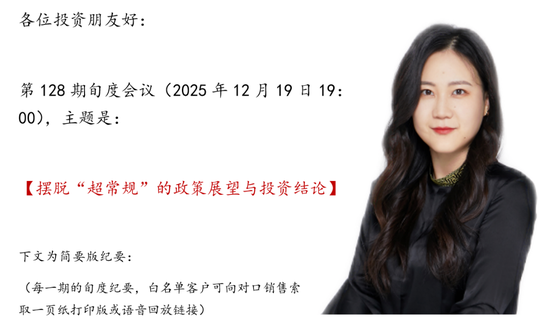
张瑜:摆脱“超常规”,春水向“中游”——张瑜旬度会议纪要No.128
Xin Lang Cai Jing· 2025-12-20 00:30
Group 1 - The core viewpoint of the article emphasizes the shift from "extraordinary measures" to a more balanced approach in economic policy, focusing on both counter-cyclical and cross-cyclical adjustments [4][5][15] - The economic work meeting indicates a more stable and slightly positive judgment on external conditions, with China maintaining a 5.4% export growth rate over the past 11 months, providing confidence to move away from extraordinary policy reliance [5][16] - The pressure to prevent risks has significantly decreased, with the focus on risk prevention now ranked ninth among key tasks, indicating a shift in policy focus towards reform and opening up [5][16] Group 2 - Fiscal support is expected to remain stable with a slight decline, with the 2026 budget's expenditure growth rate projected to align with economic growth targets, maintaining a deficit rate around 4% [6][17][18] - The policy focus is shifting from "insufficient domestic demand" to "strong supply and weak demand," indicating a dual approach to manage both supply and demand sides, with an emphasis on price stability [8][18] - The judgment on economic conditions for 2026 highlights the midstream manufacturing sector as the most promising, benefiting from strong export performance and policy support aimed at reducing competition [9][19][20] Group 3 - The investment strategy remains bullish on stocks while being cautiously strategic on bonds, driven by improving supply-demand balance and lower stock market volatility [11][21]
股指黄金周度报告-20251219
Xin Ji Yuan Qi Huo· 2025-12-19 11:29
投资有风险,入市需谨慎 股指、黄金周度报告 新纪元期货研究 20251219 惠农保价稳产 国内外宏观经济数据 今年1-11月固定资产投资同比下降2.6%,降幅较上月扩大0.9个百分点;规模以上工业 增加值同比增长6%(前值6.1%),社会消费品零售总统同比增长4%,增速较上月回落 0.3个百分点。数据表明,我国经济恢复的基础不牢固,固定资产投资继续下行,消费 增速边际放缓,唯有工业生产维持高位运行。 数据来源:同花顺iFind 新纪元期货研究 期货6+" 目标导向,问题出口: IF 惠农保价稳产 IC AU 期货6+" 目标导向,问题出口: 股指、黄金现货价格走势 股指基本面数据 企业盈利 资金面 利率 流动性 今年11月新增人民币贷款3900亿元,较上年同期少增1900亿元;社会融资规模增量为 24888亿元,同比多增1600亿元。广义货币供应量M2同比增长8%,较上月回落0.2个百 分点,M1同比增长4.9%(前值6.2%),增速连续两个月放缓。 数据来源:同花顺iFind 新纪元期货研究 IH 沪深两市融资余额小幅降至24781.54亿元,央行本周共开展6575亿逆回购操作,实现 净回笼110亿元。 ...
建信期货国债日报-20251219
Jian Xin Qi Huo· 2025-12-19 02:23
行业 国债日报 日期 2025 年 12 月 19 日 #summary# 每日报告 | | | 表1:国债期货12月18日交易数据汇总 | | | | | | | | | --- | --- | --- | --- | --- | --- | --- | --- | --- | --- | | 合约 | 前结算价 | 开盘价 | 收盘价 | 结算价 | 涨跌 | 涨跌幅 (%) | 成交量 | 持仓量 | 仓差 | | TL2603 | 111.990 | 112.220 | 112.250 | 112.410 | 0.260 | 0.23 | 119192 | 142795 | -1510 | | TL2606 | 112.170 | 112.520 | 112.500 | 112.630 | 0.330 | 0.29 | 8741 | 21207 | 396 | | TL2609 | 112.060 | 112.280 | 112.290 | 112.420 | 0.230 | 0.21 | 101 | 381 | 25 | | T2603 | 108.005 | 107.990 | 108.010 | ...
电话会议纪要(20251214)
CMS· 2025-12-18 11:31
Macro Analysis - The central economic work conference highlighted ongoing challenges in the economy, including external environmental changes and risks in key sectors, while emphasizing the need to balance domestic economic work and international trade struggles [2][3] - The conference introduced five "musts" for economic work, focusing on the integration of investment in physical and human capital and the importance of internal strengthening to address external challenges [2] Policy Orientation - The policy tone for the upcoming year shifts from "strengthening extraordinary counter-cyclical adjustments" to "increasing counter-cyclical and cross-cyclical adjustment efforts," indicating a decrease in urgency but maintaining a proactive fiscal and moderately loose monetary policy [3] - Fiscal policy will maintain necessary levels of deficit, debt, and total expenditure, while monetary policy will focus on stabilizing growth and promoting inflation, with expectations for adjustments in interest rates and reserve requirements [3] Key Economic Work Areas - The economic work for the next year will focus on eight key areas, with an emphasis on expanding domestic demand through urban renewal policies and increasing investment scale to counteract negative growth in investment [7] - The conference reiterated the importance of stabilizing the real estate market through targeted measures, including inventory reduction and supply optimization, indicating a potentially more proactive stance on real estate policies [8][18] Real Estate Market Insights - The conference emphasized "high-quality urban renewal" as a crucial strategy for expanding investment and stimulating domestic demand, with expectations for financial tools to support urban renewal projects [17] - The focus on stabilizing the real estate market has shifted from aggressive measures to a more balanced approach, with an emphasis on controlling supply and inventory while encouraging the acquisition of existing properties for affordable housing [18][20] ESG Developments - The report highlighted significant ESG policies, including the expansion of the national carbon trading market and the promotion of integrated development in the renewable energy sector, which are crucial for achieving carbon neutrality goals [21][22] - The issuance of green financial bonds and the successful launch of digital green bonds in Hong Kong reflect growing market recognition and support for sustainable finance initiatives [24][25]
11月经济数据点评:需求偏弱延续,政策加力必要性上升
LIANCHU SECURITIES· 2025-12-18 09:42
Production - In November, industrial added value increased by 4.8% year-on-year, with a month-on-month growth of 0.4%, indicating resilience in industrial operations[1] - The service production index grew by 4.2% year-on-year, down 0.4 percentage points from the previous month[1] Investment - Fixed asset investment in November saw a month-on-month decline of 12.0%, with a cumulative growth rate dropping to -2.6%, a decrease of 0.9 percentage points from the previous month[2] - Infrastructure investment showed a cumulative growth rate of 0.1% for broad infrastructure and -1.1% for narrow infrastructure, both continuing to decline[2] - Real estate investment fell by 15.9% cumulatively, with funding and sales also showing significant declines, indicating ongoing instability in housing prices[2] Consumption - Social retail sales grew by 1.3% year-on-year in November, a decrease of 1.6 percentage points from the previous month, primarily due to high base effects from last year[3] - Restaurant consumption showed relative resilience with a year-on-year growth of 3.2%, while retail sales of goods increased by only 1.0%, reflecting a notable slowdown[3] Policy Outlook - The necessity for policy support has increased due to continued weak demand, with the December Central Economic Work Conference emphasizing the need for proactive fiscal measures and enhancing macroeconomic governance[5] - The policy toolbox remains ample, with a focus on expanding domestic demand and optimizing supply[5]
2026年经济目标怎么设定?宏观与微观“温差”成关键考量?
Jing Ji Guan Cha Bao· 2025-12-18 05:12
Group 1 - The central economic work meeting emphasizes the importance of expanding domestic demand as a primary task for the upcoming year [4][5] - There is a notable "temperature difference" between macroeconomic performance and microeconomic sentiment, with macro indicators showing strength while micro experiences remain subdued [1][2] - The "involution" phenomenon in enterprises is linked to this temperature difference, where companies focus on maintaining cash flow stability, leading to increased production but declining profit margins [2] Group 2 - Suggestions for effective consumption support policies include increasing income, ensuring leisure time, improving consumption scenarios, and providing quality products [2] - The central economic work meeting proposes enhancing counter-cyclical and cross-cyclical adjustments, focusing on demand-side short-term adjustments and supply-side structural improvements [3] - Economic growth targets for 2026 are suggested to be set between 4.5% and 5.0%, slightly lower than the previous year's target, aligning with long-term GDP growth trends [4][5] Group 3 - The macroeconomic policy direction is expected to lean towards easing, with one interest rate cut and one reserve requirement ratio reduction anticipated [5] - The construction of a modern industrial system is highlighted as a crucial aspect of cross-cyclical policies, focusing on upgrading traditional industries and fostering emerging sectors [5][6] - There is a call for deeper market-oriented reforms to stimulate microeconomic vitality and establish a unified national market, which is essential for effective policy transmission [6]
2026年经济目标怎么设定?宏观与微观“温差”成关键考量
Jing Ji Guan Cha Wang· 2025-12-18 04:18
Group 1 - The central economic work conference emphasizes "domestic demand as the main driver" for the upcoming year, focusing on building a strong domestic market [1] - There is a growing discussion about the "temperature difference" between macroeconomic performance and microeconomic sentiment, with macro indicators showing strength while micro experiences remain subdued [1][2] - The "involution" phenomenon in enterprises is linked to this temperature difference, where companies prioritize cash flow stability, leading to increased production but declining profit margins [2] Group 2 - Suggestions for boosting consumption include increasing income, ensuring leisure time, improving consumption scenarios, and providing quality products [2] - The central economic work conference proposes enhancing counter-cyclical and cross-cyclical adjustments, with a focus on demand-side policies and structural supply-side improvements [3] - Economic growth targets for 2026 are suggested to be set between 4.5% and 5.0%, slightly lower than the previous year's target, aligning with long-term GDP growth trends [4] Group 3 - The macroeconomic policy direction is expected to lean towards easing, with one interest rate cut and one reserve requirement ratio reduction anticipated [5] - The average economic growth rate during the 14th Five-Year Plan period is projected to be around 4.5%, with 2026 GDP growth expected at 4.8% [6] - A modern industrial system is highlighted as a key focus for cross-cyclical policies, emphasizing the transformation of traditional industries and the development of strategic emerging industries [6]