
美国例外论

Search documents
太平洋证券投资策略
Tai Ping Yang Zheng Quan· 2025-07-10 08:13
Group 1 - The core viewpoint indicates that domestic corporate profits remain under pressure, with capital and risk appetite driving the A-share market's upward fluctuations. The financial sectors such as banks, non-banking financial institutions, pharmaceuticals, and telecommunications are expected to lead this trend, with an anticipated increase in risk appetite by late July [3][4][12]. - As of May, the cumulative profit of industrial enterprises above designated size turned negative year-on-year, and the manufacturing PMI for June was at 49.7, indicating marginal improvement but still below the growth line. Only six industries have seen upward adjustments in profit expectations for 2025, including steel, social services, and media, suggesting that corporate profit growth remains in a bottoming phase [4][12][17]. - The overall profitability indicators, ROA and ROE, remain weak, with banks, steel, and transportation showing relatively better performance [4][12]. Group 2 - Micro liquidity is showing a net inflow trend, with equity mutual funds issuing 272.6 billion units since the beginning of the year, and the margin trading scale has continued to see net inflows since May. Northbound capital saw a significant increase in Q2, with a net inflow of 61.7 billion, compared to 13.5 billion in Q1, particularly in sectors like power equipment, pharmaceuticals, and telecommunications [5][13]. - The issuance of special government bonds and the recent political meetings are expected to enhance market risk appetite. The path from special bonds to bank capital supplementation and interest rate cuts is clear, benefiting overall macro liquidity [6][14]. Group 3 - The investment strategy recommends three main lines: first, sectors like banks and public utilities that represent bond-like characteristics due to weak profits and strong liquidity; second, sectors such as photovoltaics, live pigs, and glass that are expected to benefit from policy negotiations and rising risk appetite; third, sectors like pharmaceuticals and telecommunications that will benefit from incremental capital inflows [7][16]. - The report anticipates that the trade war is likely to settle in the third quarter, with the narrative of "American exceptionalism" potentially returning to market focus, leading to a resurgence of the dollar and U.S. stocks [7][41].

专访ATFX亚太区首席分析师:美国“股债汇三杀”或成常态
2 1 Shi Ji Jing Ji Bao Dao· 2025-07-09 13:21
Group 1 - The performance of major markets has diverged significantly in the first half of the year, with the Dow Jones up 3.64%, Nasdaq up 5.48%, and S&P 500 up 5.50%, while the KOSPI index surged 28.04%, DAX index rose 20.09%, Hang Seng index increased by 20.00%, and IBOVESPA index grew by 15.59% [1] - The MSCI Emerging Markets Index saw a nearly 14% increase in the first half of the year, marking the best performance for the same period since 2017 [1] - The shift of capital from the US to Europe and Asia is evident, driven by the US government's tariff policies and the resulting uncertainty in the US market [1][3] Group 2 - The US has experienced a "triple kill" in stocks, bonds, and currencies, with expectations that this may become a norm due to political and policy uncertainties [2] - The rising US debt and persistent fiscal deficits are undermining market confidence and financial stability, leading to a potential decline in the attractiveness of dollar assets [2][5] - If the US does not effectively manage its debt, the long-term risk of a decline in dollar assets may increase, prompting investors to diversify into other assets [5] Group 3 - The economic growth in Europe and Asia is relatively stable, with declining interest rates attracting more capital, as investors seek value in previously underperforming markets [4] - The capital cycle that traditionally supported US assets is being challenged, leading to accelerated "de-dollarization" among global economies [4][7] - The potential for a financial crisis exists if the US continues to expand its debt, which could disrupt the global financial chain [7] Group 4 - The US dollar index has dropped over 10% in the first half of the year, the largest decline since 1973, attributed to slowing economic growth and rising debt levels [6] - The demand for long-term debt is raising concerns about a "gray rhino" risk, which could lead to a debt crisis affecting global financial markets [7] - Stablecoins are seen as a potential support for US debt, but they come with regulatory and liquidity risks that need to be addressed [8] Group 5 - Hong Kong is positioned as a leading area for stablecoin development, with expectations for enhanced regulatory frameworks and international cooperation [9] - By 2025, global capital is anticipated to continue flowing into emerging markets and digital assets, reshaping the global market landscape [10] - The Federal Reserve's cautious approach to interest rate cuts may influence market stability, with potential implications for both US and Asia-Pacific markets [11] Group 6 - The Hong Kong stock market has shown strong performance, particularly in technology and renewable energy sectors, with expectations for continued growth [12] - A-share markets are expected to catch up with Hong Kong stocks, driven by government policies aimed at stimulating economic growth and innovation [12]
特朗普对等关税进入“数据验证期”
申万宏源研究· 2025-07-08 08:30
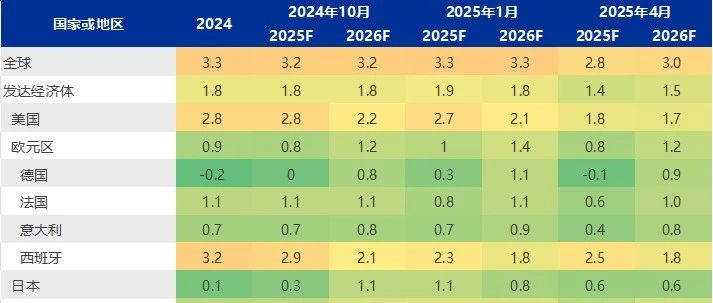
Core Viewpoint - The article discusses the potential risks of an unexpected downturn in the US economy, emphasizing the importance of monitoring unemployment rates and the implications of tariffs on trade and economic growth [1][5]. Economic Forecasts - The IMF has revised the global GDP growth forecast for 2025 down to 2.8%, a decrease of 0.5 percentage points from January [2][3]. - The US GDP growth forecast for 2025 has been lowered from 2.7% to 1.8%, reflecting a decline of 0.9 percentage points [2]. Key Economic Indicators - A rise in the unemployment rate to the range of 4.4-4.6% could trigger a "recession trade" in the market [1][5]. - The article highlights the uncertainty in trade, industrial production, and economic growth due to the implementation of Tariff 2.0 [1]. Currency Trends - There is a possibility of further depreciation of the US dollar, which may lead to an appreciation of the Chinese yuan against the dollar, similar to the situation observed in August-September 2024 [1][9]. - The potential for a gradual depreciation of the dollar may continue if the US government pursues fiscal balance and creates more room for interest rate cuts [9]. Economic Scenarios - The article outlines three possible scenarios for the US economy, indicating the risks associated with stagflation and the "triple whammy" of stocks, bonds, and currency [7][6].

50年来最惨上半年!美元噩梦未醒,更大抛售恐将至?
Jin Shi Shu Ju· 2025-07-08 04:43
Group 1 - The dollar has experienced its worst first half since the Nixon era, with a 10.7% decline against global peers as of June [1] - Factors contributing to the dollar's decline include policy unpredictability, rising debt and deficits, and potential interest rate cuts by the Federal Reserve [1][3] - The dollar's downward trend began in mid-January and has shown limited signs of recovery since then [1] Group 2 - A weaker dollar can benefit the stock market, particularly for companies in the S&P 500 that derive over 40% of their revenue from international sales [2] - Concerns are growing about the potential end of "American exceptionalism" and "dollar hegemony," with U.S. public debt nearing $30 trillion and projected deficits approaching $2 trillion by 2025 [2] - Central banks are increasing gold purchases as a hedge against inflation and economic uncertainty, with global purchases reaching 24 tons per month [2] Group 3 - The Federal Reserve's anticipated interest rate cuts could exert further downward pressure on the dollar, although the effects of such policy changes may be unpredictable [3] - Some analysts believe the dollar's decline may not be permanent, citing recent stock market rebounds as a sign of renewed confidence in U.S. assets [4][5] - Concerns regarding the dollar's role in global trade and finance may be overstated, as it remains a cornerstone of the global financial system [5]
美股散户没有退缩,反而再次爆发强大的投资热情!
美股研究社· 2025-07-07 14:10
Core Viewpoint - The article highlights the resilience and increasing participation of retail investors in the U.S. stock market during the first half of 2025, despite facing challenges such as volatility, inflation, and tariffs. Retail investors have shown strong bullish sentiment and a tendency to buy on dips, leading to record trading volumes and net inflows into the market [4][6]. Summary by Sections Retail Investor Activity - In the first half of 2025, retail investors bought stocks worth $3.4 trillion and sold $3.2 trillion, resulting in a total trading volume of $6.6 trillion [4]. - Retail net buying reached $155.3 billion, surpassing the previous record set during the meme stock craze in 2021 [6]. - Average daily net inflows from retail investors were $1.3 billion, a significant increase of 21.6% compared to 2024 [6]. Market Dynamics - The market is experiencing a shift from being dominated by large tech companies to a broader participation across various sectors, including cyclical stocks and growth-oriented small-cap companies [7]. - The Russell 2000 small-cap index has shown strong rebounds, indicating a recovery in market breadth and providing more investment opportunities [7]. - Companies with previously low valuations and improving fundamentals are gaining investor interest, particularly those involved in AI and technology [7]. Economic and Policy Considerations - The forward P/E ratio of the S&P 500 is approaching 22, significantly above historical averages, raising concerns about potential market corrections [7]. - Key upcoming events include the potential renewal of Trump's tariff suspension policy and the direction of fiscal spending towards AI infrastructure investments, which could influence market trends [8]. - The article suggests that the U.S. stock market in 2025 exhibits characteristics of high risk, high participation, and high growth, with retail investors playing a crucial role in driving market dynamics [8][9].
美股创新高之际欧股优势不再 但别忘了还有欧元
智通财经网· 2025-07-07 13:28
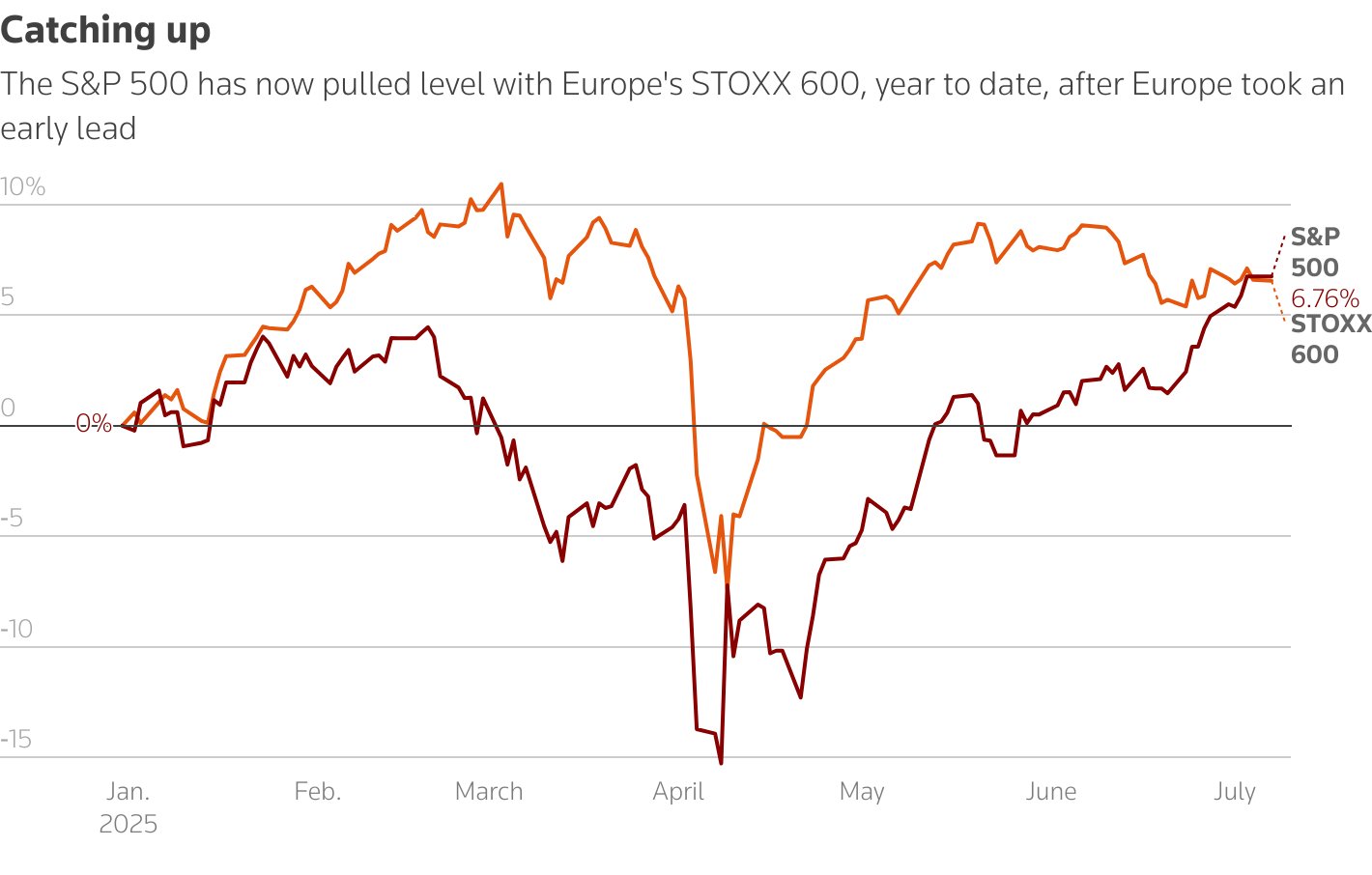
Group 1 - European stock markets initially outperformed US markets in early 2025, but US markets have since caught up, with the Stoxx 600 index up 6.6% year-to-date compared to the S&P 500's 6.8% [1] - The euro has appreciated by 14% against the US dollar this year, maintaining a currency advantage for Europe [4] - The technology sector has rebounded significantly, with a 24% increase since early April, driven by strong earnings forecasts from CEOs [5] Group 2 - Despite the S&P 500 reaching historical highs, some investors remain cautious, indicating potential overvaluation in US stocks, while European market valuations appear more reasonable [8] - The defense sector in Europe has surged by 50% this year, indicating investor caution as it contributes over 50% of returns despite only representing 16% of the Stoxx 600 index [11] - The euro is nearing a four-year high against the dollar, reversing earlier predictions of depreciation, as foreign investors adjust their strategies [14] Group 3 - Currency fluctuations are making European stocks cheaper for US investors, while US stocks are becoming more expensive for European investors, affecting overall market dynamics [17] - The Stoxx 600 index, when priced in dollars, reached a historical high in late June, despite not returning to its March peak in local currency [17]



“美国例外论“面临考验:美债避险属性承压 美元霸权遭遇欧元挑战
Zhi Tong Cai Jing· 2025-07-07 06:52
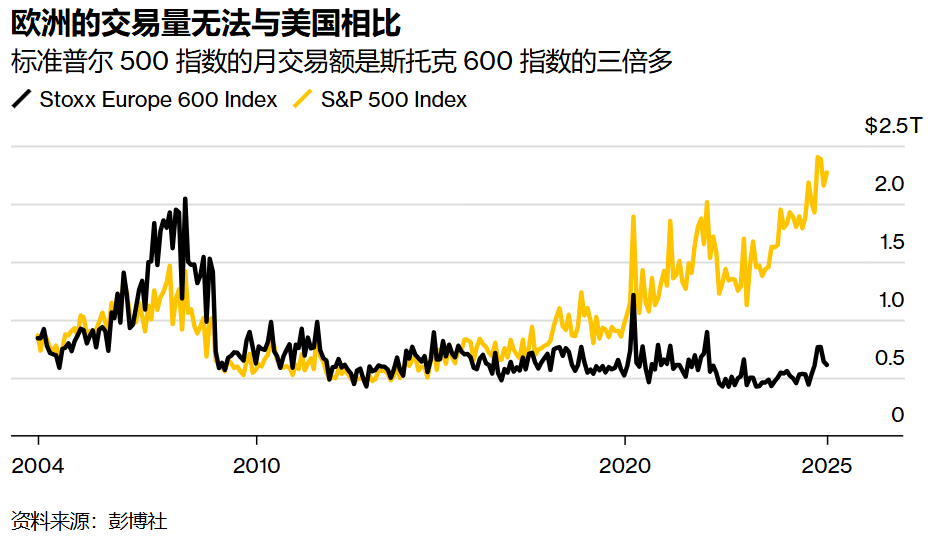
Group 1 - The concept of "American exceptionalism" highlights the unique attractiveness of the U.S. financial system, which allows American enterprises and government to access low-cost capital, creating a positive cycle that attracts global funds [2][5] - The U.S. bond market totals $29 trillion, accounting for 40% of global fixed-income assets, while the U.S. stock market has a total market capitalization of $65 trillion, representing a significant portion of the global equity market [5] - Over the past decade, U.S. corporate earnings growth has significantly outpaced other regions, with S&P 500 earnings per share doubling, compared to a much lower increase in the European Stoxx 600 index [5] Group 2 - Signs of challenges to "American exceptionalism" are emerging, including high tariffs on imports and concerns over the sustainability of federal debt, which could lead to a negative spiral of rising debt and interest rates [8][11] - Despite these challenges, there is currently no clear evidence of large-scale foreign investor withdrawal, as foreign holdings of U.S. Treasuries remain near historical highs, and the S&P 500 index continues to reach new highs [11] - The average price-to-earnings ratio of S&P 500 constituents is currently 50% higher than that of the MSCI global index (excluding the U.S.), indicating a need for sustained earnings growth from U.S. companies [11] Group 3 - The "TINA" (There Is No Alternative) investment logic is being tested, with some strategists viewing this as an opportunity to rebalance portfolios, and U.S. companies are increasingly issuing euro-denominated bonds to hedge policy risks [14] - The debate surrounding "American exceptionalism" also touches on social equity, as income growth has disproportionately favored the top 1% of earners compared to the middle and lower classes [14] - Despite the challenges, some analysts argue that the U.S. retains structural advantages, including a growing labor force, high corporate profit margins, and a large, homogeneous domestic market [14]
美元持续下坠暗示关税风险升级 美国高税率或将反噬股债涨势
Zhi Tong Cai Jing· 2025-07-07 03:21
Group 1 - The currency market is signaling that the stock and bond markets, particularly the US stock market, may be significantly underestimating the risks of tariff increases after the July 9 deadline set by the Trump administration [1][2] - There is a possibility that tariffs could exceed the previously anticipated 10%, as indicated by the strengthening of currencies from countries facing tariffs against the US dollar [1][3] - The recent trade negotiations with Vietnam and India highlight that even close US trading partners may face tariffs higher than 10%, increasing risks to global trade and economic growth [1][2] Group 2 - The market may be misjudging the situation, similar to the miscalculation in March that led to a market downturn when the Trump administration's tariff policies were perceived as gradual and not severe [3][5] - The strengthening of currencies from countries facing high tariff threats suggests that investors are hedging against potential higher tariffs, indicating a disconnect between currency and equity market perceptions [3][5] - The US dollar index has weakened significantly, down 11.5% this year, reflecting market bets against the "American exceptionalism" narrative [5][6] Group 3 - There is a growing concern among investors regarding the potential for higher tariffs, with calls for risk management and hedging strategies becoming more prominent [6][7] - The situation remains uncertain, with the primary risk centered around the Trump administration's trade policy [6][7]
美股散户高度活跃:上半年交易总额达6.6万亿美元
财联社· 2025-07-06 05:21
Core Viewpoint - Despite various challenges in the US stock market during the first half of the year, including tariff uncertainties and market volatility, retail investors continued to show strong buying interest, leading to record trading volumes of $6.6 trillion [1][2]. Group 1: Retail Investor Activity - Retail investors purchased approximately $3.4 trillion worth of stocks while selling about $3.2 trillion, resulting in a total trading volume exceeding $6.6 trillion [2]. - The net inflow of retail investor funds into individual stocks and ETFs reached $137.6 billion in the first half of the year, indicating a strong bullish sentiment despite market fluctuations [5]. - Vanda Research reported a record net buying of $155.3 billion by retail investors, surpassing the previous high of $152.8 billion in the first half of 2021 [5]. Group 2: Market Conditions and Trends - The first half of the year saw significant market challenges, including a drop in the S&P 500 index and a bear market for the Nasdaq Composite, leading some investors to describe it as one of the toughest investment environments [4]. - Retail investors demonstrated a strong inclination to buy on dips, driven by factors such as the "American exceptionalism" trade and record low buying following tariff announcements [6]. - The average daily inflow of retail funds was approximately $1.3 billion, reflecting a 21.6% increase from the previous year [7]. Group 3: Performance and Outlook - The average return of retail investor portfolios was estimated at 6.2%, closely aligning with the S&P 500 index's 6.1% gain during the same period [7]. - The US stock market continued its upward trend, achieving new highs driven by easing trade tensions, positive corporate earnings expectations, and strong economic data [7].
市场分析:美国国债和美元的表现暗示美国例外论即将结束
news flash· 2025-07-04 12:37
金十数据7月4日讯,Pictet Asset Management表示,美国经济和地缘政治领导地位的黄金时代——即美 国例外论——即将结束。"随着美元和美国国债之间关系的破裂,我们看到了这种情况的第一个迹 象,"Pictet说。从历史上看,美国国债收益率的走势与美元的走势相反。"只要出现动荡,全球投资者 就会被美国国债和美元所吸引,从而推低收益率,推高美元。"然而,自特朗普宣布所谓的"解放日"关 税以来,这种联系已经破裂,收益率上升,而美元走弱。 市场分析:美国国债和美元的表现暗示美国例外论即将结束 ...