
金九银十

Search documents
“银十”可期 甲醇中长线可布局多单
Qi Huo Ri Bao· 2025-09-28 23:29
Group 1 - The core viewpoint indicates that methanol futures have rebounded from low levels, but high port inventories continue to suppress prices in the short term [1] - Domestic methanol prices have slightly decreased due to weak port market conditions, while coal prices have rebounded, narrowing the profit margin for coal-based methanol to around 400 yuan/ton, although this remains historically high [1] - The total maintenance scale for methanol is approximately 9.5 million tons per year, with non-integrated facility maintenance amounting to about 7 million tons per year after excluding synchronized maintenance capacities [1] Group 2 - In Iran, the Kimiya methanol facility is operating at reduced capacity due to technical issues, while other facilities are functioning normally, resulting in a daily production of 35,000 tons, which is still sufficient to meet export demands to China [1] - Speculation about potential early gas supply restrictions in Iran has arisen due to maintenance issues at the Kimiya facility, which could marginally reduce methanol imports to China [1] - International methanol plant operating rates have begun to decline, but external market inventories remain high, and terminal demand continues to be weak [2] Group 3 - The production profits for downstream products such as formaldehyde and dimethyl ether have recovered above the breakeven line, indicating an overall industry nearing breakeven [2] - The upcoming winter season is expected to bring additional fuel demand for methanol, although this demand will take time to materialize [2] - The MTO facilities in Central Plains and Zhejiang have restarted, but the overall performance of downstream products remains weak, limiting operational enthusiasm among MTO enterprises [3] Group 4 - The port inventory accumulation continues to negatively impact methanol prices, while the overall economic conditions remain weak, affecting MTO enterprises' operational decisions [3] - Despite the opening of arbitrage opportunities from ports to inland areas, the reality of weak performance persists due to high port inventories [3] - The market for methanol is currently in a state of contention between weak realities and strong expectations, suggesting a cautious approach to trading strategies [3]
供应放量 北京新盘冲刺“金九银十”
Bei Jing Shang Bao· 2025-09-28 15:23
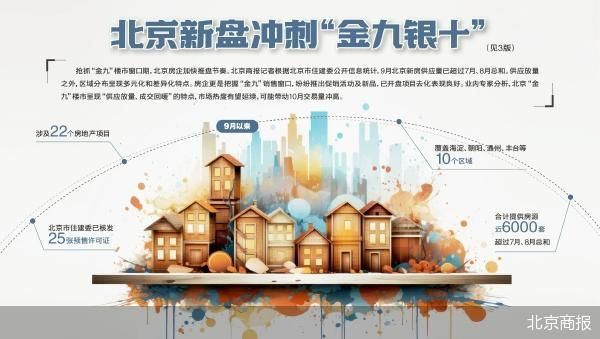
Core Viewpoint - The Beijing real estate market is experiencing a surge in supply and sales activity during the traditional peak season of September, driven by favorable seasonal conditions and supportive policies [1][9][11]. Supply and Demand Dynamics - In September, the Beijing Municipal Commission of Housing and Urban-Rural Development issued 25 pre-sale permits for 22 real estate projects, providing nearly 6,000 housing units [1][6]. - A significant supply peak occurred on September 13, with five projects obtaining pre-sale permits, releasing 1,943 units, which accounted for over 30% of the month's total supply [1][7]. Project Performance - Notable projects include Beijing Jian Gong Jia Tang Yun Xi, which achieved a 95% sales rate on its opening day, and Zhong Jian Yun He Jiu Yuan, which had a 52.75% sales rate with an average price of approximately 61,500 CNY per square meter [3][4]. - The sales strategies employed include "one-stop" services to streamline the purchasing process, significantly enhancing signing efficiency [5]. Regional Supply Distribution - The new projects are distributed across ten districts, with Chaoyang leading in project numbers (6 projects) and total supply (1,653 units), followed by Fengtai (4 projects, 757 units) and Tongzhou (2 projects, 844 units) [6][8]. - The total new housing supply in September exceeded the combined totals of July and August, indicating a robust market response [6]. Market Outlook - The market is expected to maintain its positive momentum, with analysts predicting an increase in transaction volumes for both September and October, supported by the introduction of quality projects in prime locations [10][11]. - Recent policy adjustments and a more lenient credit environment have stimulated reasonable housing demand, contributing to a positive feedback loop in market confidence [11].

对话专家:近期焦煤市场变化及四季度观点
2025-09-28 14:57
Summary of Conference Call on Coking Coal Market Dynamics Industry Overview - The focus of the conference call is on the coking coal market, particularly its price dynamics and supply-demand situation leading into the fourth quarter of 2025 [1][2]. Key Points and Arguments Coking Coal Price Trends - Coking coal futures have shown signs of early correction, indicating market expectations of weakened replenishment demand post-National Day, with prices potentially peaking and declining [1]. - Current spot prices for low-sulfur coking coal have surged, with a notable increase of 160 yuan, reaching a range of 1,580 to 1,600 yuan [3]. - The market anticipates that the coking coal price may have reached a short-term peak, as washing plants and traders have significantly sold off their stocks, raising concerns about inventory buildup due to weak downstream replenishment demand [4]. Steel Market Dynamics - The steel market is experiencing a situation where raw materials are outperforming finished products, with significant price drops in rebar and hot-rolled coils, reflecting a lackluster "golden September and silver October" season [5]. - If steel prices continue to decline in October, it could compress steel mill profits, subsequently exerting downward pressure on raw material prices, including coking coal [5]. Future Market Expectations - The coking coal market is expected to exhibit a V-shaped trend in 2025, with a decline in the first half due to high production and weak demand, followed by a rebound in the second half driven by coal mine losses and better steel mill profits [7]. - The fourth quarter is projected to see a "first suppress then rise" trend, with initial weakness due to slowing replenishment demand and potential further weakening in the finished product sector [9]. Profitability and Production Insights - The steel industry is performing better than last year, with profit levels exceeding 50%, peaking at 70% [10]. - There are concerns regarding potential double counting in steel production statistics, necessitating careful year-on-year comparisons [12]. Supply Chain and Policy Impacts - The coking coal supply situation has been affected by both domestic production and imports, with a notable increase in imports from 2020 to 2024, although a decrease is expected in 2025 [15]. - The Energy Bureau's policies have had limited impact on supply, with some coal mines not strictly adhering to production cuts, which could affect overall market dynamics [16][17]. Price Influences - Coking coal prices are primarily influenced by demand and import levels, with domestic markets being relatively stable due to long-term contracts with state-owned mines [25]. - The anticipated rebound in prices during the winter storage period is expected due to proactive replenishment by downstream users and potential production cuts by upstream coal mines [13][14]. Additional Important Insights - The market is currently facing a potential supply-demand gap, which could lead to price fluctuations in the short term but an overall positive trend in the long run [33]. - The expected high point for coking coal prices in 2026 could reach around 1,600 yuan per ton, contingent on stable supply and demand conditions [37]. - The low point for coking coal prices by the end of this year is projected to be around 1,100 yuan per ton, with a potential high of 1,400 yuan [38]. This summary encapsulates the critical insights from the conference call regarding the coking coal market, highlighting price trends, market dynamics, and future expectations.
铸造铝合金产业链周报-20250928
Guo Tai Jun An Qi Huo· 2025-09-28 09:26
铸造铝合金产业链周报 国泰君安期货研究所 有色及贵金属组 王蓉(首席分析师/所长助理) 投资咨询从业资格号:Z0002529 强弱分析:中性 精废价差趋势性回落 0 1000 2000 3000 4000 5000 6000 01-02 01-14 01-26 02-07 02-19 03-03 03-15 03-27 04-09 04-21 05-06 05-18 05-30 06-11 06-23 07-05 07-17 07-29 08-10 08-22 09-03 09-15 09-27 10-16 10-28 11-09 11-21 12-03 12-15 12-27 元/吨 佛山破碎生铝精废价差 2021 2022 2023 2024 2025 ADC12-A00收敛明显 -2000 -1500 -1000 -500 0 500 1000 1500 01-02 01-14 01-26 02-07 02-19 03-03 03-15 03-27 04-09 04-21 05-06 05-18 05-30 06-11 06-23 07-05 07-17 07-29 08-10 08-22 09-03 ...
锰硅产量抬升至较高水平 短期内预计盘面偏弱震荡
Jin Tou Wang· 2025-09-28 07:45
News Summary Core Viewpoint - The manganese market is experiencing fluctuations in supply and demand, with a notable decrease in manganese ore shipments from Gabon and an increase in silicon-manganese inventory among independent producers, indicating potential challenges in the market dynamics [1][3]. Supply and Inventory - Gabon's manganese ore shipments fell to 47,700 tons, while Australian ore supply has increased, leading to a slight decrease in port manganese inventory to 4.27 million tons, down by 250,000 tons [1]. - The inventory of 63 independent silicon-manganese producers reached 233,800 tons, a month-on-month increase of 34,900 tons, marking a 17-month high. The Ningxia region saw the most significant increase, with inventory rising by 30,600 tons to 169,000 tons [1]. Profitability - Current spot profits for silicon-manganese in Inner Mongolia are at -80 yuan/ton, while in Ningxia, they are at -190 yuan/ton. Hebei Steel Group set the final pricing for silicon-manganese at 6,000 yuan/ton, a decrease of 200 yuan/ton from the previous month [1]. Demand and Market Dynamics - New Lake Futures noted a decrease in silicon-manganese operating rates and weekly production, but iron output is gradually increasing, aligning with seasonal demand expectations. However, the actual demand for silicon-manganese remains uncertain, with ongoing inventory accumulation and weak spot market transactions [3]. - Guotou Anxin Futures reported that iron output has risen above 241, and silicon-manganese production continues to increase without significant inventory accumulation. Manganese ore prices have seen a slight uptick, and the market is advised to consider buying on dips due to a potential upward price correction [4].
22个项目集中取证,北京新盘供应放量冲刺“金九银十”
Bei Jing Shang Bao· 2025-09-28 05:33
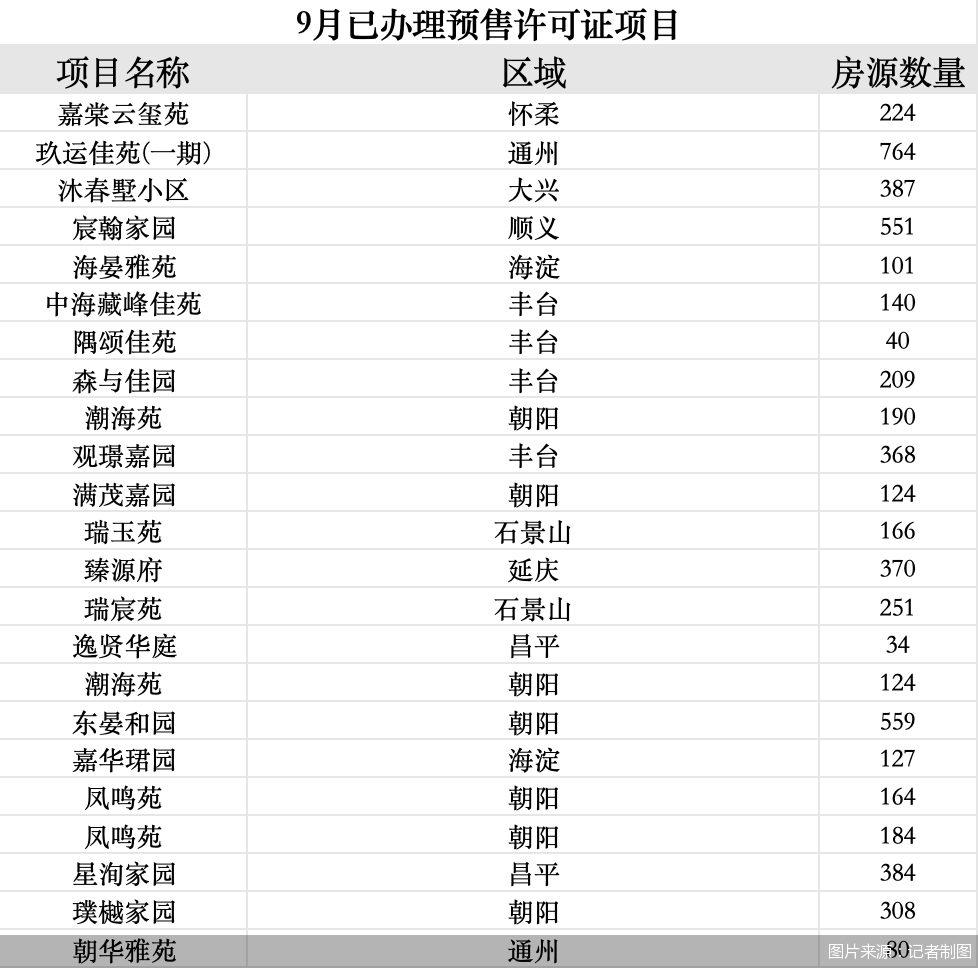
Core Insights - The Beijing real estate market is experiencing a surge in supply and sales activity during the traditional peak season of September, driven by favorable seasonal conditions and supportive policies [1][8][12] Supply and Demand Dynamics - In September, the Beijing Municipal Commission of Housing and Urban-Rural Development issued 25 pre-sale permits for 22 real estate projects, providing nearly 6,000 housing units [1][7] - A significant supply peak occurred on September 13, with five projects obtaining pre-sale permits, releasing 1,943 units, which accounted for over 30% of the month's total supply [1][8] Project Performance - Several projects have shown strong sales performance, with the Beijing Construction Engineering's Jiatang Yunxi achieving a 95% sales rate on its opening day [3] - The Zhongjian Yunhe project, which adopted a "permit-to-sale" strategy, reported a 52.75% sales rate with an average price of approximately 61,500 yuan per square meter [4] Market Trends - The distribution of new projects is diverse, with Chaoyang District leading in the number of new projects and total housing supply, followed by Fengtai and Changping [7] - The market is characterized by a variety of product types, providing more choices for buyers, which is seen as a positive trend [5][12] Future Outlook - The market is expected to maintain its positive momentum, with analysts predicting an increase in transaction volumes in September and October due to the influx of new projects and improved market conditions [11][12] - The recent policy adjustments and a more lenient credit environment are believed to have stimulated reasonable housing demand, contributing to a favorable market outlook [12]
国内库存基本维持去化格局 原木期货呈震荡格局
Jin Tou Wang· 2025-09-28 02:11
Core Viewpoint - The main focus is on the recent performance of the lumber futures market, which has shown a slight increase of 0.50% in the main contract, indicating a potential for future price movements and trading strategies [1][2][3]. Group 1: Market Performance - On September 26, the lumber futures main contract experienced fluctuations, reaching a peak of 810.0 yuan and closing at 808.5 yuan, reflecting a 0.50% increase [1]. - The current market is characterized by a situation of internal and external price discrepancies, with international prices remaining high while domestic spot prices are weak, leading to increased pressure on traders [2][3]. Group 2: Trading Strategies - New Lake Futures suggests a strategy of low buying for the November lumber contract, anticipating a seasonal demand increase during the "golden September and silver October" period, while monitoring macroeconomic policies and actual demand [2]. - Green Dahan Futures also recommends a strategy of buying on dips for the November contract, emphasizing the importance of the upcoming traditional peak season and the current low valuation of the market [3].
“金九”成色初显
HUAXI Securities· 2025-09-27 13:09
1. Report Industry Investment Rating No relevant content provided. 2. Core Viewpoints of the Report - The property market continued a mild recovery this week, with second - hand housing outperforming new housing. However, the recovery momentum weakened on a weekly basis, and there was a significant divergence in transaction heat among cities at different tiers [1][3]. - The "Golden September" effect was initially shown at the aggregate level, but the policy focus may shift to second - tier cities to boost market confidence [3]. 3. Summary by Relevant Catalogs 3.1 Market Overview - This week (September 19 - 25), the second - hand housing market in 15 cities had a transaction area of 2.18 million square meters, a 1% week - on - week decline but with six consecutive weeks of year - on - year growth. The new housing market in 38 cities had a transaction area of 2.56 million square meters, a 7% week - on - week increase, but only one week of year - on - year growth in the past 16 weeks [1]. - From September 1 - 25, the second - hand housing transactions in 15 cities increased by 26% year - on - year, and the new housing transactions in 38 cities increased by 9% year - on - year, reversing the decline in August [3]. 3.2 Market Performance by City Tiers Second - hand housing market - First - tier cities had stable growth overall, with Beijing and Shanghai performing well (7% and 5% week - on - week growth, 15% and 29% year - on - year growth respectively), while Shenzhen showed a decline (31% week - on - week and 6% year - on - year) [2]. - Second - tier cities had a 3% week - on - week and 15% year - on - year growth, but the sustainability of the recovery needed further observation [2]. - Third - tier cities experienced a significant cooling, with a 21% week - on - week decline and a year - on - year change from 14% to - 8% [2]. New housing market - First - tier cities were the only ones with year - on - year growth, with a 23% year - on - year increase this week. Shanghai and Beijing were strong performers (74% and 26% year - on - year growth respectively) [2]. - Second - and third - tier cities faced significant year - on - year declines, 13% and 31% respectively [2]. 3.3 Key City Observations First - tier cities - For second - hand housing from September 19 - 25, Beijing and Shanghai increased by 7% and 5% week - on - week, while Shenzhen decreased by 31%. Year - on - year, Shanghai and Beijing increased by 29% and 15%, while Shenzhen decreased by 6% [20]. - For new housing from September 19 - 25, Shanghai, Beijing, and Shenzhen increased by 17%, 10%, and 5% week - on - week respectively, while Guangzhou decreased by 21%. Year - on - year, Shanghai and Beijing increased by 74% and 26%, while Shenzhen and Guangzhou decreased by 26% and 22% respectively [21]. Other key cities - In Hangzhou, second - hand housing increased by 8% and new housing decreased by 1% week - on - week, equivalent to 45% and 22% of the annual high respectively [21]. - In Chengdu, second - hand housing increased by 22% and new housing increased by 5% week - on - week, equivalent to 86% and 60% of the annual high respectively [21]. 3.4 Housing Price Observation - From September 15 - 21, the weekly listed prices of second - hand housing in Shanghai, Beijing, and Shenzhen decreased by 0.33%, 0.03%, and 0.61% week - on - week respectively. Compared with the week before the "924" policy last year, they still decreased by 2.1%, 8.5%, and 8.0% respectively [46].
8月湖南汽车上险榜发布,小米表现抢眼
Chang Sha Wan Bao· 2025-09-27 07:34
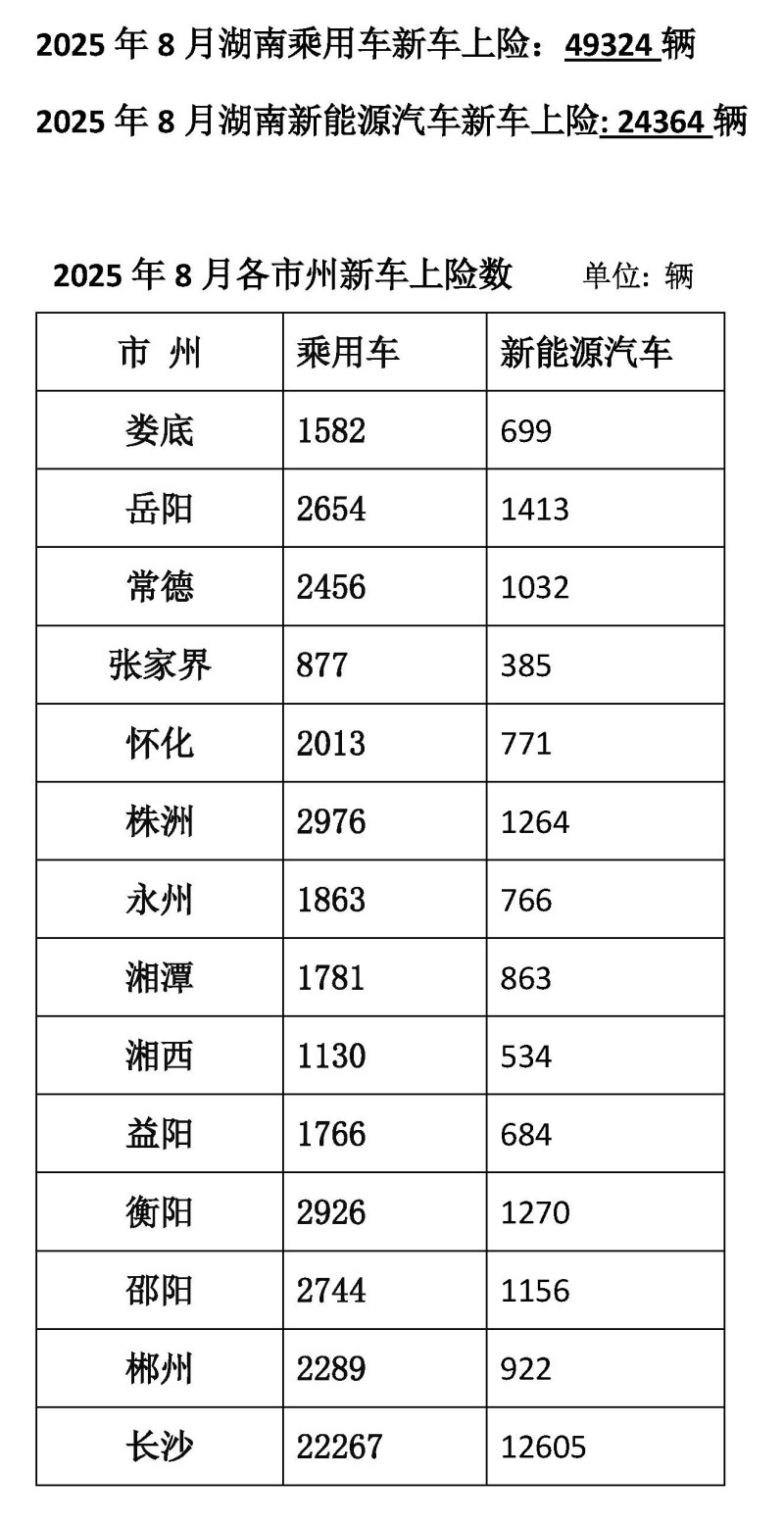
Core Insights - The data released by the Hunan Automobile Association indicates a significant decline in new car insurance numbers in August compared to July, with a total of 49,324 vehicles insured, representing a decrease of 40.69% for passenger cars and 40.4% for new energy vehicles [1][4][5] - Despite the overall decline, Changsha remains the dominant market in Hunan, with 22,267 new cars insured, which is a decrease of 35.23% compared to July, and 12,605 new energy vehicles, down 31.93% [4][5] - Xiaomi Auto emerged as the biggest winner in the Hunan car market for August, with its model SU7 leading the new energy vehicle segment with 622 units sold, surpassing Tesla's Model Y [5][9] Summary by Category Overall Market Performance - In August, Hunan's total new car insurance volume was 49,324 units, with new energy vehicles accounting for 24,364 units [4] - The decline in insurance numbers is attributed to changes in the "old-for-new" national subsidy policy and the seasonal sales slump typical of August [4][5] Regional Insights - Changsha's new car insurance volume of 22,267 units and new energy vehicle insurance volume of 12,605 units highlight its resilience compared to other cities in Hunan [4][5] - Other cities like Zhuzhou and Hengyang also showed notable figures, with 2,976 and 2,926 new cars insured, respectively [3][4] Brand and Model Performance - The top-selling model in the overall category was the Wuling Hongguang MINI with 1,105 units, while Xiaomi's SU7 led the new energy segment [5][6] - The performance of Xiaomi's SU7 and YU7 indicates a strong market presence, with the latter ranking third in new energy vehicle insurance [5][9] - The competitive landscape is shifting, with traditional leaders like Nissan and Tesla facing challenges from emerging brands like Xiaomi [5][6] Future Outlook - As the "Golden September and Silver October" sales season begins, it is anticipated that car manufacturers will launch significant new models, potentially altering the insurance volume rankings in September [10]

高频|黑色系商品领跌,“金九”成色如何?
CAITONG SECURITIES· 2025-09-27 06:48
1. Report Industry Investment Rating No information about the industry investment rating is provided in the given reports. 2. Core Views of the Report - This week, the spot price of rebar decreased slightly, terminal demand remained weak, and the willingness to replenish inventory before the holiday was low. The black - series led the decline in the commodity market on Friday, and the coking industry association issued a clarification statement in the afternoon. The double - coke continued to fall at night, indicating significant uncertainties in the fundamentals. The real estate sales declined marginally this week, with first - tier cities providing support. The momentum of travel was strong approaching the holiday [1]. - In terms of real estate sales, the transaction area of new homes in 20 cities tracked by Wind increased by 7.58% week - on - week and decreased by 10.63% year - on - year. The transaction area in first - tier cities was significantly stronger than the same period last year, while that in second - tier cities turned negative year - on - year. The sales area of second - hand homes in Beijing and Shanghai was much higher than last year [1]. - In investment and production, most commodity prices rose. The rebar price decreased slightly, with weak terminal demand and low pre - holiday inventory replenishment willingness. The glass futures price increased due to stable supply and improved demand in the peak season, along with positive policy sentiment. The cement price index rose as the traditional peak season deepened, and the asphalt price increased slightly supported by the rebound in oil prices [1]. - In industrial production, the operating rates showed differentiation. The PTA operating rate declined, while the operating rates of automobile tires, coking enterprises, and polyester filament remained basically flat. The blast furnace operating rate of steel mills increased slightly, and the operating rate of petroleum asphalt increased significantly [1]. - In consumption, the travel momentum was strong. Subway travel exceeded the seasonal level, and automobile consumption, domestic flights, and movie box - office were in line with the season [1]. - In terms of inflation, the pork price declined, vegetable prices rose, and oil prices increased. The increase in vegetable prices was due to some vegetables entering the end of the harvest season and reduced production after the temperature drop in the north. The rise in crude oil prices was mainly driven by the geopolitical disturbances in Russia and Ukraine [1]. - In exports, the SCFI declined, and the BDI increased. The demand in the transportation market remained unchanged, and the spot - market booking prices continued to fall [1]. 3. Summary According to Relevant Catalogs 3.1 Real Estate Sales: First - Tier Cities Provide Support - New home sales: From September 19th to 25th, the transaction area of new homes in 20 cities tracked by Wind increased by 7.58% week - on - week and decreased by 10.63% year - on - year. First - tier cities' transaction area was significantly stronger than last year, second - tier cities' year - on - year sales turned negative, and third - and fourth - tier cities' sales were weaker than last year and the previous period [1][6]. - Second - hand home sales: The sales area of second - hand homes in Beijing and Shanghai was much higher than last year. Overall, the transaction area of second - hand homes in key cities was basically flat week - on - week, with the year - on - year increase showing a decline. Except for Shenzhen, the transaction areas of other key cities were stronger than the previous period [1][20]. 3.2 Investment: Most Commodity Prices Rose - Rebar: The price decreased slightly. Due to weak terminal demand and low pre - holiday inventory replenishment willingness, merchants focused on reducing inventory. The inventory decreased by 2.75% week - on - week, and the apparent consumption increased by 4.96% [1][5]. - Glass: The futures price increased. The supply output was stable, the demand improved marginally in the peak season, and the policy sentiment of the "Building Materials Industry Stable Growth" was positive. The price increased by 3.71% week - on - week [1][5]. - Cement: The price index rose. As the traditional peak season deepened, enterprises generally raised prices, with a 2.51% increase week - on - week [1][5]. - Asphalt: The price increased slightly. The rebound in oil prices provided price support, with a 0.78% increase week - on - week [1][5]. 3.3 Production: Operating Rates Showed Differentiation - PTA: The operating rate declined, dropping from 77.29% to 76.48% [1][5]. - Automobile tires, coking enterprises, and polyester filament: The operating rates remained basically flat [1]. - Steel mills' blast furnaces: The operating rate increased slightly, rising from 84% to 84.47% [1][5]. - Petroleum asphalt: The operating rate increased significantly, rising from 34.4% to 40.1% [1][5]. 3.4 Consumption: Strong Travel Momentum - Subway travel: It was higher than the seasonal level, although it decreased by 2.54% week - on - week [1][5]. - Automobile consumption, domestic flights, and movie box - office: They were in line with the season. Automobile consumption increased by 7.07% week - on - week, domestic flights decreased by 1.37% week - on - week, and movie box - office increased by 17.00% week - on - week [1][5]. 3.5 Exports: SCFI Declined, BDI Increased - SCFI: It decreased by 6.98% week - on - week, indicating that the demand in the transportation market remained unchanged and the spot - market booking prices continued to fall [1][5]. - BDI: It increased by 2.86% week - on - week [1][5]. - CRB spot index: It decreased slightly by 0.75% week - on - week [1][5]. 3.6 Prices: Pork Price Declined, Vegetable and Oil Prices Rose - Pork: The price decreased slightly, dropping from 19.48 yuan/kg to 19.42 yuan/kg [1][5]. - Vegetables: The price increased, rising by 2.01% week - on - week, due to some vegetables entering the end of the harvest season and reduced production after the temperature drop in the north [1][5]. - Oil: The price increased. The Brent crude oil spot price in the UK rose from $67.15/barrel to $72.09/barrel, mainly driven by geopolitical disturbances in Russia and Ukraine [1][5].