
避险资产

Search documents
深夜!全线暴跌,发生了什么?
券商中国· 2025-10-10 23:27
Core Viewpoint - The U.S. stock market experienced a significant downturn, referred to as "Black Friday," with major indices suffering substantial losses due to rising uncertainties and macroeconomic concerns [2][4][10]. Market Performance - On October 10, U.S. stock indices fell sharply, with the Dow Jones dropping by 1.9%, the Nasdaq plunging by 3.56%, and the S&P 500 declining by 2.71% [4]. - Major tech stocks also faced heavy losses, with TSMC ADR down over 6%, Broadcom and Tesla down over 5%, and Nvidia and Amazon down over 4% [6]. - Chinese stocks listed in the U.S. were affected as well, with the Nasdaq Golden Dragon China Index falling over 6% [6]. Global Market Impact - European markets also saw declines, with the Euro Stoxx 50 index down 1.75% and major indices in Germany, France, and Italy dropping over 1% [7]. - Commodities like WTI crude oil fell over 4%, nearing yearly lows, while Bitcoin experienced a drop of over 13% [7]. Investor Behavior - The uncertainty in the market led to a surge in demand for protective derivatives, with investors flocking to safe-haven assets like gold and U.S. Treasury bonds [8]. - Gold prices rose over 1%, surpassing $4000 per ounce, while the yield on the U.S. 10-year Treasury note fell to 4.034% [8]. Macroeconomic Indicators - The preliminary consumer confidence index from the University of Michigan for October was reported at 55, the lowest since May, indicating stagnant consumer sentiment [12]. - Approximately 63% of respondents expect unemployment to rise next year, and over two-thirds anticipate inflation to exceed income growth [12]. Government Actions - The U.S. government shutdown has escalated, with the Trump administration initiating large-scale permanent layoffs of federal employees, marking a departure from previous practices during shutdowns [10][11].



满屏深绿
小熊跑的快· 2025-10-10 19:28
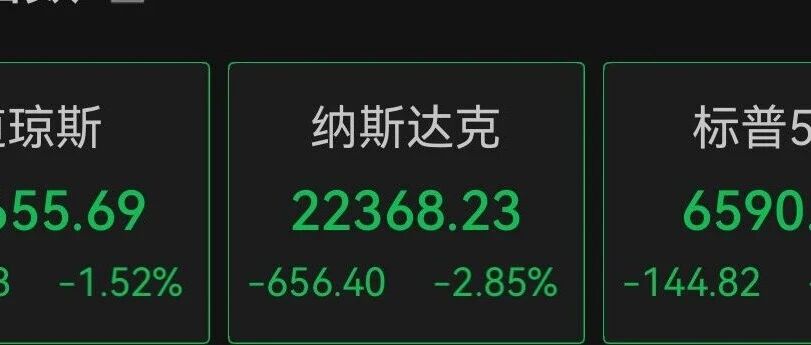
Market Overview - The US stock market experienced a significant decline, with the Nasdaq dropping by 2.8% [1] - A50 futures fell by 3.86%, indicating a bearish sentiment in the market [1] Sector Performance - Following the long holiday, the market showed a stark contrast, with only safe-haven assets like gold and government bonds performing well, while other sectors were predominantly in the red [2] - The Hang Seng Index futures and Hang Seng Tech futures also reflected a downward trend, with declines of 5.00% and 4.99% respectively [3] Key Index Movements - The Dow Jones Industrial Average decreased by 1.52%, closing at 45,655.69, while the Nasdaq and S&P 500 fell by 2.85% and 2.15%, closing at 22,368.23 and 6,590.29 respectively [3] - Gold and silver prices showed slight increases, with London gold rising by 0.80% to 4,007.887 and COMEX silver up by 0.59% to 47.435 [3]
四千美元只是起点? 市场信任危机或助推黄金冲击4500
Jin Tou Wang· 2025-10-10 10:54
Core Insights - Strong catalysts are driving gold prices higher, with current prices surpassing $4000 per ounce despite the strengthening dollar [1] - Demand for gold remains robust among investors and central banks, even as acquisition costs rise [1] - After a pause in July, central banks resumed gold purchases in August, indicating continued interest in gold as a reserve asset [1] Market Dynamics - Platinum has outperformed other precious and base metals, with a year-to-date increase of over 80%, while silver has reached a multi-decade high of $50 [1] - The rise in gold prices reflects a growing crisis of confidence in fiscal and monetary order, particularly as major economies like the US and UK have debts exceeding 100% of GDP without plans for fiscal consolidation [1] - Traditional safe-haven assets are losing appeal, but recent expectations of Federal Reserve rate cuts, US government shutdown hedging, and geopolitical tensions have led to a short-term surge in gold prices [1] Long-term Outlook - Although short-term factors may fade, long-term prospects for gold remain strong, with models predicting prices could exceed $4500 per ounce in the first quarter of next year under neutral assumptions [1] - In India, the cultural affinity for gold persists, with its collateral function supporting economic development, and institutional interest is growing alongside a continued weak dollar [1] - By 2030, gold is expected to become a primary reserve asset for central banks [1] Current Market Status - As of October 10, 2023, spot gold is priced at $3987.77 per ounce, reflecting a slight increase of 0.303% [1]
每日投行/机构观点梳理(2025-10-10)
Jin Shi Shu Ju· 2025-10-10 09:51
Group 1: Inflation and Economic Outlook - Citigroup economists expect a cooling in core CPI for September, projecting a rise of 0.28%, down from 0.35% in August, with housing inflation easing overall service inflation [1] - Barclays highlights that the rise in gold prices reflects increasing market distrust in the existing fiscal and monetary order, with major economies' debt exceeding 100% of GDP and a lack of political will for fiscal consolidation [1] - Dutch International Group anticipates a continued bull market for gold, forecasting an average price of $4,000 per ounce in Q4, driven by central bank purchases and geopolitical risks [1] Group 2: Bond Market and Eurozone Stability - Dutch International Group reports that the low volatility environment in the Eurozone makes current bond yield spreads highly attractive, with the 10-year French and Italian bond spreads tightening to 82 basis points [2] - The political crisis in France serves as a warning for Europe, with ongoing challenges in managing rising government debt and the need for structural reforms [2] - Mitsubishi UFJ analysts suggest that if France avoids early elections, the euro may regain an upward trend against the dollar [2] Group 3: Currency and Interest Rate Predictions - Dutch International Group indicates that the yen is becoming the preferred funding currency for carry trades, as expectations for low interest rates persist [4] - Capital Economics forecasts that the USD/JPY exchange rate will end at 150 by the end of 2025, with a potential rebound for the yen expected once the Bank of Japan resumes rate hikes [4] - Mizuho Securities maintains that the Bank of Japan will adopt a hawkish stance in the short term, despite reduced urgency for rate hikes [4] Group 4: Gold Market Projections - China International Capital Corporation predicts that gold prices could exceed $4,500 per ounce in Q1 of next year, driven by rising expectations for Fed rate cuts and geopolitical tensions [5] - The report emphasizes that while short-term factors may fade, the long-term bullish fundamentals for gold remain intact [5] Group 5: Energy Storage and Lithium Battery Industry - CITIC Securities identifies that the energy storage sector is at a pivotal point, with significant cost reductions and policy support driving demand and market penetration [6] - The report highlights that the lithium battery supply chain is expected to improve significantly as energy storage demand accelerates [6] Group 6: Superhard Materials and Coal Sector - CITIC Securities notes that recent export controls on superhard materials may accelerate industry consolidation, leading to potential price increases in the long term [7] - The coal sector is projected to experience sustained excess returns due to balanced supply and demand dynamics, with potential price upside in the upcoming quarter [7] Group 7: AI Industry Developments - CITIC Securities observes that advancements in AI technology are exceeding expectations, with significant progress in commercialization and monetization [7] - The report emphasizes the growing importance of computing power in the AI industry, highlighting opportunities in related sectors such as optical modules and fiber optics [7]
比黄金涨得还猛!价格创14年新高
Sou Hu Cai Jing· 2025-10-10 08:16
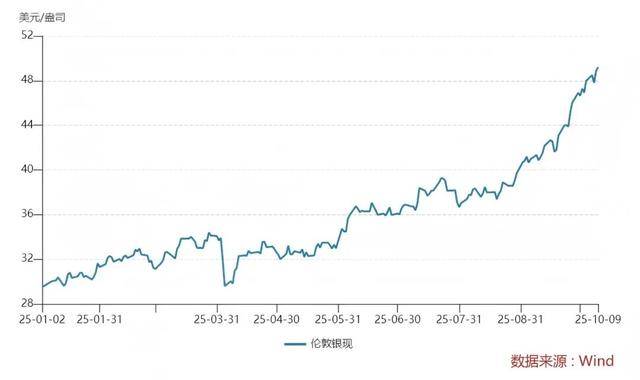
Core Insights - The spot silver price has surpassed $50 per ounce for the first time in history, marking a 14-year high with an intraday increase of over 4% [1] - Silver has shown a stronger year-to-date increase of over 70%, compared to gold's increase of over 50% [1] Group 1: Market Drivers - The recent surge in silver prices is driven by a combination of "financial attributes + industrial demand" [3] - Rising gold prices have led to a reevaluation of precious metals, with investors viewing silver as a leveraged inflation hedge [3] - Increased consumption of silver in industries such as renewable energy, photovoltaics, and electric vehicles has reinforced its dual role as both a "safe-haven asset" and an "industrial metal" [3] - Additional factors include rising expectations for Federal Reserve interest rate cuts, a weakening dollar, and heightened geopolitical risks, which have collectively pushed silver into a rapid upward trajectory [3] Group 2: Future Outlook - According to Citi's global commodity research head, both gold and silver are likely to continue their upward trends due to structural and cyclical tailwinds [4] - In the short term, silver may experience volatility and potential pullbacks after breaking the $50 per ounce mark, but the medium-term outlook remains solid [4] - The director of the China (Hong Kong) Financial Derivatives Investment Research Institute maintains a positive long-term outlook for silver prices, emphasizing the importance of risk management [4]
比黄金涨得还猛,它,价格创14年新高
3 6 Ke· 2025-10-10 07:27
Core Viewpoint - The price of spot silver has historically surpassed $50 per ounce for the first time, reaching $51 per ounce, marking a 14-year high with a daily increase of over 4% [1][3]. Price Movement - As of October 10, the spot silver price has slightly retreated to $49.73 per ounce [1]. - Year-to-date, spot silver has seen a cumulative increase of over 70%, while spot gold has risen by more than 50% [1]. Driving Factors - According to Li Gang, the recent surge in silver prices is driven by a combination of "financial attributes + industrial demand" [3]. - The rise in gold prices has led to a reevaluation of precious metals, with investors viewing silver as a leveraged inflation hedge [3]. - Strong demand from sectors such as renewable energy, photovoltaics, and electric vehicles has reinforced silver's dual role as both a "safe-haven asset" and an "industrial metal" [3]. - The expectation of interest rate cuts by the Federal Reserve, a weakening dollar, and increasing geopolitical risks have contributed to the liquidity and sentiment that propel silver prices upward [3]. Supply and Demand Outlook - A report from the World Silver Institute indicates that due to a 1% decline in demand and a 2% increase in total supply, the global silver deficit is expected to narrow by 21% to 117.6 million ounces by 2025 [4]. Future Price Predictions - Citi's global commodity research head, Maximilian Layton, has raised the three-month price forecast for silver from $45.00 per ounce to $55.00 per ounce, suggesting a continuation of the upward trend for both gold and silver [5]. - Li Gang anticipates that silver may experience some technical corrections after breaching the $50 per ounce mark, but the medium-term outlook remains strong, with expectations of silver trading between $47 and $55 per ounce over the next three months [5]. - Wang Hongying emphasizes the importance of risk control in investment strategies, suggesting that if silver prices experience a technical pullback, investors should consider building positions near key support levels, such as $46 per ounce, while maintaining strict risk management [5].
突破每盎司4000美元!五张图读懂黄金如何强势回归全球货币体系核心舞台
智通财经网· 2025-10-10 02:11
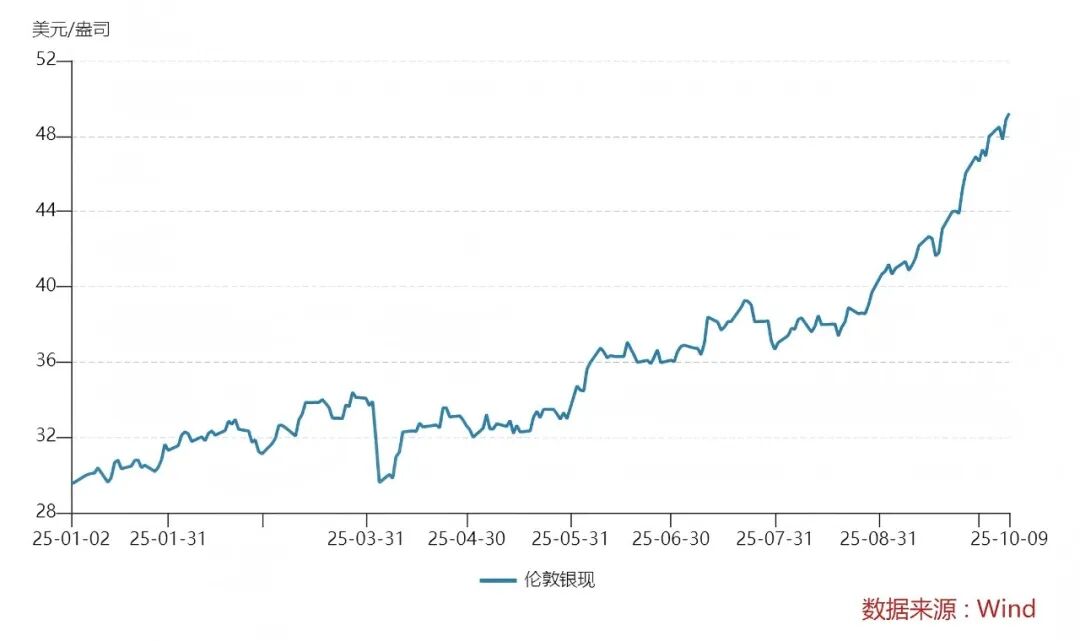
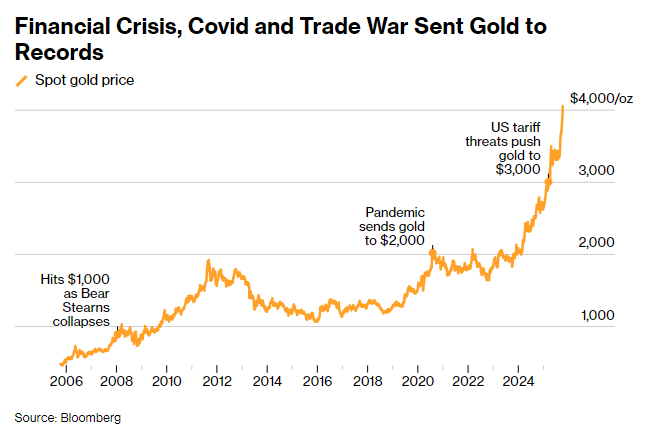
Core Viewpoint - Gold prices have surpassed $4,000 per ounce, marking a significant milestone in a three-year bull market, defying bearish predictions and traditional forecasting models [1] Part 01: Pandemic-Induced Turning Point - Gold prices initially surged past $2,000 per ounce due to market panic triggered by the pandemic, followed by the Russia-Ukraine conflict, which further fueled a 27% increase in gold prices in 2024 [1] - The return of Donald Trump to the White House in March 2025 contributed to gold breaking the $3,000 per ounce barrier [1] - Major macroeconomic factors, including a potential U.S. government shutdown and a weakening dollar, have supported the gold market [1] Part 02: Surpassing Inflation-Adjusted Historical Peaks - Last month, gold prices exceeded the inflation-adjusted historical peak of $850 per ounce set in January 1980 during a period of economic crisis in the U.S. [4] - The current market environment is seen as reminiscent of the conditions that led to the previous gold price surge [4] Part 03: Surpassing U.S. Treasury Status - Central banks have played a dominant role in the gold market, significantly increasing their gold purchases to diversify assets and reduce reliance on the U.S. dollar [7] - Gold's current value has surpassed the amount of U.S. Treasury securities held by non-U.S. central banks, becoming the second-largest asset in central bank foreign exchange reserves [7] - The market value of gold held by the U.S. has exceeded $1 trillion, significantly outpacing the recorded amounts on its government balance sheet [7] Part 04: Temporary Pause in Chinese Demand - In the first four months of 2024, Chinese market demand was a key support for rising gold prices, driven by a new wave of demand for safe-haven assets [10] - Recently, despite record high gold prices, Chinese market prices have fallen below international benchmarks, indicating a shift in market dynamics towards Western investors [10] Part 05: Surge in Gold ETF Holdings - Gold ETFs have become a mainstream channel for Western investors to gain exposure to gold, with significant inflows pushing prices higher [13] - After a period of outflows, gold inflows into ETFs have reversed, with over 16 million ounces added since mid-2024, although current holdings remain below pandemic-era peaks [13] Additional Insights - The recent surge in gold prices reflects a structural shift in investor sentiment and global capital flows, driven by sanctions, asset seizures, and concerns over fiscal sustainability [15]
国际原油、黄金大跌,英伟达再创新高
2 1 Shi Ji Jing Ji Bao Dao· 2025-10-10 02:00
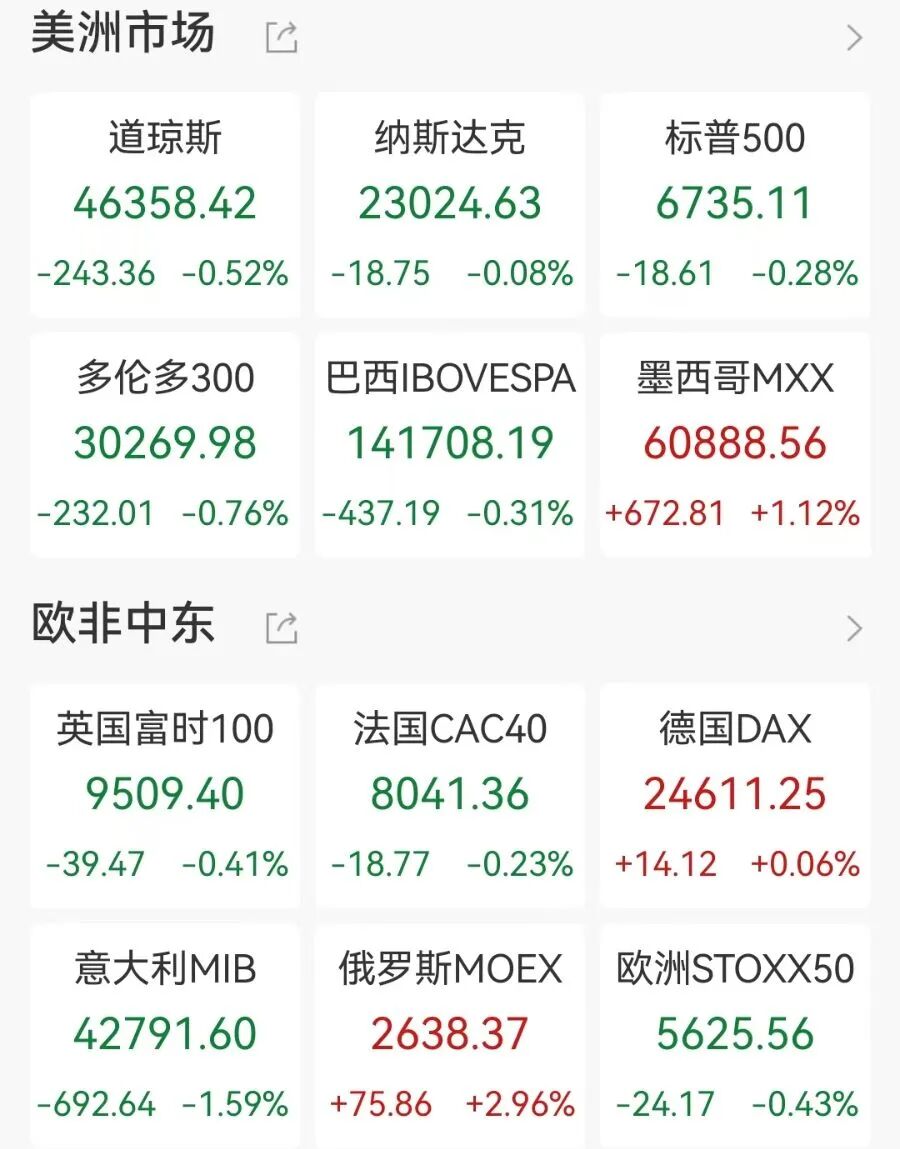
视频丨柳润瑛 美股三大指数周四集体收跌,英伟达股价创历史新高。纳斯达克中国金龙指数收跌2.03%,热门中概股多数下跌。 黄金、白银也结束了价格一路飙升的态势,COMEX黄金期货收跌1.95%,COMEX白银期货收跌2.73%。国际油价下跌,ICE布 油、NYMEX WTI原油均跌逾1%。 | 美洲市场 [^ | | | | --- | --- | --- | | 道琼斯 | 纳斯达克 | 标普500 | | 46358.42 | 23024.63 | 6735.11 | | -243.36 -0.52% -18.75 -0.08% -18.61 -0.28% | | | | 多伦多300 | 巴西IBOVESPA | 墨西哥MXX | | 30269.98 | 141708.19 | 60888.56 | | -232.01 -0.76% -437.19 -0.31% +672.81 +1.12% | | | | 欧非中东 区 | | | | 英国富时100 法国CAC40 | | 德国DAX | | 9509.40 | 8041.36 | 24611.25 | | -39.47 -0.41% -18.77 ...

黄金结束四连涨跌破4000关口后企稳 美元走强与股市波动引发多头平仓
智通财经网· 2025-10-10 01:58
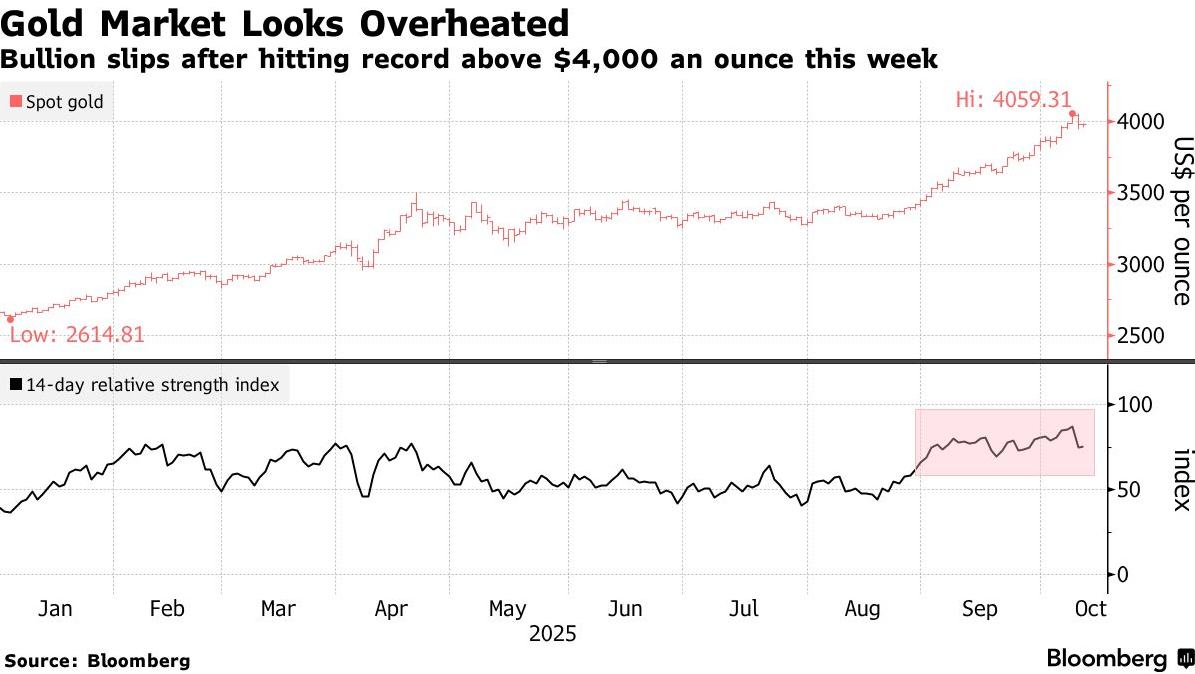
Core Viewpoint - Gold prices stabilized after falling below $4000 per ounce, closing at $3987.04, down 1.6% from the previous day, following a four-day rally that peaked at a historical high of $4059.31 per ounce [1][4] Group 1: Gold Market Dynamics - Gold prices experienced a significant drop after reaching a historical high, indicating a potential profit-taking behavior among investors due to overbought conditions [1][4] - Despite the recent decline, gold is expected to achieve its eighth consecutive week of gains, reflecting ongoing investor interest [4] Group 2: Silver Market Insights - Silver prices also fell after hitting a 40-year high of $51.235 per ounce, although it has seen a cumulative increase of approximately 70% this year, outperforming gold [1][4] - The silver market is facing a supply-demand imbalance, with predictions of a fifth consecutive year of supply shortages by 2025 [6] Group 3: Market Influences - The recent fluctuations in precious metals coincided with a downturn in the U.S. stock market, highlighting gold's dual role as a safe-haven asset and a risk asset during market corrections [4] - Concerns over inflation, unsustainable U.S. fiscal policies, and threats to the Federal Reserve's independence have increased the attractiveness of precious metals [4] Group 4: Industrial Demand for Silver - Silver's industrial applications, particularly in solar panels and wind turbines, account for over half of its total demand, emphasizing its importance beyond just investment [6] - The London silver market is experiencing unprecedented tightness, with rising borrowing costs and fears of potential tariffs on silver imports to the U.S. leading to rapid depletion of inventories [6]
英伟达股价再创收盘新高!国际原油、黄金大跌
2 1 Shi Ji Jing Ji Bao Dao· 2025-10-10 01:04
英伟达股价创历史新高,收盘上涨1.79%,最新市值为46778亿美元。 纳斯达克中国金龙指数收跌2.03%,热门中概股多数下跌,小鹏汽车、蔚来跌超5%,理想汽车、阿里巴 巴跌超4%,百度跌近4%,京东跌超2%,哔哩哔哩涨近3%。 美股三大指数周四集体收跌,英伟达股价创历史新高。纳斯达克中国金龙指数收跌2.03%,热门中概股 多数下跌。 黄金、白银也结束了价格一路飙升的态势,COMEX黄金期货收跌1.95%,COMEX白银期货收跌 2.73%。国际油价下跌,ICE布油、NYMEX WTI原油均跌逾1%。 消息面上,据央视新闻,当地时间9日,美国共和党提出的结束美国政府停摆的法案未能在参议院获得 足够票数,法案未获通过。 另据新华社报道,以色列政府10日凌晨批准加沙停火协议。根据谈判斡旋方宣布的相关内容,以色列与 巴勒斯坦伊斯兰抵抗运动(哈马斯)达成的协议将促成战争结束、以色列被扣押人员与巴勒斯坦囚犯获 释,以及人道主义救援物资进入加沙地带。 英伟达股价创新高 当地时间10月9日,美股三大指数全线收跌,热门科技股普涨跌不一,甲骨文涨超3%,Meta涨超2%, 苹果、谷歌跌超1%。 (文章来源:21世纪经济报道) ...