
新能源

Search documents
中信建投:2025后市场投资机遇与板块分析
Sou Hu Cai Jing· 2026-01-26 01:44
Group 1 - The current macroeconomic environment is similar to the investment peak period of 2020-2021, with resilient industrial production and rapid export growth, while domestic consumption and investment indicators remain weak [1] - Monetary policy remains accommodative, with the central bank indicating room for further rate cuts and reserve requirement ratio reductions this year [1] - The combination of weak macro demand and loose liquidity favors structural investment opportunities, particularly in sectors like AI semiconductors and renewable energy, which are seen as core areas of growth [1] Group 2 - Emerging hotspots such as AI applications are receiving policy support and accelerating commercialization, while space photovoltaic capacity planning exceeds expectations, opening up a trillion-dollar market [1] - The non-ferrous metals industry has the highest forecasted performance improvement rate for 2025, indicating potential investment opportunities [1] - Under the current monetary easing, funds are expected to shift from the financial system to the real economy, benefiting sectors such as non-ferrous metals, chemicals, machinery, and consumer goods sequentially [1] Group 3 - Since December 2025, the South China Metal Index has increased by 12.5%, while the energy and industrial product indices have risen by approximately 7%, indicating better investment value in the current market [1]

国泰君安期货商品研究晨报:绿色金融与新能源-20260126
Guo Tai Jun An Qi Huo· 2026-01-26 01:37
1. Report Industry Investment Rating - No information provided in the report regarding industry investment rating 2. Core Views - Nickel: The situation in Indonesia is undetermined, with a game between hedging and speculative positions [2] - Stainless Steel: Concerns about nickel ore in Indonesia are intensifying, and the rising price of nickel - iron supports the price center [2] - Lithium Carbonate: Supported by strong current market conditions, it fluctuates at a high level [2] - Industrial Silicon: Upstream factories are reducing production, and the futures market fluctuates strongly [2] - Polysilicon: Attention should be paid to the spot trading situation [2] 3. Summary by Related Catalogs Nickel and Stainless Steel Fundamental Data - For nickel, the closing price of the Shanghai Nickel main contract was 148,010, with a change compared to T - 1 of 5,510; the stainless - steel main contract closing price was 14,725, with a change of 75 compared to T - 1 [4] - The trading volume of the Shanghai Nickel main contract was 752,840, with a change of - 572,380 compared to T - 5; the stainless - steel main contract trading volume was 488,280, with a change of - 12,019 compared to T - 5 [4] Macro and Industry News - Indonesia has suspended issuing new smelting licenses through the OSS platform, targeting products like Nickel matte, MHP, FeNi, and NPI [4] - China's Ministry of Commerce and General Administration of Customs will implement export license management for some steel products from January 1, 2026 [5] - Indonesia may revise the benchmark price formula for nickel ore, considering cobalt as an independent commodity for royalty collection [5] - Indonesia plans to cut the 2026 nickel ore production target from 3.79 billion tons to 2.5 billion tons [7] - Some Indonesian mines are facing potential fines of about 80.2 trillion Indonesian rupiah for illegal land occupation [7] - Indonesia will adjust nickel production according to industry demand, with production likely between 2.5 - 2.6 billion tons [7] - The KPPU found monopoly behavior in the IMIP park's port storage and logistics, but ship transportation was not affected as of January 23 [7] - A Singapore - flagged bulk carrier carrying about 50,000 tons of nickel ore sank on its way to China [8] Trend Strength - Nickel trend strength is 0; stainless - steel trend strength is 0 [9] Lithium Carbonate Fundamental Data - The closing price of the 2605 contract was 181,520, with a change of 12,740 compared to T - 1; the trading volume was 342,805, with a change of - 121,592 compared to T - 1 [12] - The spot price of battery - grade lithium carbonate was 171,000, with a change of 6,500 compared to T - 1; industrial - grade lithium carbonate was 167,500, with a change of 6,500 compared to T - 1 [12] Macro and Industry News - The SMM battery - grade lithium carbonate index price rose by 4,103 yuan/ton compared to the previous working day [13] - The preliminary estimate of narrow - sense passenger car retail sales in January is about 1.8 million, with a month - on - month decrease of 20.4% and a year - on - year slight increase; new energy vehicle retail sales may reach about 800,000, with a penetration rate of 44.4% [13][14] Trend Strength - Lithium carbonate trend strength is 0 [14] Industrial Silicon and Polysilicon Fundamental Data - The closing price of the Si2605 contract was 8,820, with a change of - 5 compared to T - 1; the PS2605 contract closing price was 50,720, with a change of 205 compared to T - 1 [17] - The industrial silicon - social inventory was 55.6 million tons, with an increase of 0.1 million tons compared to T - 5; the polysilicon - factory inventory was 33.0 million tons, with an increase of 0.9 million tons compared to T - 5 [17] Macro and Industry News - Tesla CEO Elon Musk announced the commercialization schedule of Optimus humanoid robots and the promotion plan of Robotaxi [19] Trend Strength - Industrial silicon trend strength is 1; polysilicon trend strength is 0 [19]
牛弹琴:中国这件事,正改变人类未来
Xin Lang Cai Jing· 2026-01-26 01:33
Core Viewpoint - The discussion at the Davos Forum highlighted the significant role of China's renewable energy sector in global energy transition, countering misconceptions about its surplus and inefficacy [2][4][14]. Group 1: China's Renewable Energy Contribution - China's renewable energy products are becoming a crucial foundation for global energy transition, providing competitive costs that support worldwide green transformation [4][27]. - The value of China's exported green technology has surpassed that of all fossil fuel exports from the United States by 50%, indicating a shift towards "value-added assets" [4][27]. - Zhang Lei, Chairman of Envision Group, emphasized that China's renewable energy is a "civilizational output," akin to the steam engine during the Industrial Revolution, which helps build new energy infrastructure globally [2][25]. Group 2: Misconceptions and Global Perspective - The notion of "overcapacity" in China's renewable energy sector is a misunderstanding; these products should be viewed as tools for future energy infrastructure rather than mere trade commodities [7][31]. - The urgency of the climate crisis necessitates a global green transition, and current renewable energy production is insufficient to meet the goals of the Paris Agreement [14][37]. - Criticism of China's renewable energy efforts is misplaced, as they represent a significant contribution to global progress rather than a threat [14][38]. Group 3: International Reactions and Engagement - Global leaders, including Canadian Prime Minister Carney, recognize the importance of engaging with Chinese energy companies to address energy challenges [28][29]. - The need for Chinese entrepreneurs to actively voice their perspectives on international platforms is crucial for enhancing China's soft power and correcting misconceptions about its renewable energy sector [20][42]. - The narrative surrounding renewable energy must shift to reflect its role in shaping the future, with Chinese voices contributing to this discourse [44].

今日看点|国新办将就2025年商务工作及运行情况举行新闻发布会
Jing Ji Guan Cha Bao· 2026-01-26 01:14
Group 1 - The National Development and Reform Commission will hold a press conference on January 26 to discuss the business work and operational situation for 2025 [1] - The National Health Commission will hold a press conference on January 26 to introduce the promotion of the Sanming medical reform experience and the development of traditional Chinese medicine [2] - The 19th Asian Financial Forum will take place from January 26 to 27, focusing on how high-growth industries impact the global economy, including sectors like fintech, healthcare technology, new energy, artificial intelligence, and green technology [3] Group 2 - On January 26, a total of 8 companies will have their restricted shares unlocked, with a total of 164 million shares and a market value of 4.449 billion yuan based on the latest closing price [4] - Among the companies, Yifang Bio-U, Ophtai, and Yuntian Lifei-U have the highest unlock volumes, with 161 million shares, 952,100 shares, and 776,700 shares respectively [4] - Yifang Bio-U, Rongchang Bio, and Yuntian Lifei-U have the highest unlock market values, at 4.251 billion yuan, 78.4656 million yuan, and 67.5979 million yuan respectively [4] Group 3 - Two companies disclosed stock repurchase progress on January 26, with one company announcing a new repurchase plan exceeding 100 million yuan [5] - Zhongchong Co. plans to repurchase up to 200 million yuan worth of shares, while Kaifa Electric has completed a repurchase amounting to 31.7282 million yuan [5] Group 4 - One company announced a private placement on January 26, with one plan being halted [6] Group 5 - One A-share will undergo stock rights registration on January 26, with Xiyi Co. declaring the highest dividend of 1.10 yuan per 10 shares [7] Group 6 - Economic data including the Dallas Fed Business Activity Index for January and Germany's IFO Business Climate Index will be released [8]
基金早班车丨有色金属ETF规模破千亿,供需共振引公募密集加码
Jin Rong Jie· 2026-01-26 00:52
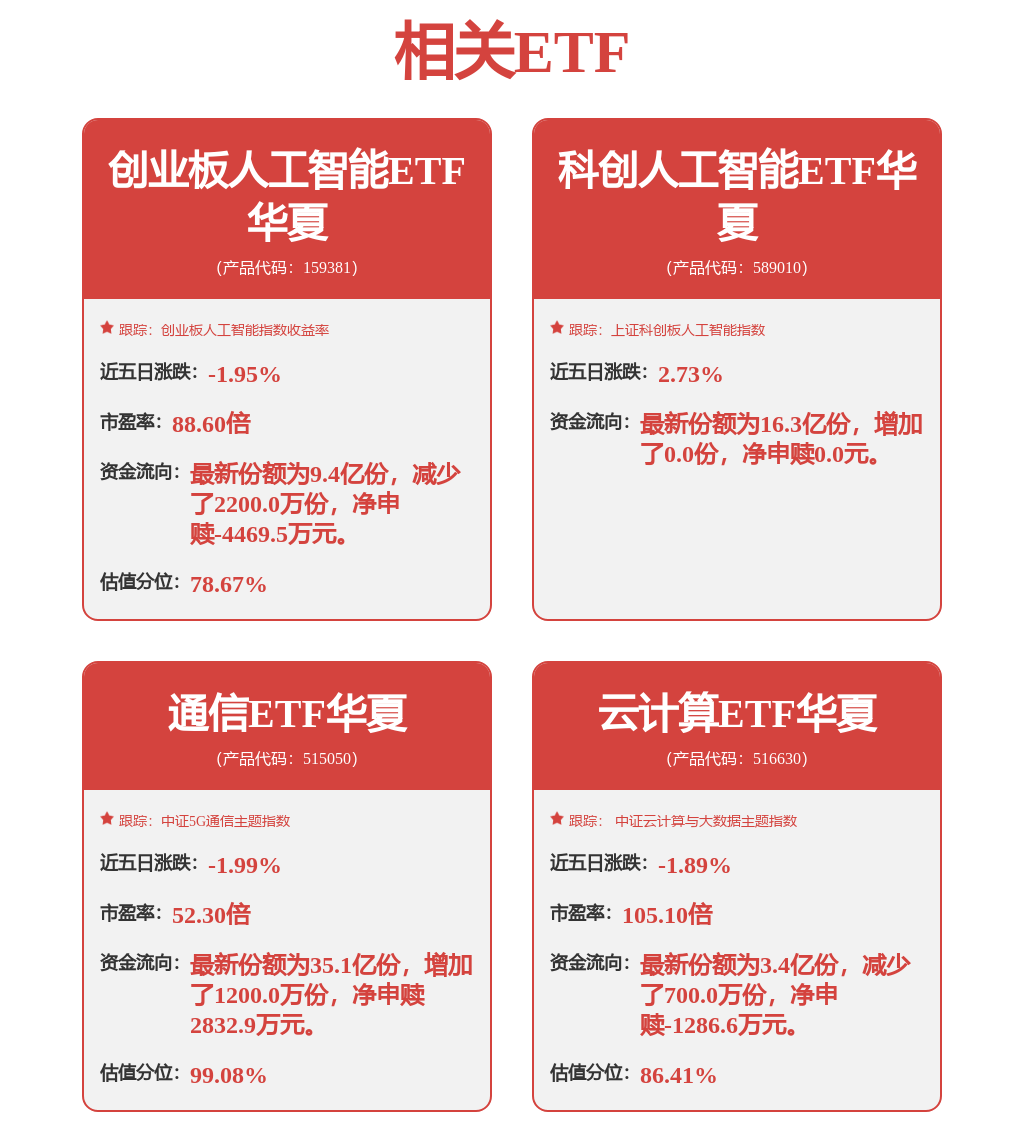
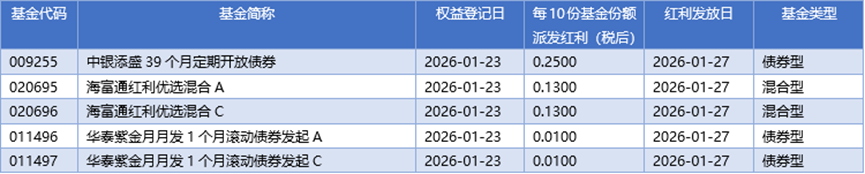
Group 1 - The core viewpoint of the articles highlights significant capital inflow into the non-ferrous metals sector, with related ETFs (excluding gold) seeing a net inflow exceeding 36 billion yuan this year, pushing the total scale beyond 100 billion yuan [1][2] - The demand-supply mismatch, coupled with the needs for new energy and grid upgrades, has led to notable price elasticity in copper, aluminum, and rare earths, prompting funds to quickly position through ETFs [1][2] - Multiple public funds are actively applying for new products, indicating a continuous increase in the toolization of investment strategies, which has become a key focus for institutions during the recovery phase of the year [1][2] Group 2 - As of January 23, 2026, there were no new fund launches, but five funds announced dividends, primarily bond funds, with the highest dividend being 0.25 yuan per 10 fund shares from the Bank of China’s 39-month regular open bond fund [2][4] - Data shows that seven private equity firms have either newly entered or returned to the 10 billion yuan tier this year, indicating a growing trend in the private equity sector, with stock long strategies being particularly popular [2] - Foreign investment firms, including BlackRock and Fidelity, reported that several of their products had net value increases exceeding 50%, with a strong focus on high-quality technology assets expected to lead value reassessment in the upcoming year [3]
川恒股份:受益于行业高景气的磷化工一体化企业-20260126
HTSC· 2026-01-26 00:45
Investment Rating - The report initiates coverage on Chuanheng Co., Ltd. with a "Buy" rating, assigning a target price of RMB 50.73 based on a 19x PE for 2026 [1][8][6]. Core Insights - Chuanheng Co., Ltd. is a leading player in the domestic phosphate chemical industry, possessing a nominal phosphate rock capacity of 3.3 million tons. The company's self-owned phosphate mines contribute to its high gross margin in the industry. The global phosphate supply-demand balance is expected to remain tight in the next 1-2 years, benefiting the company. Additionally, the anticipated growth in new energy demand is expected to enhance the company's business in iron phosphate, ammonium phosphate, and phosphoric acid [1][15][19]. - The company is projected to achieve a net profit of RMB 1.31 billion, RMB 1.62 billion, and RMB 1.8 billion for the years 2025-2027, representing year-on-year growth of 37%, 24%, and 11%, respectively [6][12]. Summary by Sections Phosphate Supply and Demand - The global expansion of phosphate rock production is slow due to limited new supply overseas and regulatory constraints in China. The demand for phosphate fertilizers is expected to grow by 3% annually starting in 2024, driven by the expansion of arable land and increasing new energy needs. The projected global phosphate rock supply-demand gap is estimated to reach 178,000 tons, 95,000 tons, and 121,000 tons from 2025 to 2027 [2][14]. New Energy Demand - The demand for phosphate chemical products has significantly increased due to the rise in lithium battery materials. Although there was a notable price drop in 2023-2024 due to concentrated production, the demand for energy storage and power batteries is expected to improve, leading to a recovery in the industry. The company's iron phosphate and industrial-grade ammonium phosphate are anticipated to benefit from this trend [3][16]. Profitability and Dividend Policy - The company has entered a growth realization phase, with a significant reduction in its debt ratio and an attractive dividend yield. The dividend payout ratio has increased to around 70%, with expected dividend yields of 3.7%, 4.5%, and 5.0% for 2025-2027 [17][33]. The company’s net profit for 2024 is projected to be RMB 956.48 million, reflecting a compound annual growth rate (CAGR) of approximately 37% since 2021 [17][12]. Market Perspective - The report contrasts with market concerns regarding the sustainability of tight phosphate supply. It argues that the demand for phosphate fertilizers remains robust, and the growth in iron phosphate production capacity will support continued tightness in supply. The company is expected to benefit from high phosphate prices and a favorable cost structure due to its significant export share [5][18]. Company Overview - Chuanheng Co., Ltd. is recognized as a leading integrated phosphate chemical enterprise in China, with a comprehensive production base from phosphate mining to fine phosphate chemicals. The company has a total phosphate rock capacity of 3.3 million tons and has been expanding its production capabilities [19][24].

券商晨会精华 | 景气为纲 坚守“科技+资源品”双主线
智通财经网· 2026-01-26 00:39
Market Overview - The market experienced a significant rally last Friday, with the Shenzhen Composite Index rebounding from a low point, and both the ChiNext and Shenzhen Composite indices rising over 0.5%. The North Star 50 Index surged over 3% [1] - The total trading volume in the Shanghai and Shenzhen markets reached 3.09 trillion yuan, an increase of 393.5 billion yuan compared to the previous trading day. Over 3,900 stocks rose, with 121 stocks hitting the daily limit [1] Sector Performance - The photovoltaic sector saw explosive growth, with over 30 stocks, including Longi Green Energy and Junda Co., hitting the daily limit [1] - The commercial aerospace sector remained active, with more than ten constituent stocks reaching the daily limit, including Goldwind Technology and Runbei Aerospace [1] - The AI application sector also showed strong performance, with Zhejiang Wenhuan achieving two consecutive limit-ups in four days [1] - Precious metals continued their strong trend, with silver and non-ferrous metals seeing four consecutive limit-ups, and stocks like China Gold and Yuguang Gold Lead hitting the daily limit [1] - The pharmaceutical retail sector was active, with Yifeng Pharmacy hitting the daily limit [1] - Conversely, the insurance and banking sectors experienced the largest declines [1] Investment Strategies - CITIC Securities emphasizes a focus on "technology + resource products" as the dual main lines for investment, highlighting AI semiconductors and new energy as current core areas of prosperity [2] - Dongfang Caifu suggests that the spring market is progressing, driven by commercial aerospace and AI applications, alongside a price increase chain that reflects significant profit elasticity [3] - Huatai Securities notes that the recent surge in gold and silver prices indicates a need to adjust the pricing system for scarce physical assets and core equity assets due to changes in supply-demand balance [4]
乐观预期与市场情绪共振 锡价维持强势
Qi Huo Ri Bao· 2026-01-26 00:32
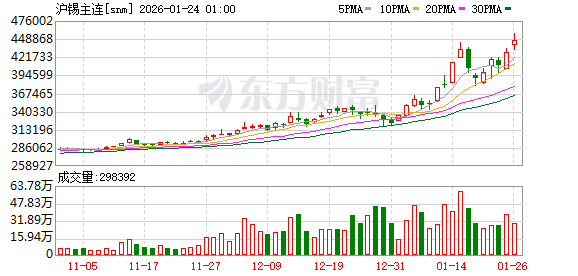
Core Viewpoint - The recent rise in tin prices is primarily driven by improved macroeconomic sentiment and geopolitical policy disturbances, with the main support coming from a stable inflation environment in the U.S. and pressure on the Federal Reserve to lower interest rates, creating a weak dollar scenario [2] Group 1: Price Movements and Influencing Factors - As of last Friday, the main contract price for tin on the Shanghai Futures Exchange closed above 447,140 yuan per ton, marking a 6.56% increase [2] - The significant price increase on Friday was closely linked to allegations of monopolistic practices in port logistics by Indonesia's Qingshan Industrial Park, despite limited actual export impact [2] - The approval delay for mining explosives in Myanmar has resulted in the resumption level of the Manxiang tin mine being only 40%-50% of pre-ban levels [2] Group 2: Market Dynamics and Sentiment - The exuberance in the funding environment has amplified the rise in tin prices, with a surge in precious metals like silver boosting market risk appetite and leading to increased capital inflow into the non-ferrous metals sector [3] - There is a divergence between market expectations and actual demand, with current consumption being notably weak due to the seasonal slowdown and high prices, leading to widespread production cuts among downstream processing enterprises [3] Group 3: Supply and Demand Outlook - Global tin visible inventory has significantly increased to approximately 16,000 tons, with domestic social inventory rising from below 8,000 tons to around 10,000 tons, and LME inventory climbing from 3,000 tons to over 7,000 tons [3] - The core operational logic for tin prices in the medium to long term revolves around resource scarcity and emerging demand growth, with potential supply disruptions and depletion risks due to fragile overseas mining operations and resource protection policies [4] Group 4: Future Projections - Even if Myanmar's supply returns to normal levels, a supply gap for tin is still expected in 2026, with limited elasticity on the supply side and optimistic demand projections from sectors like renewable energy and AI [5] - The overall short-term volatility in tin prices may arise from a retreat in market sentiment and inventory pressures, but the medium to long-term supply-demand balance remains tight, suggesting that the price center is likely to stay elevated [5]
乐观预期与市场情绪共振,锡价维持强势
Qi Huo Ri Bao· 2026-01-26 00:17
Group 1 - The core viewpoint of the article highlights that the recent rise in tin prices is driven by improved macroeconomic sentiment and geopolitical policy disturbances [3] - As of last Friday, the main contract price of tin on the Shanghai Futures Exchange closed above 447,140 yuan per ton, marking a 6.56% increase [2] - The supply of tin is facing significant uncertainties due to geopolitical and policy disturbances in Myanmar, Congo (DRC), and Indonesia, which are major tin-producing regions [3] Group 2 - The market is currently experiencing a divergence between expectations and reality, leading to uncertainty in tin price trends ahead of the Spring Festival [4] - Global visible tin inventories have significantly increased to approximately 16,000 tons, with domestic social inventory rising from below 8,000 tons to around 10,000 tons [4] - Short-term tin price movements are expected to largely depend on market sentiment, with potential for prices to reach new highs if sentiment remains strong [4] Group 3 - From a medium to long-term perspective, the core logic of tin price movements revolves around resource scarcity and emerging demand growth [5] - Despite potential weak loosening in static supply-demand projections for 2026 due to the resumption of production at certain mines, risks of supply interruptions and depletion remain [5] - Overall, while short-term fluctuations may occur due to sentiment and inventory pressures, the medium to long-term supply-demand balance is expected to remain tight, supporting high tin price levels [5]

十大券商一周策略:慢牛未改!科技 + 资源品成共识配置,警惕赚钱效应收敛
Jin Rong Jie· 2026-01-25 23:50
Core Viewpoint - The A-share market is characterized by "structural differentiation and simultaneous repair," with various institutions noting that despite ongoing redemption pressure on broad-based ETFs, sectors such as consumer chains, real estate chains, and resource products are entering a repair window [1][2]. Group 1: Market Trends - The broad-based ETF redemption pressure continues to grow, with significant differences in the承接力 (support capacity) among different industries and stocks [2]. - The consumer chain is expected to see an increase in allocation leading up to the Two Sessions, with the real estate chain also likely to experience noticeable recovery during this period [2]. - The spring market is supported by ample liquidity and policy backing, which may sustain the ongoing spring rally, although caution is advised regarding the marginal contraction of profit effects at high levels [1][3]. Group 2: Investment Focus - The consensus among institutions is to focus on technology (AI, semiconductors) and resource products (non-ferrous metals, chemicals) as key investment directions [1][7]. - There is growing attention on cyclical sectors showing signs of bottom reversal, such as power grid equipment and lithium batteries, as well as non-bank sectors [1][3]. - The current market environment is conducive to exploring basic combinations centered around chemicals, non-ferrous metals, new energy, and power equipment, while also considering low allocation in non-bank sectors like securities and insurance [2][4]. Group 3: Performance and Earnings - As the annual report forecast disclosure period peaks, the impact of earnings on market structure is expected to become more pronounced, with a focus on sectors with earnings highlights [4][11]. - The performance of sectors such as AI hardware, batteries, pharmaceuticals, steel, and non-bank financials is anticipated to improve, given their relatively low price increases [4][12]. - The market is likely to experience a rotation among sectors, with a focus on high-growth areas and those benefiting from price increases [12][14]. Group 4: Future Outlook - The market is expected to continue its slow bull trend, with the potential for a correction after reaching a phase high between 4200 and 4300 points [6][10]. - The spring market is seen as an extension of the structural bull market, with a likelihood of a consolidation phase following the current rally [3][5]. - The focus for 2026 includes a clearer dual mainline of asset allocation towards physical assets and Chinese assets, with thematic investments becoming essential [9][10].



