成本管控

Search documents
航发控制:加强采购协调、技术创新与成本管控,维护股东利益
Quan Jing Wang· 2025-11-04 08:16
Core Viewpoint - The event highlighted the importance of innovation and cost management in enhancing the company's core competitiveness and shareholder value [1] Group 1: Company Strategy - The company is focusing on high-quality, efficient, low-cost, and sustainable procurement models for weaponry [1] - There is an emphasis on strengthening price coordination with users to align with procurement requirements [1] Group 2: Technological Innovation - The company is advancing its existing products through "powering intelligence" to upgrade traditional offerings [1] - New product development is underway, focusing on multi-electric and fully electric control system configurations [1] Group 3: Cost Management - The company is deepening cost engineering efforts, including design source cost reduction, quality improvement cost reduction, and process optimization cost reduction [1] - Key measures include reducing costs for specific models and optimizing supplier management to enhance internal value creation [1]

南方航空(600029):Q3盈利同比增长,重视价格回升的盈利释放能力
Minsheng Securities· 2025-11-04 06:03
Investment Rating - The report maintains a "Recommended" rating for China Southern Airlines [6][8]. Core Views - The company's Q3 earnings showed a year-on-year growth, driven by improved cost management despite revenue pressures from declining prices [3][4]. - The overall capacity growth in Q3 partially offset the impact of price declines, with a 5.3% increase in available seat kilometers (ASK) [4]. - The unit fuel cost and financial expenses are on a downward trend, contributing to profit improvements [5]. - The report forecasts a rebound in ticket prices, which is expected to enhance profitability [6]. Summary by Sections Financial Performance - For the first three quarters of 2025, the company reported revenue of 137.7 billion yuan, a year-on-year increase of 2.2%, and a net profit attributable to shareholders of 2.31 billion yuan, up 17.4% [3]. - In Q3 alone, revenue reached 51.4 billion yuan, reflecting a 3.0% year-on-year growth, with a net profit of 3.84 billion yuan, up 20.3% [3]. Capacity and Revenue - The company's capacity growth slowed in Q3, with domestic ASK increasing by 4.5% and international ASK by 9.4% [4]. - The overall passenger revenue decreased by 3.6% year-on-year, indicating pricing pressures, although September saw a price increase of 1.0% [4]. Cost Management - The unit cost decreased by 3.5% year-on-year, with unit fuel costs at 0.14 yuan, down 7.3% [5]. - Financial expenses also decreased, with interest expenses down by approximately 300 million yuan year-on-year [5]. Profitability Outlook - The report projects net profits for 2025-2027 to be 1.84 billion, 4.24 billion, and 7.67 billion yuan respectively, with corresponding price-to-earnings ratios of 68, 30, and 16 [6][7].

侨源股份(301286)2025年三季报点评:25Q3归母净利润同比增长 产能建设稳步推进
Xin Lang Cai Jing· 2025-11-03 13:00
Core Insights - The company reported a revenue of 797 million yuan for the first three quarters of 2025, representing a year-on-year increase of 8.75%, and a net profit attributable to shareholders of 181 million yuan, up 40.54% year-on-year [1] - In Q3 2025, the company achieved a revenue of 267 million yuan, a year-on-year increase of 5.57% but a quarter-on-quarter decrease of 2.18%, with a net profit of 63 million yuan, reflecting a year-on-year increase of 16.88% and a quarter-on-quarter increase of 2.34% [1] - The company has strong cost control capabilities, optimizing product structure and expanding market presence while effectively managing costs [1] Financial Performance - The gross profit margin for the first three quarters of 2025 was 36.23%, an increase of 5.1 percentage points year-on-year [1] - The expense ratios for sales, management, R&D, and financial expenses were 2.9%, 4.9%, 0.02%, and 0.05% respectively, showing a year-on-year decrease of 0.03, 0.53, 0.04, and 0.15 percentage points [1] Market Expansion - The company is deepening its presence in the industrial gas market in the Southwest and Fujian regions, with steady progress in capacity construction [2] - It has the largest full liquid air separation gas production line in the Southwest region and is expanding production bases in Meishan, Jintang, and Deyang [2] - The company is focusing on high-purity electronic gases, medical gases, and rare gases to meet the growing demand in high-end markets such as semiconductors, biomedicine, and new materials [2] Client Base - The company's clients span traditional and emerging industries, creating a strong brand effect [3] - Key clients include listed companies and well-known domestic enterprises across various sectors, including metallurgy, chemicals, military, medical, food, machinery, photovoltaics, semiconductors, and new energy [3] - The company serves major military and medical institutions, enhancing its reputation and market reach [3] Profit Forecast and Valuation - The company is adjusting its profit forecasts for 2025-2026 and introducing a forecast for 2027, expecting net profits of 252 million (up 23.4%), 300 million (up 29.7%), and 374 million yuan respectively [3] - The ongoing capacity expansion in the Southwest and Fujian regions is expected to provide sufficient momentum for long-term growth, maintaining a "buy" rating for the company [3]
侨源股份(301286):25Q3归母净利润同比增长,产能建设稳步推进:——侨源股份(301286.SZ)2025年三季报点评
EBSCN· 2025-11-03 12:53
Investment Rating - The report maintains a "Buy" rating for the company, indicating a positive outlook for future performance [6]. Core Insights - The company reported a year-on-year increase in net profit attributable to shareholders of 40.54% for the first three quarters of 2025, reaching 1.81 billion yuan, with a revenue increase of 8.75% to 7.97 billion yuan [1]. - The company is actively expanding its production capacity in the southwestern and Fujian regions, focusing on high-end products to meet the growing demand in sectors such as semiconductors and biomedicine [2]. - The company has a diverse customer base across traditional and emerging industries, enhancing its brand effect and market presence [3]. - Profit forecasts for 2025-2027 have been adjusted upwards, with expected net profits of 2.52 billion yuan (up 23.4%), 3.00 billion yuan (up 29.7%), and 3.74 billion yuan respectively [3]. Financial Performance Summary - For Q3 2025, the company achieved a revenue of 2.67 billion yuan, a year-on-year increase of 5.57%, and a net profit of 0.63 billion yuan, reflecting a 16.88% increase year-on-year [1]. - The gross profit margin for the first three quarters of 2025 was reported at 36.23%, an increase of 5.1 percentage points year-on-year [1]. - The company has effectively controlled costs, with a decrease in various expense ratios compared to the previous year [1]. Capacity Expansion and Market Strategy - The company is enhancing its production capabilities with the largest liquid air separation gas production line in the southwestern region and is expanding its production bases in locations such as Meishan and Jintang [2]. - The focus on high-purity electronic gases, medical gases, and rare gases positions the company to cater to the increasing demands of high-end markets [2]. Customer Base and Industry Position - The company's clients span various sectors, including metallurgy, chemicals, military, healthcare, and emerging industries like photovoltaics and new materials, which strengthens its market position [3].
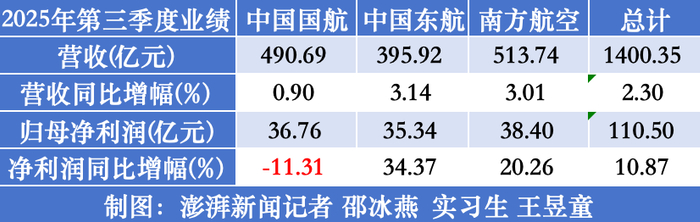
七家航司前三季集体盈利:海航最赚钱,多家单季净利下滑
Xin Lang Cai Jing· 2025-11-03 12:45
Core Insights - All seven listed airlines in China reported profits for the third quarter of 2025, with performance growth varying significantly among them [1][2] Group 1: Major Airlines Performance - The three major state-owned airlines (Air China, China Eastern Airlines, and China Southern Airlines) generated over 140 billion yuan in revenue for Q3, a year-on-year increase of over 2%, and net profits exceeding 11 billion yuan, up over 10% [1][3] - For the first three quarters, the three major airlines collectively reported revenues of approximately 373.9 billion yuan, a year-on-year increase of over 2%, and net profits exceeding 6.2 billion yuan, up over 90% [1][3] - China Eastern Airlines achieved a turnaround from losses to profits, while Air China and China Southern Airlines saw net profit increases of over 37% and 17%, respectively [2][4] Group 2: Private Airlines Performance - The four private airlines (Hainan Airlines, Spring Airlines, Juneyao Airlines, and Huaxia Airlines) reported combined revenues of over 35.3 billion yuan for Q3, with a year-on-year increase of over 2%, but net profits dropped by over 4% [1][5] - For the first three quarters, these private airlines generated revenues exceeding 93.4 billion yuan, a year-on-year increase of over 3%, and net profits nearing 6.9 billion yuan, an 8% increase [1][6] - Hainan Airlines reported a significant increase in net profit, while Spring Airlines and Juneyao Airlines experienced declines of over 10% in net profits [4][10] Group 3: Financial Metrics - In Q3, Air China reported revenues of 49.07 billion yuan, with a net profit of 3.68 billion yuan, reflecting a year-on-year decline of 11.31% in net profit [3] - China Eastern Airlines achieved revenues of 39.59 billion yuan and a net profit of 3.53 billion yuan, with a net profit increase of 34.37% [3] - China Southern Airlines reported revenues of 51.37 billion yuan and a net profit of 3.84 billion yuan, marking a 20.26% increase in net profit [3] Group 4: Market Trends and Future Outlook - The aviation market is expected to maintain growth momentum in Q4, driven by increased travel demand during the National Day and Mid-Autumn Festival holidays, with an anticipated 5% year-on-year growth in passenger volume [15] - Hainan Airlines is positioned to benefit from the upcoming full closure of the Hainan Free Trade Port, enhancing its market share in both passenger and cargo transport [10][11] - The competitive landscape remains challenging, with Air China highlighting the impact of non-operational factors such as reduced foreign exchange gains on its profitability [8][9]






潞安环能
2025-11-01 12:41
Summary of Lu'an Huanneng Q3 Earnings Call Company Overview - **Company**: Lu'an Huanneng - **Industry**: Coal Industry Key Points Q3 Performance Overview - **Raw Coal Production**: Remained consistent with previous forecasts and was stable compared to the same period last year [4][5] - **Commodity Coal Sales**: Decreased by approximately 500,000 tons in September compared to last year, primarily due to changes in product mix and increased production of certain types of coal [4][5] - **Average Selling Price**: Experienced a downward trend, with a decrease of over 140 RMB per ton compared to the previous year, leading to a revenue drop of around 6 billion RMB [4][5] - **Profit Decline**: Operating profit for January to September was approximately 1.5 billion RMB, down 44% from 2.8 billion RMB last year. Excluding non-operating expenses, the decline in operating profit exceeded 50% [5][6] Factors Affecting Production and Sales - **Weather Impact**: Increased rainfall during Q3 led to cautious production and more maintenance schedules [8][9] - **Regulatory Environment**: Ongoing strict safety regulations in Shanxi province affected production levels [8][9] - **Geological Conditions**: Some individual mines faced geological challenges, but overall resource availability was not a significant issue [10][11] Inventory and Sales Strategy - **Current Inventory**: Approximately 400,000 tons of coal in stock, considered a normal level [20][22] - **Sales Strategy**: Increased focus on producing and selling spray coal, which accounted for 44% of sales in Q3, up from around 40% previously [24][30] Pricing Trends - **Price Fluctuations**: The average selling price for spray coal increased by about 30-40 RMB per ton compared to Q2, with current market prices around 1,050 RMB per ton [32][41] - **Future Price Expectations**: Anticipation of further price increases as the market enters the winter storage phase [48][49] Cost Management - **Cost Increase**: Noted an increase in costs due to higher salary payments and operational expenses, although overall costs remained lower than last year [50][51] - **Cost Control Measures**: The company is actively managing costs but has not set specific reduction targets for the year [60][61] Taxation and Financial Outlook - **Tax Rate**: The company continues to apply a 15% tax rate for high-tech enterprises, with no expected changes in the near term [64][66] - **Profitability and Dividends**: Management believes that dividend levels can be maintained despite fluctuations in profit margins [99][100] Future Developments - **Resource Acquisition**: The company is actively seeking new resource opportunities and has plans to participate in upcoming auctions [92][93] - **Mining Rights Progress**: Anticipation of obtaining mining rights by the end of the year, which could accelerate project timelines [88][89] Conclusion - The company is facing challenges in production and profitability due to external factors such as weather and regulatory pressures. However, there are positive indicators for Q4, including potential price increases and a focus on maintaining a high proportion of spray coal in sales. The management remains optimistic about future resource acquisitions and overall market conditions.

【百威亚太(1876.HK)】整体销量承压,中国市场持续调整——2025年三季报点评(陈彦彤/汪航宇/聂博雅)
光大证券研究· 2025-11-01 00:05
Core Viewpoint - Budweiser APAC reported Q3 2025 revenue of $1.555 billion, with a year-on-year decline of 8.4% in organic terms, and normalized EBITDA of $438 million, down 6.9% year-on-year, while normalized net profit attributable to the parent was $204 million, a decrease of 9.3% year-on-year [3]. Group 1: Performance Analysis - In Q3 2025, the company achieved a sales volume of 2.2512 million kiloliters, reflecting an organic year-on-year decline of 8.6% [4]. - Revenue per hectoliter in Q3 2025 increased by 0.1% year-on-year, with a gross margin of 51.4%, showing a slight increase year-on-year [4]. - Normalized EBITDA margin improved to 28.2%, with an organic year-on-year increase of 0.46 percentage points, primarily benefiting from favorable commodity prices and cost management measures [4]. Group 2: Regional Performance - In the Western Asia-Pacific region, Q3 2025 revenue and normalized EBITDA saw organic year-on-year declines of 12.0% and 11.9%, respectively, with sales volume down 9.9% and revenue per hectoliter down 2.4% year-on-year. Notably, the Indian market showed strong performance with double-digit revenue growth [4]. - In the Eastern Asia-Pacific region, Q3 2025 revenue and normalized EBITDA experienced organic year-on-year growth of 3.9% and 8.7%, respectively, with sales volume down 0.6% and revenue per hectoliter up 4.5% year-on-year. South Korea's performance was stable, with significant growth in non-alcoholic beer and RTD categories [4]. Group 3: China Market Dynamics - In Q3 2025, revenue and normalized EBITDA in China saw organic year-on-year declines of 15.1% and 17.9%, respectively, with sales volume down 11.4%, primarily due to business layout, weak on-the-go channels, and inventory management impacts [5]. - Revenue per hectoliter in China decreased by 4.0% year-on-year, attributed to increased investments in innovative products and brand promotion, as well as adverse brand mix effects during inventory management [5]. - The company has been optimizing channel inventory, with significant reductions in inventory levels and turnover days, outperforming industry averages. Future strategies will focus on enhancing non-on-the-go channels and investing in premium brands like Budweiser and Corona [5].

中国海油(600938):业绩表现稳健,现金流环比显著提升
Shenwan Hongyuan Securities· 2025-10-31 12:15
Investment Rating - The investment rating for the company is "Buy" (maintained) [2] Core Views - The company has shown stable performance with a significant increase in cash flow quarter-on-quarter [1] - The report highlights a decrease in revenue and net profit for the first three quarters of 2025, with a year-on-year decline of 4.1% in revenue and 12.6% in net profit [6] - The company is expected to maintain a good dividend payout ratio due to stable cash flow and capital expenditure [6] Financial Data and Earnings Forecast - Total revenue for 2025 is estimated at 421.87 billion, with a year-on-year growth rate of 0.3% [5] - The net profit attributable to the parent company is projected to be 129.79 billion for 2025, reflecting a decline of 5.9% year-on-year [5] - Earnings per share (EPS) for 2025 is expected to be 2.73 yuan, with a projected return on equity (ROE) of 15.9% [5] - The company’s gross margin is forecasted to be 50.6% for 2025, down from 52.2% in 2024 [5] - The company’s operating cash flow for the first three quarters of 2025 was 141.7 billion, with a year-on-year decrease of 6% [6] Operational Performance - The company achieved a net oil and gas production of 578 million barrels of oil equivalent in the first three quarters of 2025, a year-on-year increase of 6.7% [6] - The average realized oil price in Q3 2025 was 66.62 USD per barrel, with a narrowing discount compared to Brent crude [6] - The company’s oil and gas production is expected to continue increasing, driven by new projects and improved operational efficiency [6]

中国海油(600938):业绩稳健,持续上产
Minsheng Securities· 2025-10-31 06:58
Investment Rating - The report maintains a "Recommended" rating for the company, with a target price of 27.01 CNY per share [7]. Core Insights - The company reported a steady performance with a focus on production growth, despite a decline in revenue and net profit year-on-year [1][5]. - Oil and gas production showed a year-on-year increase, with net production reaching 194 million barrels of oil equivalent, up 7.9% year-on-year [2]. - The Brent crude oil price showed a slight recovery, and the company has effectively managed its costs, with a major cost per barrel of 27.35 USD, down 2.8% year-on-year [3]. - The company has continued to invest in new projects, successfully evaluating 22 oil and gas structures and bringing 14 new projects into production [4]. Financial Performance Summary - For the first three quarters of 2025, the company achieved operating revenue of 312.5 billion CNY, a decrease of 4.1% year-on-year, and a net profit attributable to shareholders of 101.97 billion CNY, down 12.6% year-on-year [1]. - In Q3 2025, the company reported operating revenue of 104.9 billion CNY, an increase of 5.7% year-on-year, but a net profit decline of 12.2% year-on-year [1]. - The company’s net profit forecasts for 2025 to 2027 are 123.72 billion CNY, 127.54 billion CNY, and 131.39 billion CNY, respectively, with corresponding EPS of 2.60 CNY, 2.68 CNY, and 2.76 CNY [5][6].
崇达技术(002815) - 2025年10月31日投资者关系活动记录表
2025-10-31 05:30
Financial Performance - In the first three quarters of 2025, the company achieved revenue of CNY 5.593 billion, a year-on-year increase of 20.27% [2] - The net profit attributable to shareholders reached CNY 314 million, up 19.58% year-on-year [2] - In Q3 2025, the net profit attributable to shareholders was CNY 92 million, showing a significant year-on-year growth of 252.87% [3] Profitability Improvement Measures - The company is focusing on high-value customers and orders, optimizing the sales structure by eliminating loss-making orders and reducing low-margin orders [4] - Strengthening the sales team by expanding the overseas sales force and implementing a performance evaluation system that includes high-value customer development [5] - Enhancing cost management through standardized cost management practices to lower unit product costs [5] - Improving order delivery and customer service levels by optimizing internal communication and production scheduling [5] - Innovating product offerings to meet high-value customer demands, particularly in high-frequency and high-reliability PCB products [5] - Accelerating capacity expansion to meet future market demands, including upgrades at existing plants and new factory constructions [5] Raw Material Cost Management - The company is facing rising raw material costs, particularly for copper and other key materials, which are closely linked to commodity prices [6][7] - Measures to mitigate cost pressures include dynamic monitoring of costs, improving material utilization, and implementing price adjustments based on market conditions [7] Capacity Utilization and Expansion - The current overall capacity utilization rate is approximately 85% [8] - The company is actively optimizing and expanding its capacity, particularly in its Zhuhai plants and new facilities in Thailand [8] Subsidiary Performance - The subsidiary, San De Guan, has turned profitable in Q3 2025, despite ongoing challenges in the flexible printed circuit board (FPC) sector [9][10] - The FPC industry is expected to see a moderate growth of 3.6% in 2025, driven by improving market demand [9] Future Growth Drivers - The company anticipates growth in 2026 driven by increased demand in mobile, server, and communication sectors, with a focus on high-layer PCBs and IC substrates [10] - Plans to enhance product quality, cost control, and pricing strategies while developing new key customers in high-value sectors [10]