积极的财政政策

Search documents
一季度地方债券计划发行规模超2万亿元
Zheng Quan Ri Bao· 2026-01-08 17:20
Core Viewpoint - The issuance of local government bonds in China is set to exceed 20 trillion yuan in the first quarter of 2023, reflecting a more proactive fiscal policy aimed at supporting economic stability and infrastructure investment [1][2]. Group 1: Bond Issuance Overview - On January 8, Ningbo issued a batch of local bonds, including 1 billion yuan in general bonds and 24.372 billion yuan in special bonds [1]. - As of January 8, the total planned issuance of local bonds across various regions for the first quarter is approximately 20,862 billion yuan, surpassing the 20 trillion yuan mark [1]. - Seven regions, including Sichuan, Shandong, Yunnan, and Hunan, plan to issue over 100 billion yuan each, with Sichuan leading at 188.7 billion yuan, followed by Shandong at 172.481 billion yuan and Yunnan at 145.136 billion yuan [1]. Group 2: Types of Bonds and Their Implications - In the first quarter, approximately 8,173 billion yuan of new bonds are planned for issuance, with 6,514 billion yuan designated as new special bonds and 12,689 billion yuan for refinancing bonds [2]. - Special bonds, which account for over 30% of the new bonds, are expected to directly supplement infrastructure investment funds [2]. - The issuance of special bonds is anticipated to have several highlights, including an accelerated issuance pace, optimized fund allocation towards urban village renovations and public infrastructure, and stricter project management and performance requirements to enhance the efficiency of investment [2].
中信证券首席经济学家明明:2026年长债收益率或“先下后上”
2 1 Shi Ji Jing Ji Bao Dao· 2026-01-07 07:38
Group 1 - In 2025, the domestic capital market demonstrated strong resilience and vitality, with major equity indices surpassing 4000 points, particularly in technology and banking sectors [1] - The central economic work conference has laid out plans for 2026, indicating that growth-stabilizing policies are expected to continue, which may further enhance market confidence [1] - Consumption is projected to continue its moderate recovery, becoming the main driver of economic growth, while investment is expected to stabilize amid structural improvements [4][3] Group 2 - The fiscal policy is anticipated to maintain a moderate expansion, with new special bond quotas expected to reach 5 trillion yuan, and the scale of ultra-long-term special government bonds likely to remain at 1.3 trillion yuan [6][5] - The consumer price index (CPI) is expected to rise moderately, with an annual average around 0.5%, while the producer price index (PPI) is projected to turn positive year-on-year by the third quarter [4] - The monetary policy is expected to have room for further easing, with potential for both reserve requirement ratio cuts and interest rate reductions, particularly focusing on supporting technology, green initiatives, and consumption [5][6] Group 3 - The bond market is expected to experience a "down then up" trend in long-term bond yields, influenced by economic recovery, fiscal expansion, and improved policy expectations [7] - The RMB is projected to maintain a stable appreciation trend, supported by a weaker dollar, a stabilizing domestic economy, and ongoing foreign exchange demand [8] - Key sectors such as artificial intelligence and high-end manufacturing are anticipated to emerge as new highlights in the industry landscape, driven by supportive technology policies [12][10]

2026年财政政策如何更加积极?
2 1 Shi Ji Jing Ji Bao Dao· 2026-01-06 05:25
Core Viewpoint - The 2025 Central Economic Work Conference decided to continue implementing a more proactive fiscal and monetary policy in 2026, emphasizing the need for policy optimization, enhanced fiscal management, and reform advancement [1] Group 1: Fiscal Policy Optimization - The scale of fiscal expenditure is increasing, with general public budget expenditure expected to exceed 30 trillion yuan in 2026, but its proportion relative to total social financing remains small [2] - By the end of November 2025, the social financing scale reached 440.07 trillion yuan, and the broad money (M2) balance was 336.99 trillion yuan [2] - The fiscal deficit rate for 2025 is around 4%, indicating that fiscal revenue and expenditure should focus more on policy effectiveness in 2026 [2] Group 2: Debt Financing - Debt financing is crucial for supporting a more proactive fiscal policy, necessitating a scientific assessment and optimization of the government bond portfolio [3] - In 2025, local special bonds issued amounted to 4.4 trillion yuan, with total local debt issuance exceeding 10 trillion yuan and net financing over 7.2 trillion yuan [3] - The issuance of long-term special government bonds in 2025 reached 1.3 trillion yuan, aimed at supporting specific projects and policies [3] Group 3: Local Fiscal Autonomy - Enhancing local fiscal autonomy is essential for fiscal sustainability, as local finances are directly responsible for basic public services and social security [4] - From 2023 to 2025, central government transfers to local governments are expected to exceed 10 trillion yuan annually, highlighting the central government's commitment [4] - The structure of transfer payments needs optimization, reducing the proportion of special transfers and increasing general transfers to enhance local fiscal capacity [4] Group 4: Fiscal Management - Scientific fiscal management is increasingly important as fiscal revenues and expenditures grow, requiring a focus on optimizing expenditure structures [6] - The zero-based budgeting reform is being deepened across various regions, shifting budget preparation from historical baselines to current needs [7] - Establishing a sound expenditure standard system is crucial for controlling spending and ensuring that actual needs are met [7] Group 5: Economic Stability and Reform - A more proactive fiscal policy is necessary to promote stable economic development, requiring a combination of effective markets and proactive government roles [9] - Domestic demand has significant potential for growth, and boosting consumption is essential for economic recovery [10] - The unification of the domestic market is hindered by fragmented policies, necessitating reforms to standardize tax incentives and subsidies [10] Group 6: Supply-Side Improvements - Domestic supply has room for improvement, needing to align with the upgrading demands of consumer preferences [11] - Innovation in supply is critical, as it can create new demand and enhance economic growth [11] - Increased investment in basic research is essential for fostering technological innovation, with a focus on effective investment to maximize fiscal policy impacts [12]
着眼于2026年经济“开门红”,哪些政策可能靠前发力?
Xin Lang Cai Jing· 2026-01-06 02:07
Core Viewpoint - The Chinese government is set to implement a more proactive fiscal policy and moderately loose monetary policy in 2026, with a focus on early fiscal actions compared to a cautious approach to further monetary easing [1][7]. Fiscal Policy - The National Fiscal Work Conference outlined five key areas for a more proactive fiscal policy, including expanding fiscal expenditure, optimizing government bond tools, improving transfer payment efficiency, continuously optimizing expenditure structure, and enhancing fiscal-financial collaboration [1][7]. - The Ministry of Finance announced a new policy regarding the value-added tax on personal housing sales, which stipulates a 3% tax for properties sold within two years and exemption for those sold after two years [1][7]. Monetary Policy - The People's Bank of China (PBOC) held a meeting indicating a continuation of the central economic work meeting's stance on monetary policy, without explicitly mentioning flexible use of reserve requirement ratio (RRR) cuts or interest rate reductions [1][7]. - Analysts suggest that the PBOC will rely more on structural tools, with a possibility of RRR cuts and interest rate reductions in the first quarter of 2026 [2][9]. Equipment Update and Consumption Policies - The State Development and Reform Commission and the Ministry of Finance announced a large-scale equipment update and consumption "trade-in" policy for 2026, optimizing the previous year's policies [2][9]. - The subsidy for household appliances has been narrowed from 12 categories to 6, focusing on energy-efficient products, while the automotive subsidies will shift from fixed amounts to a percentage of the vehicle price [3][10]. Special Bonds and Investment - The issuance of special bonds is expected to be expedited, with applications for 2026 being submitted two months earlier than in 2025, aiming for early effectiveness in infrastructure investment [4][10]. - Analysts noted that approximately 1.4 trillion yuan of bond funds issued in the first 11 months of 2025 had not yet resulted in actual expenditures, indicating ample fiscal resources for the upcoming year [4][10]. Economic Outlook - The proactive fiscal measures are expected to support economic growth, with early issuance of special bonds likely to create a peak in funding in the first quarter of 2026 [4][10]. - The PBOC is anticipated to adopt a cautious approach to traditional monetary easing, focusing instead on flexible liquidity management tools to maintain financial stability while supporting growth [5][11].
财政赤字率4%够吗?|请回答,2026
经济观察报· 2026-01-05 09:36
Core Viewpoint - The article emphasizes the necessity of a more proactive fiscal policy in 2026, particularly in the context of insufficient domestic demand and the need for economic growth support as the "14th Five-Year Plan" begins [1][6]. Fiscal Policy Overview - The fiscal deficit rate for 2026 is expected to be no lower than 4%, with some scholars suggesting it could rise to between 4.5% and 5% [2][5]. - The central economic work conference highlighted the need for a more active fiscal policy, maintaining necessary levels of fiscal deficit, total debt, and expenditure [2][6]. - The fiscal deficit for 2025 is set at approximately 56,600 billion yuan, with expectations that the 2026 deficit will exceed this amount due to GDP growth [3][4]. Government Debt and Expenditure - The broad central fiscal expenditure for 2025 includes an additional local government special bond limit of 44,000 billion yuan and a special long-term national bond issuance of 13,000 billion yuan [3][4]. - For 2026, the government is expected to continue issuing special bonds and increase the scale of new government debt to between 15.5 trillion and 16.3 trillion yuan, which will support economic stability and domestic demand [5][6]. Economic Challenges and Responses - The article notes ongoing economic challenges, including weak domestic demand and employment issues, which necessitate a robust fiscal response [6][7]. - The central government aims to address these challenges through increased fiscal spending, particularly in major projects and public services, to stimulate economic growth [6][7]. Monetary Policy Direction - The monetary policy for 2026 will remain moderately loose, with potential interest rate cuts of up to 0.3 percentage points to lower financing costs and stimulate investment and consumption [7][8]. - Structural monetary policies will focus on directing financial resources towards innovation, manufacturing upgrades, and small enterprises, enhancing support for key economic sectors [8].

早知道:科创板第五套上市标准扩围落地;巴菲特正式退休
Sou Hu Cai Jing· 2026-01-04 23:32
Group 1 - The State Council will no longer approve the construction of ore dressing projects without self-built mines and supporting tailings utilization and disposal facilities [1] - The Ministry of Finance emphasizes the implementation of an active fiscal policy to continuously enhance the effectiveness and precision of macroeconomic regulation [1] - The scale of "West-to-East Power Transmission" is expected to exceed 420 million kilowatts by 2030 [1] Group 2 - The fifth set of listing standards for the Sci-Tech Innovation Board has been expanded, with Blue Arrow Aerospace's IPO application accepted [1] - Shanghai aims for the core industry scale of the low-altitude economy to reach approximately 80 billion yuan by 2028 [1] - During the New Year holiday, Chinese assets performed strongly [1] Group 3 - Warren Buffett has officially retired, stepping down as CEO of Berkshire Hathaway [1]
【财金视野】把“国补”资金用在刀刃上
Sou Hu Cai Jing· 2026-01-04 23:09
落实好一系列优化政策,需要强化统筹安排、协调推进。 一方面,做好资金保障,均衡有序使用资金。国家层面,合理把握节奏,按季度分批次向地方下达"国 补"资金;各地方要分领域合理制定资金均衡使用计划,平稳有序实施消费品以旧换新政策。近期,中 央已向地方提前下达2026年第一批625亿元超长期特别国债支持消费品以旧换新资金计划,满足元旦、 春节等旺季消费需求。只有做好资金的安排、使用,才能更好地稳定市场预期,激发消费热情。 另一方面,打好提振消费的政策"组合拳",特别是加强财政金融协同,放大政策效能。中央经济工作会 议提出,实施更加积极有为的宏观政策,增强政策前瞻性针对性协同性。在支持扩大内需中,财政、货 币、金融政策的协同配合发挥了重要作用。去年9月份以来,我国实施个人消费贷款和服务业经营主体 贷款贴息政策,分别从消费的需求端和供给端发力,通过降低信贷成本、提高政策覆盖面等措施加力提 振消费。财政与金融政策的协同配合还有很多"文章"可做,特别是引导金融机构用好用足再贷款和贴息 政策、加大服务消费领域信贷投放力度,优化消费金融产品和服务,力争产生"1+1>2"的政策效果。 实施更加积极有为的宏观政策,充分发挥财政政策 ...

【金融发展】2025年国债市场年鉴:筹资精准服务国家战略 收益率于预期交织中锚定“新平衡”
Xin Lang Cai Jing· 2026-01-04 11:30
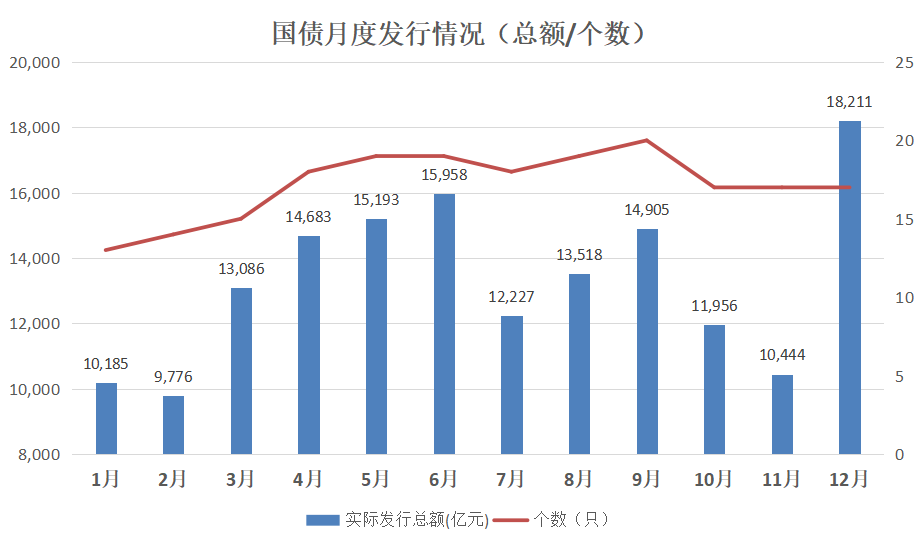
Core Viewpoint - The 2025 Chinese government bond market has undergone deep calibration amid frequent macro narratives and intense long-short logic battles, characterized by record supply and a proactive issuance pace in the primary market, effectively supporting active fiscal policies while the secondary market experienced a narrow range of fluctuations in the 10-year bond yield, which gradually shifted downward throughout the year [1][13]. Group 1: Primary Market Dynamics - In 2025, the primary market for government bonds achieved a historic leap under the theme of "active fiscal policy moderately strengthened, quality improved," with notable features including increased supply scale, scientifically advanced issuance pace, and continuous optimization of maturity structure [2][15]. - The total issuance of government bonds reached a historic high of 16,014.02 billion yuan, a significant increase of 28.37% compared to 12,474.83 billion yuan in 2024, with 206 bonds issued throughout the year [2][15]. - The issuance of special bonds focused on long-term funding for national strategic security areas and key projects, with the issuance of ultra-long special bonds reaching 1.3 trillion yuan, expected to significantly boost annual GDP growth [5][19]. Group 2: Interest Rate Trends - The overall issuance interest rates of government bonds declined, effectively guiding the financing costs across society. The short-term interest rates (1-3 years) ranged from 1.16% to 1.79%, while the 10-year bond issuance rate stabilized around 1.78% [6][19]. - The systematic decline in issuance costs of government bonds, as a risk-free rate anchor, directly contributed to the reduction of comprehensive financing costs in the bond market and the real economy, achieving efficient unity between fiscal sustainability and financial benefits to the real sector [6][19]. Group 3: Secondary Market Developments - The secondary market for government bonds in 2025 was characterized by complex dynamics, with the 10-year bond yield fluctuating between approximately 1.6% and 1.9%, undergoing a "four-round game" of expectations that ultimately established a new oscillating equilibrium [7][21]. - The first round saw a rapid correction of overly optimistic expectations regarding monetary easing, with yields rebounding nearly 40 basis points by mid-March [9][21]. - The fourth round featured a key institutional benefit with the central bank's announcement to restart government bond trading operations, which was interpreted as a significant step in enhancing liquidity management tools and stabilizing long-term expectations [10][22]. Group 4: Strategic Role of Government Bonds - The evolution of the government bond market in 2025 transcended mere financing and trading, extending its functions to monetary policy operations, financial openness, and the construction of the national credit system [11][23]. - The "stabilizer" and "attractiveness" roles of RMB assets have strengthened, with foreign investors steadily increasing their holdings, leading to broader inclusion of government bonds in major global bond indices [11][23]. - The modernization of government bond management, including the incorporation of bond trading into the central bank's regular monetary policy toolbox, marks a significant milestone in establishing a modern central banking system [11][23]. Group 5: Future Outlook - The government bond market is expected to continue evolving under the overarching theme of "high-quality development," balancing necessary government financing, reducing debt costs, and maintaining financial system stability [12][24]. - As market depth, product innovation, and institutional openness progress, the yield curve of government bonds will increasingly serve as a benchmark for asset pricing across society [12][24]. - Market participants will need to shift from merely chasing interest rate trends to developing a deeper understanding of macro logic, seizing structural opportunities, and effectively managing interest rate risks to succeed in the new balanced market [12][24].
财政赤字率4%打的住吗?
Sou Hu Cai Jing· 2026-01-04 09:21
Group 1 - The core viewpoint of the article emphasizes the necessity of maintaining a fiscal deficit rate of no less than 4% for 2026, as proposed in the Central Economic Work Conference [2][7] - The Central Economic Work Conference and the National Financial Work Conference both advocate for a more proactive fiscal policy, which includes maintaining necessary fiscal deficits, total debt scale, and expenditure volume [2][3] - The fiscal deficit for 2025 is set at approximately 4%, amounting to 56,600 billion yuan, with a projected increase for 2026 [3][4] Group 2 - Scholars suggest that the fiscal deficit rate for 2026 could rise to between 4.5% and 5%, leading to a broad deficit scale exceeding 16 trillion yuan [5] - The narrow deficit rate, if reaching 4.5% to 5%, would correspond to a deficit scale of approximately 6.6 trillion to 7.4 trillion yuan [5] - The fiscal expenditure is expected to play a crucial role in addressing economic challenges, particularly in enhancing domestic demand and employment [6] Group 3 - The article highlights that the 2026 fiscal policy will need to be more aggressive to support the economic growth targets, especially in light of the ongoing challenges in domestic demand and local government finances [6][7] - The monetary policy for 2026 is expected to remain moderately loose, with anticipated interest rate cuts to stimulate economic growth and stabilize prices [8] - Structural monetary policies will focus on directing financial resources towards key sectors such as technology innovation, manufacturing upgrades, and small enterprises [8]

财政部:2026年财政工作抓好六项重点工作,扩大财政支出盘子|前瞻2026
清华金融评论· 2026-01-01 10:18
Core Viewpoint - The article emphasizes the implementation of a more proactive fiscal policy in 2026, focusing on maintaining necessary fiscal deficits, total debt scale, and overall expenditure while enhancing the effectiveness of fund utilization [2][22]. Group 1: Fiscal Policy Implementation - The national fiscal work meeting highlighted six key areas for a more proactive fiscal policy in 2026, ensuring necessary expenditure intensity and optimizing the government bond tool combination [2][12]. - The meeting underscored the importance of maintaining a strong fiscal stance to support economic growth and social stability, particularly in the context of the "14th Five-Year Plan" [10][22]. Group 2: Key Tasks for 2026 - The meeting outlined several priority tasks for 2026, including: - Focusing on domestic demand to support a robust domestic market and boost consumption through targeted actions [13]. - Supporting technological and industrial innovation by increasing fiscal investment in technology and enhancing the management of technology funding [6][18]. - Promoting urban-rural integration and regional coordination to expand development space [14]. - Strengthening basic social security and improving public services to enhance the welfare of residents [7][19]. - Advancing green transformation in economic and social development to build a beautiful China [14][19]. - Enhancing international financial cooperation and supporting high-level opening-up [14][19]. Group 3: Fiscal Management and Risk Prevention - The meeting emphasized the need for comprehensive fiscal management, including the implementation of zero-based budgeting reforms and enhancing the efficiency of fiscal governance [15][20]. - It highlighted the importance of preventing and mitigating local government debt risks, ensuring that no new hidden debts are created, and establishing a long-term regulatory framework for local government debt management [20][22]. Group 4: Enhancing Fiscal Effectiveness - The article stresses the need to improve the effectiveness of fiscal spending by optimizing expenditure structures and enhancing the efficiency of transfer payments to local governments [12][22]. - It calls for a focus on timely fiscal resource allocation to maximize the impact of fiscal policies on economic growth and social welfare [23].