
去美元化

Search documents
不敢信!黄金站上5000美元,白银突破100美元,原因竟是AI和电动汽车跟光伏企业抢白银,库存都快见底了
Sou Hu Cai Jing· 2026-01-25 16:28
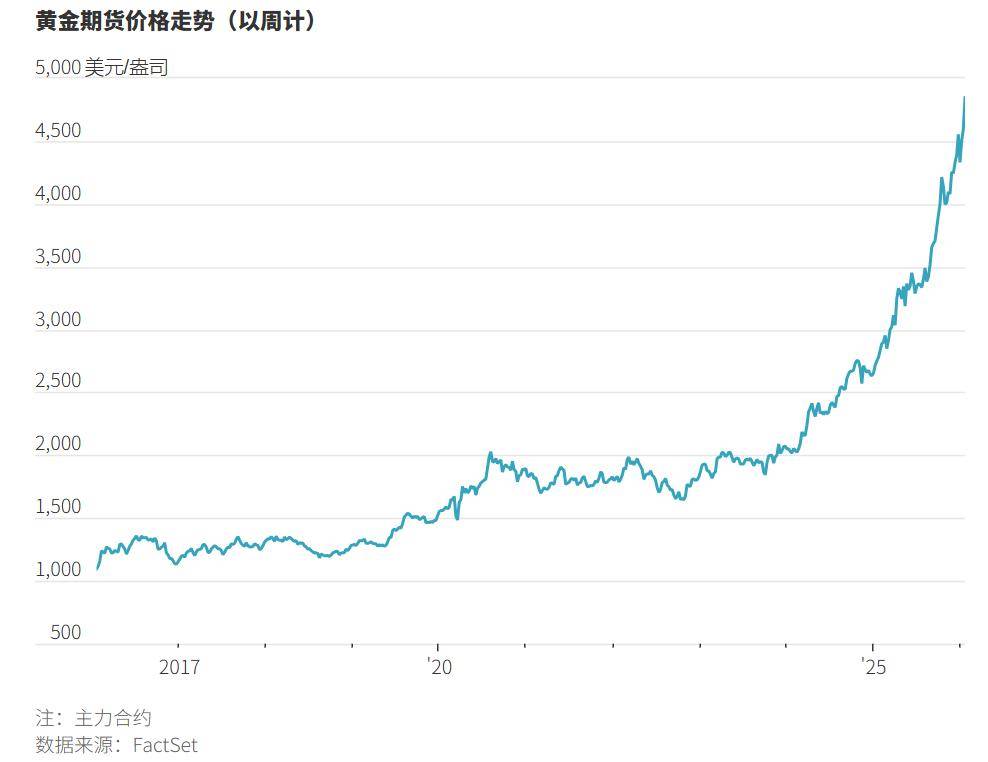
Group 1: Market Overview - Gold prices have surpassed $5000 per ounce, with silver reaching over $100 per ounce, marking a significant shift in the precious metals market [1][3] - Silver prices have more than doubled since the second half of 2025, with a 44% increase in January 2026 alone [1][3] Group 2: Driving Forces - A structural force known as "de-dollarization" is driving the precious metals market, as trust in the US dollar declines [3] - European institutions and sovereign funds are beginning to sell US Treasury bonds, indicating a shift in asset allocation [3] Group 3: Central Bank Actions - Central banks globally have aggressively increased gold purchases, with a net acquisition of 634 tons in the first three quarters of 2025 [3] - Poland's central bank plans to buy an additional 150 tons of gold, aiming to enhance its financial security [3] Group 4: Geopolitical Influences - Geopolitical tensions, such as the Greenland dispute and trade wars, have heightened market anxiety, driving investors towards gold [4] - The Federal Reserve's credibility is under scrutiny, contributing to rising long-term inflation expectations and a reevaluation of the dollar's value [4] Group 5: Silver Market Dynamics - The global silver market has faced a supply-demand imbalance for five consecutive years, with a projected shortfall of 3600 tons in 2025 [5] - Silver inventories at the London Metal Exchange have reached a ten-year low, indicating a tight market that could lead to price spikes [5] Group 6: Industrial Demand for Silver - Industrial demand for silver has surged, now accounting for 60% of total demand, driven by its use in high-tech applications [5][6] - The rising cost of silver is impacting industries like solar energy, where silver is a key material for solar panels [6] Group 7: Market Reactions and Future Predictions - Companies in the solar sector are exploring alternatives to silver to mitigate rising costs, indicating a shift in production strategies [6] - Major financial institutions have raised their gold price forecasts, with UBS predicting a target of $5000 per ounce by Q3 2026 [7] - There is a divergence in outlook for silver, with some institutions optimistic about its short-term prospects while others caution about potential volatility [7]

银河基金权益投资团队详解五大产业发展
Shang Hai Zheng Quan Bao· 2026-01-25 14:24
Group 1: Medical Industry - The brain-computer interface (BCI) has emerged as a significant theme in 2026, with potential for growth in the medical device sector [2] - The domestic payment system for non-invasive and invasive BCI technologies is becoming clearer, with quantifiable prices and quantities [2] - The valuation of innovative drugs has seen some recovery, and there is anticipation for other pharmaceutical sub-sectors to gradually increase in valuation due to predictable catalytic events [2] Group 2: Cyclical Industry - The precious and non-ferrous metals market remains strong, supported by three main factors: global de-dollarization, de-globalization, and AI industry trends [3] - The core logic behind the current gold market is the continuous purchasing of gold by multiple central banks, indicating that bullish sentiment may persist despite high prices [3] - The chemical sector is currently at historical low price indices, and any confirmation of an upward trend in chemical prices could attract market attention [3] Group 3: Energy Sector - The energy sector is a focal point for capital markets, with space-based solar power identified as a potential breakthrough in the renewable energy sector [4] - The lithium battery and energy storage industry is at a turning point, primarily driven by increased storage demand [4] Group 4: Media Industry - The application of AI is expected to see significant advancements this year, driven by improvements in large model capabilities and the commercial pressures faced by major internet companies [5] - The market is focusing on the commercialization of AI applications, particularly in advertising and content generation, such as short dramas and realistic dramas [5] Group 5: AI Industry - The robotics sector is experiencing growth, with a major electric vehicle and energy company planning to deploy thousands of robots this year [6] - The AI industry is viewed as a long-term growth direction, with expectations for rapid monetization from hardware to software, although there may be interim waiting periods for breakthroughs [6] - The application and robotics sectors are anticipated to present broader development opportunities as the market seeks tangible returns from AI investments [6]
国泰海通|宏观:美元资产的“双击时刻”
国泰海通证券研究· 2026-01-25 14:03
Core Viewpoint - The article discusses the "double whammy" moment for dollar assets, triggered by Trump's comments on Greenland and tariff threats, alongside the early dissolution of the Japanese House of Representatives leading to a sell-off in Japanese bonds, resulting in credit breakdown and liquidity withdrawal for dollar assets [2][8]. Group 1: Dollar Assets and Market Reactions - Trump's remarks on Greenland elevated the issue to a matter of "national security and sovereignty," coupled with tariff threats against European allies, causing a significant market reaction where U.S. stocks, bonds, and currencies faced a triple hit, leading to a "death cross" between the dollar and U.S. Treasuries [2][8]. - The sell-off in Japanese bonds, particularly the long-term bonds, was described as a "High City Moment," with the 30-year bond yield rising by 26 basis points to 3.875% and the 40-year bond yield increasing by 27 basis points to 4.215% [10]. Group 2: Economic Data and Consumer Confidence - The U.S. job market remains stable, with initial jobless claims at 260,000, indicating seasonal alignment, but the high number of continuing claims suggests difficulties for unemployed individuals in finding new jobs [4][17]. - The Michigan Consumer Sentiment Index for January showed a slight rebound to 56.4 from a previous 54, although it remains at historically low levels, raising questions about the sustainability of this trend [5][19]. - Mortgage applications in the U.S. showed a slight decline, with the purchase index at 78.2 (previously 79.9) and the refinancing index at 319.4 (previously 340.9), indicating a mixed recovery in housing market activity [4][18].

都说盛世古董乱世金,为什么一代股神巴菲特,宁可买地也不买金?
Sou Hu Cai Jing· 2026-01-25 12:17
Core Viewpoint - The article discusses the ongoing bullish trend in gold prices, which have risen nearly 15% in January 2026, and contrasts this with Warren Buffett's long-standing skepticism towards gold as an investment, emphasizing the differing perspectives on asset classes and their value generation [1][5]. Group 1: Gold Price Trends - Gold prices have shown a significant increase, with a record daily rise of $171.20 per ounce amid geopolitical tensions [1]. - Goldman Sachs has raised its gold price target for 2026 from $4900 to $5400 per ounce, indicating potential for further price increases [4]. - The current gold price surge is attributed to structural changes in demand, particularly from central banks and private investors seeking to hedge against macroeconomic uncertainties [11][13]. Group 2: Investment Perspectives - Buffett categorizes assets into three types: monetary assets, non-productive assets (like gold), and productive assets, favoring the latter for their ability to generate cash flow [5][6]. - The article critiques the reliance on gold as a non-productive asset, suggesting that its value is driven by market sentiment rather than intrinsic value [7][10]. - Historical analysis shows that gold prices have experienced cyclical patterns influenced by macroeconomic events, with significant price fluctuations occurring during periods of crisis [9][10]. Group 3: Demand Dynamics - Central banks, particularly from countries like China and Russia, have significantly increased their gold purchases, with annual net buying expected to exceed 1000 tons from 2022 to 2024 [11]. - Private investors are also shifting their strategies, viewing gold as a hedge against currency devaluation and macroeconomic instability, leading to increased demand [13][14]. - The influx of institutional investors into the gold market has created a self-reinforcing cycle of price increases, as these players compete for limited physical gold supplies [14]. Group 4: Future Outlook - Goldman Sachs indicates that as long as global macroeconomic uncertainties persist, the current demand for gold will likely remain strong, with potential price corrections only occurring if demand significantly declines [14][16]. - The article suggests that the valuation of gold is closely tied to the prevailing economic environment, with its appeal rising during periods of instability and declining during stable economic phases [17].
地缘政治风险增加,黄金大涨再创新高
Dong Zheng Qi Huo· 2026-01-25 11:12
1. Report Industry Investment Rating - The investment rating for gold is "Oscillation" [1] 2. Core View of the Report - Geopolitical risks have increased, causing gold prices to surge and reach new highs. After a rapid short - term increase in gold prices, it is expected that future price fluctuations will intensify. It is recommended to wait for a price correction before making long - position allocations [1][3][5] 3. Summary by Directory 3.1 Gold High - Frequency Data Weekly Changes - The internal basis (spot - futures) was - 5.29 yuan/gram, with a weekly change of - 4.06 yuan/gram and a change rate of 330.1%. The internal - external futures price difference (internal - external) was - 0.10 yuan/gram, with a weekly change of - 1.50 yuan/gram and a change rate of - 106.9%. The Shanghai Futures Exchange gold inventory was 102,009 kilograms, with a weekly increase of 1,956 kilograms and a change rate of 2.0%. The COMEX gold inventory was 36,144,280 ounces, with a weekly increase of 8,379 ounces and a change rate of 0.02%. The SPDR ETF holding volume was 1086.53 tons, with a weekly increase of 0.86 tons and a change rate of 0.08%. The CFTC gold speculative net long position was 139,162 lots, with a weekly increase of 2,614 lots and a change rate of 1.9%. The U.S. Treasury bond yield was 4.24%, with no change. The U.S. dollar index was 97.51, with a weekly decrease of 1.86 and a change rate of - 1.88%. The SOFR was 3.64%, with no change. The U.S. 10 - year break - even interest rate was 2.3100%, with a weekly increase of 0.0105 and a change rate of 0.46%. The S&P 500 index was 6,916, with a weekly decrease of 24 and a change rate of - 0.4%. The VIX volatility index was 16.1%, with a weekly increase of 0.2 and a change rate of 1.5%. The gold cross - market arbitrage trading was 7.0, with no change and a change rate of - 0.2%. The U.S. 10 - year real interest rate was 1.91%, with a weekly increase of 0.04 and a change rate of 2.3% [11] 3.2 Financial Market - Related Data Tracking 3.2.1 U.S. Financial Market - The U.S. overnight secured financing rate was 3.64%. Oil prices rose 0.7%, and the U.S. inflation expectation was 2.3%. The U.S. dollar index dropped 1.8%, and the U.S. Treasury bond yield rose to 4.22%. The S&P 500 index fell 0.35%, and the VIX index rebounded to 16. The real interest rate slightly rose to 1.91%, and the gold price soared 8.5%. The spot commodity index closed up, and the U.S. dollar index dropped 1.8% [17][19][21] 3.2.2 Global Financial Markets - Stocks, Bonds, Currencies, and Commodities - Most developed - country stock markets declined, with the S&P 500 falling 0.35%. Most developing - country stock markets rose, while the Shanghai Composite Index fell 0.84%. U.S. and German bonds rebounded, with a U.S. - German yield spread of 1.37%. The yield of UK Treasury bonds was 4.43%, and that of Japanese bonds was 2.25%. The euro appreciated 1.94%, the pound sterling appreciated 1.93%, the yen appreciated 1.53%, and the Swiss franc appreciated 2.88%. The U.S. dollar index dropped 1.8% to 97.6, and all non - U.S. currencies appreciated [23][27][28] 3.3 Gold Trading - Level Data Tracking - Gold speculative position data is available. The SPDR gold ETF holding volume rebounded to 1086 tons [33] 3.4 Weekly Economic Calendar - Monday: U.S. November durable goods orders; Tuesday: China's January - February industrial enterprise profits; Wednesday: Bank of Japan interest rate meeting minutes, Bank of Canada interest rate meeting; Thursday: Federal Reserve interest rate meeting, U.S. December core PCE; Friday: Eurozone Q4 GDP, U.S. December PPI [36]
基本金属行业周报:地缘扰动叠加央行购金,贵金属价格持续突破历史新高-20260125
HUAXI Securities· 2026-01-25 11:12
Investment Rating - Industry Rating: Recommended [4] Core Views - Geopolitical disturbances combined with central bank gold purchases have led to precious metal prices consistently breaking historical highs. This week, COMEX gold rose by 8.30% to $4,983.10 per ounce, and COMEX silver increased by 14.80% to $103.26 per ounce. SHFE gold rose by 8.07% to ¥1,115.64 per gram, while SHFE silver increased by 11.04% to ¥24,965.00 per kilogram [1][30][34]. Summary by Sections Precious Metals - The geopolitical situation, particularly regarding Greenland and tariffs imposed by the U.S. on several European countries, has heightened market concerns, driving up safe-haven demand for precious metals [3][52]. - The SPDR gold ETF holdings increased by 27,574.43 gold ounces, and SLV silver ETF holdings rose by 544,084.20 ounces, indicating strong investor interest [34][54]. - The gold-silver ratio fell by 5.66% to 48.26, reflecting a shift in market dynamics [34]. Base Metals - In the LME market, copper rose by 2.54% to $13,128.50 per ton, while aluminum increased by 1.26% to $3,173.50 per ton. Zinc rose by 1.87% to $3,269.00 per ton, but lead fell by 0.44% to $2,035.00 per ton [9][10]. - Domestic copper supply is under pressure due to strikes and accidents at overseas mines, which are expected to impact annual production targets [11][12]. - The demand for copper is supported by structural growth in emerging industries such as robotics and clean energy, despite current seasonal demand weakness [12][13]. Small Metals - Magnesium prices decreased by 2.60% to ¥17,980 per ton, with stable demand but low market acceptance of current prices [19][20]. - Molybdenum prices increased by 0.78% to ¥257,500 per ton, driven by rising costs and strong demand from steel manufacturers [21]. - The overall market for small metals is experiencing a tightening supply situation, which is expected to support prices in the near term [21].
海外经济政策跟踪:美元资产的双击时刻
GUOTAI HAITONG SECURITIES· 2026-01-25 11:06
Group 1: Market Dynamics - The "double-click moment" for USD assets is triggered by Trump's comments on Greenland and tariff threats, alongside the early dissolution of Japan's House of Representatives, leading to a sell-off in Japanese bonds[1] - Trump's elevation of the Greenland issue to a matter of "national security and sovereignty" has reignited concerns over USD credit, causing a "death cross" between the USD and US Treasury bonds, while safe-haven assets like gold and silver have strengthened[7] - The sell-off in Japanese bonds saw the 30-year yield rise by 26 basis points to 3.875% and the 40-year yield increase by 27 basis points to 4.215%, raising fears of a reversal in carry trade[9] Group 2: Economic Indicators - Initial jobless claims in the US for the week ending January 17 were 260,000, indicating a stable labor market but high continuing claims suggest difficulty for unemployed individuals in finding new jobs[13] - The Michigan Consumer Sentiment Index for January rose to 56.4 from 54, showing signs of stabilization but remaining at historically low levels[13] - The MBA mortgage application index showed a slight decline, with the purchase index at 78.2 (previously 79.9) and the refinancing index at 319.4 (previously 340.9), indicating a mixed recovery in housing loans[13]
教你看懂金银疯涨!黄金逼近5000,白银破百,都是去美元化的信号
Sou Hu Cai Jing· 2026-01-25 10:42
Core Viewpoint - The recent surge in gold and silver prices is primarily driven by escalating geopolitical risks and strengthened expectations of interest rate cuts by the Federal Reserve [1][4]. Geopolitical Risks - The Venezuelan crisis, which began on January 3, has raised global concerns about political instability in the Americas, leading to a significant drop in Venezuela's oil exports from 950,000 barrels to 500,000 barrels per day, increasing energy supply risks and driving funds into gold and silver as safe-haven assets [4]. - The escalation of the Greenland dispute, where the U.S. threatened to use force and impose tariffs on eight European countries, has contributed to global market volatility, making precious metals a refuge despite subsequent calming statements from Trump [4]. - Tensions in the Middle East and Asia, including increased U.S. military presence and domestic political instability in Japan and South Korea, have further heightened risk aversion among investors [4]. Federal Reserve and Dollar Credibility - Concerns over the independence of the Federal Reserve have intensified following the lawsuit against Chairman Powell on January 11, leading to heightened expectations of interest rate cuts, with the market anticipating 2-3 cuts in 2026, thereby reducing the opportunity cost of holding gold [5]. - The acceleration of de-dollarization is evident as Poland's central bank announced the purchase of 150 tons of gold, and Denmark's pension fund plans to sell U.S. Treasuries, indicating a shift away from dollar-denominated assets [5]. De-dollarization Trend - The de-dollarization trend began in February 2022 with the onset of the Russia-Ukraine conflict, which led to the U.S. freezing Russian foreign reserves and using the dollar as a weapon for sanctions, further accelerating the move away from the dollar [7]. - Central banks globally have been increasing their gold reserves, with China's central bank purchasing gold for 14 consecutive months as of December 2025, while industrial demand for silver in sectors like photovoltaics and electric vehicles has surged [7]. Market Outlook - The ongoing de-dollarization and the collapse of the old monetary system, with no new system established yet, suggest that gold and silver may become anchors in the new monetary framework, with strong upward momentum expected in the long term [7]. - In the short term, persistent geopolitical risks and expectations of Federal Reserve rate cuts may push gold prices to challenge $5,000 per ounce and silver to reach $100 per ounce [7]. - Potential easing of the Greenland conflict or a delay in Fed rate cuts could trigger a correction in precious metals, necessitating close monitoring of U.S.-Europe negotiations and the upcoming Federal Reserve meeting on January 27-28 [7].
A股投资策略周报(0125):调控与降温,银价破百美元,A股如何应对-20260125
CMS· 2026-01-25 09:02
Group 1 - The report indicates that the A-share market is experiencing significant changes in liquidity, with a notable outflow of funds from ETFs, particularly from broad-based indices like the CSI 300 and SSE 50, which saw a net outflow exceeding 300 billion [2][5][9] - The report highlights a paradigm shift in the pricing mechanism of global resource assets, particularly after silver prices surpassed 100 USD, suggesting a systemic revaluation of commodities and a return to a "quasi-gold standard" mindset [2][6][8] - The report emphasizes the importance of focusing on high-performance growth sectors, including cyclical resource stocks and technology sectors like semiconductors, as key investment strategies moving forward [2][8][9] Group 2 - The report notes that the global monetary system is undergoing a significant transformation, with the trust in the US dollar as a reserve currency declining, leading to a potential revaluation of precious metals and strategic resources [6][26][27] - It discusses the implications of geopolitical tensions and the shift in resource security becoming a core national strategy, which could lead to increased volatility and pricing power in critical minerals [29][30][31] - The report suggests that the demand for resources is being structurally supported by coordinated policies from major economies, particularly in China and the US, which are expected to drive significant demand for industrial metals [31][32]
地缘风险升温,美元短期走弱
Dong Zheng Qi Huo· 2026-01-25 08:11
1. Report Industry Investment Rating - The rating for the US dollar is "oscillating" [5] 2. Core View of the Report - Geopolitical risks are rising, which is the dominant factor in the market. The US dollar is under short - term downward pressure, and asset prices are biased towards safe - haven assets [2][34][35] 3. Summary by Directory 3.1 Global Market Overview This Week - Market risk appetite has cooled. Most stock markets have fallen, and most bond yields have rebounded. The US Treasury yield has risen to 4.22%. The US dollar index has dropped 1.8% to 97.6. Most non - US currencies have appreciated. Gold prices have soared 8.5% to $4987 per ounce. The VIX index has rebounded to 16. The spot commodity index has closed up, and Brent crude oil has risen 0.7% to $68 per barrel [1][9] 3.2 Market Trading Logic and Asset Performance 3.2.1 Stock Market - Most global stock markets have fallen. The S&P 500 has dropped 0.35%, while the Shanghai Composite Index has risen 0.84%. Geopolitical risks have led to a decline in US stocks, and the subsequent easing of tensions has only slightly alleviated market sentiment. Geopolitical factors remain a major market influence. The Japanese central bank has maintained its policy rate but raised economic and inflation expectations. The Chinese stock market has shown high - level oscillations [10][11][13] 3.2.2 Bond Market - Most global bond yields have rebounded, with the 10 - year US Treasury yield rising to 4.22%. Developed - country bond yields face upward risks. The 10 - year Chinese Treasury yield has slightly declined to 1.828%, and the Sino - US interest rate spread inversion has widened to 239bp. The domestic bond market has continued its oscillating trend [14][18][21] 3.2.3 Foreign Exchange Market - The US dollar index has dropped 1.8% to 97.6, and most non - US currencies have appreciated. Offshore RMB has risen 0.26%, the euro has risen 1.94%, the pound has risen 1.93%, the yen has risen 1.53%, the Swiss franc has risen 2.88%, the Australian and New Zealand dollars have risen over 3%, and the Canadian dollar, real, rand, ringgit, peso, etc. have risen over 1% [24][26] 3.2.4 Commodity Market - Spot gold has soared 8.5% to $4987 per ounce, and silver has broken through the $100 per ounce mark. Brent crude oil has risen 0.7% to $68 per barrel. The commodity spot index has closed up [27][28] 3.3 Hot - Spot Tracking - Geopolitical risks have significantly increased, and the US dollar has weakened. Trump's actions and attitudes have led to continued geopolitical instability, and the market's de - dollarization trading has intensified in the short term [29][34] 3.4 Next Week's Important Event Reminders - Monday: US November durable goods orders - Tuesday: China's January - February industrial enterprise profits - Wednesday: Bank of Japan interest rate meeting minutes, Bank of Canada interest rate meeting - Thursday: Federal Reserve interest rate meeting, US December core PCE - Friday: Eurozone Q4 GDP, US December PPI [36]