贸易战

Search documents
美国新“印钞机”?贝森特:关税收入今年有望达3000亿美元
Jin Shi Shu Ju· 2025-07-09 03:58
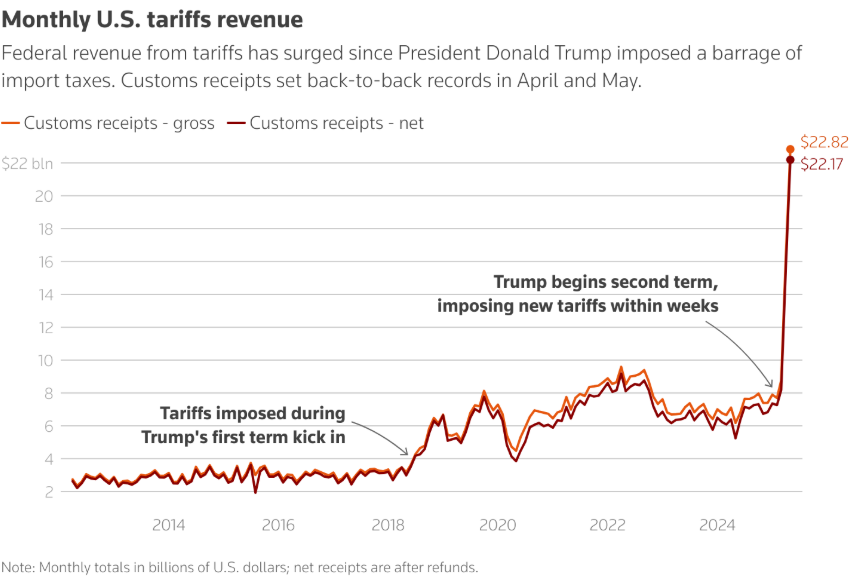
Core Insights - The U.S. Treasury Secretary, Mnuchin, announced that the U.S. has collected approximately $100 billion in tariff revenue so far this year, with projections suggesting this could rise to $300 billion by the end of 2025 due to the acceleration of tariffs from the trade war initiated by President Trump [2][3] - The significant increase in tariff revenue is attributed to the implementation of nearly universal 10% tariffs on imported goods and increased tariffs on steel, aluminum, and automobiles [2][3] - The Treasury Department reported a record tariff collection of $22.8 billion in May, a nearly fourfold increase compared to $6.2 billion in the same month last year, contributing to a total of $86.1 billion in tariff revenue for the first eight months of the fiscal year [4][7] Revenue Projections - Mnuchin indicated that the target of $300 billion in tariff revenue corresponds to the calendar year 2025, not the fiscal year, implying a need for exponential growth in tariff collections in the coming months [3] - The Congressional Budget Office previously estimated that tariff revenue could total approximately $2.8 trillion over the next decade, a figure Mnuchin believes may be underestimated [4] Future Tariff Actions - President Trump has set a deadline of August 1 for implementing higher reciprocal tariff rates on nearly all trading partners, while still allowing for negotiations with some countries to potentially lower these rates [10] - Trump announced plans to impose a 50% tariff on copper imports, which is widely used across various sectors, including housing, consumer electronics, and military hardware, with additional tariffs on semiconductors and pharmaceuticals expected [10]

特朗普为啥把关税延期大8月1日?贝森特还需要谈判时间
Hua Er Jie Jian Wen· 2025-07-09 03:52
Group 1 - The core point of the article is that President Trump has postponed the implementation of reciprocal tariffs from July 9 to August 1, aiming to gain more time for negotiations with major trading partners [1][2] - Treasury Secretary Mnuchin indicated that negotiations with the EU, India, and other trade partners are making progress, which influenced Trump's decision to extend the deadline [1][2] - Despite the postponement, Trump has announced a 50% tariff on copper and up to 200% on pharmaceuticals, indicating a tactical shift in the U.S. trade strategy from immediate tariff implementation to using tariff threats as negotiation leverage [1][4] Group 2 - Trump initially favored automatic tariff implementation but changed his mind after hearing from Mnuchin that some agreements were close but required more time [2] - The postponement of tariffs has temporarily avoided direct escalation of trade conflicts but has opened a period of intense negotiations filled with uncertainty [3] - The U.S. government is also preparing to introduce new tariffs based on other legal authorities, with specific announcements regarding copper and pharmaceuticals expected soon [4][5]
贵金属数据日报-20250709
Guo Mao Qi Huo· 2025-07-09 03:50
Report Summary 1. Report Industry Investment Rating - Not provided in the report 2. Core Viewpoints - In the short - term, the extension of the tariff suspension period by Trump and the expected meeting between US and Chinese officials have alleviated tariff concerns, improving market risk appetite, which is beneficial to silver and slightly negative to gold. However, due to the uncertainty of tariff policies and China's continuous gold - reserve increase, gold prices are unlikely to decline significantly. Thus, short - term precious metals are expected to maintain a volatile trend [4]. - In the long - term, considering the ongoing trade war, the probability of the Fed's interest - rate cut, global geopolitical uncertainties, intensified great - power competition, and the wave of de - dollarization, the long - term upward trend of gold remains unchanged. It is recommended to allocate gold on dips [4]. 3. Summary by Relevant Content a. Price Tracking of Precious Metals - **15 - point Prices of Domestic and Foreign Gold and Silver**: On July 8, 2025, the prices of London Gold Spot, London Silver Spot, COMEX Gold, and other indicators all showed increases compared to July 7, with daily price increases ranging from 0.6% to 0.9%. For example, the price of London Gold Spot rose from $3308.77 per ounce on July 7 to $3336.45 per ounce on July 8, an increase of 0.8% [3]. - **Price Difference and Ratio Tracking**: The price differences and ratios of precious metals also changed. For instance, the gold TD - SHFE active price difference decreased by 16.2% from July 7 to July 8, while the silver TD - SHFE active price difference decreased by 31.3% [3]. b. Position Data - **COMEX and ETF Positions**: As of July 7, 2025, the non - commercial net long positions of COMEX gold increased by 3.58% compared to July 3, while the non - commercial net long positions of COMEX silver decreased by 2.06%. The holdings of gold ETF - SPDR and silver ETF - SLV remained unchanged [3]. c. Inventory Data - **SHFE and COMEX Inventories**: On July 8, 2025, SHFE gold inventory increased by 0.48% compared to July 7, and SHFE silver inventory increased by 0.30%. COMEX gold inventory decreased by 0.19% from July 3 to July 7, and COMEX silver inventory decreased by 0.20% [3]. d. Other Market Data - **Exchange Rates, Yields, and Indexes**: The dollar - to - RMB central parity rate increased by 0.04% from July 7 to July 8. The dollar index, 2 - year and 10 - year US Treasury yields, VIX, and NYMEX crude oil prices also showed different degrees of change [4]. e. News and Market Analysis - **Tariff Policy News**: Trump extended the so - called "reciprocal tariff" suspension period from July 9 to August 1 and announced new tariff policies for multiple countries starting from August 1 [4]. - **Trade Negotiation News**: US Treasury Secretary Bessent said he expected to meet with Chinese officials in the next few weeks to promote trade and other topic negotiations [4].
美联储降息预期放缓 美元指数继续反弹
Jin Tou Wang· 2025-07-09 03:45
Group 1 - The US dollar index is currently on the rise, reported at 97.69 with an increase of 0.20%, driven by a decrease in risk aversion and a slowdown in Federal Reserve rate cut expectations [1] - Japan and South Korea are attempting to negotiate with the US to mitigate the impact of President Trump's planned significant tariff increases starting in early August [1][2] - Investors are anticipating a 50 basis point rate cut from the Federal Reserve by the end of the year, with actions expected to begin in October [3] Group 2 - President Trump announced a 50% tariff on copper to boost US copper production, escalating the trade war and warning 14 countries of higher tariffs [2] - The market is awaiting the latest policy meeting minutes from the Federal Reserve, with several officials scheduled to speak this week, providing insights into economic and policy directions [2] - The dollar index is facing resistance around the 99 area, with key support levels identified at 97.20-40, and upward pressure noted near 98.00 [3]
铜市巨震!美加征铜超高关税割裂中美欧贸易与金融定价
Jin Shi Shu Ju· 2025-07-09 03:15
据央视及新华社报道证实,7月8日特朗普政府表示,将对所有进口到美国的铜征收50%的新关税,而据 美国消费者新闻与商业频道报道,在特朗普内阁会议结束后,美国商务部长卢特尼克最新说,美国商务 部已完成对铜进口状况的调查,他预计新关税"可能在7月底或8月1日实施"。 尽管特朗普政府的贸易政策反复多变,但由于事发突然且已点燃金融资本的逐利冲动。风口浪尖的铜市 场金融定价掀起巨浪,冲击中美欧贸易稳定性与金融定价! 8日当日纽约铜价单日暴涨逾10%,因美国瞬间涌现多头逼空及大量空头回补潮,美国铜期货正上演单 日突破历史高位记录的逼空大戏,与此同时伦敦铜价高位巨震日内回落近2%,而我国铜期货价格8日夜 盘结束仍以微涨收盘,但预计9日开盘交易后预计沪铜将小幅调整回落后跟跌伦敦铜。 但由于铜资源卡脖子问题突出,预计全球铜价经历了短期割裂之后,中国铜现货将依赖"上游资金极紧 缺,可交割铜库存极低,下游反内卷回暖"等结构性强势因素,中长期预计维持抗跌坚挺,下半年或将 朝向年内新高! 从铜市本轮结构变化来看,目前美国铜期货市场上演逼空行情后,现货升水升至极端历史高位水平,而 伦敦LME铜价则因跨大西洋贸易流断裂担忧承压下行,美国与欧 ...
大越期货原油早报-20250709
Da Yue Qi Huo· 2025-07-09 02:53
Report Summary 1. Report Industry Investment Rating No relevant content provided. 2. Core Viewpoints - Overnight, Trump's approval to send more defensive weapons to Ukraine and consideration of further sanctions on Russia raised geopolitical concerns and boosted oil prices. Meanwhile, the news of imposing tariffs on imported copper also caused market resonance and pushed prices up. However, the significant unexpected increase in API crude oil inventory in the early morning had a certain suppressing effect on oil prices. Short - term oil prices are expected to fluctuate, with short - term trading in the range of 510 - 520, and long - term investors are advised to wait and see [3]. 3. Summary by Directory 3.1 Daily Tips - **Fundamentals**: The US will impose tariffs of 25% - 40% on imported products from 14 countries including Japan and South Korea starting from August 1st, and extend the "reciprocal tariff" suspension deadline to August 1st. Trump approved sending more defensive weapons to Ukraine and considered further sanctions on Russia, which is neutral for the market [3]. - **Basis**: On July 8th, the spot price of Oman crude oil was $70.77 per barrel, and that of Qatar Marine crude oil was $70.4 per barrel, with a basis of 15.17 yuan/barrel, indicating that the spot price was higher than the futures price, which is bullish [3]. - **Inventory**: The US API crude oil inventory for the week ending July 4th increased by 7.128 million barrels, far exceeding the expected decrease of 2.6 million barrels. The EIA inventory for the week ending June 28th increased by 3.845 million barrels, also exceeding the expected decrease of 1.809 million barrels. The Cushing region's inventory for the week ending June 28th decreased by 1.493 million barrels. As of July 8th, the Shanghai crude oil futures inventory was 4.517 million barrels, a decrease of 440,000 barrels, which is bearish [3]. - **Market Trend**: The 20 - day moving average was flat, and the price was below the moving average, which is neutral [3]. - **Main Positions**: As of July 1st, the long positions of WTI crude oil main contracts increased, while those of Brent crude oil main contracts decreased, which is neutral [3]. 3.2 Recent News - **Geopolitical News**: Trump approved sending more defensive weapons to Ukraine and considered further sanctions on Russia. He also said he was "very dissatisfied" with Russian President Putin. He is considering supporting a new bill in the Senate to impose severe sanctions on Russia. Additionally, Trump expanded the global trade war by announcing a 50% tariff on imported copper and threatening to impose tariffs on semiconductors and pharmaceuticals [5]. - **Supply - side News**: Saudi Arabia promoted OPEC+ to increase production rapidly. Eight major oil - producing countries decided to jointly increase production by 548,000 barrels per day in August and accelerate the lifting of the 2.17 million barrels per day production cut plan that started in April. Combined with the UAE's additional production quota increase of 300,000 barrels per day, OPEC+'s production target for this year may be increased by 2.5 million barrels per day. However, the new quota may not significantly change the organization's total output as most member countries' actual production has reached or exceeded the quota levels [5]. 3.3 Long - Short Concerns - **Bullish Factors**: The intensification of the Russia - Ukraine conflict [6]. - **Bearish Factors**: OPEC+ has increased production for three consecutive months; the continuous tension in the US trade relations with other economies; the cease - fire between Iran and Israel [6]. - **Market Drivers**: In the short term, geopolitical conflicts drive up prices, and in the medium - long term, the market awaits the peak summer demand season [6]. 3.4 Fundamental Data - **Futures Market**: The settlement price of Brent crude oil decreased from $68.80 to $68.30, a decrease of 0.73%. The settlement price of WTI crude oil decreased from $67.00 to $62.36, a decrease of 6.93%. The settlement price of SC crude oil increased from 503.7 to 506.4, an increase of 0.54%. The settlement price of Oman crude oil increased from $68.70 to $69.78, an increase of 1.57% [7]. - **Spot Market**: The price of UK Brent Dtd decreased from $71.28 to $70.91, a decrease of 0.52%. The price of WTI decreased from $67.00 to $66.50, a decrease of 0.75%. The price of Oman crude oil in the Asia - Pacific region increased from $69.84 to $70.03, an increase of 0.27%. The price of Shengli crude oil in the Asia - Pacific region increased from $66.72 to $67.07, an increase of 0.52%. The price of Dubai crude oil in the Asia - Pacific region increased from $69.70 to $69.85, an increase of 0.22% [9]. - **Inventory Data**: The API inventory for the week ending July 4th increased by 7.128 million barrels, far exceeding the expected decrease. The EIA inventory for the week ending June 27th increased by 3.845 million barrels, also exceeding the expected decrease [3]. 3.5 Position Data - **WTI Crude Oil**: As of July 1st, the net long positions of WTI crude oil funds were 234,693, an increase of 1,724 [15]. - **Brent Crude Oil**: As of July 1st, the net long positions of Brent crude oil funds were 166,717, a decrease of 25,881 [18].
大越期货沪铜早报-20250709
Da Yue Qi Huo· 2025-07-09 02:35
Report Industry Investment Rating No relevant content provided Core Viewpoints - The fundamentals of copper are neutral as smelting enterprises are reducing production, the scrap copper policy has been relaxed, and the manufacturing PMI in June was 49.5%, indicating stable manufacturing sentiment [2]. - The basis shows that the spot price is 79745 with a basis of 125, indicating a premium over futures, which is considered neutral [2]. - Copper inventories increased by 5100 to 102500 tons on July 8, and the SHFE copper inventory increased by 3039 tons to 84589 tons compared to last week, which is neutral [2]. - The closing price is above the 20 - day moving average and the 20 - day moving average is upward, suggesting a bullish signal [2]. - The net position of the main players is short, but the short position is decreasing, which is bearish [2]. - With the Fed's slowdown in interest rate cuts, high - level inventory reduction, uncertainties in US trade tariffs, and geopolitical disturbances, and a 50% US copper tariff overnight, market volatility has intensified [2]. Summary by Relevant Catalogs Daily Viewpoint - Copper fundamentals are neutral due to smelting production cuts, scrap copper policy changes, and stable manufacturing PMI [2]. - The basis is neutral with a spot premium over futures [2]. - Inventory changes are neutral as both total and SHFE inventories increased [2]. - The price trend is bullish as the closing price is above the rising 20 - day moving average [2]. - The main players' position is bearish with a net short position that is decreasing [2]. - Market expectations are volatile due to Fed policy, inventory changes, trade tariffs, and geopolitical factors [2]. Recent利多利空Analysis - The logic involves domestic policy easing and an escalation of the trade war, but specific利多 and利空 factors are not detailed [3]. Supply - Demand Balance - In 2024, there is a slight surplus, and in 2025, it is expected to be in a tight balance [20]. - The China annual supply - demand balance table shows different supply - demand situations from 2018 - 2024, with a surplus of 110,000 tons in 2024 [22]. Other Data - Bonded area inventories are rising from a low level [14]. - Processing fees are falling [16].
国际白银小幅下行 投资者等待美国贸易政策进一步明朗
Jin Tou Wang· 2025-07-09 02:14
Group 1 - International silver prices experienced a slight decline, currently trading at $36.66 per ounce, with a decrease of 0.20% [1][4] - The opening price for silver today was $36.69 per ounce, reaching a high of $36.76 and a low of $36.49 [1][4] - The resistance level for silver is identified at $37.30-$37.40, while the support level is at $35.90-$36.00 [4] Group 2 - The S&P 500 index in the U.S. saw a slight decline amid ongoing uncertainty regarding U.S. trade policies, particularly due to President Trump's recent tariff threats [2] - Trump's announcement of a 50% tariff on imported copper expands the scope of the global trade war, with additional tariffs on semiconductors and pharmaceuticals expected soon [2][3] - Investors are awaiting the second-quarter earnings season starting mid-July, feeling reassured by the recent passage of a government spending plan that includes business-friendly tax policies [3]
五矿期货农产品早报-20250709
Wu Kuang Qi Huo· 2025-07-09 00:50
农产品早报 2025-07-09 五矿期货农产品早报 五矿期货农产品团队 从业资格号:F0273729 交易咨询号:Z0002942 邮箱:wangja@wkqh.cn 白糖、棉花研究员 从业资格号:F03116327 交易咨询号:Z0019233 邮箱:yangzeyuan@wkqh.cn 从业资格号:F03114441 交易咨询号:Z0022498 电话:010-60167188 邮箱:sxwei@wkqh.cn 王俊 组长、生鲜研究员 周二美豆延续下跌,天气较好及贸易战可能波及出口施压美豆,不过美豆估值略低,生物柴油政策支撑 需求,整体维持区间震荡趋势。周二国内豆粕现货下跌,华东报 2790 元/吨,油厂开机率仍较高,豆粕 成交较弱,提货仍较好。据 MYSTEEL 统计上周国内压榨大豆 233.22 万吨,本周预计压榨 235.17 万吨。 饲料企业库存天数为 7.91(+0.61)天,油厂豆粕库存超 80 万吨,维持累库趋势。 杨泽元 美豆产区未来两周降雨偏好,覆盖大部分产区,天气有利。巴西方面,升贴水近期稳中小涨,叠加雷亚 尔升值,中美大豆关税仍未解除等支撑当地升贴水,对冲美豆跌幅。总体来看,大豆进 ...
美国关税暂缓90天的“得与失”
Huan Qiu Shi Bao· 2025-07-08 22:46
【环球时报特约记者 任重 环球时报记者 杨舒宇 倪浩】7月9日美国"对等关税"政策暂缓期到期在即,美国总统特朗普再度突然调整该政策方向。 当地时间7日,特朗普签署行政命令,延长所谓"对等关税"暂缓期,将实施时间从7月9日推迟到8月1日。消息一出,美股市场周一低开低收,三大 指数均录得6月中旬以来最差单日表现。 关税生效期再延 "关税威胁造成的不确定性似乎正在减缓投资和招聘"。《纽约时报》称,自特朗普去年11月宣布当选以来,美国工厂建设支出有所下降,从业人 员数量也大幅下降。贸易专家告诉哥伦比亚广播公司,"关税威胁以及这种不确定性使得资金处于观望状态。如果你连一周后的成本都无法预估, 又怎能规划未来的一年呢?这些都造成了不确定性,阻碍投资和经济整体增长。" 同时,越来越多的外资倾向于"逃逸"出美国。7日,德勤的一项新调查显示,只有2%的英国大型企业首席财务官仍然认为美国具有投资吸引力, 较2024年底特朗普上任前的59%大幅下降。官方数据也显示,美国第二季度外商直接投资大降5.2%。 还有越来越多的证据表明,美国通胀压力恐进一步加剧。高盛集团的一份报告预计,企业将把60%的关税成本转嫁给消费者。经济信心也开始下 ...