消费提振

Search documents
“实现全年预期目标,有较好条件”
Zhong Guo Zheng Quan Bao· 2025-12-15 07:04
国家统计局12月15日发布数据显示,11月份,全国规模以上工业增加值同比增长4.8%,环比增长 0.44%;全国服务业生产指数同比增长4.2%;社会消费品零售总额43898亿元,同比增长1.3%。1—11月 份,全国固定资产投资(不含农户)444035亿元,同比下降2.6%;扣除房地产开发投资,全国固定资 产投资增长0.8%。 付凌晖表示,我国消费稳步扩大是人均GDP超过1万美元、消费结构升级发展的必然表现,也是促消费 政策持续发力、消费潜能释放的结果,还是新技术新模式广泛渗透、消费新增长点不断涌现的反映。 "也要看到,居民消费能力和信心有待进一步提升,消费增长内生动力仍需增强。下阶段,要继续深入 实施提振消费专项行动,着力稳就业促增收,积极扩大优质供给,大力优化消费环境,不断释放消费潜 力,促进消费市场持续稳定健康发展。"付凌晖说。 市场销售扩大。付凌晖表示,商品销售持续增长。11月份,社会消费品零售总额同比增长1.3%,居民 消费品质提升,部分升级类商品销售较快增长。11月份,限额以上商品零售额中化妆品类和金银珠宝类 零售额分别增长6.1%和8.5%。服务零售较快增长。1—11月份,服务零售额同比增长5. ...
中央经济会议定调内需,提振消费政策值得期待
China Post Securities· 2025-12-15 04:49
Investment Rating - The industry investment rating is "Outperform the Market" and is maintained [1] Core Insights - The central economic work conference emphasized the importance of domestic demand and proposed measures to boost consumption, which is expected to positively impact the building materials industry [4] - The cement sector is anticipated to see a temporary price increase due to supply constraints from seasonal production policies, despite current weak demand [5] - The glass industry is facing ongoing demand challenges, with inventory levels remaining high and limited improvement in downstream demand [6] - The fiberglass sector is experiencing growth driven by AI-related demand, with expectations for continued price and volume increases [6] - The consumer building materials segment has reached a profitability bottom, with strong price increase demands from companies [7] Summary by Sections Cement - November saw a slight improvement in cement demand, with a production volume of 148 million tons, down 15.8% year-on-year [10] - Seasonal production policies are expected to lead to a temporary price increase, while demand remains in a weak recovery phase [10] Glass - The glass industry is under pressure with traditional Q4 demand not meeting expectations, and inventory levels are relatively high [16] - The supply-demand imbalance persists, and future policy changes are crucial for demand recovery [16] Fiberglass - The fiberglass sector is benefiting from price increases of 5%-10% due to strong demand in the AI industry, with expectations for continued growth [6] Consumer Building Materials - The sector has reached a profitability low point, with companies actively seeking price increases to improve margins [7]
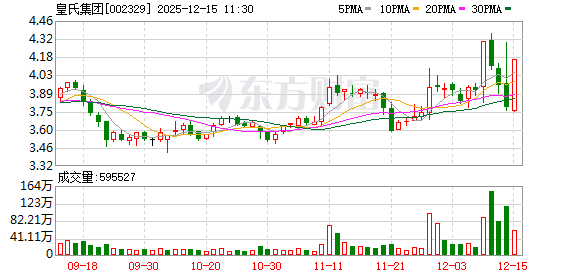
002329、001318 直线涨停
Shang Hai Zheng Quan Bao· 2025-12-15 04:48
Group 1: Dairy Industry - The dairy sector has shown strong performance, with stocks like Huangshi Group reaching the daily limit [1][3] - On December 13, a national medical insurance conference highlighted the promotion of maternity insurance and long-term care insurance, which is expected to boost demand in the dairy industry [3] - Recent reports indicate that the baby formula industry has faced demand pressure, but policy support is anticipated to restore consumer confidence and demand [3][5] Group 2: Retail Sector - The retail sector has been active, with Baida Group achieving three consecutive daily limits [6][7] - According to the National Bureau of Statistics, the consumer market remains stable, with service consumption growing rapidly, indicating a positive trend in consumption [7] - The government plans to implement actions to boost consumption, focusing on stabilizing employment and enhancing the quality of supply [7] Group 3: Company Specifics - Enjie Co., a leading separator manufacturer, saw its stock price drop significantly after announcing a merger and acquisition deal [8][9] - The company plans to acquire 100% of Qingdao Zhongke Hualian New Materials Co., which specializes in lithium-ion battery separator production [9]


消费利好!三部门,最新部署!深化商务和金融系统协作
Zheng Quan Shi Bao Wang· 2025-12-15 02:57
Core Viewpoint - The joint notice issued by the Ministry of Commerce, the People's Bank of China, and the Financial Regulatory Administration aims to strengthen the collaboration between commerce and finance to boost consumption significantly [1][2]. Group 1: Policy Measures - The notice outlines 11 policy measures across three main areas: enhancing collaboration between commerce and finance, increasing financial support for key consumption areas, and expanding cooperation among government, finance, and enterprises [2][4]. - It emphasizes the need for local departments to improve communication and collaboration, encouraging the establishment of mechanisms to address challenges in financial support for consumption [4][5]. Group 2: Financial Support for Consumption - Financial institutions are encouraged to focus on five key areas: upgrading product consumption, expanding service consumption, fostering new consumption types, innovating diverse consumption scenarios, and supporting consumption assistance [2][7]. - Specific measures include enhancing financial services for durable goods and digital products, improving loan policies for personal consumption, and supporting cross-border trade financing [7][8]. Group 3: Government-Finance-Enterprise Cooperation - The notice promotes joint consumption activities organized by local commerce departments and financial institutions, aiming to reach more businesses and consumers [11]. - It encourages the sharing of information and resources between local departments and financial institutions to facilitate precise service delivery and enhance credit construction in the consumption sector [12].
资讯早班车-2025-12-15-20251215
Bao Cheng Qi Huo· 2025-12-15 02:53
1. Report Industry Investment Rating - No relevant information provided in the report. 2. Core Views of the Report - The overall performance of China's economy in 2025 shows a complex situation, with some indicators improving and others facing challenges. The government is expected to introduce more incremental policies in 2026 to boost consumption, promote investment, and address key risks. The bond market remains in a volatile and weak pattern, while the stock market is expected to see more balanced opportunities with technology stocks continuing as the main theme [17][22][34]. 3. Summary by Relevant Catalogs 3.1 Macro Data Overview - GDP growth in Q3 2025 was 4.8% year - on - year, slightly lower than the previous quarter. The manufacturing PMI in November was 49.2%, and the non - manufacturing PMI for business activities was 49.5%. Social financing scale, M2, M1, and other financial indicators showed certain trends, with social financing scale increment in the first 11 months exceeding last year's full - year figure [1]. 3.2 Commodity Investment Reference 3.2.1 Comprehensive - China's November financial data showed that RMB loans increased by 15.36 trillion yuan in the first 11 months, and the cumulative social financing scale increment was 33.39 trillion yuan. The authorities issued a notice to boost consumption through financial support [2]. 3.2.2 Metals - Global physical gold ETFs had continuous inflows in November, with the total asset management scale and total holdings reaching new highs. The copper price was approaching $12,000 per ton, with a cumulative increase of over 30% this year. The zinc, copper, and other metal inventories showed different trends [5][6][7]. 3.2.3 Coal, Coke, Steel, and Minerals - The prices of coke and coking coal decreased in early December. The 2026 Shanxi Coal Trading Conference was held, and some steel products will be under export license management from January 1, 2026 [9]. 3.2.4 Energy and Chemicals - China's oil and gas industry is moving towards a new stage of development, with the expected natural gas production to reach 300 billion cubic meters by 2030. The shale oil exploration and development work was promoted, and the number of US oil drilling platforms increased [11][12]. 3.2.5 Agricultural Products - The prices of some agricultural products such as soybean meal and corn increased, while the price of peanuts decreased. The total grain output of Beidahuang Group achieved "22 consecutive years of harvest" [14][15]. 3.3 Financial News Compilation 3.3.1 Open Market - The central bank conducted 1205 billion yuan of 7 - day reverse repurchase operations on December 12, with a net withdrawal of 193 billion yuan. This week, there are large - scale reverse repurchase maturities, and the central bank will conduct 6000 billion yuan of 6 - month - term repurchase operations on December 15 [16]. 3.3.2 Key News - Multiple departments held meetings to implement the spirit of the Central Economic Work Conference, emphasizing policies such as promoting consumption, stabilizing investment, and preventing financial risks. The issuance scale of public funds and bonds in the market showed certain trends [17][25]. 3.3.3 Bond Market Summary - The Chinese bond market turned cold, with bond yields rising and bond futures prices falling. The money market interest rates showed different trends, and the yields of European and US bonds also changed [28][32]. 3.3.4 Foreign Exchange Market - The on - shore RMB against the US dollar rose, and the US dollar index also showed a slight increase. Non - US currencies had different trends [33]. 3.3.5 Research Report Highlights - Different institutions analyzed the November financial data and the Central Economic Work Conference, providing investment suggestions for the bond market, such as holding short - term credit bonds and medium - term interest - rate bonds [34]. 3.4 Stock Market Key News - Last week, the A - share market was volatile, with the technology growth sector performing well. The scale of ETFs linked to the CSI A500 index continued to expand. Multiple public funds are currently being issued, and the market is at the time of cross - year layout, with more balanced investment opportunities expected in 2026 [39][40].

国泰君安期货商品研究晨报:贵金属及基本金属-20251215
Guo Tai Jun An Qi Huo· 2025-12-15 02:09
1. Report Industry Investment Ratings The document does not provide industry investment ratings. 2. Core Views - Gold: Interest rates were cut as expected [2][4]. - Silver: Adjusting at a high level [2][4]. - Copper: The long - term driving logic remains, and the price decline is limited [2][8]. - Zinc: Domestic inventory is continuously decreasing [2][11]. - Lead: Inventory reduction supports the price [2][14]. - Tin: Supply is disrupted again [2][16]. - Aluminum: Macroeconomic disturbances are increasing [2][19]. - Alumina: Continuously monitor production capacity cuts [2][19]. - Cast aluminum alloy: Fluctuating at a high level [2][19]. - Platinum: Breaking through the previous high and starting to make up for lost ground [2][22]. - Palladium: ETF holdings have increased significantly, and it is expected to hit the previous high [2][22]. - Nickel: The structural surplus has changed, and attention should be paid to policy risks in Indonesia [2][26]. - Stainless steel: Supply and demand are both weak, and steel prices are fluctuating at a low level [2][26]. 3. Summary by Directory Gold - **Fundamentals**: The closing prices of various gold products such as Shanghai Gold 2602, Gold T + D, etc. showed different degrees of increase, and trading volumes and positions also changed. ETF and inventory data also had corresponding changes [4]. - **News**: Trump prefers to appoint Warsh or Hassett as the Fed Chairman; China's November new social financing, new RMB loans, and M2 - M1 scissors - gap data are released; multiple Chinese ministries respond to the Central Economic Work Conference [4][6]. - **Trend Intensity**: Neutral [7]. Silver - **Fundamentals**: The closing prices of Shanghai Silver 2602 and other products had significant price fluctuations, and trading volumes, positions, ETF holdings, and inventory data also changed [4]. - **Trend Intensity**: Neutral [7]. Copper - **Fundamentals**: The closing prices of Shanghai Copper and London Copper had different trends, and trading volumes, positions, inventory, and price spreads all changed. China's November copper - related import data and Chile's copper - related export and production data are released [8][10]. - **News**: The Chinese central bank will flexibly use various monetary policy tools; Trump hopes the interest rate will be 1% or lower in a year; the US is negotiating to provide over $1 billion for key mineral and railway projects in Central Africa [8][10]. - **Trend Intensity**: Neutral [10]. Zinc - **Fundamentals**: The closing prices of Shanghai Zinc and London Zinc changed, and trading volumes, positions, inventory, and price spreads also had corresponding changes [11]. - **News**: Three Chinese ministries will strengthen business - finance cooperation to boost consumption [11]. - **Trend Intensity**: Strongly bullish [11]. Lead - **Fundamentals**: The closing prices of Shanghai Lead and London Lead decreased slightly, and trading volumes, positions, inventory, and price spreads all changed [14]. - **News**: The Chinese central bank will flexibly use various monetary policy tools; Trump hopes the interest rate will be 1% or lower in a year [14]. - **Trend Intensity**: Neutral [14]. Tin - **Fundamentals**: The closing prices of Shanghai Tin and London Tin showed different trends, and trading volumes, positions, inventory, and price spreads all changed. Spot and industrial chain prices also increased [16]. - **News**: Trump prefers to appoint Warsh or Hassett as the Fed Chairman; China's November new social financing, new RMB loans, and M2 - M1 scissors - gap data are released; multiple Chinese ministries respond to the Central Economic Work Conference [16][17]. - **Trend Intensity**: Bearish [18]. Aluminum, Alumina, Cast Aluminum Alloy - **Fundamentals**: The closing prices, trading volumes, positions, inventory, and price spreads of Shanghai Aluminum, LME Aluminum, Shanghai Alumina, and cast aluminum alloy all changed. Data on related premiums, processing fees, and corporate profits are also updated [19]. - **News**: Global monetary policy is at a critical turning point; the Fed's asset - liability purchase may push up inflation in 2026 [21]. - **Trend Intensity**: Aluminum is neutral, Alumina is bearish, and Cast Aluminum Alloy is neutral [21]. Platinum and Palladium - **Fundamentals**: The closing prices of platinum and palladium products increased, and trading volumes, positions, ETF holdings, and price spreads all changed [22]. - **News**: Multiple international events such as the US - Mexico water resource agreement and Zelensky's decision to abandon NATO membership are reported [25]. - **Trend Intensity**: Both are strongly bullish [24]. Nickel and Stainless Steel - **Fundamentals**: The closing prices of Shanghai Nickel and stainless steel had different trends, and industrial chain - related prices, profits, and spreads all changed [26]. - **News**: There are multiple events in Indonesia related to nickel production, including government sanctions, policy changes, and production restrictions. The Fed has dovish remarks, and China will implement export license management for some steel products [26][29]. - **Trend Intensity**: Both are neutral [30].
三部门:更大力度提振消费,适当减免汽车以旧换新提前结清贷款违约金
Cai Jing Wang· 2025-12-15 02:07
其中提到,升级商品消费。加强大宗耐用消费品、数码产品等消费金融服务,挖掘商品消费升级潜能。 推动金融机构与平台、重点商户合作,加快推动个人消费贷款业务发展。适当减免汽车以旧换新过程中 提前结清贷款产生的违约金。完善消费品以旧换新服务平台,扩大金融机构参与范围。 近日,商务部办公厅、中国人民银行办公厅、金融监管总局办公厅发布《关于加强商务和金融协同,更 大力度提振消费的通知》。 ...
刚刚,大利好来了!
天天基金网· 2025-12-15 01:24
Core Viewpoint - The article discusses the release of a notification aimed at strengthening collaboration between the business and financial systems to boost and expand consumption in China [2][4]. Group 1: Strengthening Collaboration - The notification outlines 11 policy measures across three main areas, emphasizing the need for local departments to enhance communication and collaboration, and to create mechanisms for cooperation [4][8]. - It encourages local governments to utilize digital currency and various financial tools to improve the effectiveness of consumption promotion policies [7][9]. Group 2: Financial Support for Key Consumption Areas - Financial institutions are urged to focus on five key areas: upgrading product consumption, expanding service consumption, nurturing new consumption types, innovating diverse consumption scenarios, and supporting consumption assistance [5][10]. - Specific measures include enhancing financial services for durable goods and digital products, and developing tailored financial products to meet consumer needs [10][11]. Group 3: Expanding Government-Financial-Enterprise Cooperation - The notification promotes joint consumption promotion activities involving financial institutions, local governments, and businesses to reach a wider audience [14][15]. - It emphasizes the importance of information sharing between local business departments and financial institutions to facilitate precise service delivery [15][16].
A股盘前播报 | 更大力度提振消费!三部门重磅部署 茅台控价政策刷屏
智通财经网· 2025-12-15 00:41
Group 1: Industry Insights - The People's Bank of China and other departments have issued a notice to enhance financial support for key consumption areas, aiming to stimulate domestic demand through various promotional activities and information sharing [1] - The central economic work conference has outlined the direction for economic policy in 2026, emphasizing the importance of stabilizing economic growth and reasonable price recovery as key considerations for monetary policy [3] Group 2: Company Developments - Kweichow Moutai is set to implement a quantity control policy, halting the distribution of all Moutai products to distributors in December and planning to reduce non-standard product quotas next year, leading to a price increase for its flagship product, with retail prices exceeding 1884.1 yuan per bottle in major cities [2] - The mother and baby products market is expected to grow, with a focus on sectors such as dairy products, care and durable goods, clothing, and e-commerce, driven by the national health insurance bureau's goal to minimize childbirth costs [10]

重磅!三部门联合发布更大力度提振消费举措
Sou Hu Cai Jing· 2025-12-15 00:20
Core Viewpoint - The joint issuance of the "Notice" by the Ministry of Commerce, the People's Bank of China, and the Financial Regulatory Administration aims to strengthen the collaboration between commerce and finance to boost consumption, with a focus on precise policies and innovative mechanisms to support sustained growth in consumer spending [4][17]. Group 1: Policy Framework - The "Notice" outlines a three-pronged approach with 11 specific measures to create a collaborative system for boosting consumption, emphasizing the importance of consumer spending as a driver of endogenous growth [4][5]. - A full-chain collaborative system is established to address the previous disconnect between commerce and financial institutions, transforming isolated efforts into a unified approach [5][6]. Group 2: Mechanism Innovation - Local commerce and financial management departments are required to establish a regular coordination mechanism, encouraging regions to develop specialized work plans [6]. - A shared project list system in the consumption sector is proposed to facilitate precise matching between project needs and financial resources, addressing issues of information asymmetry and delayed policy implementation [6][7]. Group 3: Policy Synergy - The "Notice" encourages the use of financing guarantees and loan interest subsidies to create a synergistic effect between fiscal and financial resources, particularly in the automotive sector [7]. - The combination of subsidies and financial incentives is expected to amplify the impact of consumption-boosting policies, as evidenced by the success of the "old-for-new" vehicle replacement program [7]. Group 4: Technological Integration - The introduction of digital RMB and smart contract red envelopes aims to enhance the efficiency of subsidy distribution and ensure targeted use of funds, improving the effectiveness of consumption policies [8]. - This integration of technology and policy is projected to increase the efficiency of consumption promotion measures by over 30% in pilot regions [8]. Group 5: Targeted Financial Support - The "Notice" outlines differentiated support strategies for five key consumption areas, including durable goods, service consumption, and new consumption models, to ensure precise allocation of financial resources [9][10][11][12]. - Specific measures include enhancing installment payment options and credit card services for durable goods, as well as expanding financing for service sectors like home services and tourism [10][11]. Group 6: Rural and Urban Market Development - The "Notice" proposes tailored loan products for rural markets and initiatives to enhance inbound consumption, aiming to stimulate growth in both urban and rural areas [14]. - The integration of local consumption activities with financial support is intended to empower rural economies and improve the sales of local agricultural products [14]. Group 7: Execution and Implementation - A robust execution framework is established to ensure that policy benefits reach businesses and consumers effectively, focusing on activity coordination, information sharing, and promotional efforts [15][16]. - Financial institutions are encouraged to actively participate in local consumption promotion activities, creating exclusive products and offers to stimulate consumer spending [15]. Group 8: Long-term Vision - The "Notice" signifies a shift towards a more precise and collaborative approach to consumption stimulation, addressing structural imbalances in the market and fostering a sustainable consumption ecosystem [17][18]. - The emphasis on long-term mechanisms, such as credit system development and new consumption cultivation, aims to ensure the continuous release of consumption potential [18].