
量化紧缩(QT)

Search documents
海外高频 | 海外无风险利率悉数下行,黄金大涨续创新高 (申万宏观·赵伟团队)
Sou Hu Cai Jing· 2025-10-19 14:52
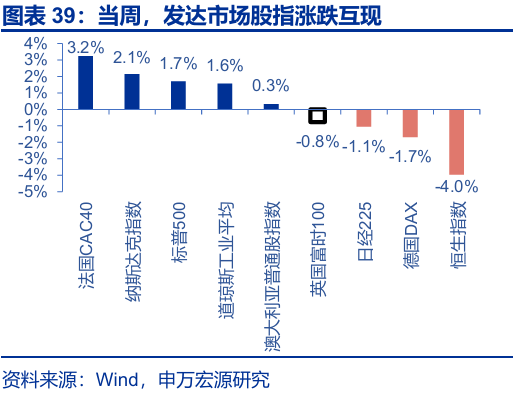
Group 1 - The core viewpoint of the articles indicates a downward trend in overseas risk-free interest rates, leading to a significant rise in gold prices, which reached a new high [1][3] - The S&P 500 index increased by 1.7%, and the Nasdaq index rose by 2.1% during the week, while the 10-year U.S. Treasury yield fell by 3 basis points to 4.02% [1][3] - The U.S. government shutdown has entered its third week, with expectations that it may last over 30 days, impacting various sectors and government operations [54][55] Group 2 - In the developed markets, stock indices showed mixed results, with the French CAC40 rising by 3.2% and the Nikkei 225 declining by 1.1% [3] - Emerging market indices mostly rose, with the South Korean Composite Index increasing by 3.8% and the Brazilian IBOVESPA rising by 1.9% [3] - The Hang Seng Index and its sub-indices, including the Hang Seng Tech Index, experienced declines of 8.0% and 4.0%, respectively [13] Group 3 - The U.S. Treasury yields for developed countries fell, with the French 10-year yield down by 11.8 basis points to 3.36% and the German yield down by 13.0 basis points to 2.62% [17] - Emerging market 10-year yields showed mixed results, with Turkey's yield rising by 76 basis points to 29.8% while South Africa's yield fell by 11.0 basis points to 9.0% [21] Group 4 - The U.S. dollar index decreased by 0.3% to 98.56, while several other currencies appreciated against the dollar, including the euro and the British pound [25] - The offshore Chinese yuan appreciated to 7.13 against the dollar, indicating a stable exchange rate [30] Group 5 - Commodity prices mostly declined, with WTI crude oil down by 2.3% to $57.5 per barrel, while COMEX gold surged by 6.2% to $4,234.9 per ounce [35][41] - Precious metals saw an overall increase, with COMEX silver rising by 6.3% to $50.4 per ounce [41] Group 6 - The geopolitical tensions, particularly the ongoing Russia-Ukraine conflict, are expected to exacerbate oil price volatility and disrupt global inflation control efforts [64] - The U.S. economy is showing signs of unexpected slowdown, raising concerns about employment and consumer spending [64] - The Federal Reserve's shift towards a more hawkish stance may impact future interest rate cuts if inflation remains resilient [64]

海外高频 | 海外无风险利率悉数下行,黄金大涨续创新高 (申万宏观·赵伟团队)
申万宏源宏观· 2025-10-19 14:39
Core Viewpoint - The article discusses the recent trends in major asset classes, highlighting the decline in overseas risk-free interest rates and the significant rise in gold prices, alongside the performance of various stock indices and the implications of political events in the US and Japan [2][4][77]. Major Asset Classes & Overseas Events & Data - Overseas risk-free interest rates have uniformly declined, with the 10-year US Treasury yield falling by 3 basis points to 4.02%. The S&P 500 rose by 1.7%, and the Nasdaq increased by 2.1%. The dollar index decreased by 0.3% to 98.6, while offshore RMB strengthened to 7.13. WTI crude oil dropped by 2.3% to $57.5 per barrel, and COMEX gold surged by 6.2% to $4,234.9 per ounce [2][4][77]. - In developed markets, stock indices showed mixed results, with the French CAC40, Nasdaq, and S&P 500 rising by 3.2%, 2.1%, and 1.7% respectively, while the Hang Seng Index, German DAX, and Nikkei 225 fell by 4.0%, 1.7%, and 1.1% respectively. Emerging markets generally saw gains, with the Korean Composite Index, Brazilian IBOVESPA, and Indian SENSEX30 rising by 3.8%, 1.9%, and 1.9% respectively [4][10]. - The US government shutdown has entered its third week, with expectations that it may last over 30 days. The Polymarket predicts a shutdown duration of over 30 days, while the Kalshi market estimates it could last up to 42 days [55][56]. - The Japanese Liberal Democratic Party (LDP) is seeking a coalition with the Japan Innovation Party after the Komeito party withdrew from their long-standing alliance. The new LDP president, Sanae Takaichi, is negotiating for majority support [50]. - Federal Reserve Chairman Jerome Powell indicated that the balance sheet reduction (QT) may end in the coming months, citing tightening liquidity conditions. He noted that the economic outlook has not changed significantly since the September meeting [62][77]. Commodity Prices - The article notes that commodity prices have mostly declined, with WTI crude oil and Brent crude both down by 2.3%. However, coal prices increased by 1.6%, while rebar prices fell by 2.1% [35][41]. - Precious metals saw a significant increase, with COMEX gold rising by 6.2% and COMEX silver increasing by 6.3%. In contrast, base metals like LME copper and aluminum experienced declines of 1.9% and 0.4% respectively [41][36].

铜产业链周度报告-20251017
Zhong Hang Qi Huo· 2025-10-17 11:05
Report Industry Investment Rating - Not provided in the report Core Views of the Report - The copper price is expected to fluctuate weakly. Attention should be paid to Sino-US trade policies and upcoming important meetings. The mid - term strategy of buying on dips remains unchanged, while being vigilant against the impact of macro - risks [5][57] Summary by Directory 1. Report Summary - The US Federal Reserve's Beige Book shows that the overall economic activity has changed little recently. Overall consumer spending, especially retail spending, has declined slightly. Employment levels have remained basically stable, but demand for labor has weakened [5] - The US Senate voted to advance a Republican stop - gap funding bill. The market is concerned about the US government shutdown and its impact on economic data release [5] - The US economy shows signs of weakness, but the market has high expectations for the Fed's interest rate cuts. Sino - US trade relations are unstable, which repeatedly triggers market concerns about demand [5] - In terms of fundamentals, copper concentrate processing fees remain low, and the tightness at the mine end persists. The production of refined copper has declined slightly, while social inventory has continued to accumulate [5] - The trading strategy is to buy on dips in the medium term, while being alert to macro - risks [5] 2. Multi - and Short - Focus Bullish Factors - Spot processing fees for copper concentrates remain low, and the tightness at the mine end persists [8] - The production of refined copper has declined slightly [8] - The market's expectation of a Fed interest rate cut in October has increased [8][9][10] Bearish Factors - Sino - US trade frictions have escalated, and there is uncertainty in the macro - market [8] - Domestic social inventory of refined copper has accumulated [8] 3. Data Analysis Copper Mine Supply - In the first half of 2025, the combined output of major global copper mining companies increased by only 1.28% year - on - year, falling short of expectations. The Grasberg mine's production is expected to decrease significantly in the fourth quarter of 2025 and 2026, and there have been multiple supply disruptions in other large copper mines in 2025, increasing market concerns about supply shortages [18] Copper Concentrate TC - As of the week of October 11, the Mysteel standard clean copper concentrate TC weekly index was - 40.53 dollars per dry ton, up 0.06 dollars per dry ton from the previous week. The copper concentrate market shows intensified supply - demand game and continuous pressure on processing fees. Most participants believe that there will be no significant rebound in the short term [21] Electrolytic Copper Production - In September 2025, the actual domestic electrolytic copper production was 1.1498 million tons, a month - on - month decrease of 3.2% and a year - on - year increase of 14.48%. From January to September, the cumulative production was 10.1596 million tons, a year - on - year increase of 14.64%. In October, production is expected to continue to decline due to the peak of smelter maintenance, the impact of scrap copper policies, and reduced incentives for smelters to increase production [23] Scrap Copper Import - In August 2025, China's scrap copper imports were 179,400 tons, a month - on - month decrease of 5.6% and a year - on - year increase of 5.8%. From January to August, the cumulative imports were 1.5149 million tons, a year - on - year decrease of 0.3%. The decline was due to import losses, extreme weather, and reduced overseas scrap copper exports [27] Copper Plate and Strip Production - In September 2025, the domestic copper plate and strip production was 196,200 tons, a month - on - month increase of 2.35%, ending four consecutive months of decline, but still lower than the same period last year, with a year - on - year decrease of 8.7% [31] Copper Rod Production - In September 2025, the domestic refined copper rod production was 849,300 tons, a month - on - month increase of 0.18%. The recycled copper rod production was 170,800 tons, a month - on - month decrease of 1.04%. Although it was the traditional peak season, the overall demand was not strong [35] Refined - Scrap Copper Price Difference - As of October 16, the refined - scrap copper price difference was around 470 yuan per ton, which has expanded, being unfavorable for refined copper consumption [39] Copper Inventory - LME copper inventory has continued to decline, with the latest level at 137,450 tons. SHFE copper inventory increased by 15.4% to 109,690 tons in the week of October 10. COMEX copper inventory has continued to accumulate, reaching a new high since January 2004 at 344,652 tons. As of October 16, the domestic electrolytic copper spot inventory was 183,100 tons, an increase of 2,100 tons from the 13th [51] Copper Spot Premium - On October 16, the spot premium of Shanghai Wumaohui 1 copper was around 35 yuan per ton, with an expanding premium. The LME 0 - 3 spot discount was around - 11.16 dollars per ton, with a narrowing discount [55] 4. Market Outlook - The copper price is expected to fluctuate weakly. Attention should be paid to Sino - US trade policies and upcoming important meetings. The mid - term strategy of buying on dips remains unchanged, while being vigilant against the impact of macro - risks [57]
高地集团:当黄金站上4233美元:一场全球财富迁移的序幕
Sou Hu Cai Jing· 2025-10-17 03:37
Core Viewpoint - The current surge in gold prices is not just a market trend but signifies a new global consensus on the asset's value [1] Group 1: Gold Price Dynamics - Gold prices have reached $4200 per ounce, marking a new high, with market sentiment showing divergence between bearish and bullish perspectives [3] - The current market fluctuation is seen as a "digesting" phase rather than a reversal, supported by ongoing global inflation pressures, central bank gold purchases, low real interest rates, and weakening dollar attractiveness [3][5] - Structural factors ensure a robust long-term upward trend for gold, with short-term volatility unlikely to alter this trajectory [3] Group 2: Trading Structure - In the international gold market, the dynamics between long and short positions are asymmetric, with long positions incurring lower costs compared to short positions that face higher borrowing costs [4] - The expectation of Federal Reserve rate cuts is increasing the cost of short positions, thereby pushing more capital towards long positions and driving gold prices higher [5][6] Group 3: Institutional Consensus - Major financial institutions are uniformly bullish on gold, with Morgan Stanley, UBS, and Goldman Sachs projecting significant price increases, with Goldman Sachs raising its 12-month target to $4600 per ounce [7] - The World Gold Council notes that central banks in Asia and the Middle East continue to increase their gold reserves, indicating stable demand [7] Group 4: Federal Reserve Rate Cut Expectations - The probability of the Federal Reserve cutting rates in the next 15 days is as high as 96.7%, with expectations of multiple rate cuts in upcoming meetings [8] - Recent signals from Fed Chairman Jerome Powell suggest a potential end to quantitative tightening and a shift towards quantitative easing, which would enhance liquidity and favor gold and other inflation-hedged assets [8] Group 5: Conclusion - The current price level of $4200 per ounce is seen as a new starting point, with short-term fluctuations viewed as part of the market rhythm rather than risks [10] - The long-term bullish logic remains intact due to unresolved inflation pressures, an impending rate cut cycle, ongoing central bank purchases, and rising demand for safe-haven assets [10]

机构称市场短期震荡后可能继续向上,关注A500ETF基金(512050)等产品布局机会
Mei Ri Jing Ji Xin Wen· 2025-10-17 02:28
Group 1 - The A-share market opened slightly lower on October 17, with sectors such as gold jewelry, lithium batteries, rare earths, and industrial metals showing active performance [1] - The A500 ETF fund (512050), tracking the CSI A500 Index, rose by 0.09% as of 9:36, with stocks like Huatians Technology hitting the daily limit up [1] - Federal Reserve Chairman Jerome Powell indicated that the long-term asset reduction plan, known as quantitative tightening (QT), may be nearing its end, with expectations of another 25 basis point rate cut in October following a similar cut in September [1] Group 2 - Dongwu Securities forecasts that after short-term fluctuations, the market may continue to rise, although there are internal demands for adjustment due to uncertainties in US-China relations, third-quarter earnings, and overall market valuations [1] - The market style may shift from AI hardware and overseas mapping to defensive sectors and industries with performance support logic, such as innovative pharmaceuticals, non-bank financials, and consumer discretionary during the fluctuation period [1] - After the fluctuation period in October and November, the market may gain momentum for further upward movement, potentially shifting back from defensive to growth styles [1] Group 3 - The new generation core broad-based A500 ETF fund (512050) assists investors in strategically allocating to core A-share assets, covering all 35 sub-industries with a balanced industry allocation and leading stock selection strategy [2] - The ETF has a natural "barbell" investment attribute, overweighting new productivity sectors such as AI industry chain, pharmaceutical biology, electric equipment, new energy, and national defense [2]
鲍威尔暗示缩表即将落幕,恐成为股市下跌前奏?
Jin Shi Shu Ju· 2025-10-17 02:12
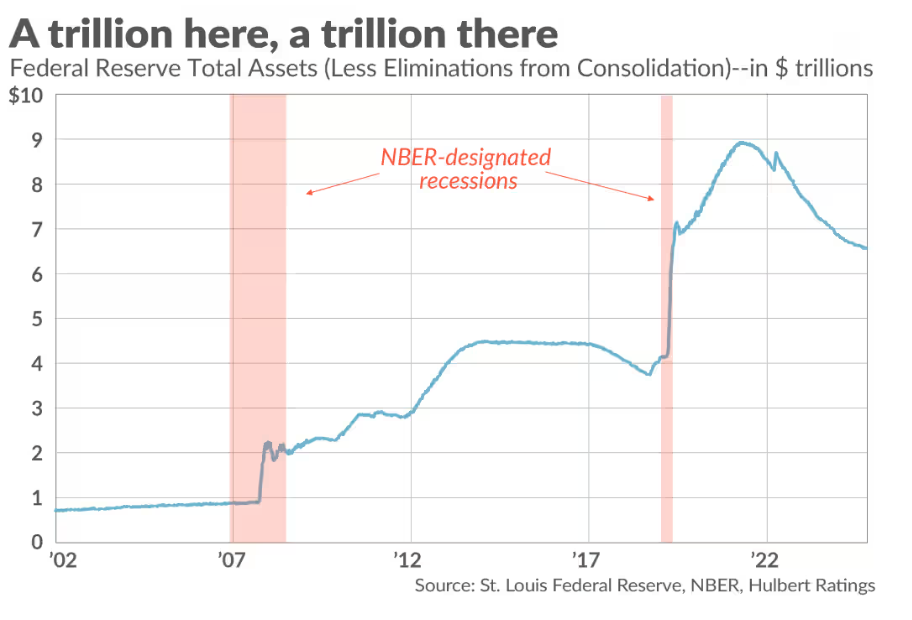
Core Viewpoint - The Federal Reserve's decision to end its quantitative tightening (QT) may not be as beneficial for the stock market as most investors believe, despite the significant implications of this policy shift [1]. Group 1: Federal Reserve's Actions - The Federal Reserve has reduced its balance sheet by $2.2 trillion since June 2022, which has been a major obstacle for the stock market [1]. - Historically, the stock market has performed better during periods of quantitative tightening than during quantitative easing (QE) [1][2]. Group 2: Stock Market Performance - During the recent QT phase, the S&P 500 index had an annualized total return of 20.9%, approximately double its historical average [1]. - Since 2003, during the 12-month periods of balance sheet contraction, the S&P 500 has averaged a gain of 16.9%, compared to only 10.3% during periods of balance sheet expansion [1]. Group 3: Economic Context - The negative correlation between the Fed's balance sheet size and the stock market is linked to the economic conditions when the Fed decides to expand or contract its balance sheet [2]. - The recent QT was possible due to a strong economy, suggesting that the announcement to end QT may indicate an impending economic downturn [5].
德意志银行:预计美联储将在12月FOMC货币政策会议上宣布结束量化紧缩(QT,即缩减资产负债表)
Sou Hu Cai Jing· 2025-10-16 19:50
Core Viewpoint - Deutsche Bank anticipates that the Federal Reserve will announce the end of quantitative tightening (QT) during the December FOMC monetary policy meeting [1] Group 1 - The expectation is based on the current economic conditions and the Fed's previous communications regarding monetary policy [1]
QT接近尾声 鲍威尔“鸽声”一锤定音 10月降息几成定局
2 1 Shi Ji Jing Ji Bao Dao· 2025-10-15 23:41
Group 1 - The Federal Reserve, led by Chairman Powell, is signaling a potential interest rate cut in October due to signs of a cooling labor market [1][7] - Powell indicated that the quantitative tightening (QT) program may be nearing its end, as the financial system's liquidity conditions are tightening [1][3] - The Fed's balance sheet has decreased from over $9 trillion to $6.6 trillion since mid-2022 due to QT measures [3] Group 2 - The end of QT is seen as a way to balance market sentiment, control inflation, and adjust liquidity conditions, with the timing differing from the cessation of interest rate hikes [4][5] - Analysts predict that ending QT could improve market liquidity, alleviate pressure on the bond market, and enhance expectations for monetary policy easing [5][6] Group 3 - Market expectations for a rate cut have increased, with concerns about the labor market overshadowing inflation risks [7][8] - The anticipated rate cut is expected to lower the 10-year U.S. Treasury yield, reflecting the impact of easing monetary policy on asset prices [9][10] Group 4 - A preventive rate cut is likely to benefit U.S. equities by enhancing market liquidity and reducing financing costs for companies [11] - The expected decline in U.S. Treasury yields may improve global financial market conditions and attract capital to emerging markets [11][12]
中国资产爆发,新东方涨超7%,阿里、京东、百度涨超2%
2 1 Shi Ji Jing Ji Bao Dao· 2025-10-15 15:48
Market Performance - The three major U.S. stock indices collectively rose, with the Dow Jones up 0.6%, S&P 500 up 1%, and Nasdaq up 1.32% [1] - The Philadelphia Semiconductor Index surged over 3%, with notable gains from companies like Supermicro (up over 8%) and Kioxia (up over 6%) [2] Technology Sector Highlights - Apple officially launched its M5 chip, which utilizes a third-generation 3nm process, achieving over four times the peak performance in AI computing compared to the previous M4 chip [2] - The M5 chip is now integrated into the new 14-inch MacBook Pro, iPad Pro, and Apple Vision Pro, with pre-orders already open [2] Chinese Stocks Performance - The Nasdaq Golden Dragon China Index rose over 2%, with significant increases from New Oriental and WeRide, both up over 7% [3] - Major Chinese tech stocks like Alibaba, JD.com, and Baidu also saw gains of over 2% [3] Commodity Market - Spot gold prices exceeded $4,210 per ounce, marking a new historical high with a year-to-date increase of over 60% [5] - Spot silver prices broke through $53 per ounce, also reaching a new historical high [5] Cryptocurrency Market - Bitcoin rose to $113,451.1, with a 24-hour increase of 1.35%, while Ethereum reached $4,202.2, up 5.18% in the same period [6]


鲍威尔“鸽声”一锤定音:QT接近尾声,10月降息几成定局
2 1 Shi Ji Jing Ji Bao Dao· 2025-10-15 12:55
Core Viewpoint - The Federal Reserve, led by Chairman Powell, is signaling a potential interest rate cut in October due to signs of a cooling labor market and tightening liquidity conditions [1][7]. Group 1: Federal Reserve's Monetary Policy - Powell's recent statements indicate a cautious approach to monetary policy, with a focus on avoiding past market pressures experienced in September 2019 [1][3]. - The end of the quantitative tightening (QT) program is anticipated, which has been in place since mid-2022 to absorb excess liquidity injected during the pandemic [2][4]. - The timing of ending QT is seen as a strategy to balance market sentiment and control inflation while adjusting the Fed's balance sheet [4][10]. Group 2: Market Reactions and Implications - The market is responding positively to the prospect of ending QT, which is expected to support U.S. equities, particularly growth and technology stocks [5][9]. - The cessation of QT will alleviate selling pressure in the bond market, potentially lowering long-term yields and enhancing expectations for monetary easing [4][5]. - A significant drop in the 10-year U.S. Treasury yield below 4% reflects market anticipation of rate cuts and the subsequent impact on asset prices [9][10]. Group 3: Economic Indicators and Future Outlook - Concerns about the labor market are overshadowing inflation risks, with Powell emphasizing the need for caution in policy adjustments [7][8]. - The upcoming data releases, including employment and inflation figures, are critical for shaping future monetary policy decisions [7][10]. - The potential for a "soft landing" in the economy could lead to a bullish scenario for both stocks and bonds, while persistent inflation or a sharp decline in employment could increase market volatility [10].