A股牛市

Search documents
境内ETF迈入“5万亿”时代,创业板ETF天弘(159977)、科创综指ETF天弘(589860)、中证A500ETF天弘(159360)午后翻红
2 1 Shi Ji Jing Ji Bao Dao· 2025-08-26 06:43
Market Performance - A-shares experienced a volatile trading day on August 26, with all major indices turning positive in the afternoon, led by the consumer electronics sector [1] - The total trading volume of the Shanghai and Shenzhen stock markets exceeded 2.2 trillion yuan, marking the 10th consecutive trading day above 2 trillion yuan [1] - The Tianhong ChiNext ETF (159977) saw a slight increase of 0.24% in the afternoon, with a trading volume surpassing 50 million yuan, and Tianfu Communication's stock rising over 13% [1] ETF Market Growth - As of August 25, the total scale of domestic ETFs surpassed 5 trillion yuan for the first time, reaching a historical high of 5.07 trillion yuan [1] - The breakdown of ETF types includes stock ETFs at 3.46 trillion yuan, cross-border ETFs at 753.72 billion yuan, bond ETFs at 555.90 billion yuan, commodity ETFs at 153.26 billion yuan, and money market ETFs at 142.47 billion yuan [1] Future Market Outlook - According to Caixin Securities, the current A-share bull market remains relatively healthy, with significant potential for new capital inflow [2] - The ratio of financial institutions' savings deposits to the market capitalization of the Shanghai and Shenzhen stock markets is at 142%, indicating a higher potential for capital migration from savings to equities compared to previous years [2] - Longcheng Securities noted that the "wealth effect" in the stock market has become more pronounced in recent months, suggesting further upward potential for A-share indices [2] ETF Characteristics - The Tianhong ChiNext ETF (159977) closely tracks the ChiNext Index, which consists of 100 representative companies listed on the ChiNext board [3] - The Tianhong Sci-Tech Innovation ETF (589860) tracks the Sci-Tech Innovation Index, covering approximately 97% of the market capitalization of the Sci-Tech Innovation board, focusing on small-cap hard technology companies [3] - The Tianhong CSI A500 ETF (159360) tracks the CSI A500 Index, which selects 500 stocks that represent strong market capitalization across various industries, balancing large-cap stocks with core industry leaders [3]

A股大涨后的灵魂拷问:追还是不追?
Hu Xiu· 2025-08-25 23:28
Group 1 - The recent surge in A-shares is primarily driven by liquidity rather than fundamental improvements, with insurance funds playing a significant role in this rally [3][4][5] - Approximately 1.5 to 1.7 trillion yuan of net inflow into the A-share market was recorded in the first half of the year, with two-thirds coming from insurance companies due to regulatory changes [3][9] - The strong performance of A-shares is expected to continue at least until September, influenced by upcoming political events and the potential for further capital inflows [5][36] Group 2 - The "national team" has not played a significant role in the recent bull market, with a slight decrease in related ETF investments since June [8] - Insurance funds have significantly increased their direct investments in stocks, with an estimated increase of around 1 trillion yuan over the past year [9][10] - Retail investors are cautiously increasing their stock market exposure, with potential excess savings of 55 trillion yuan available for investment [12][13] Group 3 - Despite the stock market rally, macroeconomic indicators remain weak, with industrial production and retail sales growth slowing down [26][27] - Fixed asset investment has seen a significant decline, and the real estate market continues to face challenges, with new home sales dropping sharply [28][29] - The overall economic environment suggests that while the stock market is performing well, underlying economic issues need to be addressed for sustainable growth [32][34] Group 4 - The rise of AI and innovative pharmaceuticals in China is contributing to a more favorable market sentiment, with significant advancements in these sectors [16][18][19] - Policy reforms over the past decade have laid the groundwork for the growth of the biotechnology industry, leading to a substantial increase in the number of innovative drugs under development [20][21] - The relationship between the U.S. and China, particularly regarding tariffs, is also influencing market perceptions, with expectations that the impact on Chinese exports may be less severe than previously thought [22][23][25] Group 5 - The valuation re-evaluation of A-shares is driven by the long-term competitiveness of Chinese companies and the easing of systemic risks in the real estate sector [35][36] - Key indicators to monitor for the sustainability of the current market rally include domestic bond yields, policy catalysts, quarterly earnings results, and potential government interventions [36]
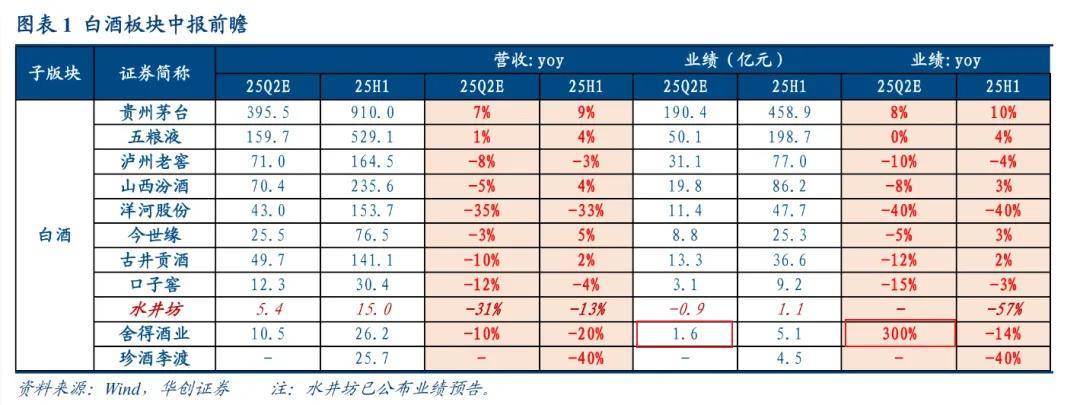
白酒意外大涨!踏空资金可能在批量进场了
Sou Hu Cai Jing· 2025-08-25 15:46
Group 1: Company Performance - Shede Liquor reported a net profit of 440 million yuan for the first half of 2025, a year-on-year decrease of 25% [1] - In the second quarter, the net profit was less than 100 million yuan, showing a year-on-year increase of 140%, which was significantly below the previous forecast of 160 million yuan by brokerage institutions [1] - Despite the poor performance, Shede's stock price did not plummet but instead hit the daily limit up [1] Group 2: Industry Overview - The overall performance of the liquor industry has shown mixed results, with major brands like Kweichow Moutai and Wuliangye experiencing slight revenue growth, while others like Luzhou Laojiao and Yanghe Co. faced declines [2] - The liquor sector has seen a recent surge in stock prices, driven by funds that missed out on previous gains, leading to increased buying in lower-priced stocks [3] - The sentiment in the market suggests a growing "FOMO" (fear of missing out) among investors, particularly in sectors like liquor, real estate, and chemicals, despite the lack of significant improvement in their fundamentals [3]

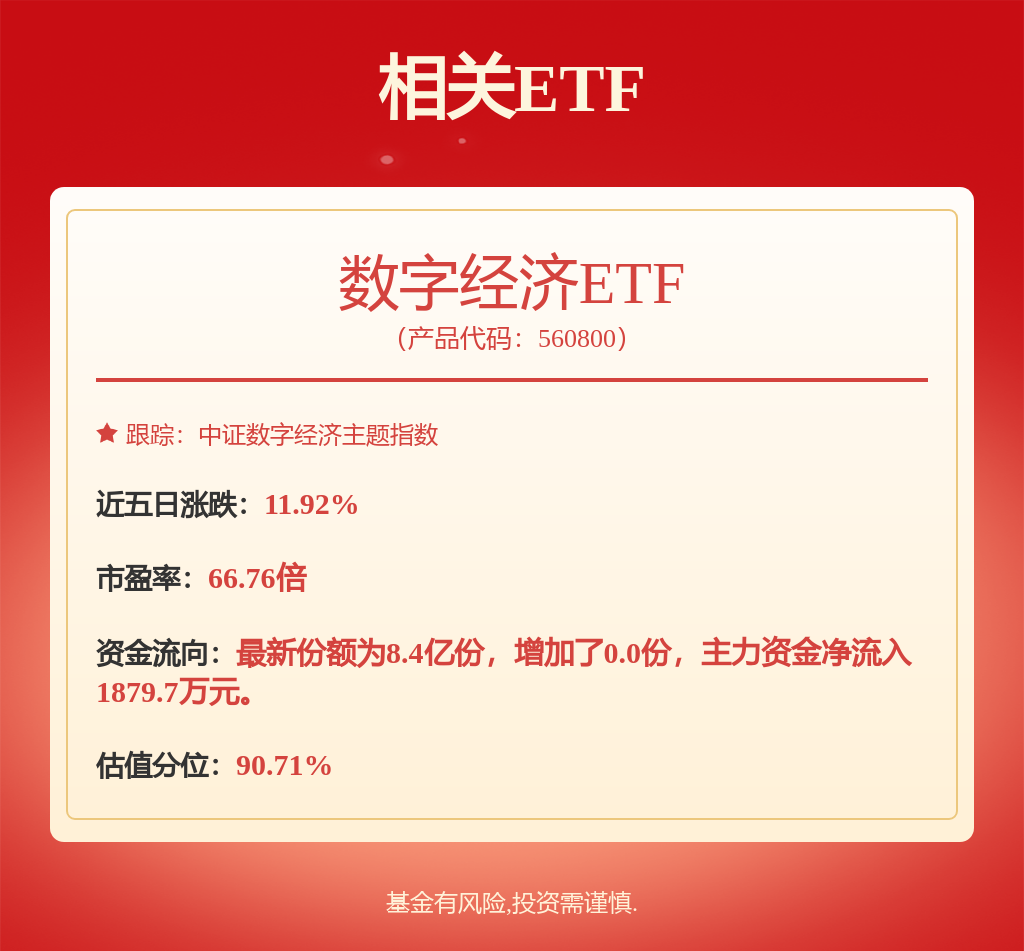
A股剑指3900点,单日成交破3万亿元,A500ETF龙头(563800)冲击4连涨!中证A500指数盘中突破5300点创年内新高
Xin Lang Cai Jing· 2025-08-25 07:37
Group 1 - The core driving force behind the recent rise in the A-share market is the increase in liquidity, with a positive cycle expected to form as new and old funds take turns to drive the market upward [1] - As of August 25, 2025, the A-share market saw a significant increase in trading volume, with over 2 trillion yuan traded in a single day, indicating strong market activity [1] - The semiconductor industry has shown notable performance, with key stocks reaching new highs, such as Cambrian Technology's stock price surpassing 1300 yuan [1] Group 2 - Foreign institutional investors are accelerating their entry into the A-share market, with hedge funds buying Chinese stocks at the fastest pace since June [2] - As of August 21, 2025, foreign institutions held approximately 2.5 trillion yuan in A-shares, an 8% increase from the end of 2024, indicating growing foreign interest [2] - The market outlook remains positive, supported by reasonable valuations and the potential for a new easing cycle from the Federal Reserve, which could further boost market sentiment [2]
史上第二次!A股成交额超3万亿元 专家解读来了
2 1 Shi Ji Jing Ji Bao Dao· 2025-08-25 07:16
Core Insights - The A-share market has reached a historic moment with trading volume exceeding 3 trillion yuan, marking a significant increase from the previous year [1] - The market has seen a continuous surge in trading volume, with 63 consecutive trading days surpassing 1 trillion yuan and 9 consecutive days exceeding 2 trillion yuan, indicating a record-breaking activity [2] - Economic factors such as the transfer of household savings to capital markets and continued foreign investment are driving this market activity, although caution is advised regarding the sustainability of this trend [2][4] Market Activity - The current high trading volume is attributed to a combination of policy support and market dynamics, with a notable shift of household savings into the stock market [2] - The macro liquidity environment is relatively loose, with the 10-year government bond yield below 1.8% and the 1-year LPR at 3%, encouraging the movement of deposits into equities [2] - The number of new A-share accounts opened in July reached 1.9636 million, a nearly 71% increase compared to the same period last year, indicating heightened investor interest [3] Investment Trends - Various sources of incremental capital are contributing to the current bull market, including long-term funds like insurance and pension funds, active trading by private equity, and increasing foreign interest in A-shares [3] - International funds are shifting towards A-shares and H-shares, with notable increases in investment from South Korean retail investors, reflecting a growing interest in Chinese equities [3] Future Outlook - Analysts suggest that while the current market conditions are favorable, the bull market cycle typically does not exceed one year, necessitating a rational approach to the upward momentum [5] - The market is expected to benefit from a potential recovery in PPI and improved corporate profitability, supported by ongoing liquidity and policy expectations [5]
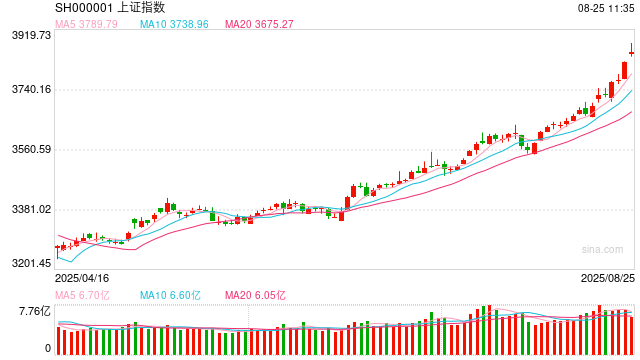
大盘午后反弹,沪指剑指3900点,A500ETF易方达(159361)等产品成交活跃
Mei Ri Jing Ji Xin Wen· 2025-08-25 06:56
Group 1 - The core index of the A-share market, the Shanghai Composite Index, regained the 3850-point level after a midday pullback, with sectors such as rare earth permanent magnets, liquor, and precious metals leading the gains [1] - The CSI A500 Index rose by 1.4%, with several constituent stocks including Robotech, Goldwind Technology, Jiangsu Guotai, China Satellite, and Zhongke Shuguang hitting the daily limit [1] - The A500 ETF managed by E Fund (159361) saw a trading volume of nearly 2 billion yuan during the session, indicating strong investor interest [1] Group 2 - Huaxi Securities noted that the current bull market in A-shares has evolved since the "924" period, with diverse sources of incremental capital, including long-term funds from insurance and pension funds, active trading from margin financing and private equity, and increasing foreign interest [1] - There are early signs of "deposit migration" among residents, suggesting that household funds may continue to enter the market through ETFs, direct stock holdings, and public funds, which could be a key driver for the sustained "slow bull" market [1] - The CSI A500 Index is composed of 500 stocks with large market capitalization and good liquidity across various industries, leveraging a "balanced industry + leading segments" compilation logic to achieve dual-driven growth of "core assets" and "new productive forces" [1]
杨德龙:A股这轮牛市是十年一遇的特大牛市,级别可以与07年和15年两轮牛市相媲美!突破6000点大关也不是不可能
Sou Hu Cai Jing· 2025-08-25 03:55
近期资本市场高歌猛进,迎来了重大利好。美联储主席鲍威尔在杰克逊霍尔全球央行年会上发表了鸽派 讲话,明确表示9月份降息的可能性非常大。此前,鲍威尔一直谨慎,未明确暗示9月份会降息。然而, 当前美国非农就业数据下降,特别是美国劳工局大幅下调了5月和6月的就业数据,这让特朗普非常恼 火,当场解雇了美国劳工局局长。此外,特朗普近期还对另一位美联储理事发起免职威胁,试图换上支 持降息的理事,给鲍威尔施加压力。 美联储降息会导致美元指数继续回落,非美货币升值,人民币升值预期增强。这将减少中国央行降息降 准的顾虑,可能会采取更加果断的措施实施适度宽松的货币政策,以稳住经济增速,实现全年增长5% 左右的目标。 这轮大牛市与2006年、2007年以及2014年、2015年这两轮大牛市相比,共同之处在于行情级别高,上涨 高度可能超出所有人预期。投资者在这轮大牛市中普遍会赚到钱,只有极少数投资者追涨杀跌、频繁交 易会出现亏损,而且会出现很多10倍牛股。不同点在于上涨逻辑不一样。2007年主要是经济基本面加上 资金加持共同推动的牛市,市场上涨节奏平稳,几乎每月上涨几百点。2014年、2015年牛市,经济基本 面没有太大提升,但资金流 ...
十大券商看后市|A股行情仍有一定的演绎空间,波动或将增加
Xin Lang Cai Jing· 2025-08-25 00:01
Group 1 - The A-share market has reached 3800 points for the first time in ten years, with most brokerages believing that the internal and external fundamentals and liquidity conditions do not present significant bearish factors, supporting a continued upward trend in the market [1][9] - Citic Securities indicates that the current market rally is primarily driven by institutional investors rather than retail investors, emphasizing the importance of focusing on industry trends and performance rather than merely liquidity [2] - Guotai Junan Securities expresses optimism about the A-share market, citing multiple factors such as capital market reforms and improved risk appetite, which are expected to support the performance of Chinese assets [3] Group 2 - Galaxy Securities warns of potential increased volatility in the A-share market as it enters an acceleration phase, despite a generally positive mid-term outlook [4][6] - Zheshang Securities advises investors to ignore short-term fluctuations and focus on medium-term strategies, suggesting to increase positions near key support levels [10][11] - Xinyi Securities highlights the importance of identifying low-position opportunities in technology growth sectors while also considering cyclical sectors with growth potential [12] Group 3 - Huatai Securities notes that the consensus on the upward trend in the market is strengthening, driven by improvements in domestic fundamentals and liquidity [7][8] - The market is expected to maintain its strength until early September, with a shift in focus from short-term momentum to mid-term developments post-September [6] - The overall sentiment in the market remains bullish, with a focus on sectors such as AI, innovative pharmaceuticals, and military industries as key strategic allocations [8][13]




杨德龙:鲍威尔释放鸽派信号,美联储9月降息板上钉钉 | 立方大家谈
Sou Hu Cai Jing· 2025-08-24 12:46
Group 1 - Federal Reserve Chairman Jerome Powell's speech at the Jackson Hole global central bank conference indicated a dovish stance, emphasizing employment risks and suggesting potential interest rate cuts, with a significant increase in the probability of a 25 basis point cut in September [1] - Powell acknowledged the clear impact of the trade war on consumer prices but suggested it may be a temporary shock, allowing the central bank to overlook it [1] - The current employment landscape presents significant downward risks, indicating that the Federal Reserve may cut rates two to three times this year, potentially lowering the benchmark rate from the current range of 4.25% to 4.5% to below 4% [1] Group 2 - The anticipated rate cuts by the Federal Reserve could positively impact the U.S. stock market, although concerns remain regarding high valuations, as evidenced by Warren Buffett's significant reduction in U.S. stock holdings [1][2] - The A-share market has established a bullish trend, with trading volume exceeding 2 trillion yuan for eight consecutive trading days, and the Shanghai Composite Index successfully surpassing 3,800 points [2] - Five main sources of capital inflow into the stock market are identified: a shift from household savings, funds moving from the bond market, capital exiting the real estate market, funds from traditional industries, and increased foreign investment, particularly in technology innovation [2] Group 3 - The current bull market in A-shares and Hong Kong stocks is expected to last 2 to 3 years, driven by continuous capital inflow, contrasting with previous bull markets in 2007 and 2015 [3] - Unlike past cycles, the current economic fundamentals have not shown significant improvement, which may take until next year or the year after to manifest, leading to a slow bull market that could eventually boost consumption and market confidence [3] - Investors are advised to maintain confidence in the ongoing bull market while managing risks and avoiding excessive leverage, learning from the lessons of the 2015 market crash [3]
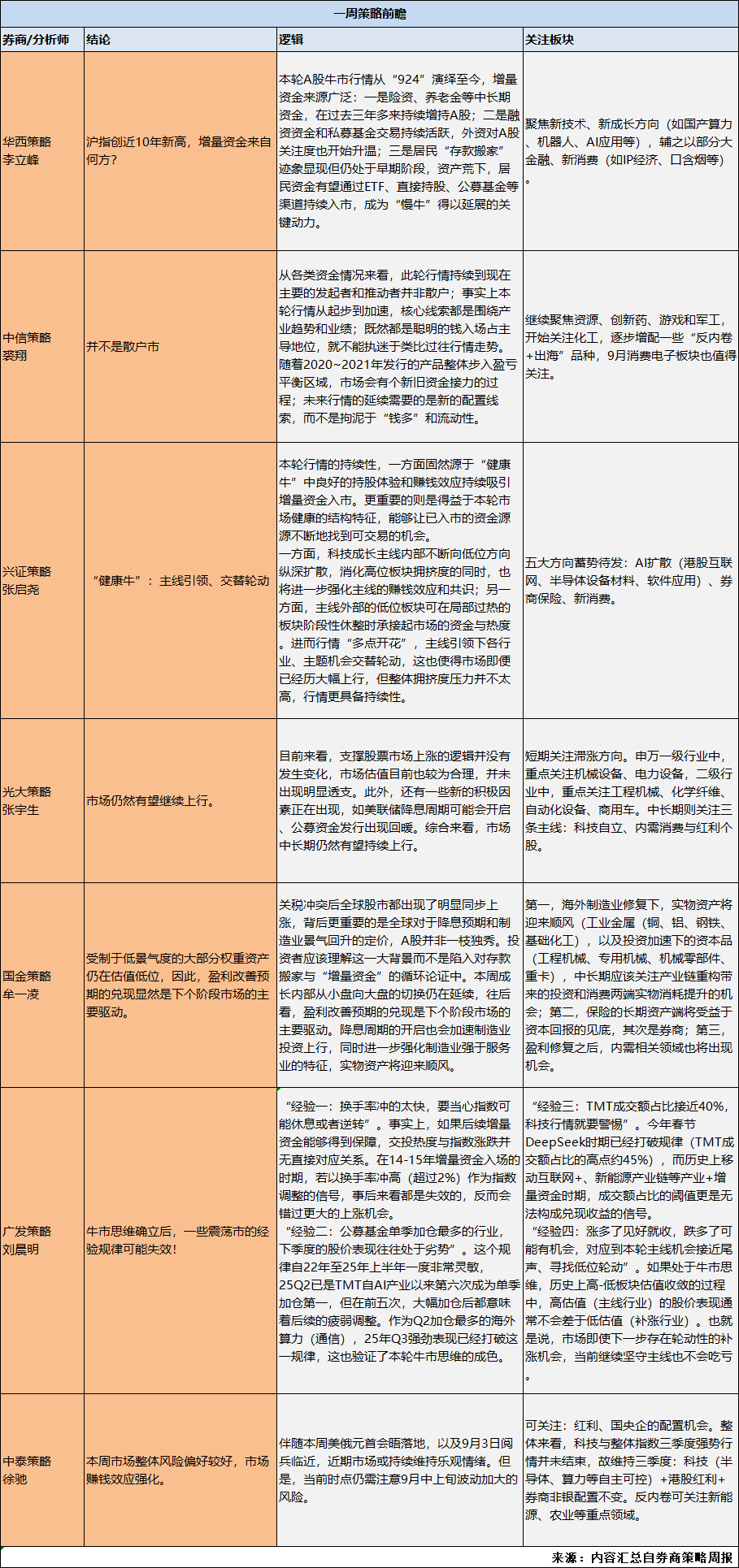
A股分析师前瞻:策略普遍看好行情延续性,这些方向或蓄势待发
Xuan Gu Bao· 2025-08-24 12:09
Group 1 - The current bullish trend in A-shares is supported by various sources of incremental capital, including long-term funds such as insurance and pension funds, active trading by margin financing and private equity, and increasing foreign interest in A-shares [1][2][3] - There are signs of residents moving their savings into the market, although this is still in the early stages, which could provide a key driving force for the continuation of a "slow bull" market [1][3] - The focus for future investments should be on new technologies and growth sectors, such as domestic computing power, robotics, and AI applications, alongside major financial and new consumption sectors [2][3] Group 2 - The current market is characterized by a "healthy bull" phase, where good holding experiences and profit effects continue to attract incremental capital [2][3] - The market's sustainability is attributed to its healthy structural characteristics, allowing existing capital to continuously find trading opportunities [2][3] - Future market trends will require new allocation clues rather than merely relying on liquidity and the abundance of capital [2][3] Group 3 - Analysts emphasize that this market rally is not driven by retail investors but rather by smart money, focusing on industrial trends and performance [2][3] - As products issued in 2020-2021 approach breakeven, a transition between old and new capital is expected, which will be crucial for the market's continuation [2][3] - The market is anticipated to maintain upward momentum, supported by a potential interest rate cut cycle and a recovery in manufacturing investment [4]