
避险资产

Search documents
创纪录涨势后,美国黄金储备价值触及1万亿美元
Hua Er Jie Jian Wen· 2025-09-29 13:30
Core Viewpoint - The market value of the U.S. Treasury's gold reserves has surpassed $1 trillion for the first time, driven by a significant increase in gold prices, which have risen by 45% this year, reaching a peak of $3,824.5 per ounce [1][6]. Group 1: Gold Price Dynamics - The surge in gold prices is attributed to investors seeking safe-haven assets amid trade wars, geopolitical tensions, and concerns over potential U.S. government financing crises [1][6]. - The Federal Reserve's resumption of interest rate cuts has further enhanced the attractiveness of gold by lowering the opportunity cost of holding non-yielding assets [6][10]. - Institutional and official buying has provided solid support for gold prices, with gold ETFs experiencing strong demand, marking one of the strongest years on record [6][7]. Group 2: Valuation Discrepancies - The official value of gold on the U.S. government's balance sheet remains fixed at just over $11 billion, based on a price set by Congress in 1973, creating a disparity where the market value is over 90 times the book value [3][12]. - A revaluation of the gold reserves at current market prices could theoretically release approximately $990 billion in funds for the U.S. Treasury, which is particularly enticing given the current debt ceiling constraints [4][12]. - Discussions around the potential revaluation of gold reserves have emerged, although U.S. Treasury Secretary Yellen has denied that such a move is being seriously considered [4][12][13]. Group 3: Market Sentiment and Technical Analysis - Current market sentiment indicates that speculative long positions in gold have increased but have not reached extreme levels, suggesting that the market has not entered a "panic buying" phase [10]. - Technical analysis points to a potential target price of around $4,000 per ounce, based on trend lines connecting previous highs, indicating that there may still be room for price increases [9][10]. Group 4: Historical Context and Storage - The U.S. gold reserves total approximately 261.5 million ounces, with over half stored at Fort Knox, Kentucky, and the remainder in various locations, including West Point and Denver [14]. - There have been public speculations regarding the existence of the gold at Fort Knox, fueled by comments from notable figures, highlighting ongoing interest and concern about the U.S. gold reserves [14].

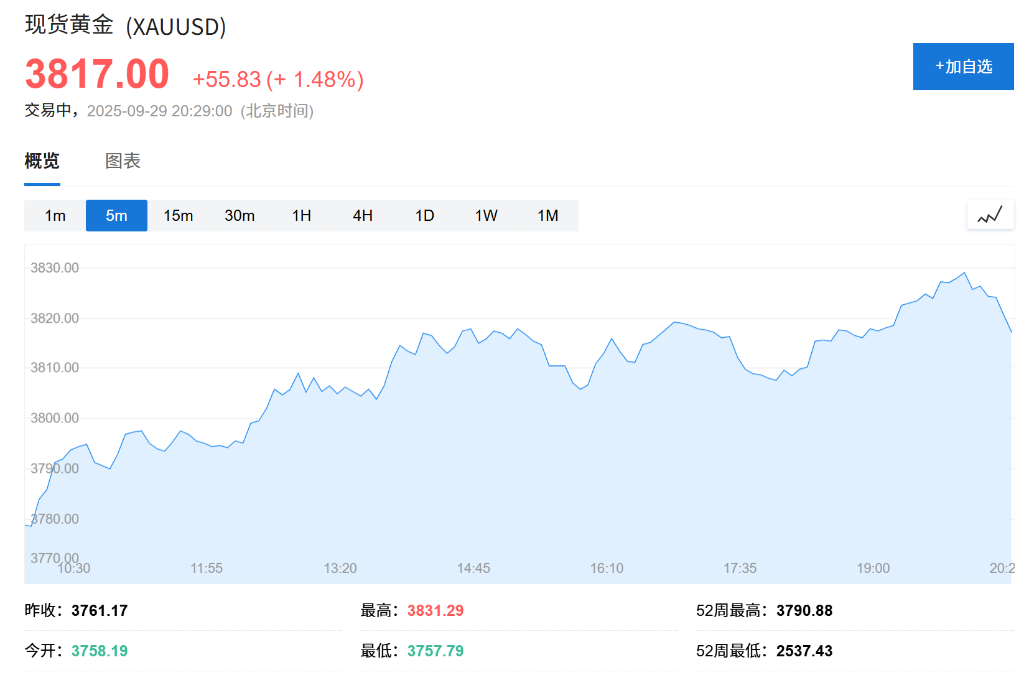
三大期指齐涨,中概股普涨;现货黄金突破3800美元/盎司;阿斯利康将在纽交所上市,保留英国总部【美股盘前】
Mei Ri Jing Ji Xin Wen· 2025-09-29 11:38
Market Overview - Major U.S. stock index futures are showing positive movement, with Dow futures up 0.37%, S&P 500 futures up 0.49%, and Nasdaq futures up 0.64% [1] Chinese Stocks - Chinese concept stocks are experiencing a pre-market rally, with Bilibili, Li Auto, and Alibaba rising over 3.5%, while JD.com, Baidu, and Beike are up over 2.5%, and Xpeng Motors is up over 1% [2] Company News - Spotify's stock has increased by over 1% in pre-market trading, following a price target upgrade from JPMorgan from $740 to $805 [3] - Electronic Arts (EA) is reportedly negotiating a privatization deal that could reach $50 billion, with potential investors including Saudi Arabia's Public Investment Fund, Silver Lake Partners, and Jared Kushner's Affinity Partners [4] - Danish pharmaceutical giant Novo Nordisk has seen its stock drop over 3% after Morgan Stanley lowered its European stock price target from 380 Danish Krone to 300 Danish Krone and downgraded its rating from "in line with the market" to "underweight" [4] - AstraZeneca plans to list on the New York Stock Exchange while retaining its headquarters in the UK, aiming to attract more investors while continuing to trade in London [4] Energy Sector - TotalEnergies has announced the sale of a 50% stake in its North American solar portfolio for $950 million to KKR, which aligns with its renewable energy business model [4] Commodities - Spot gold prices have surpassed $3,800 per ounce, reaching a new historical high, while spot silver has increased over 2%, hitting $47 per ounce, the highest since May 2011 [4] Economic Outlook - Jefferies economists suggest that U.S. interest rates may not decline as quickly or significantly as the market anticipates, due to the resilience of the U.S. economy [4]

黄金白银,彻底涨疯了!
格隆汇APP· 2025-09-29 11:11
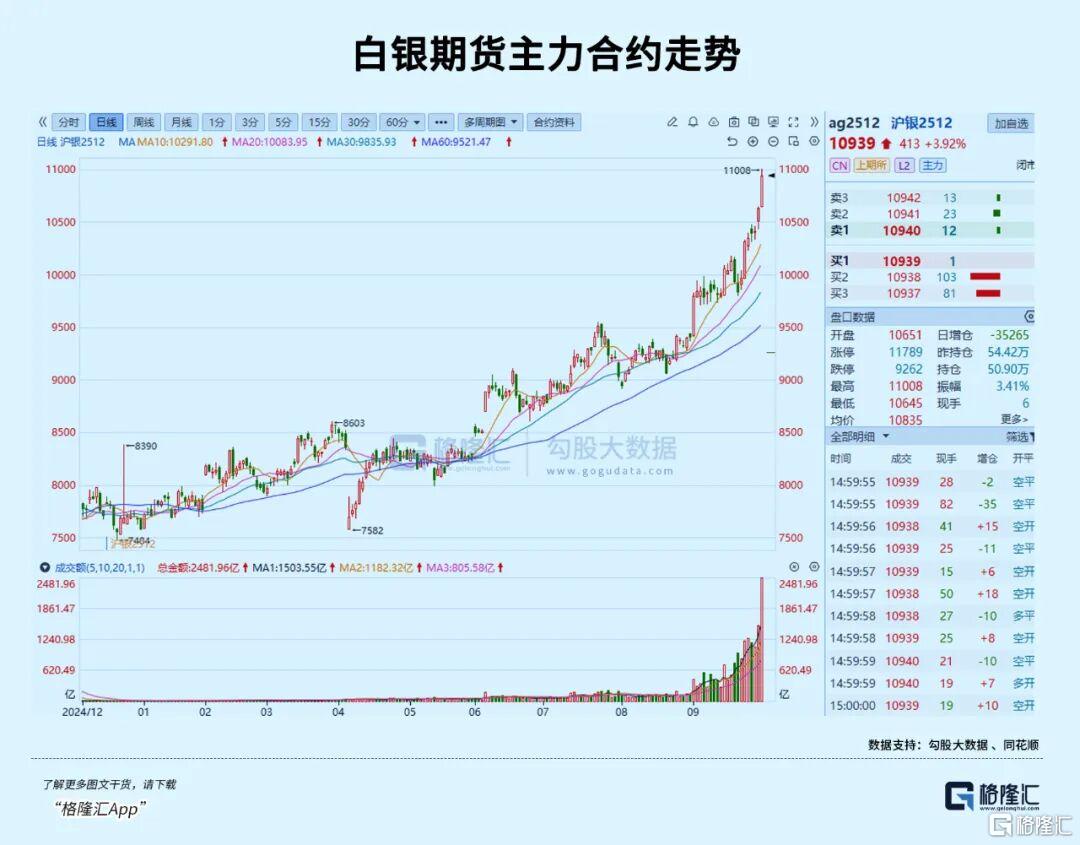
Core Viewpoint - The article highlights a significant surge in gold and silver prices, driven by various market factors, including inflation data, geopolitical tensions, and central bank policies, indicating a strong demand for these precious metals as safe-haven assets [2][3][8]. Group 1: Market Performance - On September 29, gold futures rose by 1.35% to 866.52 CNY per gram, reaching a historical high, while silver futures surged by 3.92% to 10,939 CNY per kilogram, also breaking new records [2]. - The A-share precious metals sector increased by 3.6%, with all related stocks showing strong performance, positively impacting the non-ferrous and minor metals sectors [2]. - The trading volume for gold futures reached 287.447 billion CNY, an increase of over 50 billion CNY from the previous day, while silver futures saw a trading volume of 248.196 billion CNY, up nearly 100 billion CNY, marking a 64% increase [4][7]. Group 2: Influencing Factors - Recent favorable news for precious metals includes the U.S. August core PCE price index year-on-year at 2.9%, which alleviated concerns about interest rate cuts, leading to accelerated price increases for gold and silver [8]. - Dovish statements from several Federal Reserve officials supporting potential interest rate cuts have reinforced market expectations for an accelerated easing cycle [8]. - Geopolitical tensions, particularly in regions like Ukraine and the Middle East, have heightened market anxiety, further driving demand for gold and silver as safe-haven assets [8]. Group 3: Central Bank Activities - Global central banks have significantly increased their gold reserves, with a total value of approximately 4.5 trillion USD, surpassing the 3.5 trillion USD in U.S. Treasury reserves [9]. - China's central bank reported a gold reserve of 74.02 million ounces as of August 2025, marking a continuous increase for ten months, with a total purchase of 36 tons from January to July 2025 [12]. Group 4: Price Trends and Predictions - Gold prices have risen nearly 45% year-to-date, making it the best-performing asset among major asset classes, while silver has seen an increase exceeding 60% [15]. - Institutions have raised their price targets for gold, with expectations of reaching 4,000 USD per ounce by the end of the year, and potential scenarios suggesting prices could rise to 4,500 USD or even 5,000 USD under certain conditions [18]. Group 5: Silver Market Dynamics - Silver futures have experienced a notable increase in trading volume, indicating heightened market interest compared to gold [20][21]. - The silver market is facing a significant supply-demand imbalance, with industrial demand driven by sectors like solar energy and electric vehicles, while supply constraints are exacerbated by environmental regulations and labor disputes in major producing countries [24][26]. - The current market dynamics reflect a structural phase where industrial demand and valuation recovery are driving silver prices, supported by the ongoing energy revolution and monetary easing [33].
黄金白银,彻底涨疯了!
Ge Long Hui· 2025-09-29 11:03
Core Viewpoint - The precious metals market, particularly gold and silver, has experienced significant price increases and trading volume surges, driven by various economic and geopolitical factors. Group 1: Price Movements - As of September 29, gold futures rose by 1.35% to 866.52 yuan per gram, reaching a historical high, while silver futures surged by 3.92% to 10,939 yuan per kilogram, also hitting a new peak [1] - The precious metals sector in the A-share market increased by 3.6%, indicating strong performance across all related stocks [1] - Year-to-date, COMEX gold prices have increased by nearly 45%, while COMEX silver has risen over 60%, outperforming most commodities and stock markets [11] Group 2: Trading Volume - The combined trading volume of gold and silver futures reached 778 billion yuan, accounting for over one-third of the total A-share market turnover of 2.18 trillion yuan [3] - Gold futures trading volume increased by over 500 billion yuan from the previous day, while silver futures saw a nearly 1 billion yuan increase, marking a 64% rise [1] Group 3: Market Drivers - Recent favorable economic indicators, such as the U.S. core PCE price index remaining at 2.9%, have alleviated concerns about interest rate cuts, contributing to the rise in gold and silver prices [4] - Geopolitical tensions, including conflicts in Ukraine and the Middle East, have heightened market uncertainty, driving demand for safe-haven assets like gold and silver [4] - The potential U.S. government shutdown could delay key employment data, further complicating the Federal Reserve's monetary policy outlook and increasing demand for precious metals [4] Group 4: Central Bank Activities - Global central banks have significantly increased their gold reserves, with total holdings valued at approximately $4.5 trillion, surpassing the $3.5 trillion in U.S. Treasury holdings [6] - China's central bank has also been actively increasing its gold reserves, with a total of 7.402 million ounces as of August 2025, marking the tenth consecutive month of purchases [8] Group 5: Silver Market Dynamics - Silver has seen a more pronounced price increase compared to gold, with a 40% rise since June, driven by strong industrial demand, particularly in the solar energy sector [15] - The supply-demand imbalance for silver is at its most acute in a decade, with significant increases in demand from the electric vehicle and semiconductor industries [17][18] - The silver market is characterized by rigid demand growth and limited supply elasticity, with a projected supply deficit of 3,657 tons by 2025 [19][20] Group 6: Investment Sentiment - Institutional forecasts for gold prices have risen, with expectations of reaching $4,000 per ounce by the end of the year, and potential scenarios suggesting prices could approach $5,000 per ounce if a small percentage of U.S. Treasury funds flow into gold [14] - Speculative trading in silver has intensified, with non-commercial net long positions increasing significantly, indicating strong market interest [23]
Bullion bonanza: why is gold hitting record highs?
The Guardian· 2025-09-29 09:33
Group 1: Gold Market Overview - Gold is experiencing its best year since 1979, with record highs in 2025, driven by various economic and geopolitical factors [1][6] - The spot price of gold has surged by 45% since January, reaching a record high of $3,190 per ounce [6] - Inflows into gold have been significant, with $5.6 billion in a single week and record inflows of $17.6 billion over the past four weeks [6] Group 2: Demand Drivers - Gold is seen as a safe haven and store of value amid fears of economic slowdown and geopolitical tensions, particularly between Russia and NATO [2] - Concerns regarding U.S. economic policies, including interest rates and trade wars, are contributing to the rising demand for gold [3][10] - Central banks, especially in China, are increasing their gold reserves to reduce dependence on the U.S. dollar and strengthen their position in the global market [11] Group 3: Comparisons with Other Precious Metals - Gold's scarcity and its role as a store of value differentiate it from other precious metals like copper, platinum, and palladium, which are consumed in large quantities [4][5] - The World Gold Council notes that total gold supplies are increasing at an estimated rate of 1.7% per year, reinforcing its value proposition [4] Group 4: Market Sentiment and Future Outlook - Analysts suggest that gold is currently "overbought" but "under owned," indicating potential for further price increases [7] - Deutsche Bank has raised its gold price forecast for 2026 to $4,000 per ounce, reflecting bullish sentiment in the market [14] - The weakening U.S. dollar, down over 9% in 2025, is mechanically lifting gold's value in dollar terms [13]
黄金再创新高!华安黄金ETF(518880)单日成交近44亿领跑同类,资金加速涌入
Xin Lang Ji Jin· 2025-09-29 07:50
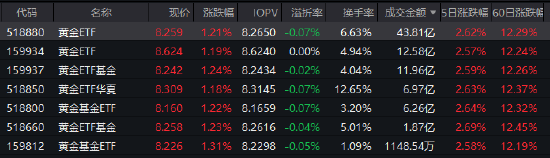
Core Viewpoint - The A-share market experienced a strong rebound on September 29, with the Shanghai Composite Index rising nearly 1% and the ChiNext Index increasing by almost 3%, indicating a positive market sentiment towards investments, particularly in gold ETFs [1]. Group 1: Market Performance - The Huazhang Gold ETF (518880) closed at 8.259 yuan, with a daily increase of 1.21% and a trading volume of 4.381 billion yuan, leading the category of gold ETFs in terms of scale [1][2]. - Despite a net outflow of 721 million yuan over the past 60 trading days, there has been a significant inflow of funds in the short to medium term, with net inflows of 4.112 billion yuan over the last 20 days and 1.188 billion yuan over the last 10 days [2]. Group 2: Gold Price Dynamics - The international gold market has shown strong performance, with spot gold prices surpassing 3,800 USD per ounce, contributing to the bullish sentiment in domestic gold ETFs [1][3]. - Factors driving the increase in gold prices include rising global investment demand and heightened market risk aversion due to potential U.S. government shutdowns and challenges to the Federal Reserve's monetary policy independence [3]. Group 3: Investment Outlook - Goldman Sachs has a bullish long-term outlook for gold prices, predicting they could reach 4,000 USD per ounce by 2026, with potential scenarios suggesting prices could rise to 4,500 USD or even 5,000 USD under extreme conditions [3]. - The Huazhang Gold ETF, established in July 2013, has a current circulation scale of 65.627 billion yuan and a cumulative return rate of 208.28%, making it a core tool for investors looking to allocate gold assets [4].
金条降价,黄金跌价,25年9月28日,各大银行黄金金条最新价格
Sou Hu Cai Jing· 2025-09-28 22:22
Core Insights - The gold price has surged to record levels, driven by optimistic institutional forecasts and macroeconomic factors, indicating potential investment opportunities in the precious metals market [1][26][30]. Domestic Retail Market - Domestic gold retail prices show significant differentiation, with international gold spot prices at $3,761.9 per ounce, approximately ¥859.5 per gram. Major brands like Caibai and Lao Fengxiang set prices at ¥1,058 and ¥1,108 per gram respectively, reflecting competitive pricing strategies [2][3]. - The lowest price recorded was at Sun Gold Store, priced at ¥969 per gram [3]. International Market Dynamics - The international precious metals market experienced volatility on September 28, with gold prices declining to ¥3,311.86 per gram, a decrease of 1.27%. In contrast, platinum and palladium prices saw significant increases, with platinum rising by 3.03% to ¥1,176.76 per gram and palladium soaring by 5.36% to ¥1,065.20 per gram [4]. Bank Paper Precious Metals Pricing - Various banks exhibited differing price trends for paper precious metals. For instance, Industrial and Commercial Bank of China (ICBC) reported a paper gold price of ¥863.71 per gram, up by 0.84%, while China Construction Bank's price fell by 0.51% to ¥862.66 per gram [6][7][8]. Coin Series Pricing - The 2025 Panda gold coin series pricing was detailed, with the complete set priced at ¥52,119. Individual coins ranged from ¥1,170 for a 1-gram coin to ¥480,000 for a 1-kilogram commemorative coin [14][15][22]. Price Outlook and Institutional Predictions - The gold price has seen an unprecedented rise, with a cumulative increase of over 8.5% since September, and a year-to-date increase of 38%, outperforming major global stock indices and bond yields [26]. - Key factors supporting the gold price surge include expectations of Federal Reserve interest rate cuts, concerns over economic stagflation, geopolitical risks, and increased central bank gold purchases [27][28][29]. - Institutions like JPMorgan and Goldman Sachs maintain optimistic forecasts, predicting gold prices could exceed $4,000 per ounce in the near future, with potential spikes to $5,000 per ounce under certain conditions [30].
美联储降息后,最利好的资产出现了?
大胡子说房· 2025-09-28 10:31
Core Viewpoint - The article highlights the significant rise in silver prices, which have outperformed gold this year, driven by both investment demand and industrial usage, particularly in renewable energy sectors [1][2]. Group 1: Silver Market Dynamics - Silver has seen a year-to-date increase of 48% as of mid-September, surpassing gold's performance, with a peak price of $42.96 per ounce, the highest in 14 years [1]. - The silver market is characterized by a strong physical trading volume compared to gold, making it more susceptible to market squeezes and price volatility [2]. - The industrial demand for silver, particularly in photovoltaic cells and electric vehicles, is expected to surge, with projections indicating over 600 GW of new solar installations by 2025 [2]. Group 2: Economic Context and Future Outlook - The current economic environment is marked by fears of a debt-driven collapse, with parallels drawn to historical instances of currency devaluation in countries like Argentina and Turkey [3][4]. - The article posits that the global economy is transitioning away from a dollar-dominated system, with gold and silver serving as alternative hard currencies during this shift [4]. - Predictions suggest that silver prices could rise to over $60 per ounce in the coming years, particularly as the Federal Reserve continues its easing policies [2][5]. Group 3: Investment Strategy - The article advocates for the inclusion of gold and silver in investment portfolios as a hedge against potential economic downturns, emphasizing their role as hard currencies during periods of financial instability [5]. - It suggests that as the Federal Reserve accelerates rate cuts, the price gap between gold and silver may widen further, presenting a compelling investment opportunity [5].

全球最大黄金ETF持仓超1000吨 创三年新高
2 1 Shi Ji Jing Ji Bao Dao· 2025-09-28 06:31
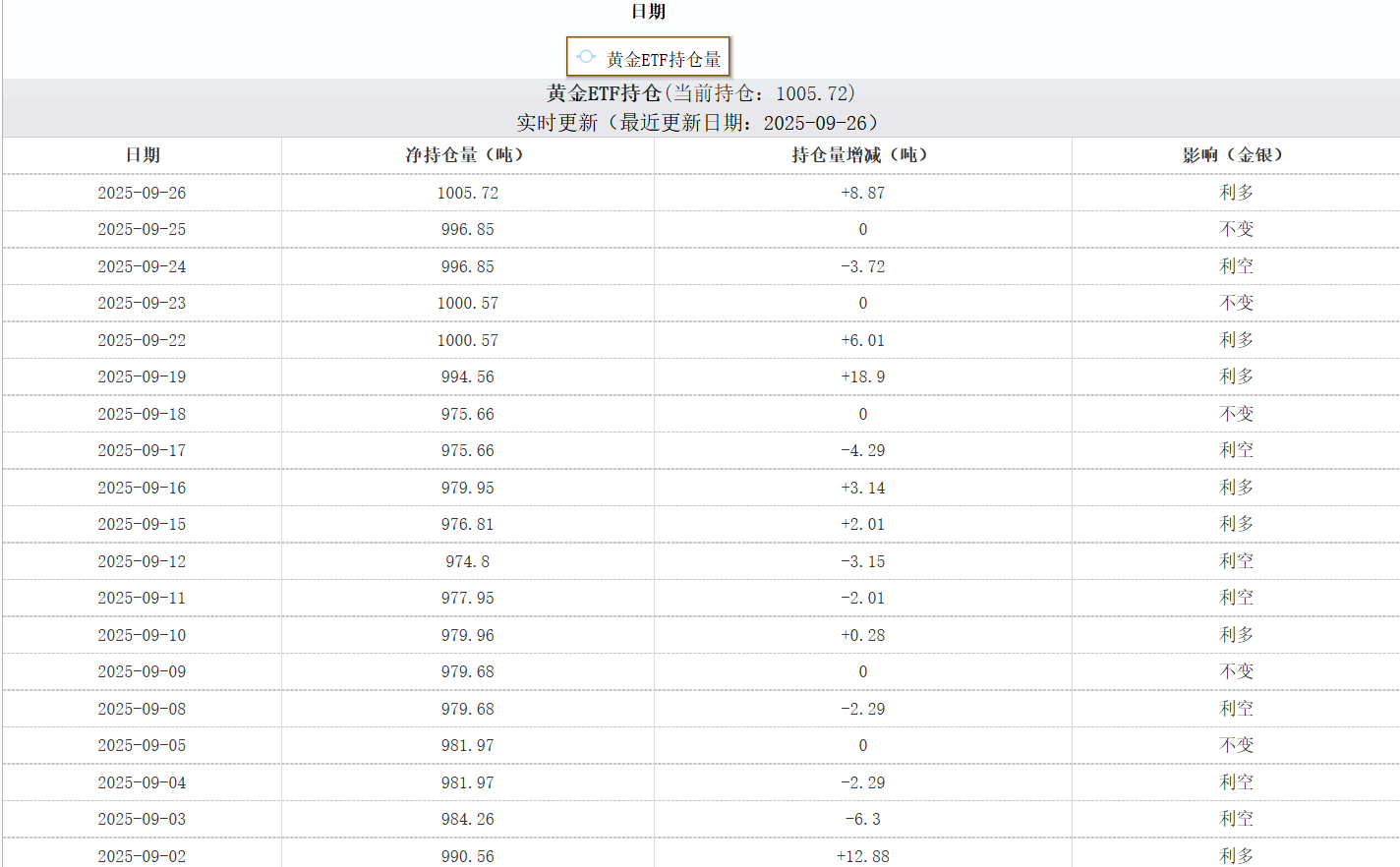
Core Viewpoint - The gold market has seen unprecedented confidence, with gold prices rising significantly and the largest gold ETF, SPDR, reaching a record holding of 1005.72 tons, marking a 43% increase this year [1][3]. Group 1: Gold ETF Holdings - SPDR's gold holdings have increased significantly in September, with notable additions of 18.9 tons on September 19, 6.01 tons on September 22, and 8.87 tons on September 26, surpassing 1000 tons [3]. - As of September 26, 2025, SPDR's gold holdings stood at 1005.72 tons, reflecting a net increase of 8.87 tons from the previous day [2]. Group 2: Market Drivers - The recent surge in gold prices is attributed to lower opportunity costs for holding gold due to declining yields on dollar assets, a weaker dollar, and heightened geopolitical tensions in the Middle East, which have increased market risk aversion [3]. - Analysts predict that gold prices will continue to experience upward momentum, supported by expectations of further interest rate cuts by the Federal Reserve and ongoing geopolitical risks [3]. Group 3: Gold Price Trends - Gold prices have risen by over 37% this year, with Shanghai gold ETFs seeing an increase of more than 45%, and gold stock ETFs rising over 77% [6]. - Deutsche Bank attributes the record high gold prices to investor panic and the perception of gold as a safe haven during times of uncertainty [7]. Group 4: Gold Stocks and Market Activity - The gold sector has outperformed other industry sectors with a year-to-date increase of 67.5%, with some stocks like Western Gold, Chao Hong Ji, and Zhaoshang Gold seeing gains exceeding 150% [9]. - Several shareholders have opted to take profits, leading to notable reductions in holdings, such as Schroders PLC's sale of 4.29 million shares of Shandong Gold [9][12].
金价上涨的基本面因素均未实质性改变 新高可能只是上涨过程中的里程碑
Sou Hu Cai Jing· 2025-09-28 06:20
Core Viewpoint - The historical fluctuations in gold prices are deeply tied to global economic patterns, technological revolutions, and changes in the monetary system, with the current surge in gold prices reflecting a combination of loose monetary policies, weakened dollar credibility, and a trend towards "de-dollarization" [1][3][10] Historical Gold Market Cycles - The first major bull market in gold lasted from August 1971 to January 1980, with prices soaring from $35 to $850 per ounce, a cumulative increase of approximately 2328.57%, driven by the collapse of dollar credibility due to U.S. deficits and stagflation [2] - The second bull market spanned from February 2001 to August 2011, with prices rising from $251.9 to $1920.3 per ounce, a cumulative increase of about 662.3%, influenced by economic weakness following the dot-com bubble and the subprime mortgage crisis [2] - The current bull market, recognized as the third, began in 2022, with its driving forces being multifaceted pressures including political turmoil, fiscal challenges, and technological competition, rather than solely monetary policy [2][3] "De-dollarization" Trend - The global "de-dollarization" process is expected to accelerate by 2025, becoming a core driver for rising international gold prices, as central banks, including China's, increase their gold reserves [3][4] - A significant shift is observed as countries like Germany and Italy repatriate gold stored in the U.S., indicating a fundamental questioning of the safety of dollar assets [3] - A survey indicates that 95% of central banks plan to continue increasing gold reserves, reflecting strategic adjustments based on the expanding cracks in the dollar credit system [3] Current Drivers of Gold Prices - Global monetary policy easing is a primary factor driving gold prices upward, with the U.S. Federal Reserve recently lowering interest rates, enhancing gold's investment appeal [4][5] - The weakening dollar index, which has dropped from around 108 to approximately 97.62, has made gold cheaper for holders of other currencies, stimulating demand [5] - Political and economic uncertainties, including U.S. domestic political interventions and financial turmoil in emerging markets, have increased the demand for gold as a safe-haven asset [5][6] Structural Changes in the Gold Market - Continuous gold purchases by central banks provide a stable source of demand, with global gold ETF inflows reaching 473 tons since 2025, contrasting with net outflows in 2024 [6] - The potential shift from "diversification" to "strategic" gold purchases by central banks could lead to structural growth in official demand for gold [6][8] Future Price Outlook - In the next six months, international gold prices are expected to maintain a strong oscillating pattern, with potential to break through $3800 per ounce depending on U.S. Federal Reserve signals and geopolitical developments [7][10] - The baseline scenario predicts gold prices fluctuating between $3500 and $4500 per ounce over the next 12 months, with a central tendency around $3750 per ounce, reflecting a 15% to 30% increase from September 2025 levels [10] - Long-term projections suggest that gold prices could exceed $6000 per ounce within 3 to 5 years, driven by the reconfiguration of the global monetary system and increasing official demand [8][10]