
CPI

Search documents
经济飘红,考验仍在——3月经济数据前瞻
一瑜中的· 2025-04-02 10:37
Core Viewpoint - The economy is expected to achieve a "good start" in Q1, with GDP growth projected around 5.1%, exceeding the annual target growth rate [2][4]. Economic Outlook for Q1 - Q1 GDP growth is anticipated to be approximately 5.1%, slightly lower than the 5.4% in Q4 of the previous year [9]. - Industrial growth is expected to be strong at around 5.7%, driven by the "new economy," export incentives, and advancements in "hard technology" [4][9]. - Financial sector growth is projected to be below 6.5%, influenced by lower stock trading volumes and insurance premium income [4][9]. - Real estate growth is forecasted at 1%, down from 2% in Q4, primarily due to negative growth in new housing sales [4][9]. - Information technology, leasing, and business services are expected to maintain high growth rates [4][9]. Key Economic Data for March - CPI is expected to rebound from -0.7% to around -0.2%, while PPI is projected at -2.3% [5][12][13]. - Retail sales growth is anticipated to rise to 4.8%, driven by a surge in "trade-in" activities [5][20]. - Exports are projected to grow by 2.5%, while imports may decline by 5.5%, influenced by increased tariffs [5][15][16]. - Fixed asset investment growth is expected at 4.2%, with real estate investment declining by 10% [5][17]. - Industrial production growth is forecasted at 5.5%, supported by strong PMI indices [5][14]. Sector-Specific Insights - Retail sales are expected to benefit from accelerated "trade-in" programs, with significant increases in automotive and home appliance sales [20][21]. - Financial sector growth is projected to remain stable, with new social financing expected at 4.8 trillion, reflecting a year-on-year increase [22].


2025年第一季度北京写字楼市场报告
Cushman & Wakefield· 2025-04-01 00:35
Investment Rating - The report provides an investment rating of 17.16% for the industry in 2024, indicating a positive outlook for growth [2][7]. Core Insights - The industry is projected to reach a market size of ¥13,679.92 billion by 2025, with a significant growth rate of 17.16% [7]. - The GDP growth rate is expected to be 5.1% in 2024, with a slight increase in CPI by 0.1% [2]. - The report highlights a strong performance in the TMT (Technology, Media, and Telecommunications) sector, which is expected to contribute significantly to the overall growth [3][7]. Summary by Relevant Sections - **Market Size and Growth**: The industry is anticipated to grow to ¥13,679.92 billion by 2025, with a compound annual growth rate (CAGR) of 17.16% from 2024 [7]. - **Sector Performance**: The TMT sector shows a robust growth trajectory, with specific segments projected to grow at rates exceeding 20% [3][7]. - **Economic Indicators**: The report notes a GDP growth of 5.1% and a CPI increase of 0.1% for 2024, suggesting a stable economic environment for the industry [2].
本周重点关注美欧日3月份PMI——海外周报第83期
一瑜中的· 2025-03-25 14:35
Core Viewpoint - The report provides an overview of key economic data and events from the US, Eurozone, and Japan, highlighting trends in retail sales, industrial production, consumer confidence, and inflation metrics, which are crucial for understanding the current economic landscape and potential investment opportunities [5][6][11]. Group 1: Upcoming Economic Data - Key economic data to be released this week includes the March preliminary PMI for the US, Eurozone, and Japan, as well as various consumer confidence indices and housing data [2][3][4][12][13]. Group 2: Recent Economic Data and Events Review - In the US, the FOMC maintained the policy interest rate, aligning with market expectations, and slowed the pace of balance sheet reduction [5][10]. - February retail sales in the US were below expectations, with a month-on-month increase of only 0.2%, compared to the expected 0.6% [5][10]. - Industrial production in the US exceeded expectations with a month-on-month increase of 0.7% [5][10]. - The US housing market showed resilience with February's existing home sales at an annualized rate of 4.26 million units, surpassing the expected 3.95 million [5][10]. - Eurozone's February CPI was slightly below expectations at 2.3% year-on-year, while the core CPI remained stable at 2.6% [6][11]. - Japan's CPI for February was higher than expected at 3.7% year-on-year, indicating persistent inflationary pressures [6][11]. Group 3: High-Frequency Data Review - The US economic activity index showed a slight decline, with the WEI index at 2.32% for the week of March 15, down from 2.59% the previous week [5][13]. - In Germany, the economic activity index improved, with the WAI index rising to 0.3% [5][13]. - Retail sales in the US showed a minor year-on-year decline, with the Redbook retail sales index at 5.2% [7][16]. - Global flight numbers decreased by 3.1% compared to the previous year, indicating a slowdown in travel demand [7][19]. - The US mortgage rate remained stable at 6.67%, with a slight decline in mortgage application indices [7][22]. Group 4: Employment and Price Trends - Initial jobless claims in the US were in line with expectations at 223,000, indicating stable employment conditions [7][24]. - Global commodity prices increased, with the RJ/CRB commodity price index rising by 1% [7][27]. - US gasoline prices remained stable at $2.94 per gallon, reflecting minimal fluctuations in fuel costs [7][27]. Group 5: Financial Conditions - Financial conditions in the US and Eurozone showed marginal easing, with indices rising to 0.301 and 1.381 respectively [7][29][31]. - Offshore dollar liquidity showed signs of easing, with slight narrowing in swap points for the yen and euro against the dollar [7][32]. - Long-term bond yield spreads indicated a narrowing between US and Japanese bonds, while spreads between US and Eurozone bonds widened [7][35].

宏观经济宏观周报:国内经济增长动能稳健提升
Guoxin Securities· 2025-03-23 07:14
Economic Growth - The domestic economic growth momentum is steadily improving, with the Guosen High-Frequency Macro Diffusion Index A remaining positive and Index B continuing to rise[1] - Investment sector sentiment is improving, while consumer and real estate sectors show little change; investment performance is relatively strong[1] - Seasonal comparison indicates that Index B typically rises by an average of 0.17 weekly after the Spring Festival, with this week's standardized increase at 0.14, aligning with historical averages[1] Asset Prices and Predictions - Current domestic interest rates are low, while the Shanghai Composite Index is high; a mean reversion suggests that the ten-year government bond yield is expected to rise and the Shanghai Composite Index to fall in the upcoming week[1] - The predicted ten-year government bond yield for the week of March 21, 2025, is 2.47%, while the actual yield is 1.87%, indicating a deviation of 61 basis points[18] - The predicted Shanghai Composite Index for the same week is 3,174.98, lower than the actual value of 3,411.22[19] Price Trends - Food and non-food prices have both slightly decreased, with March CPI food expected to be -1.0%, non-food at -0.1%, and overall CPI at -0.3%[2] - The domestic Producer Price Index (PPI) is expected to remain flat month-on-month, with a slight year-on-year increase to -2.1%[2]
金属周报 | 主权信用风险推升黄金破3000,铜价站上8万大关
对冲研投· 2025-03-17 11:01
Group 1 - The overall CPI for February showed a moderate decline, which alleviated concerns about recession and did not lead to a re-evaluation of the Federal Reserve's interest rate cut path, with the market still expecting a rate cut in June [1][3][28] - Gold and silver prices increased, with COMEX gold rising by 2.6% and silver by 4.41%, while SHFE gold and silver also saw gains of 2.28% and 3.85% respectively [2][16] - The copper market continued its upward trend, with COMEX copper prices increasing by 3.59% and SHFE copper by 2.72%, driven by supply tightness and production cuts from domestic smelting enterprises [2][5][28] Group 2 - The U.S. government faced another "shutdown" crisis, but a temporary funding bill was signed, leading to a surge in gold prices, which broke the $3,000 mark due to declining U.S. sovereign credit [4][14] - The copper concentrate market showed limited activity, with processing fees continuing to decline, and traders adopting a wait-and-see approach due to high copper prices [8][10] - COMEX gold inventory increased by approximately 670,000 ounces, while SHFE gold inventory remained stable, indicating a mixed supply situation in the precious metals market [22][24]

国家统计局回应“2月份CPI同比和环比均转负”:总的来看,CPI温和上涨态势没有改变
Zheng Quan Shi Bao Wang· 2025-03-17 03:07
Core Viewpoint - The Consumer Price Index (CPI) experienced a year-on-year decline of 0.7% in February due to the timing of the Spring Festival, with a mild upward trend in CPI remaining intact overall [1] Group 1: CPI Analysis - In January, the CPI rose by 0.5% year-on-year, significantly higher than the previous month, influenced by the Spring Festival [1] - The year-on-year decline of 0.7% in February was primarily due to the Spring Festival occurring in January this year, while it was in February last year [1] - Excluding the Spring Festival effect, the CPI in February would have increased by 0.1% year-on-year [1] Group 2: Price Influences - The prices of fresh vegetables decreased by 12.6% year-on-year in February, contributing to a 0.31 percentage point drop in the CPI [1] - The prices of fuel and new energy vehicles fell by 5% and 6% respectively, together impacting the CPI by approximately 0.16 percentage points [1] - Overall, the mild upward trend in CPI remains unchanged despite the recent fluctuations [1]
信贷不足VS财政拐点?——2月金融数据点评
赵伟宏观探索· 2025-03-16 16:22
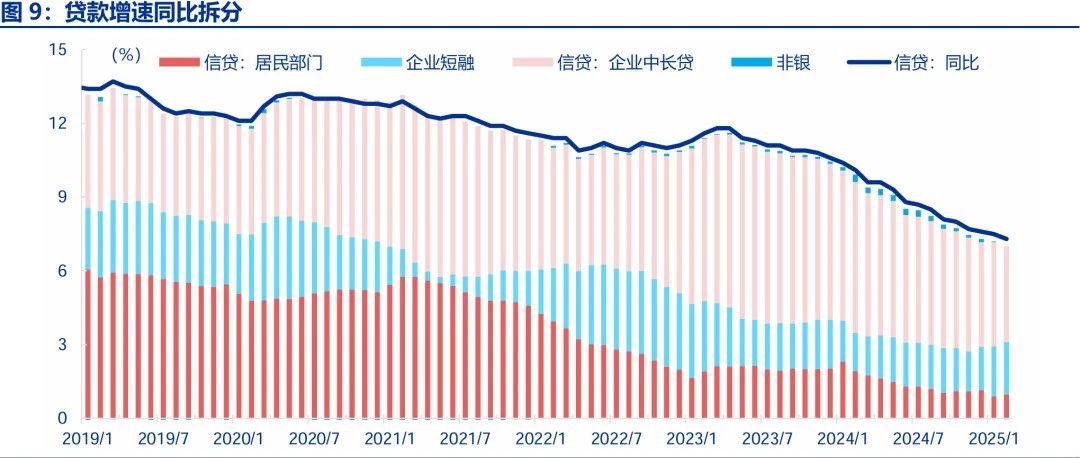
Core Viewpoint - A more proactive fiscal policy may break the current weak expectation cycle, as the decline in M2 year-on-year is primarily due to weak growth in household demand deposits rather than insufficient corporate activity, indicating a shift in household asset allocation towards equity markets [2][9] Financial Data Summary - In February, new credit amounted to 10,100 billion, a year-on-year decrease of 4,400 billion, mainly dragged down by corporate medium and long-term loans. Household loans decreased by 3,891 billion, a year-on-year reduction of 2,016 billion, with short-term loans down by 2,741 billion and medium and long-term loans down by 1,150 billion [4][22] - The total social financing (社融) in February was 22,375 billion, a year-on-year increase of 7,416 billion, supported by a significant increase in government bond financing while loans decreased. New RMB loans were 6,528 billion, a year-on-year decrease of 3,245 billion [5][23] - The M2 year-on-year growth remained stable at 7.0%, with the new M2 year-on-year growth rate declining by 0.3 percentage points to 0.1%. In terms of deposit structure, household deposits increased by 6,100 billion, a year-on-year decrease of 25,900 billion, while corporate deposits decreased by 8,940 billion [5][28] Economic Outlook - The increase in social financing in February was supported by fiscal financing, but the delayed arrival of debt repayment funds and weak credit demand indicate that the recovery foundation is still not solid. A more proactive fiscal policy is expected to effectively break the current weak expectation cycle, with increased spending intensity and accelerated expenditure expected to stabilize social financing [3][21]
欧元区3月投资者信心指数大幅回升——海外周报第82期
一瑜中的· 2025-03-16 14:40
Core Viewpoints - The article discusses recent economic data from the US, Eurozone, and Japan, highlighting trends in inflation, employment, and financial conditions [2][4][10]. Group 1: Important Data Review - In February, the US PPI increased by 3.2% year-on-year, lower than the expected 3.3% and previous 3.5%, with a month-on-month change of 0% against an expected increase of 0.3% [9]. - The US CPI for February grew by 2.8% year-on-year, below the expected 2.9% and previous 3%, with a month-on-month increase of 0.2% [9]. - The Eurozone's Sentix investor confidence index for March rose to -2.9, significantly above the expected -8.4 and previous -12.7 [10]. - Germany's January exports fell by 2.5% month-on-month, contrary to the expected growth of 0.5% [10]. - Japan's 2024 Q4 real GDP annualized quarter-on-quarter growth was revised down to 2.2%, below the expected 2.8% [10]. Group 2: Weekly Economic Activity Index - The US WEI index increased to 2.65% for the week of March 8, up from 2.24% the previous week [13]. - The German WAI index rose to 0.51% for the week of March 9, compared to 0.24% the previous week [13]. Group 3: Demand - The US Redbook retail sales year-on-year growth rate decreased to 5.7% for the week of March 8, down from 6.6% the previous week [14]. - The US mortgage application numbers increased, with the MBA market composite index rising to 269.3, an 11.2% week-on-week increase [15]. Group 4: Employment - Initial jobless claims in the US fell to 220,000 for the week of March 8, down from 222,000 the previous week [16]. - Continuing claims also decreased to 1.87 million, compared to 1.90 million the previous week [16]. Group 5: Prices - The RJ/CRB commodity price index was 302.67 on March 14, a 0.1% decrease from the previous week [17]. - The US gasoline retail price was $2.95 per gallon on March 10, down 0.1% from the previous week [17]. Group 6: Financial Conditions - The Bloomberg financial conditions index for the US was 0.20 on March 14, down from 0.27 the previous week [18]. - The Eurozone's Bloomberg financial conditions index increased to 1.30, up from 1.17 the previous week [18]. - Offshore dollar liquidity showed deterioration, with the yen and euro swap basis against the dollar decreasing [19]. Group 7: Bond Yield Spread - The 10-year bond yield spread between the US and Eurozone narrowed, with the US-EU spread at 135.6 basis points, down from 144.7 basis points the previous week [21].

张瑜:关注今年CPI可能存在的预期差
一瑜中的· 2025-03-16 14:40
Core Conclusion - This year remains a year where "price is more important than quantity," with a focus on CPI trends. The report highlights that due to base effects and the influence of food and energy prices, the CPI year-on-year may differ from current market expectations, but this does not imply increasing price pressure. Core CPI is expected to recover moderately [2][12]. Factors Influencing CPI Factor 1: Initial Monthly Changes Impacting New Price Increases - The initial monthly changes have a significant impact on new price increases for the entire year. For instance, the average monthly CPI for the first quarter is expected to be lower than last year, leading to lower new price increases compared to previous years [3][15]. Factor 2: Caution in Using Historical Seasonality for Food Prices - Recent fluctuations in food prices, particularly outside of pork, necessitate caution in applying historical seasonality to predict current trends. For example, vegetable prices may be affected by abnormal weather patterns, and pork prices are expected to remain lower than last year due to increased supply [4][16][17]. Factor 3: Potential Decline in Oil Prices - Oil prices are expected to decrease, which will directly affect transportation fuel prices. A 10% change in international oil prices could impact CPI by approximately 0.2 percentage points. Current forecasts suggest a significant drop in oil price averages compared to last year [8][24]. Factor 4: Moderate Recovery of Core CPI - Core CPI, which excludes food and energy, is anticipated to recover slowly. Factors influencing this include rental prices, core goods, and core services. The recovery of rental prices is contingent on improvements in employment and income levels [9][25][26]. Outlook for CPI Trends - The CPI trend for the latter part of the year is expected to be weak. Factors contributing to this include a continued loose supply of pork, potential weakness in food prices outside of pork, and a likely decrease in oil prices. Core CPI is expected to recover moderately, contingent on significant economic recovery [12][30].

海外周报第82期:欧元区3月投资者信心指数大幅回升-2025-03-16
Huachuang Securities· 2025-03-16 14:15
Investment Rating - The industry investment rating is "Recommended," indicating an expected increase in the industry index by more than 5% over the next 3-6 months compared to the benchmark index [51]. Core Insights - The Eurozone's investor confidence index saw a significant rebound in March, with the Sentix index rising to -2.9, surpassing expectations of -8.4 and the previous value of -12.7 [8]. - In the U.S., the Producer Price Index (PPI) for February was lower than expected, while the Consumer Price Index (CPI) showed an unexpected decline [7][9]. - The U.S. financial conditions are tightening, while the Eurozone is experiencing a loosening of financial conditions, as indicated by the Bloomberg financial conditions index [28]. Summary by Sections 1. Important Data Review - U.S. February PPI increased by 3.2% year-on-year, below the expected 3.3% and previous 3.5% [7]. - Eurozone's investor confidence index rebounded significantly in March [8]. - Japan's GDP for Q4 2024 was slightly revised down [7]. 2. Weekly Economic Activity Index - The U.S. WEI index rose to 2.65% for the week of March 8, up from 2.24% the previous week [14]. - Germany's WAI index increased to 0.51% for the week of March 9, compared to 0.24% the previous week [14]. 3. Demand - U.S. retail sales growth, as measured by the Redbook index, decreased to 5.7% year-on-year from 6.6% the previous week [17]. - Mortgage rates in the U.S. rose slightly to 6.65%, while mortgage applications increased by 11.2% [20]. 4. Employment - Initial jobless claims in the U.S. fell to 220,000, down from 222,000 the previous week [22]. 5. Prices - The RJ/CRB commodity price index was 302.67, showing a 0.1% decline from the previous week [25]. - U.S. gasoline prices decreased to $2.95 per gallon, down 0.1% from the previous week [25]. 6. Financial Conditions - The Bloomberg financial conditions index for the U.S. was 0.20, down from 0.27 the previous week, indicating tightening conditions [28]. - Offshore dollar liquidity has worsened, with the yen and euro swap basis against the dollar showing declines [28]. 7. Bond Yield Spread - The 10-year bond yield spread between Germany and Portugal narrowed, with spreads of -49.3bp and -106.0bp respectively [33].