健康饮食

Search documents
2025年中国寿司行业相关政策、产业链图谱、市场规模、竞争格局及发展趋势研判:三四线城市有望成为行业新的增长点[图]
Chan Ye Xin Xi Wang· 2025-08-01 01:31
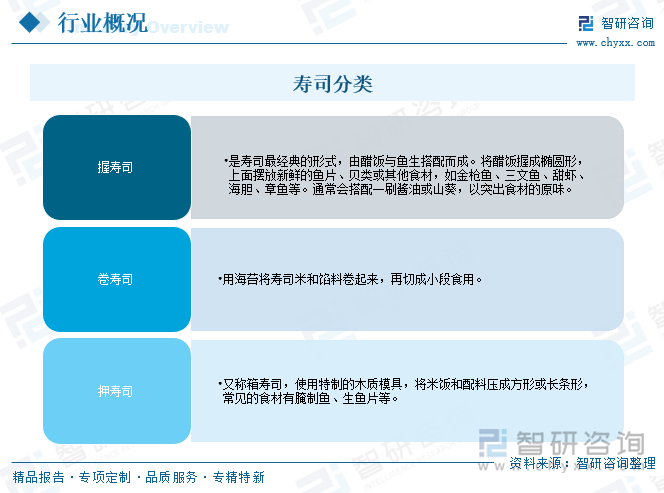
Overview - The sushi industry in China is experiencing growth due to rising living standards and changing dietary preferences, with a market size projected to reach 24.22 billion yuan in 2024, reflecting a year-on-year increase of 2.80% [1][9] - Sushi consumption is primarily concentrated in first- and second-tier cities, but there is a growing acceptance and recognition of sushi in third- and fourth-tier cities, which are expected to become new growth points for the industry [1][9] Industry Policies - The Chinese government has implemented various policies to support the development of the restaurant industry, including sushi, creating a favorable policy environment for growth [3][4] Industry Chain - The upstream of the sushi industry includes suppliers of raw materials such as rice, seafood, vegetables, and packaging materials, while the midstream consists of sushi processing and production, and the downstream includes sales channels like dine-in and takeout [5] Consumer Insights - Female consumers dominate the sushi market, accounting for over 50%, with the majority of consumers aged between 20 and 39 years [7] - Freshness of ingredients is the most important factor for over 80% of consumers, followed by hygiene and service quality [7] Competitive Landscape - The sushi market in China is fragmented, with numerous participants. As of June 2025, N多寿司 leads the market with over 2000 stores, while other notable brands include 鲜目录 and 争鲜, each with over 400 stores [11][13] - N多寿司 operates nearly 1800 chain stores across 21 provinces and is recognized as a prominent brand in the sushi sector [13] - 杭州将太餐饮管理有限公司 has over 1000 franchise restaurants nationwide, showcasing its strong presence in the industry [15] Development Trends - Future trends indicate a focus on food safety and quality, with sushi companies likely to emphasize fresh and safe ingredients [18] - There will be an increase in low-fat, low-salt, and low-sugar sushi products to meet health-conscious consumer demands, along with innovative product offerings that incorporate regional flavors [18] - Cross-industry collaborations are expected to rise, linking sushi with dining, culture, and tourism to create themed sushi packages and cultural experiences [18]

十月稻田发布盈利预告,品类创新加全链路布局撬动业绩攀升
Zhong Guo Jing Ji Wang· 2025-07-29 09:56
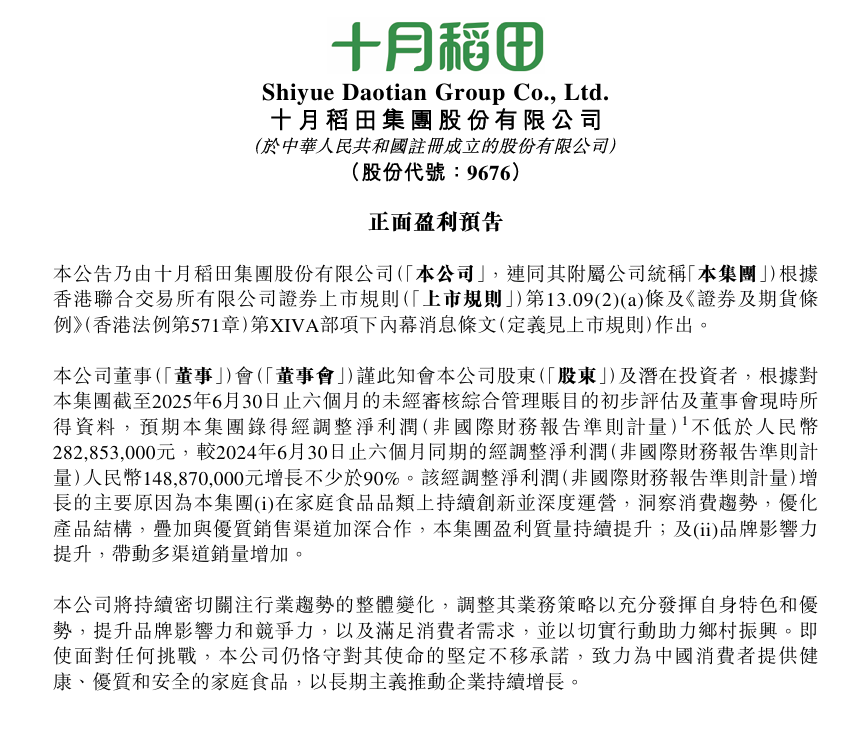
Core Insights - The food industry is experiencing a transformation towards innovation-driven development, with October Rice Field emerging as a strong player in the household food innovation sector [1][3] - October Rice Field forecasts a significant increase in adjusted net profit for the first half of 2025, expecting it to be no less than approximately RMB 283 million, representing a growth of at least 90% compared to RMB 149 million in the same period last year [1][3] Group 1: Brand Strategy and Innovation - October Rice Field has upgraded its brand strategy, transitioning from a "kitchen staple enterprise" to a "household food innovation enterprise," which has contributed to sustained high growth [3][9] - The company’s revenue from rice products reached RMB 4.014 billion in 2024, a year-on-year increase of 4.8%, accounting for 69.9% of total revenue, indicating a solid foundation in its core rice business [3][4] - The corn category has shown remarkable performance, generating RMB 815 million in revenue, a year-on-year increase of 523.2%, becoming the company's second growth curve [3][4] Group 2: Product Development and Market Trends - October Rice Field has identified new trends in healthy eating, moving beyond traditional grain processing to create corn products as healthy fast-moving consumer goods, such as corn sticks and flavored corn varieties [4][9] - The company has received recognition from Frost & Sullivan for leading sales in the corn category in China for two consecutive years, further validating its market position [4][9] Group 3: Supply Chain and Distribution - To ensure product quality and stability, October Rice Field has established five modern industrial bases in key grain-producing areas, with plans for a new base in Nanning, Guangxi [6][7] - The company has invested billions in building modern factories and warehouses in core production areas, ensuring timely procurement and storage of raw materials [7] - October Rice Field has partnered with over 40 major e-commerce platforms and nearly 100 supermarkets, creating a comprehensive multi-channel sales network [7][9] Group 4: Marketing and Consumer Engagement - The company employs an omnichannel marketing strategy, leveraging both online and offline platforms to enhance brand visibility and consumer engagement [7][9] - October Rice Field has successfully tapped into the instant retail market by establishing partnerships with various platforms, addressing urban consumption challenges [7][9] Group 5: Industry Recognition and Future Outlook - October Rice Field has maintained its industry-leading position for several years, recently receiving three certifications from Frost & Sullivan, including serving 140 million Chinese households [9] - The company is well-positioned to capitalize on the growing trend of healthy eating and the expanding household food market, with a clear growth logic based on a robust supply chain and continuous innovation [9]
官方:推动老旧农产品冷链物流设施更新,加大再贷款政策力度
Sou Hu Cai Jing· 2025-07-29 08:37
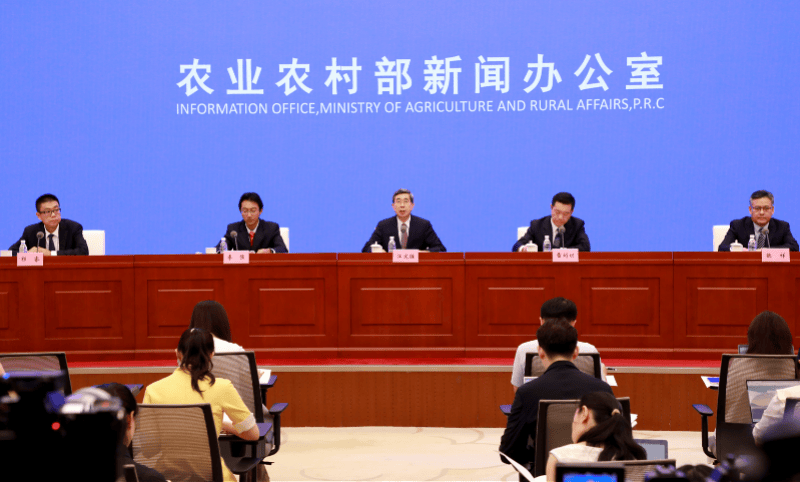
Core Viewpoint - The Ministry of Agriculture and Rural Affairs has introduced the "Implementation Plan for Promoting Agricultural Product Consumption," focusing on enhancing the quality and diversity of agricultural products to meet changing consumer demands [1][3]. Group 1: Consumption Trends - There is a growing consumer preference for high-quality, personalized agricultural products, including brand-name items and functional foods [3]. - The current dietary structure in China is not sufficiently balanced, with significant room for improvement in the intake of high-quality proteins such as soy products and dairy [4]. Group 2: Policy Measures - The plan outlines 23 specific measures across nine areas, aiming to optimize supply, innovate distribution, and activate market demand in response to new consumption trends [3]. - Initiatives include a series of promotional activities for the upcoming harvest season, leveraging social media influencers and local products to enhance consumer engagement [3]. Group 3: Nutritional Improvement - The plan emphasizes improving dietary structures, particularly for students, by promoting the consumption of soy products and dairy, and integrating nutrition education into school curricula [4]. - Current per capita dairy consumption in China is 40.5 kg, significantly below the recommended intake of 110-183 kg, indicating substantial growth potential [4]. Group 4: Cold Chain Logistics - The Ministry is working on a national development plan for agricultural product markets, focusing on enhancing cold chain logistics, including storage and distribution facilities [5]. - Financial policies will support the modernization of outdated cold chain logistics infrastructure, promoting innovation in financing models to facilitate investment in this sector [5].

30 万份销量只是开始!京东七鲜让高品质三文鱼进入“平价时代”
Zhong Jin Zai Xian· 2025-07-23 05:25
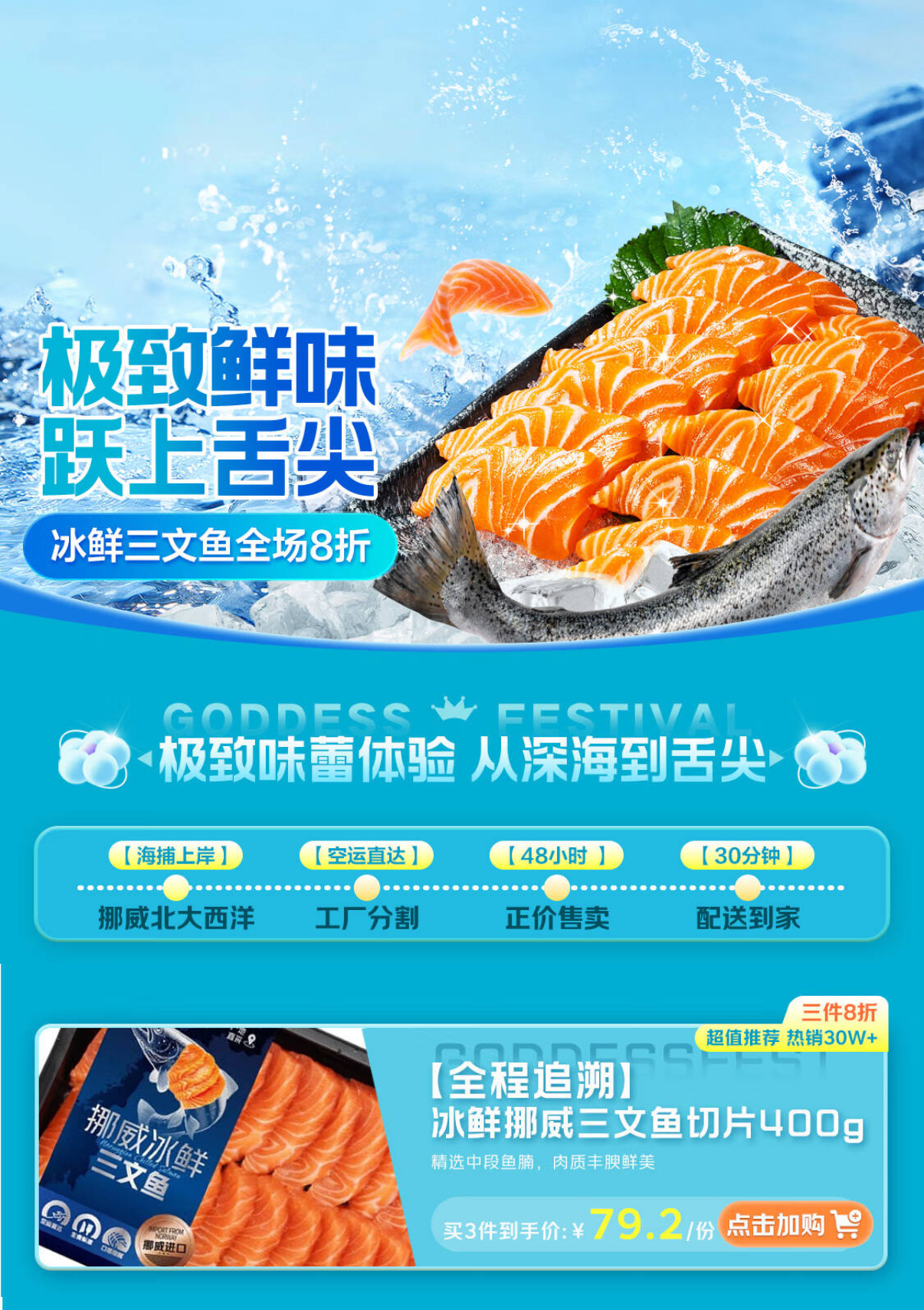
Core Insights - The rising trend of healthy and refreshing diets during the hot summer months has led to the popularity of salmon, which is being referred to as "edible air conditioning" due to its cooling properties [1][3] - JD Seven Fresh has launched a "Salmon Fresh Eating Festival" with various promotions, including discounts on multiple fresh salmon products, making high-quality seafood more accessible to consumers [1][5] Group 1: Salmon Characteristics - Salmon is known for its cold nature, which helps alleviate heat and discomfort during summer, making it an ideal food choice in hot weather [3] - Nutritional experts highlight three main features of salmon: its cooling properties, high nutritional value with 20g of protein per 100g and only about 180 calories, and its richness in Omega-3 fatty acids that provide anti-inflammatory and cardiovascular protection [3] Group 2: Market Trends and Consumer Behavior - The peak season for salmon fishing in Norway is from July to September, during which the oil content is at its highest, enhancing the flavor [5] - Salmon consumption has expanded beyond traditional Japanese cuisine to include breakfast, camping, and baby food, aligning with the fast-paced urban lifestyle and becoming a "social currency" among younger consumers [7] - The trend towards instant retail and increased health consciousness is driving high-quality seafood like salmon from premium markets to mainstream dining, with expectations of a consumption peak this summer [7]

5家消费公司拿到新钱;抖音否认做外卖;KKR拟收购大窑汽水85%股权|创投大视野
3 6 Ke· 2025-07-19 09:58
Group 1: Financing Activities - Guangdong Orange Emperor Health Management Co., Ltd. completed a 10 million yuan angel round financing to enhance its internet hospital platform, expand health product supply chain, and promote brand chain store development [1] - Corn Technology Co., Ltd. announced the completion of Series A financing to drive technological innovation and market expansion for its fresh corn juice products [2] - Chengdu Fenglan Times Catering Management Co., Ltd. secured 50 million yuan in Series A financing to deepen supply chain construction, accelerate store expansion, and invest in product development [3] - Lingjing AI completed several million yuan in angel round financing to accelerate the development of multi-modal generation architecture in the AI animation field [4] - Yingmu Technology completed over 150 million yuan in B+ round financing to focus on next-generation product development, AI core capability construction, and offline scene expansion [5] Group 2: Company Developments - The acquisition of 85% equity of Dayao Soda by KKR has progressed, with the transaction expected to start this year, potentially leading to national and international expansion [6][7] - Dayao Soda's operational team remains stable, and its nationalization and youth-oriented strategies will continue unchanged post-acquisition [7] - Dayao Soda has established over a thousand national distributors and a million retail terminals across 31 provinces, indicating a strong market presence [8] Group 3: Market Trends - Douyin has denied plans to enter the takeaway market, focusing instead on in-store services, as its takeaway business has faced challenges compared to established competitors [9] - ByteDance refuted claims regarding the sale of TikTok's U.S. operations to Oracle-led consortium, with ongoing negotiations requiring government approval [10] - Xiaohongshu has rebranded its slogan to emphasize community and interests, aiming to enhance user engagement and growth [11] - Xiaohongshu announced the creation of "RED LAND," an open-world adventure event targeting gaming and anime enthusiasts, reflecting its commitment to the two-dimensional market [13] - Sweet Lala launched a new fruit and vegetable tea series in collaboration with Giant Network's game IP, focusing on health and affordability [14] Group 4: Industry Insights - The "2025 China Online Retail Top 100" report indicates that 25 consumer goods companies achieved double-digit growth, with total online sales reaching 2.17 trillion yuan, a 13.6% increase [15] - The summer box office has reached 3.5 billion yuan, showing a lukewarm performance compared to other entertainment sectors [16] - In June, 33 Chinese game companies collectively earned 1.76 billion USD, with Diandian Interactive maintaining a strong position in global mobile game revenue rankings [17] - The takeaway battle has driven significant sales growth for both restaurant and instant retail brands on platforms like Taobao, with many brands reaching historical sales peaks [18]
2025年中国牛肉干行业政策汇总、市场规模、竞争格局及发展趋势研判:企业区域分布特征明显[图]
Chan Ye Xin Xi Wang· 2025-07-18 01:46
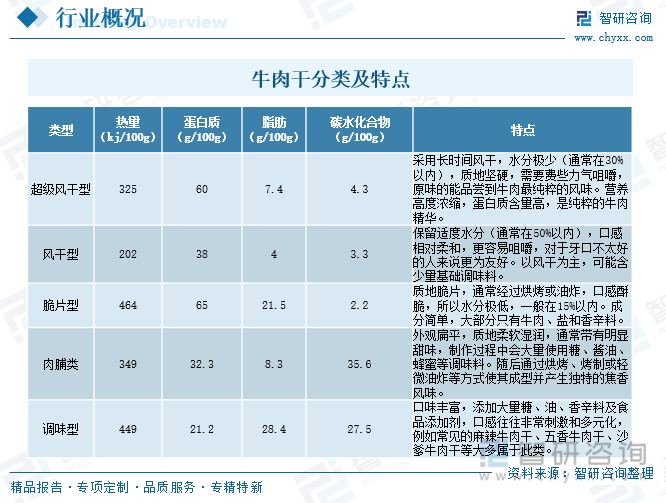
Overview - The beef jerky market in China is experiencing significant growth due to rising consumer demand for high-protein, low-fat, and convenient snacks, particularly in first-tier and some second-tier cities [1][10] - The market size of the beef jerky industry in China is projected to reach 7.2 billion yuan in 2024, representing a year-on-year growth of 22.42% [1][10] Industry Background - Beef jerky is made primarily from beef through various processing methods such as marinating, drying, and baking, retaining nutritional value while being easy to store and carry [1] - The industry is supported by a robust supply chain, including raw material suppliers, production equipment manufacturers, and various sales channels [6] Market Demand - The demand for high-quality and healthy beef jerky is increasing, driven by consumer preferences for nutritious snacks [1][10] - The market is also expanding in lower-tier cities and rural areas as consumer spending increases [1][10] Regulatory Environment - The Chinese government has implemented a series of policies to ensure food safety and quality in the beef jerky industry, promoting a shift towards standardized and high-quality production [4] Supply Chain Dynamics - The upstream of the beef jerky industry includes suppliers of beef, seasonings, and production equipment, while the downstream consists of various retail channels such as supermarkets, convenience stores, and e-commerce platforms [6] Production Capacity - As of 2024, China is expected to have a cattle inventory of approximately 100.465 million heads, with beef production reaching 7.7909 million tons, ensuring a steady supply of raw materials for the beef jerky industry [8] Competitive Landscape - The beef jerky industry in China is characterized by a fragmented market with numerous small to medium-sized enterprises, primarily located in beef-producing provinces such as Inner Mongolia, Hebei, and Sichuan [12][13] - Major companies in the industry include Sichuan Zhangfei Beef Co., Inner Mongolia Mengdu Sheep Industry Co., and Hangzhou Lusheng Group, among others [17][19] Future Trends - The beef jerky industry is expected to focus on health attributes, with companies likely to adopt low-salt recipes and natural ingredients while innovating with new flavors and product forms to meet diverse consumer preferences [21]
印媒:请卫生部放过我们的“咖喱角”
Huan Qiu Shi Bao· 2025-07-17 22:46
Core Viewpoint - The article critiques the current cultural obsession with dieting and the negative impact it has on the relationship with food, arguing that food should not be reduced to mere nutritional values but appreciated for its emotional and sensory benefits [1][2] Group 1: Cultural Context - The article highlights a societal shift where food marketing focuses on what is excluded from products rather than what is included, leading to a culture of guilt and shame surrounding eating [1] - It references a humorous take on modern food trends, emphasizing the absurdity of products that are stripped of almost all traditional ingredients in favor of low-calorie, high-protein options [1] Group 2: Government Regulations - The Indian Ministry of Health has mandated that schools, offices, and public institutions display warnings about fat and sugar content in food, which may lead to the stigmatization of traditional foods like samosas and chai [1] - This regulation raises concerns about where individuals, particularly those under stress, can find comfort in food amidst increasing scrutiny [1] Group 3: Emotional Impact of Food - The article argues that reducing food to its macronutrient content is a misguided approach, as food serves as a source of comfort and joy in daily life [1] - It discusses the complex emotions tied to eating, where individuals feel guilt for indulging and pride for restrictive eating, indicating a shift from hunger as a biological need to a calculated approach to nutrition [1]
国际市场强劲增长抵消北美疲软 百事可乐(PEP.US)Q2业绩全线超预期
智通财经网· 2025-07-17 11:54
Core Viewpoint - Despite ongoing challenges in the North American food and beverage market, the global food and beverage giant PepsiCo (PEP.US) reported quarterly results that exceeded analyst expectations, driven by strong international market performance, while maintaining its full-year guidance [1] Financial Performance - For the second quarter ending June 14, PepsiCo's revenue grew approximately 1% to $22.73 billion, surpassing the analyst forecast of a decline of 0.99% to $22.28 billion [1] - Organic revenue, excluding mergers, divestitures, and currency effects, increased by 2.1%, exceeding analyst expectations [1] - Net income attributable to the company was $1.26 billion, or $0.92 per share, significantly down from $3.08 billion ($2.23 per share) in the same period last year [1] - Adjusted earnings per share, excluding specific impairment charges, reached $2.12, exceeding market expectations of $2.03 [1] Regional Performance - Organic revenue in the Europe, Middle East, and Africa region grew by 7%, and Latin America's food business also saw a 7% increase, effectively offsetting a 2% decline in North American food business [1] - Global snack food sales declined by 1.5%, while beverage sales remained flat [1] - Currency fluctuations positively impacted performance by 1.5 percentage points [1] Strategic Initiatives - The company is actively adjusting its strategy in response to health food trends and competition from low-cost private label products, including the recent acquisition of probiotic soda brand Poppi [2] - PepsiCo plans to eliminate all synthetic colors from U.S. school foods before the new school year and introduce products without artificial colors and flavors [2] - The company aims to increase the proportion of low-sugar/no-sugar products, which has already helped its flagship brand, Pepsi, gain market share [2] - Cost-cutting measures include closing two North American food factories and improving logistics efficiency [2] - Marketing investments will focus on return on investment assessments, and the company is working to integrate North American food and beverage operations to eliminate functional redundancies [2]

火锅不止重口味——大龙燚设定植物性餐食目标,探索更健康的成都风味
Xiao Fei Ri Bao Wang· 2025-07-15 05:36
据悉,未来大龙燚将推出更多以植物性食材为灵感的菜品与小吃,巧妙结合四川在地风味与健康理 念,让顾客在享受成都风味的同时,也能体验火锅带来的健康与新鲜感。 此次设立植物性餐食目标,彰显了大龙燚对可持续发展的重视,以及对"健康中国"战略的积极响 应,主动履行社会责任。根据力矩中国一项针对数千名中国消费者的调研显示,近90%的消费者认为植 物性饮食更健康,超过85%希望在餐厅菜单中看到更多植物性选择。大龙燚新的品牌目标不仅顺应消费 者对健康、营养、体重管理等方面的需求,也体现出其作为行业先行者,对市场趋势的敏锐把握与前瞻 视野。 大龙燚火锅负责人宋波表示:"大龙燚一直关注消费者的健康需求,持续探索如何让顾客吃得过 瘾、也吃得健康。我们将持续优化菜单结构,在保留经典川味锅底精髓的同时,深入挖掘巴蜀风土丰富 的饮食文化,把特色食材融入植物性菜品创新,我们在7月推出了'蜀地非遗风味志'主题的上新动作, 搜罗了来自川西、川南、川北、川东的非遗、地标食材,像是开江的百年非遗食材-豆笋、宜宾的非遗 芽菜等。不仅是为了向健康饮食靠拢,更赋予了此目标更厚重的人文底蕴。预计在2026年实现40%的植 物性菜品供应,为消费者提供更多样 ...
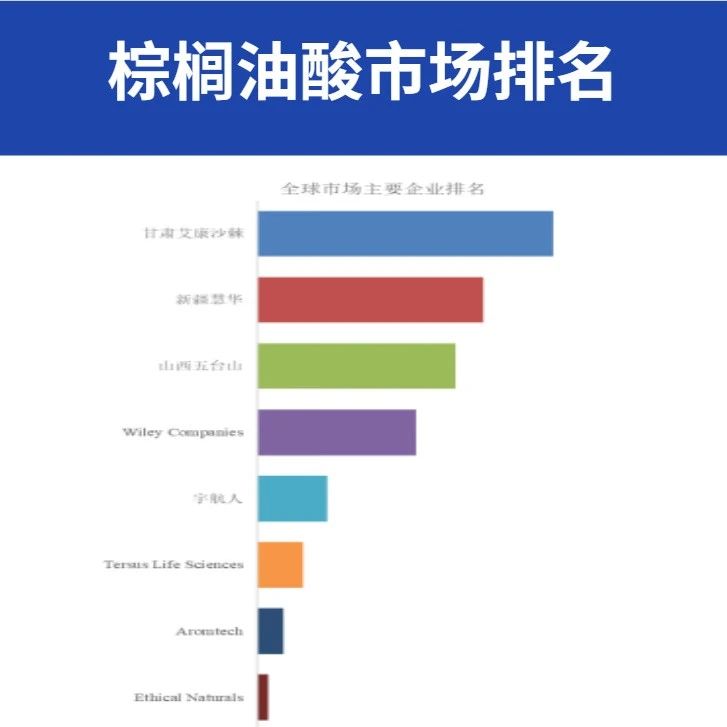
全球棕榈油酸市场核心生产商排名及市场占有率
QYResearch· 2025-07-11 09:28
Core Viewpoint - The global palm oil acid market is projected to reach $0.9 billion by 2031, with a compound annual growth rate (CAGR) of 7.8% in the coming years [1][10]. Market Overview - Palm oil acid is a natural monounsaturated fatty acid found in various animal and plant fats, particularly in marine fish oil, dairy products, and certain vegetable oils [1]. - The primary source of palm oil acid is plant-based, accounting for approximately 79.4% of the market share [7]. - The dietary supplement sector is the largest downstream market, representing about 55.0% of the demand [9]. Key Players - Major global producers of palm oil acid include Gansu Aikang Sea Buckthorn, Xinjiang Huihua, Shanxi Wutai Mountain, Wiley Companies, and Yuhangren [5]. - The top four manufacturers hold around 72.0% of the market share as of 2024 [5]. Driving Factors - Increasing consumer focus on healthy diets and lifestyles is driving the acceptance of palm oil acid as a beneficial monounsaturated fatty acid [10]. - The demand for natural, plant-based, and sustainable ingredients is rising, aligning with consumer preferences for health and environmental concerns [10]. - Scientific research supporting the health benefits of palm oil acid, including its positive effects on cardiovascular health and insulin sensitivity, is attracting more investment and attention [10]. Challenges - The production process of palm oil acid involves complex extraction and refining techniques, leading to high operational costs and technical barriers [11]. - The availability and quality fluctuations of raw materials pose challenges for large-scale production, limiting market expansion [11]. - Environmental concerns related to palm oil production, such as deforestation and biodiversity loss, are increasing pressure for sustainable practices, which can raise costs and affect competitiveness [12]. Industry Trends - The growing emphasis on health and wellness is leading to increased applications of palm oil acid in functional foods, dietary supplements, and health beverages, particularly in Europe, the U.S., and the Asia-Pacific region [13]. - Advances in extraction and production technologies are improving efficiency and reducing costs, facilitating broader applications across various industries [13]. - The demand for natural skincare products is rising, with palm oil acid becoming an important ingredient in beauty and personal care products due to its moisturizing and anti-aging properties [13].