
绿色消费

Search documents
(经济观察)2025年中国消费“账单”呈现新趋势
Zhong Guo Xin Wen Wang· 2026-01-19 11:14
中新社北京1月19日电 题:2025年中国消费"账单"呈现新趋势 中新社记者 陈溯 "服务消费占比上升趋势明显,这是2025年中国消费一个非常典型的亮点。"北京大学光华管理学院副院 长张影表示。 随着生活水平提升,中国居民消费正从商品消费为主向商品和服务消费并重转变,服务消费潜力进一步 释放。 从企业销售看,2025年服务零售额比上年增长5.5%,快于商品零售额1.7个百分点,服务零售额占整体 零售额的比重在上升。从居民消费看,2025年服务性消费支出占居民人均消费支出的比重为46.1%。 2025年9月,中国商务部等9部门印发《关于扩大服务消费的若干政策措施》,更大力度提振服务消费, 释放服务消费潜能。2025年9月以来,服务零售额累计增速连续4个月回升。 ——新型消费方兴未艾 近年来,电子商务、直播带货等带动线上消费较快增长。2025年,网上零售额比上年增长8.6%。无人 值守店、仓储会员店等新零售模式零售额保持两位数增长。 中国2025年经济数据19日对外公布,数据显示,2025年中国消费"账单"呈现若干新趋势。 ——社零总额首破50万亿元 2025年,市场销售规模继续扩大,社会消费品零售总额50120 ...
老字号焕新赋能绿色消费 第六届中国绿色饭店消费季(苏州站)启幕
Zhong Guo Jing Ji Wang· 2026-01-19 10:48
Core Insights - The sixth China Green Hotel Consumption Season officially opened in Suzhou, focusing on "Quality Consumption and Green Leadership" to explore new paths for the green, integrated, and quality development of the accommodation and catering industry [1][2] - The event aims to inject vitality into the Spring Festival consumption market by linking national time-honored brands and creating a new consumption platform [1] Group 1: Event Overview - The Green Hotel Consumption Season covers 3,500 green hotels nationwide, serving as a key platform for showcasing the achievements of green development in the accommodation and catering industry [1] - Since its launch in March 2025, the event has been held in multiple cities, with a cumulative attendance of 1,200 people and a transaction volume exceeding 150 million yuan from the "Ace Wonderful Yeah" initiative [1][2] Group 2: Industry Focus and Initiatives - The event features discussions on how to implement green consumption concepts, the new opportunities and challenges in industry transformation, and how time-honored brands can activate development through greening and innovation [2] - A joint initiative was launched by five associations to promote the creation of green hotels and encourage diverse, full-chain green business entities [2] Group 3: Integration of Traditional Brands - The integration of time-honored brands with new Spring consumption scenarios is highlighted, with the "2026 Spring Consumption Season Hotel Industry New Year Goods Festival" showcasing products from well-known brands [3] - Participating brands displayed traditional craftsmanship and innovative products, emphasizing breakthroughs in product development, green packaging, and cultural expression [3] - The collaboration between the Green Hotel Consumption Season and the New Year Goods Festival provides practical examples for industry transformation and injects new momentum into the Spring consumption market [3]

政企联动惠民生,三联家电领航潍坊绿色消费新周期
Qi Lu Wan Bao· 2026-01-19 10:03
Group 1 - The core viewpoint of the article highlights the launch of the national subsidy policy for home appliances in the Kuiwen District, which aims to promote green and smart consumption in the city [1] - The subsidy allows consumers to receive a 15% discount on the final price for six categories of energy-efficient home appliances, with a limit of one item per category [1][4] - The policy has two significant changes compared to 2025: an expanded subsidy range focusing on high-value products and stricter energy efficiency standards, excluding products below level two [1] Group 2 - Sanlian Home Appliances has established a "Green Energy Efficiency Experience Zone" in response to the policy, equipped with a professional sales team to assist consumers [1] - Consumers can quickly obtain subsidy qualifications through the "Love Shandong" app or the "Luhuanxin" mini-program [3] - The company plans to leverage the upcoming Spring Festival shopping season to enhance the policy's impact by offering exclusive promotions and diverse solutions for consumers [3]


去年消费支出对经济增长贡献率为52%
Xin Jing Bao· 2026-01-19 07:20
Core Insights - Service consumption is expected to be a significant highlight in China's economic performance by 2025, with a steady expansion of the consumption market and continuous optimization of its structure [1] - The contribution rate of final consumption expenditure to economic growth is projected to be 52%, an increase of 5 percentage points from the previous year, making it the main driver of economic growth [1] Group 1: Service Consumption - In 2025, service retail sales are anticipated to grow by 5.5% year-on-year, outpacing goods retail sales by 1.7 percentage points [1] - The proportion of service consumption expenditure in per capita consumption is expected to reach 46.1% in 2025, indicating a shift towards a balanced consumption of goods and services [1] Group 2: Online and New Retail - Online retail sales are projected to increase by 8.6% in 2025, with physical goods online retail sales growing by 5.2%, accounting for 26.1% of total social retail sales [2] - New retail models such as unmanned stores and warehouse membership stores are maintaining double-digit growth rates [2] Group 3: Consumer Trends and Policies - The 2026 outlook indicates strong support for continued consumption growth, driven by a large consumer market of 1.4 billion people and ongoing implementation of consumption-boosting policies [3] - The "old for new" policy will continue in 2026, with an initial allocation of 62.5 billion yuan in long-term special bonds to support consumption [3]
国家统计局局长康义:居民消费正从商品消费为主向商品和服务消费并重转变,服务消费潜力不断释放
Jin Rong Jie· 2026-01-19 04:07
Core Insights - The core viewpoint of the articles emphasizes the significant role of service consumption in China's economic performance in 2025, highlighting a shift towards a more balanced consumption structure between goods and services [1][2]. Group 1: Economic Performance - In 2025, China's total retail sales of consumer goods exceeded 50 trillion yuan, marking a 3.7% increase from the previous year, with a growth acceleration of 0.2 percentage points compared to 2024 [2]. - The contribution rate of final consumption expenditure to economic growth reached 52%, an increase of 5 percentage points from the previous year, establishing it as a primary driver of economic stability [2]. Group 2: Service Consumption - Service retail sales grew by 5.5% in 2025, outpacing goods retail sales by 1.7 percentage points, indicating a shift in consumer spending towards services [2][3]. - The proportion of service consumption expenditure in per capita household consumption reached 46.1%, reflecting the increasing importance of services in consumer spending [2]. Group 3: New Consumption Trends - Online retail sales increased by 8.6% in 2025, with physical goods online retail sales growing by 5.2%, accounting for 26.1% of total retail sales [3]. - New retail models, such as unmanned stores and warehouse membership stores, maintained double-digit growth, while green consumption, including electric vehicles, continued to expand [3]. Group 4: Goods Consumption - Retail sales of goods rose by 3.8% in 2025, with significant growth in essential goods like food and upgrades in sports and communication products [3]. - Policies promoting the replacement of old consumer goods with new ones have been implemented to encourage high-quality durable goods in daily life, with notable growth in categories like cultural and office supplies, furniture, and home appliances [3]. Group 5: Future Outlook - Despite challenges, the consumption market is expected to grow steadily in 2026, supported by a large middle-income population and ongoing consumption upgrade trends [4]. - Continued implementation of consumption-boosting policies and improvements in the consumption environment are anticipated to further stimulate consumer spending [4].
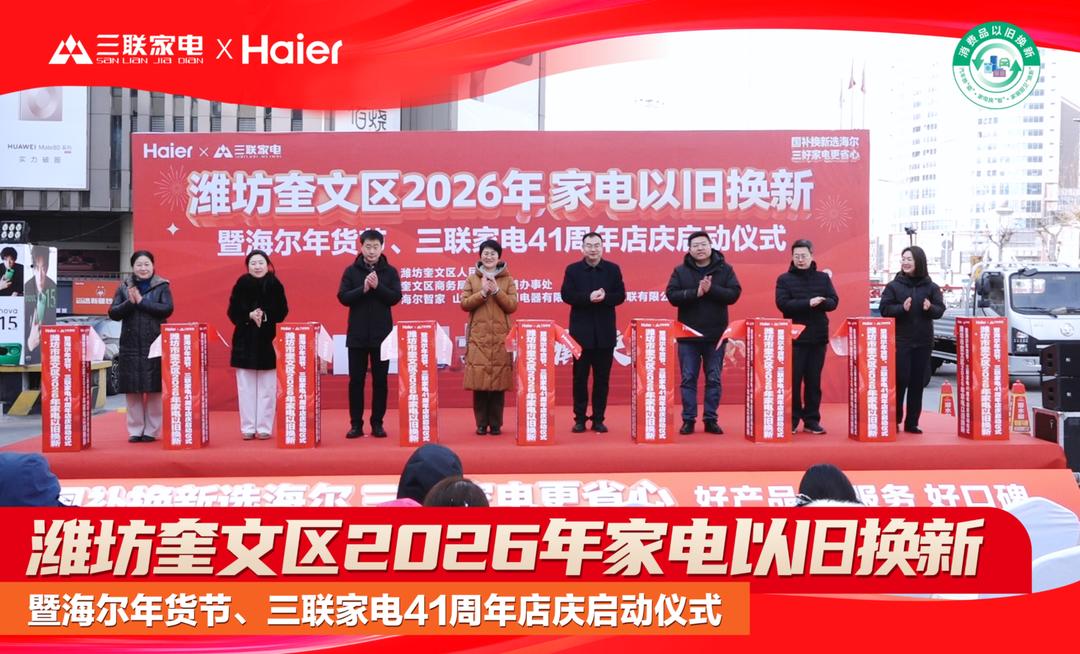
潍坊国补正式落地,三联家电41周年店庆点燃消费热情
Qi Lu Wan Bao· 2026-01-19 02:04
Group 1 - The event marks the official launch of the 2026 home appliance trade-in program in Weifang's Kuiwen District, supported by government subsidies and aimed at promoting consumer spending [1][3] - The Kuiwen District government highlighted the success of the 2025 consumer promotion initiatives, attributing achievements to the support of enterprises and citizen participation [3] - The 2026 program aims to create a "green consumption + smart upgrade" model, leveraging both online and offline channels to ensure that policy benefits reach consumers directly [3] Group 2 - Sanlian Appliances plays a crucial role as a leading retailer, leveraging its 41st anniversary to implement the trade-in policy effectively [5] - The trade-in program offers significant subsidies, with up to 1,500 yuan for six categories of energy-efficient home appliances and 500 yuan for four categories of digital products [6] - Sanlian Appliances collaborates with Haier Group to provide a triple discount scheme, enhancing consumer benefits and ensuring affordability [6] Group 3 - Haier Group, a global leader in home appliance manufacturing, supports the event with advanced products and technology, showcasing a range of smart and energy-efficient appliances [9] - The event atmosphere was lively, with a smart home experience area attracting many citizens, indicating strong community interest in the program [9] - The trade-in initiative is expected to stimulate regional consumption growth, promote green consumption concepts, and drive the transformation and upgrading of the home appliance industry [9]
2026以旧换新“换”出消费新热潮:绿色化、智能化趋势明显
Yang Guang Wang· 2026-01-19 00:09
Core Viewpoint - The implementation of the large-scale equipment update and old-for-new consumption policy in 2026 has sparked a significant consumption boom across various markets, with a focus on energy-efficient products and enhanced consumer services [1] Group 1: Policy Changes - The new policy features more precise scope, flexible subsidies, and improved services, transitioning from a flat-rate subsidy to a proportional system linked to vehicle prices, ensuring fair benefits for consumers across different price ranges [1] - The household appliance subsidy specifically targets "1st-level energy efficiency or water efficiency," promoting a shift from low-efficiency to high-efficiency products, thereby emphasizing the importance of the entire product lifecycle and social benefits [1] Group 2: Market Reactions - In Tonghua, Jilin Province, the new round of subsidies initiated on New Year's Day led to a 50% increase in sales compared to the previous year, demonstrating the strong market response to the policy [2] - In Zhengzhou, a specific air conditioning model's price dropped from 4599 yuan to 2844 yuan after applying the subsidies, showcasing the tangible benefits for consumers [3] - Xiaomi stores in Jiangsu experienced a 130% increase in foot traffic and significant sales growth of 150% for mobile phones and 120% for smartwatches, indicating a robust consumer interest in new products [3] Group 3: Consumer Behavior - The introduction of subsidies has balanced the price gap between 1st-level and 2nd-level energy-efficient products, making energy-efficient options more appealing to consumers [4][5] - In rural areas, tailored smart appliances have been developed to meet local needs, resulting in increased consumer spending and sales growth in these regions [6] Group 4: Regulatory Measures - The Ministry of Commerce emphasized the need for participating businesses to have waste appliance recycling capabilities and to provide one-stop services for consumers, enhancing convenience [2] - Strict regulations are in place to ensure compliance with pricing and subsidy management, with penalties for violations to maintain market order [7]
上海“十五五”规划建议:大力发展文化、旅游、体育、健康等改善型服务消费
Zheng Quan Shi Bao Wang· 2026-01-18 23:54
Core Viewpoint - The Shanghai Municipal Committee has released recommendations for the 15th Five-Year Plan, emphasizing the implementation of strategies to expand domestic demand and enhance consumption [1] Group 1: Consumption Strategies - The plan includes a continuation of special actions to boost consumption and the development of Shanghai as an international consumption center [1] - There is a focus on expanding service consumption, particularly in cultural, tourism, sports, and health sectors, to improve the quality of service supply [1] - The initiative promotes green and smart consumption, aiming to upgrade and expand product consumption [1] Group 2: Innovation and Integration - Encouragement for innovation in consumption models and formats, promoting the integration of online and offline consumption [1] - The plan supports the development of "AI + consumption," intellectual property derivative products, and interactive, immersive, and experiential consumption [1] - There is a push for the growth of the live-streaming economy and the deep integration of culture, tourism, commerce, and sports [1] Group 3: Economic Environment and Infrastructure - The recommendations include optimizing the consumption environment and advancing the construction of world-class business districts [1] - Development of distinctive commercial streets and enhancement of tax refund and cross-border payment convenience to increase inbound consumption [1] - The plan aims to create an all-age-friendly quality living circle to better match supply and demand in consumer goods, stimulating consumption potential among the elderly and youth [1]
情绪消费、体验消费、绿色消费齐头并进多机构预计2026年消费市场将迎三大趋势
Xin Lang Cai Jing· 2026-01-18 21:31
Core Trends - The consumer market is expected to see three major trends by 2026: increased demand for differentiated experience services, growth in "self-pleasing" consumption, and the rise of green consumption [1][2]. Differentiated Experience Services - Consumers are increasingly seeking differentiated experiences and services, prompting many companies to invest more in offline experiences and establish emotional connections with consumers [2][3]. - Brands must provide stable product quality and respond to new lifestyle characteristics to build differentiation and trust, while offering a high-quality omnichannel shopping experience [3]. "Self-Pleasing" Consumption - Emotional consumption and the "self-pleasing" mindset are emerging as new trends, with many young consumers using spending to alleviate anxiety [2]. - The emotional consumption market in China is projected to reach 27.2 trillion yuan by 2026, with expectations to exceed 45 trillion yuan by 2029 [2]. Green Consumption - Green consumption is becoming a focal point for industry transformation, supported by policies that encourage consumers to purchase energy-efficient appliances and vehicles [5][6]. - The automotive sector is being guided towards green consumption through trade-in policies that promote low-carbon vehicles, with nearly 60% of new car purchases expected to be electric by 2025 [6]. - Many foreign car manufacturers are accelerating their transition to green technologies, as evidenced by significant price reductions for electric vehicles in the Chinese market [6].
加快培育新增长点 服务消费政策支持料加码
Zhong Guo Zheng Quan Bao· 2026-01-18 21:05
Core Viewpoint - The Chinese government is accelerating the cultivation of new growth points in service consumption, with a focus on various sectors such as the silver economy, green consumption, and cultural and sports consumption, supported by multiple policies and local initiatives [1][2]. Policy Support - The State Council's meeting on January 16 emphasized the need to foster new growth points in service consumption, encouraging the emergence of new business models and enhancing the quality of service supply [2][4]. - Eight departments, including the Ministry of Civil Affairs, released measures to support the silver economy through technology-enabled elderly care services [2]. - The Ministry of Commerce and nine other departments issued a notice to promote green consumption, focusing on areas like green dining and accommodation [2]. Technological Integration - Experts believe that the integration of digital and intelligent technologies into service consumption can enhance supply-demand matching efficiency and expand the scale of service consumption [3]. - Local governments are prioritizing the use of digital technologies to improve service quality and expand consumption, with initiatives in cities like Shanghai and Jiangsu promoting AI and innovative service products [2][4]. Financial Support - Financial support policies for the service consumption sector are expected to expand, with the People's Bank of China indicating plans to include the health industry in support measures for service consumption and elderly care [6]. - The Ministry of Civil Affairs is working on specialized financial support policies to encourage social capital participation in the elderly care sector [6][7]. Market Potential - The potential for service consumption in China is significant, with calls for innovative and diversified consumption scenarios to attract more social capital and meet the diverse needs of high-income groups [5][7]. - The Ministry of Transport is exploring measures to expand yacht consumption, highlighting the broad opportunities within the service consumption market [5].