
M2

Search documents
锌:震荡下行
Guo Tai Jun An Qi Huo· 2025-08-04 02:04
Group 1: Report Industry Investment Rating - The investment rating for the zinc industry is "Oscillating Downward" [1] Group 2: Core View of the Report - The report presents the latest data on zinc's fundamentals, including prices, trading volumes, open interests, premiums, and inventories, and indicates a downward trend for zinc [1] Group 3: Summary Based on Related Content 1. Zinc Market Data - **Prices**: The closing price of SHFE zinc main contract was 22,320 yuan/ton, down 0.11%; the closing price of LME zinc 3M electronic trading was 2,729.5 dollars/ton, down 1.18% [1] - **Trading Volumes**: The trading volume of SHFE zinc main contract was 105,121 lots, a decrease of 77,539 lots; the trading volume of LME zinc was 14,107 lots, an increase of 2,308 lots [1] - **Open Interests**: The open interest of SHFE zinc main contract was 108,084 lots, a decrease of 2,397 lots; the open interest of LME zinc was 189,343 lots, a decrease of 568 lots [1] - **Premiums and Discounts**: Shanghai 0 zinc premium was 0 yuan/ton, unchanged; LME CASH - 3M premium was -6 dollars/ton, a decrease of 4.2 dollars/ton [1] - **Inventories**: SHFE zinc futures inventory was 14,982 tons, a decrease of 76 tons; LME zinc inventory was 100,825 tons, a decrease of 3,975 tons [1] 2. News - People's Bank of China Deputy Governor Zou Lan stated that from the first - half financial data, the effect of monetary policy in supporting the real economy was relatively obvious. At the end of June, the year - on - year growth rate of the stock of social financing scale was 8.9%, M2 increased by 8.3% year - on - year, and RMB loans increased by 7.1% year - on - year [2] 3. Trend Intensity - The trend intensity of zinc is -1, indicating a relatively bearish outlook [2][3]
X @Crypto Rover
Crypto Rover· 2025-08-01 12:03
Bitcoin will continue to grind higher.But global M2 is flashing warning signs of a major crash by late September.Prepare accordingly. https://t.co/sVKpzGIgok ...
X @外汇交易员
外汇交易员· 2025-07-24 05:43
Market Influence - Over a decade ago, Chinese economic indicators held little sway in overseas investment decisions, with the Purchasing Managers' Index (PMI) being the primary exception [1] - Currently, the focus on China's economic data, including CPI, M2, imports/exports, and unemployment rate, is second only to that of the United States [1]
滕泰:什么政策能避免通缩长期化
Di Yi Cai Jing· 2025-07-22 06:47
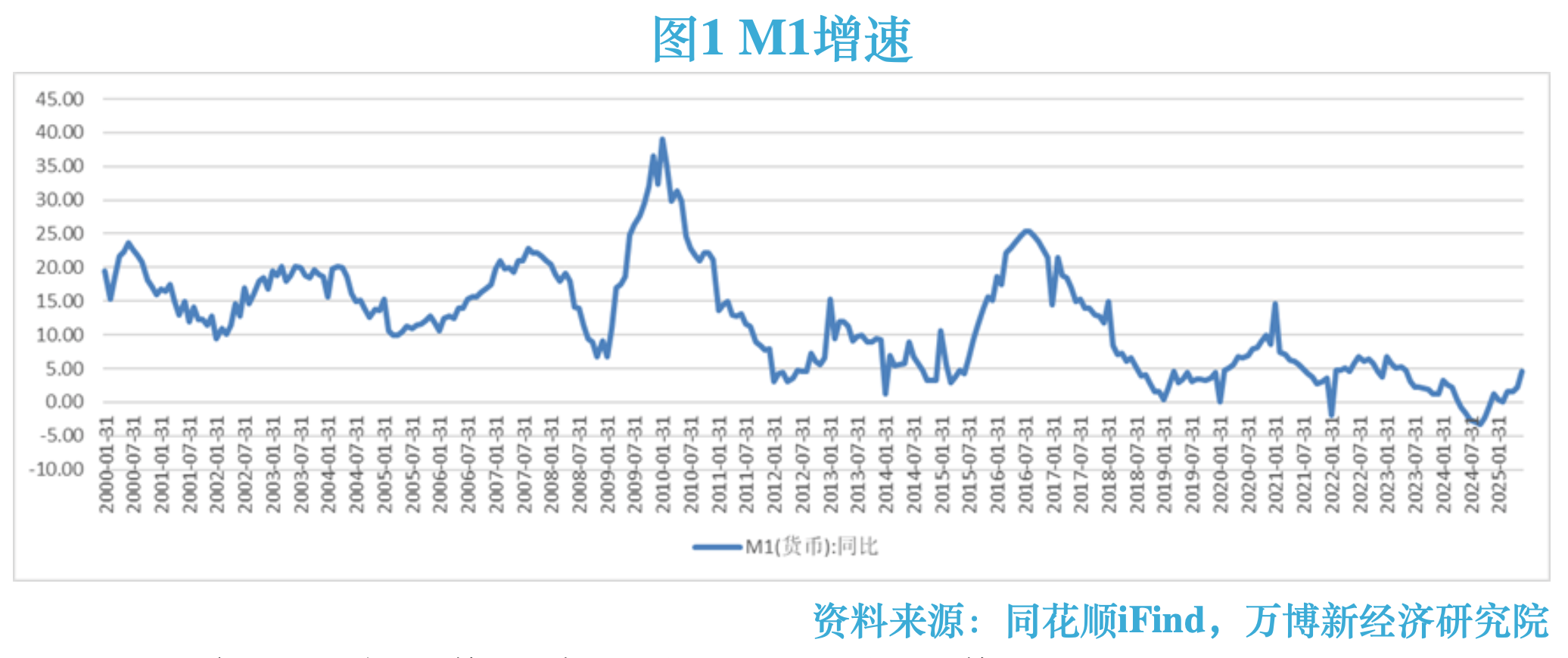
Group 1 - The central bank's continued interest rate cuts can significantly reduce the cost of existing debt for households, businesses, and the government, leading to substantial savings in interest payments each year [1][5] - As of June, the broad money supply (M2) grew by 8.3% year-on-year, while the narrow money supply (M1) increased by 4.6%, indicating positive changes in financial data [1] - M1 is considered a leading indicator of economic activity, as it reflects the liquidity available for consumption, investment, and trading [1][2] Group 2 - A further increase in M1 growth to between 5% and 10% is necessary for true monetary easing and to stimulate consumption, stabilize housing prices, and revitalize the stock market [2][4] - The net financing of government bonds in the first half of the year reached 7.66 trillion yuan, which is 4.32 trillion yuan more than the previous year, benefiting from the low-interest environment [4] - The corporate bond net financing was 1.15 trillion yuan, a decrease of 256.2 billion yuan year-on-year, indicating a need for improved business investment confidence and further interest rate cuts [4] Group 3 - The current household debt in China amounts to approximately 80 trillion yuan, and a 1% reduction in interest rates could save households around 800 billion yuan in interest payments annually [5] - Non-financial enterprises owe about 150 trillion yuan to banks, and a 1% interest rate cut could result in an additional 1.5 trillion yuan in profits for these companies [5] - The total government debt, including hidden debts, is over 100 trillion yuan, and a 1% interest rate reduction could save the government more than 100 billion yuan in interest payments each year [5] Group 4 - There is a viewpoint that emphasizes the importance of not deliberately devaluing the currency to enhance export advantages, suggesting that market forces should dictate currency value [8] - Concerns about interest rate cuts leading to currency devaluation and capital outflow are seen as misplaced, as the primary goal of monetary policy should be to stabilize domestic economic growth and employment [8][9] - Historical examples from Japan and the U.S. demonstrate that aggressive monetary policies, including zero and negative interest rates, can successfully stimulate economic recovery [9][10]

瑞达期货股指期货全景日报-20250721
Rui Da Qi Huo· 2025-07-21 10:06
Report Summary 1. Report Industry Investment Rating No industry investment rating information is provided in the report. 2. Core View of the Report - A-share major indexes rose collectively, with the Shanghai Composite Index up 0.72%, the Shenzhen Component Index up 0.86%, and the ChiNext Index up 0.87%. The trading volume in the Shanghai and Shenzhen stock markets rebounded significantly, and over 4,000 stocks rose. Industry sectors generally increased, with building materials, building decoration, and steel sectors strengthening significantly while bank stocks fell against the market [2]. - In the domestic economic fundamentals, the Q2 GDP grew 5.2% year-on-year, meeting market expectations. However, the growth rates of social retail sales and fixed - asset investment declined significantly, and the real estate market continued to decline. Exports improved due to the easing of Sino - US trade relations. In financial data, the year - on - year growth rates of M1 and M2 in June accelerated compared to May, with the M1 growth rate rising significantly and the M2 - M1 gap narrowing, indicating improved investment and consumption willingness of residents and enterprises [2]. - The LPR quotes in July remained unchanged. The Q2 GDP meeting expectations alleviated the urgency of LPR cuts. The profit performance of listed companies that have announced semi - annual performance forecasts is differentiated. Overall, the real estate market still drags down fixed - asset investment growth, and the support of the trade - in policy for social retail sales has weakened. However, the effectiveness of loose monetary policies has emerged, which may be reflected in subsequent economic indicators. As the Politburo meeting approaches at the end of July, market bulls may pre - arrange, and stock indexes still have long - term upward potential. It is recommended to buy on dips with a light position [2]. 3. Summary by Related Catalogs 3.1 Futures Disk - **Contract Prices**: IF (2509) was at 4064.8 (+29.6), IH (2509) at 2771.2 (+8.0), IC (2509) at 6055.6 (+62.4), and IM (2509) at 6463.2 (+59.4). The prices of secondary contracts also increased [2]. - **Contract Spreads**: The spreads between different contracts had various changes, such as the IF - IH spread up 17.8, the IC - IF spread up 32.0, etc. [2]. - **Quarter - to - Month Spreads**: The spreads between quarterly and monthly contracts of different varieties had different trends, with some rising and some falling [2]. 3.2 Futures Positions - The net positions of the top 20 in IF decreased by 130.0 to - 28,974.00, while those in IH increased by 1811.0 to - 15,786.00. The net positions of the top 20 in IC and IM also increased [2]. 3.3 Spot Prices - The spot prices of the CSI 300, SSE 50, CSI 500, and CSI 1000 all rose, and the basis of corresponding futures contracts changed, mostly decreasing [2]. 3.4 Market Sentiment - A - share trading volume was 17,271.35 billion yuan, up 1338.16 billion yuan. Margin trading balance decreased by 20.66 billion yuan to 19,023.36 billion yuan. Northbound trading volume increased by 99.31 billion yuan to 1946.21 billion yuan [2]. - The proportion of rising stocks was 73.92%, up 25.91 percentage points. Shibor was 1.366%, down 0.096 percentage points. The closing prices and implied volatilities of call and put options changed, and the 20 - day volatility of the CSI 300 index increased [2]. 3.5 Wind Market Strength and Weakness Analysis - All A - shares, technical, and capital indicators in the Wind analysis showed upward trends, with increases of 1.50, 2.60, and 0.50 respectively [2]. 3.6 Industry News - As of July 18, 1540 A - share listed companies announced 2025 semi - annual performance forecasts, with 674 pre - optimistic, a pre - optimistic ratio of about 43.77% [2]. - On July 21, the 1 - year and 5 - year - plus LPR remained unchanged at 3.0% and 3.5% respectively [2]. 3.7 Key Points of Attention - Key economic data and events to watch include the July SPGI manufacturing PMI preliminary values of France, Germany, the Eurozone, and the UK on July 24, the European Central Bank interest rate decision, US initial jobless claims, and the US July SPGI manufacturing PMI preliminary value, as well as China's June industrial enterprise profits on July 27 [3].
分析人士:M2、M1“剪刀差”有望继续维持在相对低位
news flash· 2025-07-20 23:44
Group 1 - The core viewpoint of the article indicates that M1's year-on-year growth rate has shown an upward trend, reaching 4.6% by the end of June, which is the smallest gap compared to M2's growth rate of 8.3% this year, narrowing significantly from the first five months [1] - Analysts expect that in the third quarter, the effects of policies aimed at stabilizing the economy, expectations, and foreign trade, along with the low base effect of M1, will continue to support the year-on-year growth rate of M1 [1] - The "scissors difference" between M2 and M1 is anticipated to remain at a relatively low level, indicating a potential for continued stability in monetary growth metrics [1]
6月金融数据点评:新增社融及信贷均超预期
Tai Ping Yang Zheng Quan· 2025-07-18 02:43
Group 1: Financial Data Overview - In June, China's social financing scale increased by 41,993 billion RMB, exceeding the expected 37,051 billion RMB and the previous value of 22,870 billion RMB[6] - New RMB loans in June amounted to 22,400 billion RMB, surpassing the expected 18,447 billion RMB and the previous value of 6,200 billion RMB[6] - M2 growth in June was 8.3%, higher than the expected 8.1% and the previous value of 7.9%[4] Group 2: Credit and Financing Trends - New credit in June was 22,400 billion RMB, with a year-on-year increase of 1,100 billion RMB, although still below seasonal averages[11] - Short-term loans contributed significantly to the increase, with a year-on-year rise of 1,334 billion RMB[16] - Government bond financing in June reached 13,508 billion RMB, a year-on-year increase of 5,032 billion RMB, supporting overall social financing[35] Group 3: M1 and M2 Analysis - M1 increased by 4.6% year-on-year, a significant rise of 2.3 percentage points from the previous month[37] - Total deposits in June increased by 32,100 billion RMB, with a year-on-year increase of 7,500 billion RMB[37] - Resident deposits rose by 3,300 billion RMB year-on-year, while non-financial corporate deposits increased by 7,773 billion RMB[37]
银行角度看6月社融:信贷增长有所恢复,政府债仍是主要支撑项
ZHONGTAI SECURITIES· 2025-07-15 10:41
Investment Rating - The report maintains an "Overweight" rating for the banking sector [2] Core Insights - The report highlights a recovery in credit growth, with government bonds remaining a primary support item. In June, social financing increased by 900.8 billion yuan year-on-year, with a total of 4.2 trillion yuan added, surpassing market expectations [9][10] - The structure of social financing shows a significant increase in credit, with a notable rise in government bond issuance, which reached 1.3508 trillion yuan in June, up 503.2 billion yuan year-on-year [10][12] Summary by Sections Social Financing Growth - In June, social financing increased by 900.8 billion yuan compared to the same month last year, with a total of 4.2 trillion yuan added, exceeding consensus expectations. The year-on-year growth rate of social financing reached 8.9%, a 0.2 percentage point increase from May [9][10] Credit Situation - New loans in June amounted to 2.24 trillion yuan, an increase of 110 billion yuan year-on-year, which is higher than market expectations. The year-on-year growth rate of credit balance was 7.1%, with the growth rate remaining stable compared to the previous month [12][13] - The credit structure indicates that various types of general loans (excluding bills) have increased year-on-year, while the characteristics of bill financing have weakened. Specifically, corporate short-term loans saw a significant increase [13][18] Liquidity and Deposit Situation - In June, M1 growth rate significantly increased, and the gap between M2 and M1 narrowed. M0, M1, and M2 grew by 12.0%, 4.6%, and 8.3% year-on-year, respectively [6][12] - The total increase in RMB deposits in June was 3.21 trillion yuan, which is 750 billion yuan more than the same period last year, with a year-on-year growth rate of 8.3% [6][12] Investment Recommendations - The report recommends focusing on the banking sector, particularly regional banks with strong certainty and advantages, such as Jiangsu Bank and Chongqing Rural Commercial Bank. It also highlights the importance of high dividend stability in large banks [6][12]





6月中国金融数据点评:M1为何大幅跳升?对后市影响如何?
Huaan Securities· 2025-07-15 07:37
Group 1: Report Industry Investment Rating No relevant content provided. Group 2: Core Viewpoints of the Report - In June, both social financing and credit showed seasonal rebounds with significant growth. The stock of social financing increased by 4.2 trillion yuan, and RMB loans increased by 2.24 trillion yuan. M2 maintained stable growth, M1 increased significantly, and M0 maintained high growth [3]. - The significant growth of social financing this month was stronger than in previous years, with the increased issuance of government bonds being the core driving force. The structure of new social financing changed from being dominated by government bonds in the previous month to "credit - based, government bonds as a supplement" [4]. - New credit increased seasonally and was slightly higher than the same period last year, mainly driven by short - term corporate loans, and medium - and long - term corporate loans also increased [4]. - The sharp rise of M1 this month may be due to factors such as the May interest rate cut, the central bank's use of outright reverse repurchases, the decline of the ten - year Treasury bond interest rate, and the acceleration of fiscal expenditure flowing into the real economy [5]. - In terms of corporate direct financing, there was differentiation among industries, and attention should be paid to the decline of real estate financing. Corporate bill financing decreased significantly, indicating an improvement in the corporate financing environment [7][8]. - The problem of insufficient currency activation has improved under the continuous acceleration of government leverage, but there are still concerns about the corporate balance sheet. The scissors gap between M2 and M1 has narrowed, but the expansion of the balance sheet of large - scale industrial enterprises depends on debt rather than profit [8]. - The policy combination of "fiscal leadership + monetary support" has achieved significant results. In the future, each sector has room for further development, and the enterprise sector may take over the social financing in the future [9]. - Currently, it is a critical transition period of "government - driven → enterprise takeover → household follow - up". The rebound of M1 this month may be a verification point of the start of recovery, and policy support is still necessary [10]. Group 3: Summary by Relevant Catalogs Data Observation - **Social Financing and Credit**: In June, the stock of social financing increased by 4.2 trillion yuan, with an year - on - year increase of 0.91 trillion yuan. RMB loans increased by 2.24 trillion yuan, with an year - on - year increase of 110 billion yuan. The growth of social financing was mainly driven by the high - growth of government bond financing year - on - year [3][4]. - **Money Supply**: M2 increased by 8.3% year - on - year, 0.4 percentage points higher than last month. M1 increased by 4.6% year - on - year, 2.3 percentage points higher than last month. M0 increased by 12% year - on - year, 0.1 percentage points slower than last month [3]. - **New Credit Structure**: New credit increased seasonally, mainly driven by short - term corporate loans, and medium - and long - term corporate loans also increased. On the supply side, banks tend to increase short - term corporate loans to meet the end - of - quarter assessment requirements. On the demand side, the PMI production and new order indexes in June showed that production and orders were recovering [4]. Depth Perspective - **Fiscal Deposits**: The financing volume of government bonds was slightly lower than in previous years, and the new fiscal deposits were at a historically low level. The difference between new government bond financing and fiscal deposits increased, indicating that government funds were flowing into the real economy [6]. - **Corporate Direct Financing**: There was differentiation among industries in corporate direct financing. The net financing of energy, materials, optional consumption, and information technology industries increased year - on - year, while that of medical, industrial, communication services, and real estate industries decreased. Attention should be paid to the decline of real estate financing [7][8]. - **Bill Financing**: Corporate bill financing decreased significantly this month, and there was no obvious bill - padding phenomenon. The bill financing interest rate center decreased compared with May, indicating an improvement in the corporate financing environment [8]. Future Outlook - **Overall Economic Pattern**: The problem of insufficient currency activation has improved, but there are still concerns about the corporate balance sheet. The scissors gap between M2 and M1 has narrowed, but the expansion of the balance sheet of large - scale industrial enterprises depends on debt rather than profit. The current cycle still depends on policy support to boost household currency activity [8]. - **Policy Level**: The policy combination of "fiscal leadership + monetary support" has achieved significant results. In the future, the government sector can release fiscal space through debt resolution, the enterprise sector can improve its ability to increase leverage through debt structure optimization, and the household sector is in a weak recovery state [9]. - **Bond Market**: Currently, it is still a liquidity - loose pattern dominated by policies. Although social financing has entered the fiscal effect verification period, the weak fundamentals remain unchanged. The downward adjustment space of the bond market may be limited, and investors should actively seize the opportunities brought by emotional changes [10].
2025年6月金融数据点评:社融信贷增长超预期,企业融资需求改善
Yin He Zheng Quan· 2025-07-15 07:07
Investment Rating - The report maintains a "Recommended" rating for the banking sector, indicating a positive outlook for the industry [1]. Core Insights - The social financing (社融) growth exceeded expectations, with June's new social financing reaching 4.2 trillion yuan, a year-on-year increase of 900.8 billion yuan. The total social financing stock grew by 8.9% year-on-year, with a month-on-month increase of approximately 0.2 percentage points [4]. - The demand for financing is showing signs of improvement, with both corporate and household credit increasing. The total RMB loans increased by 2.36 trillion yuan in June, a year-on-year increase of 171 billion yuan, marking a positive contribution to social financing growth [4]. - The report highlights that government bonds continue to be a major contributor to social financing growth, with new government bonds issued amounting to 1.35 trillion yuan in June, a year-on-year increase of 507.2 billion yuan [4]. - The M1 and M2 money supply indicators showed significant recovery, with M1 growing by 4.6% year-on-year and M2 by 8.3% year-on-year, indicating improved liquidity in the financial system [4]. Summary by Sections Social Financing Overview - In June, the new social financing was 4.2 trillion yuan, with a year-on-year increase of 900.8 billion yuan. The total stock of social financing grew by 8.9% year-on-year [4]. - The government bond issuance in June was approximately 2.77 trillion yuan, an increase of 818 billion yuan compared to the same period last year [4]. Credit Demand - By the end of June, the balance of RMB loans from financial institutions grew by 7.1% year-on-year. The new loans in June amounted to 2.24 trillion yuan, a year-on-year increase of 110 billion yuan [4]. - Household loans increased by 597.6 billion yuan, with short-term loans rising by 262.1 billion yuan, driven by consumption demand during promotional events [4]. Money Supply and Liquidity - M1 and M2 growth rates were 4.6% and 8.3% year-on-year, respectively, with month-on-month increases of 2.3 percentage points and 0.4 percentage points [4]. - Financial institutions' RMB deposits increased by 8.3% year-on-year, with a monthly increase of 750 billion yuan in June [4].