商业航天

Search documents
商业航天概念股跌幅居前 亚太卫星跌超8% 金风科技跌超5%
Zhi Tong Cai Jing· 2026-01-26 03:50
Group 1 - The commercial aerospace concept stocks have seen significant declines, with Asia Pacific Satellite down 8.18% to HKD 4.38, Junda Co. down 6.67% to HKD 36.4, Lens Technology down 5.54% to HKD 30.02, and Goldwind down 5.31% to HKD 16.05 [1] - Since 2026, the A-share market has experienced accelerated rotation of popular concepts such as commercial aerospace, AI applications, and humanoid robots, leading to short-term surges in certain stocks [1] - Regulatory measures have been implemented to cool the market, including raising financing margin ratios and initiating suspension checks on stocks with excessive price increases, aimed at distinguishing "true value" from "false speculation" [1] Group 2 - Despite the ITU's "first come, first served" principle, actual approvals may be less than the applications due to international coordination, frequency conflicts, and orbital capacity limitations [2] - The recent applications for frequency resources are seen as a strategic reserve, with Japan's government proposing a "Japanese version of Starlink," indicating intensified competition for space resources among major powers [2] - The applications have raised the potential demand ceiling for domestic commercial aerospace, with the industry expected to accelerate under the leadership of national teams like the Wireless Radio Innovation Institute [2]



午评:创业板指半日跌0.86%,两市半日成交额超2.2万亿
Feng Huang Wang· 2026-01-26 03:49
Group 1 - The three major indices showed mixed performance, with the Shenzhen Component and ChiNext Index opening high but closing lower, with a drop exceeding 1% at one point [1] - The total trading volume in the Shanghai and Shenzhen markets reached 2.24 trillion yuan, an increase of 347.8 billion yuan compared to the previous trading day [1] - Over 3,700 stocks in the market experienced declines, indicating a broad market weakness [1] Group 2 - The non-ferrous metals sector continued its strong performance, with precious metals leading the gains; Sichuan Gold achieved four consecutive trading limits in eight days [1] - The oil and gas sector showed strength, with China National Offshore Oil Corporation (CNOOC) rising over 5% to reach a historical high [1] - The commercial aerospace sector collectively weakened, with China Satellite hitting the daily limit down [1] Group 3 - The semiconductor equipment sector experienced volatility, with Kema Technology dropping over 10% [1] - The limit-up performance rate was 56%, with 45 stocks hitting the limit and 36 stocks touching the limit down [5] - The high opening rate was recorded at 73%, indicating a potential for profit-taking [5]


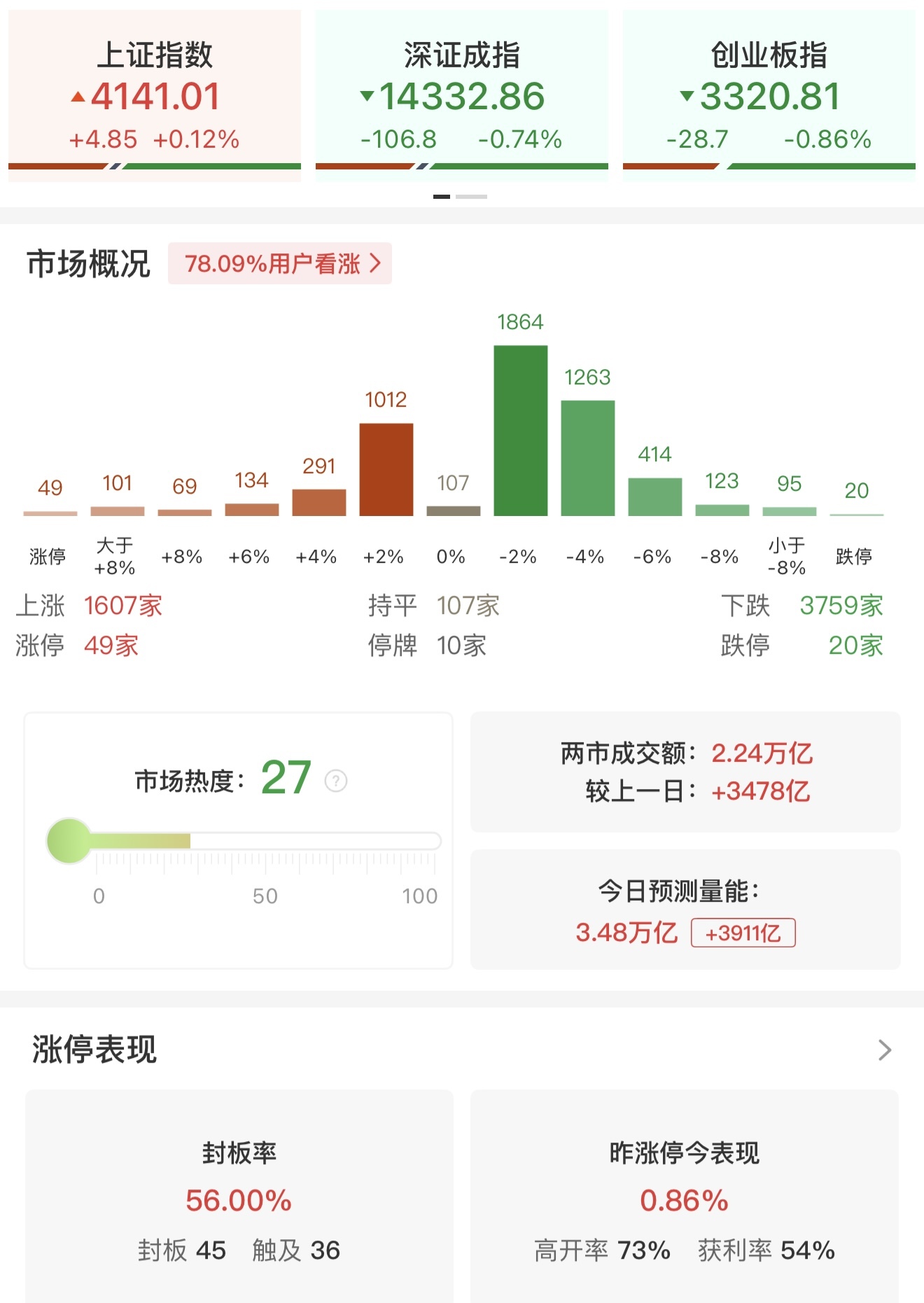
A股午评:沪指涨0.12%,贵金属、油气板块强势领涨,商业航天板块回调
Ge Long Hui· 2026-01-26 03:39
Market Performance - The three major A-share indices showed mixed results, with the Shanghai Composite Index rising by 0.12% to 4141.01 points, while the Shenzhen Component Index fell by 0.74% and the ChiNext Index decreased by 0.86% [1] - The total trading volume in the Shanghai and Shenzhen markets reached 22,631 billion yuan, an increase of 3,495 billion yuan compared to the previous day, with over 3,700 stocks declining across the market [1] Sector Highlights - The gold price approached the 5,100 USD mark, leading to a strong rally in the precious metals sector, with stocks like Hunan Gold and Zhaojin Gold hitting the daily limit [1] - Oil prices surged due to supply disruptions in the Middle East, resulting in a broad increase in oil and gas stocks [1] - The emergence of Nipah virus cases in India boosted the flu vaccine sector, with companies like Zhijiang Biology and Hualan Biological achieving a 20% daily limit increase [1] - The commercial aerospace, military equipment, and photolithography sectors experienced a pullback [1]
太空新基建有望带来万亿级市场爆发期,航空航天ETF(159227)单日“吸金”近2亿
Xin Lang Cai Jing· 2026-01-26 03:25
Core Viewpoint - The aerospace industry is experiencing significant volatility, with major stocks declining sharply, while the market anticipates a substantial growth phase driven by advancements in commercial space technology and infrastructure by 2035 [1][2]. Group 1: Stock Performance - The CN5082 aerospace industry index has seen significant declines, with stocks like Yaguang Technology down 13.41%, China Satellite down 10.00%, and Hangfa Technology down 9.60% [1]. - The Aerospace ETF (159227) is currently priced at 1.48 yuan, with a trading volume of 4.85 billion yuan and a turnover rate of 15.23% [1]. Group 2: Market Activity - The Aerospace ETF has recorded a net inflow of 1.92 billion yuan, indicating active market participation [1]. - The average daily trading volume for the Aerospace ETF over the past month is 7.06 billion yuan, reflecting strong investor interest [1]. Group 3: Industry Outlook - The 2026 Beijing International Commercial Aerospace Forum highlighted that the global space economy is expected to reach 1.8 trillion USD by 2035, driven by new infrastructure developments [1]. - According to Western Securities, the domestic commercial aerospace sector is entering a critical phase of policy support and technology validation from 2024 to 2025, with 2026 potentially marking the start of a commercialized cycle [1]. - The successful recovery and reflight validation of rockets like the "Zhuque-3" are anticipated to shift the sector from a thematic market to a mainline market [1]. Group 4: ETF Composition - The Aerospace ETF closely tracks the CN5082 index, covering key segments such as aerospace equipment, satellite navigation, and new materials, with commercial aerospace concepts accounting for 70% of its weight [2]. - Major holdings in the ETF include industry leaders like Aerospace Development, China Satellite, and AVIC [2].
中泰期货晨会纪要-20260126
Zhong Tai Qi Huo· 2026-01-26 03:03
1. Report Industry Investment Ratings No relevant information provided. 2. Core Views of the Report - The A - share market showed a differentiated trend on Friday, with small - and medium - cap indexes rising and large - cap blue - chip indexes falling. The market sentiment was affected by news such as the possible visit of US President Trump to China and the release of the first fine by the CSRC in 2026 [15]. - The long - end bonds may continue to rebound, and the interest rate curve may continue to flatten. The central bank's monetary policy is turning to be more accommodative, but the cost of funds remains relatively high [16]. - The black market as a whole maintains a volatile trend. Steel products may fluctuate and consolidate in the short term, and iron ore is relatively weak and should be shorted on rallies [18]. - The prices of coking coal and coke may fluctuate and consolidate in the short term, and the supply - demand contradiction may improve during the Spring Festival [19][21]. - The medium - term price fluctuation center of ferrosilicon and silicomanganese is rising slightly. It is recommended to go long on ferrosilicon on dips and hold short positions in silicomanganese [22]. - For soda ash and glass, it is advisable to wait and see currently. Pay attention to the supply changes of leading enterprises and the implementation of production line changes [23]. - For non - ferrous metals, it is recommended to wait and see for zinc and lead, and hold short positions in lead. Lithium carbonate is expected to fluctuate strongly in the short term [25][26][28]. - Industrial silicon is under pressure at the upper limit and should wait for opportunities to sell out - of - the - money call options after a rebound. Polysilicon should wait for guidance on anti -内卷 and anti - monopoly rectification plans [29]. - For agricultural products, cotton prices may be affected by supply and demand and policies. Sugar prices are under pressure, and eggs may weaken before the Spring Festival. Apples may fluctuate strongly, and corn prices are affected by inventory and policy. Jujubes may fluctuate weakly, and pork prices are affected by supply and demand [31][34][36][38][39][40][41]. - For energy and chemical products, crude oil prices are affected by geopolitical factors and supply - demand contradictions. Fuel oil prices follow crude oil. Plastics may have a short - term rebound but with limited space. Rubber can sell out - of - the - money put options on dips. Methanol is recommended to be long - configured. Caustic soda has different views for near - term and far - term contracts. Asphalt prices follow crude oil. The polyester industry chain may maintain a high - level operation. LPG may be strong in the short term but with limited upside. Pulp and logs may fluctuate strongly, and urea is expected to be strongly volatile [43][46][48][50][52][53][54][55][56][57][58]. 3. Summaries According to Relevant Catalogs 3.1 Macro Information - The CSRC officially released the guidelines for the performance comparison benchmarks of public funds, and the Asset Management Association of China released the operating rules, which will come into effect on March 1, 2026. The new rules target industry pain points such as "vague benchmarks", "style drift", and "fund blind boxes" [8]. - The CSRC issued its first fine in 2026, imposing a penalty on Yu Han for manipulating the stock price of "Doctor Glasses" [8]. - The market operation and consumption promotion work conference emphasized promoting the expansion and upgrading of commodity consumption and cultivating new growth points in service consumption [8]. - The CSRC is intensively investigating illegal activities in the private fund sector and will urge private institutions to rectify non - standard behaviors [9]. - The "Beijing Rocket Street" launched six platforms, aiming to form a full - chain "thousand - satellite production and launch" capacity [9]. - US President Trump said that the US is deploying troops to Iran and will impose a 25% tariff on countries trading with Iran. The US also imposed a new round of sanctions on entities and vessels related to Iran's energy and shipping systems [9]. - Representatives from Russia, the US, and Ukraine held their first meeting in Abu Dhabi to discuss security issues [9]. - The preliminary values of the US manufacturing, service, and composite PMIs in January were slightly lower than expected. The eurozone's manufacturing PMI rebounded slightly but remained in the contraction range, while the service PMI declined [10]. - The CSRC approved the registration of 20 - rubber options, low - sulfur fuel oil options, and international copper options and included 14 futures and options varieties in the scope of expanding the opening of the futures market [10]. - The Bank of Japan maintained its benchmark interest rate at 0.75% and raised its economic growth and inflation expectations for the 2026 fiscal year [10]. - A German lawmaker proposed that Germany should repatriate its gold reserves from the US due to the "unpredictable" policies of US President Trump [11]. - Silver prices reached a new high, with a year - to - date increase of over 40%, outperforming gold. Gold prices continued to approach $5000 per ounce [11]. 3.2 Macro - Finance 3.2.1 Stock Index Futures - The A - share market showed a differentiated trend on Friday, with small - and medium - cap indexes rising and large - cap blue - chip indexes falling. The market sentiment was affected by news such as the possible visit of US President Trump to China and the release of the first fine by the CSRC in 2026 [15]. 3.2.2 Treasury Bond Futures - The long - end bonds may continue to rebound, and the interest rate curve may continue to flatten. The central bank's monetary policy is turning to be more accommodative, but the cost of funds remains relatively high [16]. 3.3 Black 3.3.1 Steel and Iron Ore - The macro - policy meets market expectations, and the possibility of policy interference in the steel production end is low. The fundamentals of steel are acceptable, with small inventory increases and good order - taking. However, downstream demand is weak, especially in the building materials sector. Iron ore supply is abundant, and its inventory is accumulating [16][17]. - The black market as a whole maintains a volatile trend. Steel products may fluctuate and consolidate in the short term, and iron ore is relatively weak and should be shorted on rallies [18]. 3.3.2 Coking Coal and Coke - The prices of coking coal and coke may fluctuate and consolidate in the short term. The supply - demand contradiction may improve during the Spring Festival, which may support spot prices [19][21]. 3.3.3 Ferrosilicon and Silicomanganese - The medium - term price fluctuation center of ferrosilicon and silicomanganese is rising slightly. It is recommended to go long on ferrosilicon on dips and hold short positions in silicomanganese [22]. 3.3.4 Soda Ash and Glass - For soda ash and glass, it is advisable to wait and see currently. Pay attention to the supply changes of leading enterprises and the implementation of production line changes [23]. 3.4 Non - Ferrous Metals and New Materials 3.4.1 Zinc - As of January 22, the domestic zinc inventory decreased. It is recommended to wait and see or short on rallies due to the repeated inventory data [25]. 3.4.2 Lead - As of January 22, the lead inventory reached a two - month high. It is recommended to wait and see and hold short positions. Be cautious of the risk of lead price decline before the Spring Festival [26][27]. 3.4.3 Lithium Carbonate - Lithium carbonate is expected to fluctuate strongly in the short term, with good demand and supply - side disturbances. The market expects a narrowing of the supply surplus or even a shortage in 2026 [28]. 3.4.4 Industrial Silicon and Polysilicon - Industrial silicon is under pressure at the upper limit and should wait for opportunities to sell out - of - the money call options after a rebound. Polysilicon should wait for guidance on anti -内卷 and anti - monopoly rectification plans [29]. 3.5 Agricultural Products 3.5.1 Cotton - The global cotton supply and demand situation is favorable, with a decrease in production and inventory. The domestic cotton supply is temporarily abundant, and attention should be paid to the impact of pre - Spring Festival restocking and policy implementation [31][33]. 3.5.2 Sugar - Global sugar supply is expected to be in surplus in the 2025/26 season. Domestic sugar is under supply pressure, and it is recommended to trade in the low - level range [34]. 3.5.3 Eggs - Eggs may weaken before the Spring Festival. The futures of the 03 contract have limited upside space, and a bearish view is recommended. However, the egg - laying hen inventory is expected to decline, which may limit the downside space of futures [36][37]. 3.5.4 Apples - Apple prices may fluctuate strongly in the short term, with the supply side providing support and the demand side constraining the upside. Attention should be paid to the terminal consumption during the Spring Festival [38][39]. 3.5.5 Corn - Corn prices are expected to be stable in the short term, supported by pre - Spring Festival restocking demand. However, the upside space is limited, and attention should be paid to the selling pressure in March [39]. 3.5.6 Jujubes - Jujubes are expected to fluctuate weakly in the short term. Attention should be paid to the market performance during the consumption peak season [40]. 3.5.7 Pigs - The pig market has both supply and demand increases, and the spot market is in a fierce game. It is recommended to pay attention to the impact of weight reduction before the Spring Festival on prices and consider shorting near - term contracts on rallies [41]. 3.6 Energy and Chemical Products 3.6.1 Crude Oil - Crude oil prices are affected by geopolitical factors and supply - demand contradictions. Geopolitical factors have pushed up prices, but the supply - demand situation remains weak [43]. 3.6.2 Fuel Oil - Fuel oil prices follow crude oil, and the current supply - demand situation has a marginal improvement. The focus is on the geopolitical situation in Iran [46]. 3.6.3 Plastics - Plastics have a large supply pressure and weak downstream demand. They may have a short - term rebound but with limited space [46][47]. 3.6.4 Rubber - Rubber can sell out - of - the money put options on dips before the Spring Festival, supported by downstream restocking and the approaching off - season in overseas production areas [48]. 3.6.5 Synthetic Rubber - Synthetic rubber is expected to fluctuate upward in the first half of the year, and it is recommended to go long on pullbacks [49]. 3.6.6 Methanol - Methanol's supply - demand situation has improved, and it is recommended to be long - configured. However, there may be a short - term callback risk [50]. 3.6.7 Caustic Soda - Caustic soda has different views for near - term and far - term contracts. The near - term contract is bearish, while the far - term contract is bullish [52]. 3.6.8 Asphalt - Asphalt prices follow crude oil, and attention should be paid to the change in raw material discounts [53]. 3.6.9 Polyester Industry Chain - The polyester industry chain may maintain a high - level operation, and it is recommended to consider low - buying and 5 - 9 positive spreads for PX and PTA [54]. 3.6.10 LPG - LPG may be strong in the short term but with limited upside. Attention should be paid to the negative feedback from the demand side [55]. 3.6.11 Pulp - Pulp prices may fluctuate strongly. The spot market is weak, but there is support from the expected price increase of overseas pulp [56]. 3.6.12 Logs - Logs may fluctuate strongly, with the domestic spot market remaining stable and the supply - demand situation expected to be balanced [57]. 3.6.13 Urea - Urea is expected to be strongly volatile, and attention should be paid to the improvement of spot market liquidity [58].
每日市场观察-20260126
Caida Securities· 2026-01-26 02:58
Market Overview - The Shanghai Composite Index rose by 0.33%, the Shenzhen Component Index increased by 0.79%, and the ChiNext Index gained 0.63% on January 23, 2026, with over 3,700 stocks rising in total [4][5] - The trading volume in the Shanghai and Shenzhen markets exceeded 3.1 trillion yuan, indicating a recovery in market confidence [4] Industry Focus - The commercial aerospace sector is entering a golden era driven by both demand and supply, with significant investment opportunities in satellite manufacturing and launching [1] - The "15th Five-Year Plan" emphasizes the goal of building a strong aerospace nation, marking a strategic focus for the upcoming years [1] Fund Dynamics - Public fund management scale increased by over 1.3 trillion yuan in Q4 2025, with money market funds, bond funds, commodity funds, and index funds being the main growth drivers [13] - Headline private equity firms are increasing their positions, with stock private equity positions exceeding 81% as of January 9, 2026, indicating a bullish outlook for structural opportunities in 2026 [14] Industry Developments - The "Jiuquan Commercial Aerospace Industry Development Plan (2026-2035)" has been officially released, aiming to establish a national commercial aerospace launch base [10] - China has successfully completed its first space metal 3D printing experiment, showcasing advancements in additive manufacturing technology in microgravity environments [11] - The launch of six major platforms in Beijing's commercial aerospace sector aims to accelerate the development of a comprehensive "thousand stars production and launch" capability [12]
“北京火箭大街”六大平台启动!航空航天ETF天弘(159241)近10日净流入近1.7亿元,机构:中国商业航天开始到达从政策孵化期向工业化爆发期过渡的关键节点
2 1 Shi Ji Jing Ji Bao Dao· 2026-01-26 02:55
Group 1 - The aerospace sector experienced a morning adjustment on January 26, with the Guozheng Aerospace Industry Index falling by 2.14%. Among the constituent stocks, Zhenxin Technology rose over 7%, while China Satellite and Aerospace Development dropped more than 5% [1] - The Tianhong Aerospace ETF (159241) recorded two consecutive days of gains as of last Friday, with a trading volume of 166 million yuan. It has seen a net inflow of over 20 million yuan in the last two trading days, with a cumulative net inflow of over 62 million yuan in the past five trading days and 170 million yuan in the last ten trading days [1] - The Tianhong Aerospace ETF closely tracks the Guozheng Aerospace Industry Index, which covers sub-sectors such as aerospace equipment, military electronics, and satellite internet, with a high weight of 98.7% in the defense and military industry category [1] Group 2 - The third Beijing Commercial Aerospace Industry High-Quality Development Promotion Conference was held on January 23, launching six platforms under "Beijing Rocket Street" aimed at accelerating major project construction and forming a comprehensive "thousand-star production capacity" [2] - According to Guojin Securities, the global aerospace industry is undergoing structural changes similar to the Age of Exploration, driven by the rise of commercial aerospace companies like SpaceX. China's commercial aerospace is transitioning from a policy incubation phase to an industrial explosion phase, with 2026 expected to be a pivotal year for the industry [2]


轻指数重个股,聚焦结构性机会
British Securities· 2026-01-26 02:54
Core Views - The A-share market showed signs of recovery last Friday, with all three major indices rising, indicating strong internal resilience despite pressure on the Shanghai 50 and CSI 300 indices [3][11] - The report emphasizes a strategy of focusing on individual stocks rather than indices, highlighting structural opportunities and the importance of capturing high-quality targets in high-growth sectors [3][11] Market Overview - Last Friday, the A-share market experienced a rebound, with a total trading volume exceeding 30 trillion yuan, driven by strong performance in sectors such as photovoltaic equipment, energy metals, and commercial aerospace [5][10] - The Shanghai Composite Index closed at 4136.16 points, up 0.33%, while the Shenzhen Component Index and the ChiNext Index also reported gains of 0.79% and 0.63%, respectively [5][10] Weekly Market Review - The three major indices exhibited mixed performance over the past week, with the Shanghai Composite Index rising by 0.83% and the Shenzhen Component Index by 1.11%, while the ChiNext Index fell by 0.34% [6] - The market displayed structural characteristics, with significant movements in sectors such as precious metals, electric grid equipment, and aerospace, while AI applications and banking stocks faced downward pressure [6] Sector Analysis - Precious metals continued to rise due to several factors, including the onset of a Federal Reserve rate cut cycle, increased geopolitical tensions, and strong demand from global central banks [7] - The report notes that the price of gold has been significantly influenced by a weaker dollar and inflation concerns, suggesting that while the upward trend may continue, caution is advised against chasing prices [7] - The renewable energy sector, particularly photovoltaic equipment and energy metals, has shown strong performance, supported by ongoing global efforts to achieve carbon neutrality [8][9] - The commercial aerospace sector is experiencing growth driven by supportive policies and increasing demand for satellite internet applications, with a focus on the development of sustainable business models [10] Future Market Outlook - The report anticipates that the A-share market will maintain its resilience, with a focus on structural opportunities and high-growth sectors, particularly in the context of upcoming annual reports and expected earnings growth [11]
西部证券晨会纪要-20260126
Western Securities· 2026-01-26 02:50
Group 1: Shipping Industry - The global shipping market is expected to improve in 2026, with specific attention on container ships, bulk carriers, and tankers [1][5] - The resumption of operations in the Red Sea is crucial for container ships, while the West Simandou iron ore mine is anticipated to reshape global iron ore trade flows, benefiting bulk shipping [1][5] - OPEC+ has begun to increase production, leading to a tight supply-demand balance in the tanker market due to US sanctions on Russia [1][5] Group 2: Weigao Group (1066.HK) - Weigao Group is positioned for a transformation driven by R&D, with expectations of net profits of 2.091 billion, 2.287 billion, and 2.507 billion yuan from 2025 to 2027, reflecting growth rates of 1.18%, 9.37%, and 9.62% respectively [9][10] - The global biopharmaceutical market is projected to grow at a CAGR of 10.4% from 2024 to 2030, with significant demand for filters and consumables [9] - The company has a robust product portfolio with 927 domestic product registrations and 1,084 patents, including 218 invention patents [9] Group 3: AI Animation Industry - The continuous iteration of generative AI models is providing a technological foundation for the cost-effective and high-quality development of AI animation [16][18] - AI animations are gaining market acceptance, with significant growth in production and viewership, exemplified by the rapid increase in the number of AI animations launched on platforms like Douyin [16][17] - The cost advantages of AI animations compared to traditional animation methods are notable, with production costs significantly lower [17][18] Group 4: 3D Printing in Commercial Aerospace - 3D printing technology is effectively reducing costs and increasing efficiency in the commercial aerospace sector, with significant reductions in the number of parts and production time for rocket engines [20][21] - The domestic 3D printing equipment market is experiencing growth, with exports reaching 3.777 million units valued at 8.9 billion yuan in 2024 [21][22] - The technology is also being applied in the production of micro-nano satellite components, showcasing its advantages in mass production [21][22] Group 5: Zijin Mining (601899.SH) - Zijin Mining's Giant Dragon Copper Mine Phase II has commenced production, increasing annual copper output from 190,000 tons to an expected 300,000-350,000 tons in 2026 [28][29] - The mine's production capacity has significantly increased, positioning it as China's largest copper mine and one of the world's highest-altitude, low-grade copper mines [29][30] - The company anticipates further growth with plans for a Phase III project that could increase copper reserves and production capacity [30]
商业航天行业:太空光伏,逐日天穹,叩问千亿星辰市场
2026-01-26 02:49
Summary of the Conference Call on the Space Photovoltaics Industry Industry Overview - **Industry Focus**: Space Photovoltaics - **Key Players**: SpaceX, Amazon, Chinese satellite companies - **Market Potential**: Estimated to reach a trillion-dollar market Core Insights and Arguments 1. **Cost Reduction through Reusable Technology**: The advent of reusable rocket technology has significantly lowered launch costs, creating a golden opportunity for space photovoltaics. The successful exploration of reusable rockets by companies like SpaceX has led to a rapid decrease in launch costs, making commercial space activities more frequent [5][23][24] 2. **US-China Competition in Commercial Space**: The competition between the US and China in commercial space is accelerating, particularly in low Earth orbit (LEO) communications satellites, which is expected to drive demand for solar wings. The US currently leads in LEO satellite deployment, with China planning to submit applications for 203,000 satellites to the International Telecommunication Union (ITU) by December 2025, aiming to secure valuable orbital resources [5][44][46] 3. **AI and Space Computing**: The concept of deploying AI data centers in space is gaining traction among tech giants. Space-based computing, or "computing in space," is seen as a solution to energy and space limitations. The cost of deploying a 40MW AI data center in space is estimated at $8.2 million, significantly lower than ground deployment costs [5][52][53] 4. **Technological Developments in Photovoltaics**: - **Gallium Arsenide (GaAs)** is currently the mainstream choice for space photovoltaics due to its excellent performance, though it is costly and has material sourcing limitations. - **Heterojunction (HJT)** technology is expected to be a significant choice for large-scale industrialization due to its efficiency and simpler manufacturing process. - **Perovskite technology** shows promise but lacks sufficient empirical data for large-scale application in the short term [5][64] 5. **Investment Recommendations**: The space photovoltaics sector is entering an active exploration phase, with equipment manufacturers poised to benefit. Key companies to watch include: - **HJT/Perovskite Equipment Suppliers**: Maiwei Co., Aotwei, and Jiejia Weichuang - **Comprehensive Photovoltaic Companies**: Jing Sheng Mechanical and Gao Ce Co. [5][5] Additional Important Content 1. **Risks**: Potential risks include slower-than-expected development of the commercial space industry, uncertainties in the technological pathways for space photovoltaics, and lower-than-expected investment and application demand for space computing [5][5] 2. **Market Dynamics**: The global satellite launch frequency has increased significantly since 2020, with projections indicating around 4,000 launches annually by 2025, marking a growth rate exceeding 50% [5][38] 3. **Future Projections**: The estimated demand for space photovoltaics from existing satellite plans could reach nearly 10GW in the near term, with significant growth expected as more satellites are deployed [5][46][62] 4. **Cost Comparisons**: The Levelized Cost of Energy (LCOE) for space photovoltaics is projected to decrease significantly due to reduced launch costs and advancements in technology, potentially reaching $0.04/kWh by 2050 [5][33][34] 5. **Global Competition**: The competition for orbital resources is intensifying, with the US and China leading the charge in satellite deployments, highlighting the strategic importance of space resources [5][42][43] This summary encapsulates the key points discussed in the conference call regarding the space photovoltaics industry, emphasizing the technological advancements, market dynamics, and investment opportunities within this rapidly evolving sector.