全球化

Search documents
德尔玛(301332) - 301332德尔玛投资者关系管理信息20250513
2025-05-13 10:32
Financial Performance - In 2024, the company achieved a revenue of 3.531 billion CNY, representing a year-on-year growth of 11.98% [2] - The net profit for 2024 was 142 million CNY, with a year-on-year increase of 30.95%, indicating a higher growth rate compared to revenue [2][9] - The company plans to distribute a cash dividend of 1.5 CNY per 10 shares, amounting to approximately 68.75 million CNY, which is 48.29% of the net profit [4][10] Strategic Focus - The company aims to maintain growth through product innovation, global market expansion, and operational efficiency improvements [2][3] - Future strategies include focusing on core product categories and enhancing the product matrix based on consumer needs [3][7] - The company emphasizes a multi-brand and multi-category strategy, particularly around the "Derma" and "Philips" brands [5][10] Market Outlook - The small home appliance market is expected to grow due to rising consumer income and demand for high-quality, personalized products [4] - The company sees significant growth potential in the Chinese market, where per capita ownership of small appliances remains low compared to developed countries [4] Research and Development - R&D investment for 2024 increased by 25.54%, totaling 190 million CNY, focusing on cleaning, water health, and personal health products [7][12] - The company is adopting an Integrated Product Development (IPD) model to enhance R&D efficiency and product quality [8][12] Investor Relations and Market Management - The company is committed to improving investor relations through various communication channels and enhancing transparency [6][10] - It has implemented measures such as share buybacks and cash dividends to boost investment value and manage market perception [6][10] E-commerce Performance - In 2024, online sales generated 1.636 billion CNY, accounting for 46.34% of total revenue, with plans to expand online sales channels [9][10]
关税战暂时停火回溯,真的可以开香槟了吗?
Hu Xiu· 2025-05-13 05:25
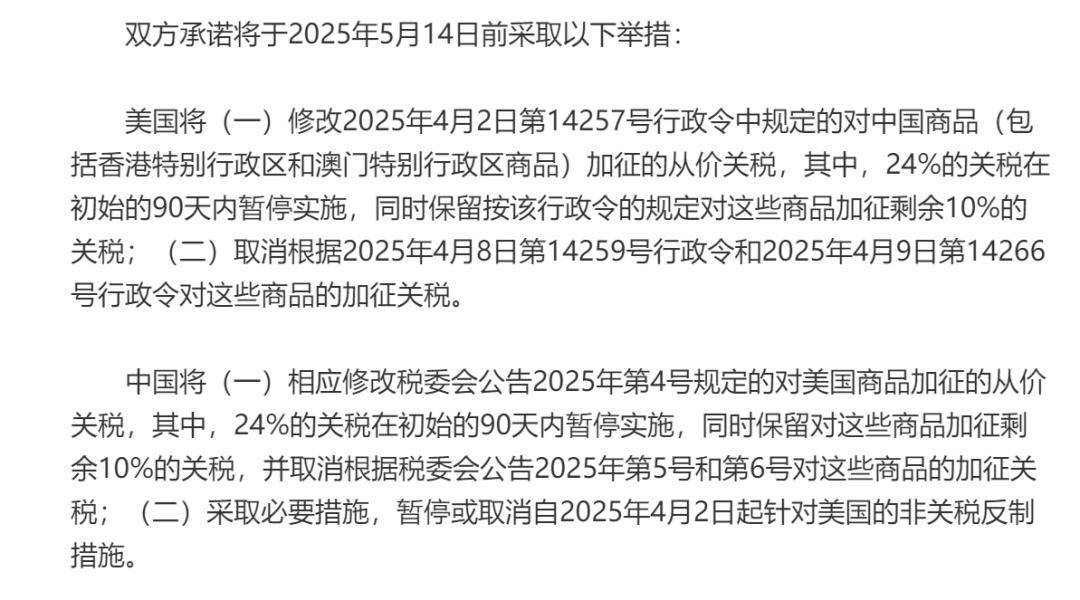
半个月前,知危刚写了国际货运代理们对于关税战的看法,文中提到国际货代们普遍认为这种高关税状态将在 5 月中旬得到一定程度解决。 5月12日,关税果然降了下来。据新华社消息,中美发表《 中美日内瓦经贸会谈联合声明 》,双方将在 5 月 14 日前采取一系列措施降低关税。 题图来自:AI生成 而报道中的中方对美关税加征仅剩 10%,即为《 中美日内瓦经贸会谈联合声明 》所披露的内容。 但实际上,在 4 月 2 日前,针对美方的前两轮税率加征,中方也有相关反制措施,所谓"仅剩 10%"并未考虑下列相关反制: 2 月 4 日,中方宣布对美方的煤炭、液化天然气加征 15% 关税,对原油、农业机械、大排量汽车、皮卡加征 10% 新关税; 2 月4 日,美国以"平衡中美贸易逆差"为由,针对中国进口商品加征 10% 的关税; 3 月 3 日,美国又以"中国未有效阻止芬太尼类物质流入美国"为由,宣布对中国输美产品,再次加征 10% 关税,此时关税的累计加征税率到达了 20%; 5 月 12 日,《 中美日内瓦经贸会谈联合声明 》披露美国在 4 月 2 日及以后对华加征的关税仅保留 10%,此时关税累计加征税率到达了 30%; ...

朱明荣:传承饶斌精神 点燃中国汽车新引擎
Zhong Guo Qi Che Bao Wang· 2025-05-13 01:24
Core Insights - In 2024, China's automotive industry achieved remarkable milestones, with production and sales exceeding 31 million units, and exports reaching 6.41 million units, solidifying its position as the largest automotive exporter globally [1] - The penetration rate of new energy vehicles reached 47.6%, and the installation rate of intelligent driving in passenger cars surpassed 65%, indicating significant advancements in technology and market adoption [1] Group 1: Historical Context and Contributions - Rao Bin is recognized as a key founder and pioneer of China's automotive industry, having initiated the establishment of the first automotive manufacturing plant in Changchun in 1952, which marked the beginning of domestic automobile production [4][6] - Under Rao Bin's leadership, the first domestically produced truck and passenger cars were launched in the late 1950s, overcoming numerous challenges in a nascent industry [4][6] - In the 1960s, Rao Bin introduced the "Four New" strategy, focusing on new materials, processes, technologies, and equipment, which laid the groundwork for modern automotive production in China [6] Group 2: Strategic Vision and Modernization - Rao Bin advocated for the "external introduction and internal connection" strategy during the reform and opening-up period, promoting joint ventures with foreign companies, which significantly accelerated the modernization of China's automotive industry [6][12] - He played a crucial role in restructuring the automotive industry by forming joint ventures and consolidating numerous enterprises, which facilitated large-scale development and improved production efficiency [6][12] Group 3: Talent Development and Education - Rao Bin emphasized the importance of talent development, establishing various educational institutions and training programs to cultivate skilled workers and engineers for the automotive sector [7][13] - His initiatives led to the creation of several technical schools and universities, significantly contributing to the growth of a skilled workforce in the automotive industry [7][13] Group 4: Legacy and Cultural Impact - Rao Bin's contributions have left a lasting legacy, with many referring to him as the "Father of China's Automotive Industry," highlighting his pivotal role in shaping the sector [8][10] - The spirit of innovation, resilience, and dedication exemplified by Rao Bin continues to inspire current and future generations in the automotive industry, fostering a culture of excellence and ambition [15][20]


从“中国制造”到“全球标准” 好孩子公司莫干山解码企业逆周期法则
Zhong Guo Jin Rong Xin Xi Wang· 2025-05-12 13:00
转自:新华财经 新华财经上海5月12日电(记者高少华)中国母婴行业出海标杆企业——好孩子集团创始人、董事局主席宋郑还于近日出席"2025世界品牌莫干山大会"相关 活动,好孩子集团同时荣获"2025新质品牌力创建"优秀案例奖项。 从首创第三代气囊儿童安全座椅颠覆行业标准,到搭建覆盖全球的柔性供应链体系,作为拥有36年发展历史的民族品牌,好孩子集团近年来坚持"以变应 变",用技术创新重塑竞争规则,以系统能力穿越周期波动,不断增强中国企业劈波斩浪的信心与底气。 好孩子集团创始人、董事局主席宋郑还(受访者供图) 技术突围,从标准追随到范式创造 优秀的产品可以抵御经济周期波动,消费者会花费更多的时间前置到筛选产品中去。好孩子的自研创新之路,正是无数中国企业凭实力闯世界的缩影。 《2024中国家庭出行报告》数据显示,我国自驾游渗透率突破68%,亲子旅行成为家庭生活的重要组成;同时,随着法律法规对儿童安全座椅配备提出明确 要求,消费者对儿童出行安全的重视程度更是空前提高。 政策东风叠加育儿观念升级,催生出一个年均复合增长率达23.7%的百亿元级市场。艾媒咨询数据显示,2024年中国儿童安全座椅市场规模预计突破142亿 元。 ...
美国造船的衰落,早在中国造船崛起之前
3 6 Ke· 2025-05-12 03:31
美国港口费重锤先砸碎的是自家供应链。中国国际海事和船舶工业的崛起,并非"非市场手 段"产物,而是全球化浪潮下要素优化配置与技术迭代的必然结果 近年来,美国对中国的国际海事行业关注热度超乎想象,专门针对中国的国际海事相关产业链开展了 301调查,各项海事制裁连环叠加。 通过立法、关税、港口并购等一系列手段,尤以对停靠美国港口的中国制造船舶以及中国航运企业征收 的天价港口费为代表,美国试图削弱中国企业竞争力、破坏全球港航布局,并限制中美贸易,重塑其主 导的供应链秩序。 美国在制定相关政策过程中,强化了对中国企业的限制措施,这种做法与全球自由市场规则存在一定偏 离,并引发对公平竞争原则的质疑。 历史早已证明,将经济问题政治化,既无法掩盖美国《琼斯法案》、货载保留等造成的本国船舶和海运 成本黑洞,也不能通过保护主义来振兴其船舶和海运经济,更难以逆转中国船舶制造和海运服务业依托 技术和产业优势形成的创新发展势能。 美国对华海事制裁的终局会走向何方,本文提出三个预言。 针对中国的海事制裁连环叠加 美国频繁对中国实施海事制裁,核心在于遏制中国在全球海运和造船业的主导地位,维护其自身及盟友 利益。美国针对中国施展了多重海事制 ...
直击科创板新能源行业集体业绩说明会:多元化布局筑牢发展根基 “新能源 +”场景应用释放新动能
Zheng Quan Ri Bao Wang· 2025-05-11 13:07
Core Viewpoint - The performance briefing of the new energy sector on the Sci-Tech Innovation Board highlighted the growth and strategic developments of key companies in the industry, showcasing a complete ecosystem from upstream materials to downstream applications, with a focus on intelligent and global advancements [1][2]. Group 1: Company Performance and Strategies - Seven listed companies participated in the performance briefing, including leading firms like Shanghai Pylon Energy Technology Co., Ltd. and Guangdong Liyuanheng Intelligent Equipment Co., Ltd. [1] - Pylon Technology, a leader in energy storage systems, expressed confidence in the growth of its performance supported by the expansion of energy storage applications, with plans to enhance home storage product performance by 2025 [2]. - Guangdong Fangyuan New Materials Group Co., Ltd. has successfully industrialized a new lithium extraction process in 2024, gaining recognition from major clients in the lithium battery supply chain [2]. Group 2: Technological Innovations - Guangdong Lair New Materials Technology Co., Ltd. reported a revenue of 526 million yuan in 2024, a year-on-year increase of 19.95%, with significant contributions from new energy materials [3]. - The company has expanded its functional coating film business into emerging fields such as automotive electronics and new energy batteries, achieving breakthroughs in various market segments [3]. Group 3: International Expansion - Dalian Haosen Intelligent Manufacturing Co., Ltd. has seen a rapid increase in European orders since 2023, with overseas orders expected to exceed 50% of total new orders in 2023 and 2024 [4]. - The company is also targeting emerging markets in ASEAN and Latin America, where countries like Indonesia, Thailand, and Brazil have set ambitious transformation goals [4]. Group 4: Smart Applications in New Energy - Hangzhou Hongquan Internet of Things Technology Co., Ltd. reported a revenue of 523 million yuan in 2024, a year-on-year increase of 27.81%, with significant growth in its T-BOX product line for new energy logistics vehicles [5]. - The company is actively expanding its overseas business, aligning products with international market standards and participating in global exhibitions to engage with potential clients [5].

汽车和汽车零部件行业周报20250511:具身智能加速,看好T链+强智能化主机厂-20250511
Minsheng Securities· 2025-05-11 09:06
具身智能加速 看好 T 链+强智能化主机厂 2025 年 05 月 11 日 ➢ 本周数据:2025 年 5 月第 1 周(4.28-5.4)乘用车销量 42.4 万辆,同比 +17.7%,环比-6.4%;新能源乘用车销量 20.4 万辆,同比+38.6%,环比-14.1%; 新能源渗透率 48.2%,环比-4.4pct。 ➢ 本周行情:汽车板块本周表现强于市场。本周(5 月 6-5 月 9 日)A 股汽车 板块上涨 2.36%,在申万子行业中排名第 11 位,表现强于沪深 300(2.13%)。 细分板块中,汽车零部件、摩托车及其他、乘用车、汽车服务、商用载货车分别 上涨 3.25%、2.14%、1.61%、1.26%、0.07%,商用载客车下跌 0.17%。 ➢ 本周观点:本月建议关注核心组合【比亚迪、吉利汽车、小鹏汽车、小米集 团、伯特利、拓普集团、新泉股份、沪光股份、春风动力】。 ➢ 机器人产业化进程加速 看好 T 链机器人+强智能化主机厂。近期,星动纪 元今日在官方公众号上宣布,开源首个 AIGC 机器人大模型 VPP;2025 世界机 器人大会将于今年 8 月 8 日至 12 日在北京经济技术开发 ...




中国公司全球化周报|奈雪再改名,或与进军欧美相关/小马智行与优步合作,在中东部署Robotaxi
3 6 Ke· 2025-05-11 04:11
Group 1: Company Developments - Nayuki Tea is reportedly changing its logo and name, possibly related to its expansion into the European and American markets [3] - Dingdong Maicai has entered the Hong Kong market through a strategic partnership with DFI Retail Group, aiming for a sales target of 100 million HKD in the first year [3] - WeRide and Uber are expanding their strategic cooperation to deploy autonomous Robotaxi services in 15 new international cities over the next five years [6] - Ant Group plans to separately list its overseas unit Ant International in Hong Kong, with no current policy obstacles reported [6] - CATL is seeking a loan of approximately 1 billion USD for its business expansion in Indonesia [7] Group 2: Industry Trends - The European market is becoming a new battleground for cross-border e-commerce platforms, with SHEIN and Temu increasing their advertising spending significantly [4] - The global retail e-commerce market in Europe reached 631.9 billion USD in 2023, indicating substantial growth potential [4] - The Chinese B2B foreign trade financial platform XTransfer has obtained an electronic money institution license from the Netherlands, enabling it to provide local accounts and cross-border settlement services [12] - China's goods trade import and export value for the first four months of the year was 14.14 trillion CNY, showing a year-on-year growth of 2.4% [13] - The automotive goods import and export total for March was 23.82 billion USD, with a month-on-month increase of 32.1% [14]

这个千亿制造业不会回流美国!
第一财经· 2025-05-10 09:44
Core Viewpoint - The article discusses the challenges faced by Chinese companies, particularly泉峰控股 and 巨星科技, in the U.S. market due to high tariffs and manufacturing costs, emphasizing the shift of production to Vietnam as a strategic response to these challenges [1][4][10]. Group 1: Market Dynamics - The U.S. electric tools and outdoor power equipment market exceeded 170 billion RMB in 2020, with a significant portion of products being manufactured in China [1]. - After the U.S. imposed a 145% tariff,泉峰控股 halted exports from China and increased production in Vietnam, which has also faced a 10% tariff [4][5]. - The U.S. market is the largest for tools, with an estimated 50% of tools sold being manufactured in China, particularly for electric tools [4][10]. Group 2: Production Strategy -泉峰控股 has been preparing to increase its production capacity in Vietnam since Trump's first term, with plans for a second manufacturing base in 2024 [5]. -巨星科技 has also expanded its production in Vietnam, moving from manual to electric tools to meet U.S. demand [5][6]. - Both companies are adjusting their supply chains to mitigate the impact of tariffs, collaborating with U.S. retailers to find solutions [6][10]. Group 3: Cost Considerations - The cost of manufacturing in the U.S. is estimated to be at least 50% higher than in China, making it unfeasible for companies to produce there [9][10]. - The lack of a complete supply chain in the U.S. for tool manufacturing further complicates the feasibility of local production [10]. - The imposition of tariffs on raw materials has increased manufacturing costs in the U.S., reducing competitiveness [10]. Group 4: Globalization and Competition - Chinese companies are pursuing globalization and brand development, with泉峰控股's global sales revenue quadrupling over the past decade [14]. - The competition with established brands like Stanley Black & Decker is intensifying, with Chinese companies gradually capturing market share [14][15]. - Despite progress, Chinese companies still face challenges in brand recognition and high-end product offerings compared to their Western counterparts [14][15].


中国出口企业放言,这个千亿制造业不会回流美国 | 海斌访谈
Di Yi Cai Jing· 2025-05-10 06:50
Core Viewpoint - The manufacturing landscape in the U.S. for tools is unlikely to return to previous levels due to high costs and supply chain issues, making it impractical for companies to produce domestically [1][10][11]. Group 1: Company Strategies - QuanFeng Holdings has shifted its production focus to Vietnam due to increased tariffs on Chinese exports to the U.S., with plans to expand its manufacturing capacity there [3][4]. - The company estimates that its sales in 2024 will reach approximately 13 billion RMB, with over 70% coming from the U.S. market [3]. - Giant Star Technology has also established production facilities in Vietnam to mitigate tariff impacts and plans to expand its product range from hand tools to electric tools [4][5]. Group 2: Market Dynamics - The U.S. tool market is the largest globally, with an estimated market size exceeding 170 billion RMB in 2020, and at least half of the tools sold in the U.S. are manufactured in China [1][3]. - The imposition of tariffs has led to a significant increase in costs, with U.S. manufacturers unable to absorb these costs, resulting in a pause in exports from China [3][4][11]. - Major U.S. retailers are seeking solutions to manage tariff costs, indicating a collective concern over the sustainability of high tariffs on consumer goods [6]. Group 3: Competitive Landscape - Companies like QuanFeng Holdings and Giant Star Technology are increasingly competing with established brands such as Stanley Black & Decker, Bosch, and Makita, as they expand their market presence in the U.S. and Europe [13][14]. - The global sales revenue of QuanFeng Holdings is projected to reach 1.77 billion USD in 2024, while Stanley Black & Decker's revenue is expected to be around 15.3 billion USD, highlighting the competitive gap [14]. - The shift in market share from established brands to Chinese companies is evident, with Chinese brands gradually replacing traditional market leaders in various segments [14][15].