资产配置

Search documents
招行跟蚂蚁杠上了
虎嗅APP· 2025-09-29 23:53
Core Viewpoint - The article discusses the competitive dynamics between China Merchants Bank (CMB) and Ant Group in the fund distribution market, highlighting how Ant has surpassed CMB in various metrics and the strategies each company employs to maintain or enhance their market positions [5][10][11]. Group 1: Market Position and Performance - As of mid-2024, Ant Group has significantly outperformed CMB in fund distribution, with Ant's equity fund holdings at 8,229 billion yuan compared to CMB's 4,920 billion yuan, marking a 40% lower performance for CMB [11][14]. - CMB has historically been a leader in fund distribution but is now facing the risk of being left behind as Ant Group continues to grow its market share [10][11]. - The shift in market dynamics is attributed to Ant's larger user base and more aggressive online strategies, which have allowed it to capture a significant portion of the fund distribution market [22][48]. Group 2: Competitive Strategies - CMB has relied on its strong retail banking presence and high-net-worth clientele, but it has struggled to adapt to the rapid changes in the fund distribution landscape [22][49]. - Ant Group has leveraged its vast user base on Alipay, with over 1 billion total users and 3 billion daily active users, to enhance its fund distribution capabilities [22][48]. - CMB's strategy includes focusing on high-net-worth clients and enhancing its wealth management services, while Ant is expanding its offerings in index funds and flexible investment products [46][47]. Group 3: Challenges and Responses - CMB is facing challenges due to a decline in wealth management income and increased competition from Ant, which has led to a strategic reassessment within CMB [29][30]. - The recent regulatory changes that lower fund sales fees pose additional challenges for CMB, which relies on its high-cost sales model [49]. - CMB is attempting to strengthen its asset allocation capabilities and improve customer experience through enhanced advisory services and product offerings [37][39]. Group 4: Future Outlook - The competition between CMB and Ant Group is expected to solidify, with CMB focusing on high-net-worth clients and complex financial products, while Ant continues to dominate the mass market with its online services [50][51]. - The article suggests that CMB must leverage its strengths in personalized service and high-net-worth client management to maintain its market position amidst increasing pressure from Ant [49][50].



社保基金会:2024年获取了A股市场反弹带来的收益
Zheng Quan Shi Bao Wang· 2025-09-29 23:48
Core Insights - The National Social Security Fund Council has released its 2024 annual report, indicating a forecast of a low-to-high trajectory for the domestic stock market in 2024, influenced by multiple domestic and international factors [1] - The fund has adopted a strategy of "seeking progress while maintaining stability" to navigate market fluctuations, maintaining a stable risk exposure in equities and capitalizing on the rebound in the A-share market [1] - The fund has increased its allocation to fixed-income assets to better capture investment opportunities arising from the continuous decline in interest rates [1] - There is a proactive approach to increasing equity investments and optimizing overseas investment layouts, which has effectively diversified investment risks and stabilized overall fund returns [1]
金价上涨推升黄金理财热
Jing Ji Ri Bao· 2025-09-29 22:26
Core Viewpoint - The surge in spot gold prices has led to an increase in the popularity of gold-linked financial products, with various banks launching such offerings to attract investors [1][2]. Group 1: Market Trends - As of September 29, approximately 50 gold-related financial products are currently available in the market, primarily categorized as "fixed income+" products with a risk level of two [1]. - The average annualized return for most "gold fixed income+" products has been between 2% and 4% over the past month, outperforming other fixed income products amid recent market fluctuations [1]. - Since July, several gold-linked structured products have achieved early profit-taking, providing a positive experience for investors [1]. Group 2: Strategic Considerations - Banks are increasingly offering gold-linked products to enhance product yield attractiveness and meet the needs of target customer groups, especially in the context of rising geopolitical risks and declining yields in traditional fixed-income products [2]. - The international gold price has shown strong momentum, breaking through significant thresholds, which has also driven domestic gold prices higher [2]. - Gold is viewed as a traditional "safe-haven" asset, with long-term asset allocation value, making it suitable for investors seeking stable returns [2]. Group 3: Investment Risks and Recommendations - Investors are advised to be cautious of fraud and illegal fundraising risks associated with gold-linked financial products, as some may exploit the current gold investment trend [3]. - It is recommended that banks enhance their research capabilities and optimize the structure of gold-related financial products to improve asset allocation and returns [3]. - Investors should assess their risk tolerance and choose appropriate investment channels, ensuring they understand product details and underlying assets [4].
公募FOF九月迎“丰收”:业绩胜率高、收益可观 四季度配置策略看这些建议
Mei Ri Jing Ji Xin Wen· 2025-09-29 16:26
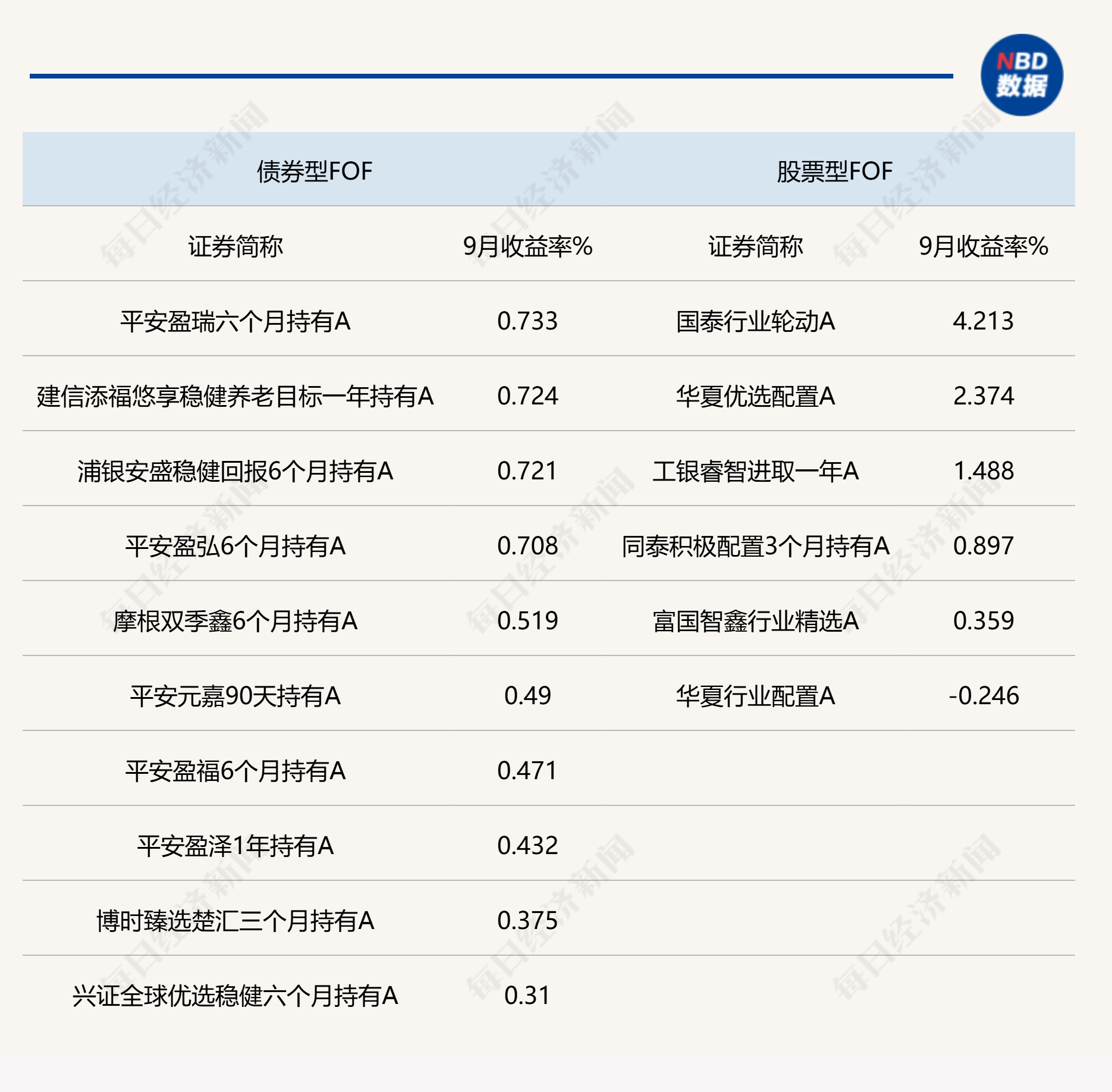
Core Insights - Publicly offered FOFs have shown strong performance in September, with equity FOFs achieving a monthly investment success rate exceeding 90% and the highest monthly return nearing 8% [2][3] - The current market dynamics indicate a divergence between equity and bond markets, with equity FOFs outperforming bond FOFs significantly [2][3] Performance Summary - As of September 28, equity FOFs recorded a maximum performance of 7.88%, led by E Fund Advantage Return A, while bond FOFs like Ping An Ying Rui Six-Month Holding A only achieved 0.73% [2][3] - Major indices such as the Shanghai Composite Index and Shenzhen Component Index experienced slight increases, indicating a positive trend in the equity market [2] Market Analysis - The bond market is experiencing a shift, with current sentiment suggesting that the previous rapid decline in interest rates may have been excessive, leading to a correction towards historical averages [3] - Fund managers are adjusting their asset allocation strategies, with a focus on equities due to improved valuations and potential for higher returns compared to bonds [4][5] Investment Strategies - Fund managers are emphasizing the importance of a balanced approach, considering both long-term trends and short-term opportunities in the market [4] - Key sectors of interest include AI computing, lithium batteries, and high-end manufacturing, with a focus on companies that can sustain growth through global competitiveness [5]
国际金价站上3800美元
Bei Jing Shang Bao· 2025-09-29 15:41
Core Viewpoint - International gold prices have reached new highs, with spot gold surpassing $3,800 per ounce, driven by multiple factors including the Federal Reserve's interest rate cuts and increased geopolitical risks [1][2][5] Group 1: Gold Price Trends - As of September 29, spot gold prices peaked at $3,819.8 per ounce, marking a 10% increase from the beginning of the month and over 45% year-to-date [1] - The Federal Reserve's decision to lower the federal funds rate by 25 basis points to a range of 4%–4.25% has initiated a new cycle of rate cuts, contributing to the rise in gold prices [1][5] - Analysts predict that gold prices will continue to rise, with JPMorgan forecasting an average of $3,800 per ounce in Q4 2023 and Goldman Sachs projecting prices could reach $4,000 per ounce by mid-2026 [2][3] Group 2: Market Dynamics - The weakening of the US dollar, increased central bank gold purchases, and rising geopolitical tensions are significant factors supporting the current gold price surge [1][2] - The trend of "de-dollarization" and the long-term demand for gold as a hedge against systemic risks are expected to sustain gold's upward trajectory [2][3] Group 3: Consumer Behavior and Jewelry Market - The rising international gold prices have led to increased prices for gold jewelry, with domestic brands seeing prices exceed 1,100 yuan per gram [3] - The upcoming traditional wedding season in September and October is driving demand for gold jewelry, further pushing prices upward [4] - Retailers are preparing for price increases in gold jewelry, with reports indicating potential hikes of around 30% in October [4]
价格持续新高!黄金各阶段配置比例看这个
Sou Hu Cai Jing· 2025-09-29 13:19
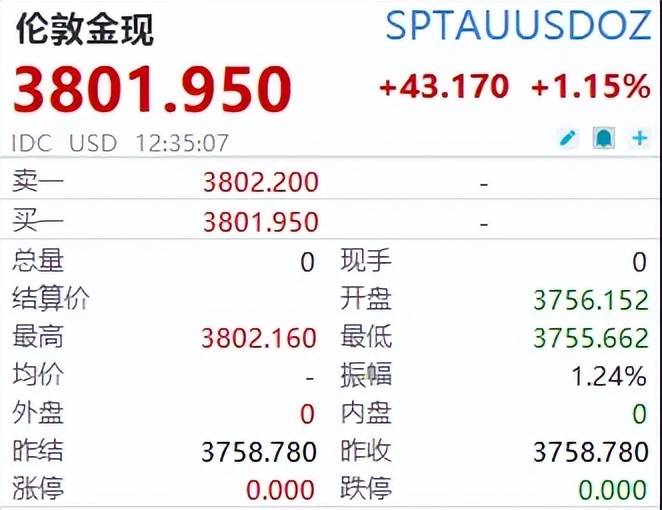
Core Viewpoint - The article emphasizes that gold has significantly outperformed major stock indices this year, with a year-to-date increase of over 40%, highlighting its status as a key asset in the current economic climate influenced by Federal Reserve interest rate cuts [1][2]. Market Performance - The London gold price has risen to 3801.950, marking an increase of 43.170 or 1.15% [1]. - Major stock indices such as the Dow Jones, Nasdaq, and S&P 500 have shown positive year-to-date performances of 8.70%, 16.43%, and 12.96% respectively [2]. Gold Investment Strategies - The article discusses two established asset allocation models: the Permanent Portfolio and the All-Weather Portfolio. - The Permanent Portfolio, proposed by Harry Browne, allocates 25% to stocks, 25% to long-term bonds, 25% to short-term bonds, and 25% to gold, aiming for stability across different economic conditions [3][4]. - The All-Weather Portfolio, created by Ray Dalio, suggests a more dynamic allocation of 30% to stocks, 40% to long-term bonds, 15% to intermediate bonds, 7.5% to gold, and 7.5% to other commodities, focusing on risk balance and efficiency [12][14]. Historical Performance - Both the Permanent and All-Weather Portfolios have achieved annualized returns of approximately 8%-9% from 1971 to 2024, with low volatility and high success rates, generating positive returns in 8 to 9 out of 10 years [15][16]. - The article notes that aside from 2022, when both portfolios experienced losses due to aggressive interest rate hikes by the Federal Reserve, they have generally performed well [18]. Recommendations for Gold Allocation - The article suggests varying gold allocation based on risk tolerance: - Aggressive investors may allocate 5%-10% to gold for extreme risk hedging. - Moderate investors might consider 10%-15%, aligning with Dalio's recent advice to increase gold allocation to 15%. - Conservative investors could allocate 20%-25% to gold, following the Permanent Portfolio model [18].
揭秘美国政府关门风险!对美股、黄金影响几何?
雪球· 2025-09-29 13:00
Group 1 - The core issue of the U.S. government shutdown is the inability to pass a new budget, which is necessary for government operations to continue after the fiscal year ends on September 30 [4][5][6] - The U.S. Congress, composed of both Republican and Democratic parties, is responsible for budget approval, leading to conflicts and delays in passing necessary funding [7][8] - Historical data shows that since 1980, there have been 22 instances of government shutdowns, with the longest being 35 days in 2018 [9] Group 2 - A government shutdown does not mean complete chaos; essential services like Social Security and Medicare continue, while non-essential services may be suspended [11][12][13] - The current budget impasse is primarily due to disagreements over healthcare spending, with Democrats wanting to extend tax credits under the Affordable Care Act, while Republicans seek a short-term funding extension without additional provisions [16][17][18] - The uncertainty surrounding the government shutdown could negatively impact the stock market, while potentially providing support for gold prices due to increased risk perception [20][21] Group 3 - The long-term trends of the stock market are expected to remain unaffected by the government shutdown, as they are driven by the Federal Reserve's interest rate cycle and the fundamentals of technology stocks [22]

上海证券2025年10月基金投资策略:聚焦核心竞争力,不惧市场估值“验证”
Shanghai Securities· 2025-09-29 11:13
Core Insights - The report emphasizes a positive global economic outlook with rising market risk appetite, but warns of persistent issues such as regionalism, inflation, and structured valuation risks [1][17] - It suggests a cautious yet optimistic approach to asset allocation, focusing on companies' core competencies and balancing risk and return [1][17] Market Overview - Global equity assets showed strong performance in September 2025, with MSCI Global returning 2.31% and emerging markets at 6.78%, outperforming developed markets [8][14] - Domestic markets continued to rise, with the CSI All Share Index yielding 1.87% and active equity funds performing well, particularly the China Equity Index which rose by 6.03% [8][14] International Market Analysis - Manufacturing expansion remains slow overseas, with potential valuation "disproof" risks due to expectation discrepancies [1][18] - The report highlights that while AI innovations are driving growth in the service sector, their impact on traditional manufacturing remains uncertain [20][18] Domestic Market Analysis - The domestic economy shows strong resilience, with industrial value-added growth of 5.2% year-on-year in August, and high-tech manufacturing increasing by 9.3% [22][24] - Service sector growth is robust, with a production index increase of 5.6% year-on-year, particularly in information technology and financial services [22][24] Asset Allocation Strategy - For equity funds, a core + opportunity "barbell" strategy is recommended, focusing on companies with high performance certainty and dividend yields [51][52] - Fixed income funds should prioritize medium to short duration products for better value, as long-duration bonds face increasing risks [54][55] Sector-Specific Insights - The technology sector is highlighted for its high growth potential, particularly in areas like chips, AI, and renewable energy, although volatility risks are noted [52][55] - The report indicates that while gold remains a long-term investment due to geopolitical tensions and inflation concerns, oil prices may face downward pressure due to seasonal demand fluctuations and OPEC+ production increases [38][44][43]
更加均衡第四季度策略
Zhao Yin Guo Ji· 2025-09-29 10:49
Group 1: Macro Strategy Overview - The report suggests a balanced asset allocation strategy for the fourth quarter, favoring equities, commodities, and non-USD currencies while being bearish on bonds and the USD [1] - The US economy is experiencing slight stagflation, with expectations of a GDP growth decline from 2% in the first half to 1.3% in Q4 2023 [9] - The Eurozone economy is performing better than expected, with inflation stabilizing and government bond yields rising [1][13] Group 2: Currency Recommendations - The report recommends an overweight allocation to currency market products (20%), emphasizing their liquidity and safety [4][7] - Specific currency allocations include an overweight in USD (10.5%), Euro (4%), and GBP (2.5%), while recommending a neutral position in RMB (1.2%) and underweight in JPY (0%) [4][6][8] Group 3: Bond Market Insights - A neutral allocation to bonds (22.5%) is suggested, with a focus on US bonds (10%) and an overweight in UK (2%) and emerging market bonds (5%) [4][42] - The report highlights that bond valuations are more attractive than equities, despite potential inflation risks [42][43] Group 4: Equity Market Analysis - A neutral allocation to equities (30%) is recommended, with specific overweight positions in Eurozone (4.3%), UK (2.5%), and China (3.5%) stocks, while underweighting US (17%) and Japanese stocks (1%) [4][6][42] - The report notes that stock valuations are currently higher than fixed income products, indicating a need for caution [4][42] Group 5: Alternative Assets - The report suggests a lower allocation to alternative assets (27.5%) due to their high risk and low liquidity, recommending a diversified approach [4][6] - Specific alternative assets include private equity (9%), hedge funds (5%), and real estate (5.5%), with a cautious outlook on digital assets (1%) [4][6][42]
香港市场,又有利好!
大胡子说房· 2025-09-29 10:35
Core Viewpoint - The article emphasizes the upcoming investment opportunities in the Hong Kong stock market (港G) due to its undervaluation compared to the A-share market (大A) and the anticipated impact of the Federal Reserve's interest rate cuts on global assets [1][3][10]. Valuation Comparison - The average PE ratio of the Hang Seng Index is approximately 10 times, while the CSI 300 Index has reached a PE ratio of 14 times, indicating that 港G is undervalued [3]. - The Hang Seng Technology Index has a PE ratio of about 21.77 times, significantly lower than the 184 times of the STAR 50 Index in 大A, highlighting the valuation gap in the technology sector [3]. Currency Strength - The RMB has appreciated from 7.24 in April to a low of 7.10, indicating a strong currency that attracts international capital to RMB-denominated assets, particularly 港G [4]. - The ease of capital movement in 港G compared to 大A makes it a more attractive option for foreign investors [4]. Federal Reserve's Interest Rate Cuts - Predictions suggest that the Federal Reserve may cut interest rates three times this year, which could lead to a significant decline in the dollar index and create panic in dollar-denominated assets [5][9]. - Non-dollar assets, including 港G, are expected to benefit from this environment, as they will serve as alternative investments [6][9]. Technical Analysis - The Hang Seng Technology Index is anticipated to break through its previous high of 6195 points if the Federal Reserve continues to lower interest rates and inject liquidity into the market [8]. - A breakthrough above 6100 points could lead to a target of 11000 points, indicating substantial growth potential for 港G [9]. Market Dynamics - The article suggests that the upcoming interest rate cuts will trigger a significant reshuffling of global assets, and investors should prepare for this shift by positioning themselves in undervalued assets [10][11].