估值修复

Search documents
金改前沿丨2025年银行股结构性上涨跑输大盘 2026年市场叙事逻辑如何?
Xin Hua Cai Jing· 2026-01-03 05:21
Core Viewpoint - In 2025, A-share bank stocks experienced steady growth but underperformed the broader market, with a total market capitalization exceeding 15 trillion yuan, reaching 15.7 trillion yuan [2][5]. Market Performance - The bank sector showed a "high first, low later" trend in 2025, with the Shenwan Bank Index rising by 7%, lagging over 10 percentage points behind the CSI 300 Index [2][5]. - The bank stocks transitioned from broad-based gains to structural differentiation, with six bank stocks rising over 20% [5][6]. - Agricultural Bank of China emerged as a standout performer, leading with a 52.66% increase in stock price, briefly surpassing Industrial and Commercial Bank of China in market capitalization [2][7]. Market Dynamics - The bank sector's performance was characterized by an initial strong start in the first half of 2025, followed by a correction from July to September, and a recovery in October [5][6]. - During the correction phase, the Shenwan Bank Index fell approximately 14%, ranking last among 31 Shenwan primary industries [6]. - By the end of 2025, 35 bank stocks increased in value, while 7 declined, with notable declines in Huaxia Bank, Zhengzhou Bank, and Beijing Bank [6]. Valuation and Investment Appeal - The banking sector remains undervalued, with a price-to-book ratio (PB) of 0.62, indicating marginal improvement from previous years [8]. - The dividend yield for bank stocks was 4.99%, significantly higher than the market average and the yield on 10-year Chinese government bonds [8]. - Experts suggest that the narrative for bank stocks is shifting from "valuation repair" to "value re-evaluation," influenced by macroeconomic stability, supportive policies, and confirmation of profit turning points [9]. Future Outlook - The outlook for bank stocks in 2026 will depend on macroeconomic recovery, ongoing policy support, and the stabilization of profit margins [9]. - Analysts predict that the banking sector will experience a "shaky upward, structurally differentiated" trend, with a focus on sustainable dividends and stable payout ratios [9].




港股拿下2025年IPO募资榜全球第一,医药板块成为“顶梁柱”?
智通财经网· 2025-12-31 12:10
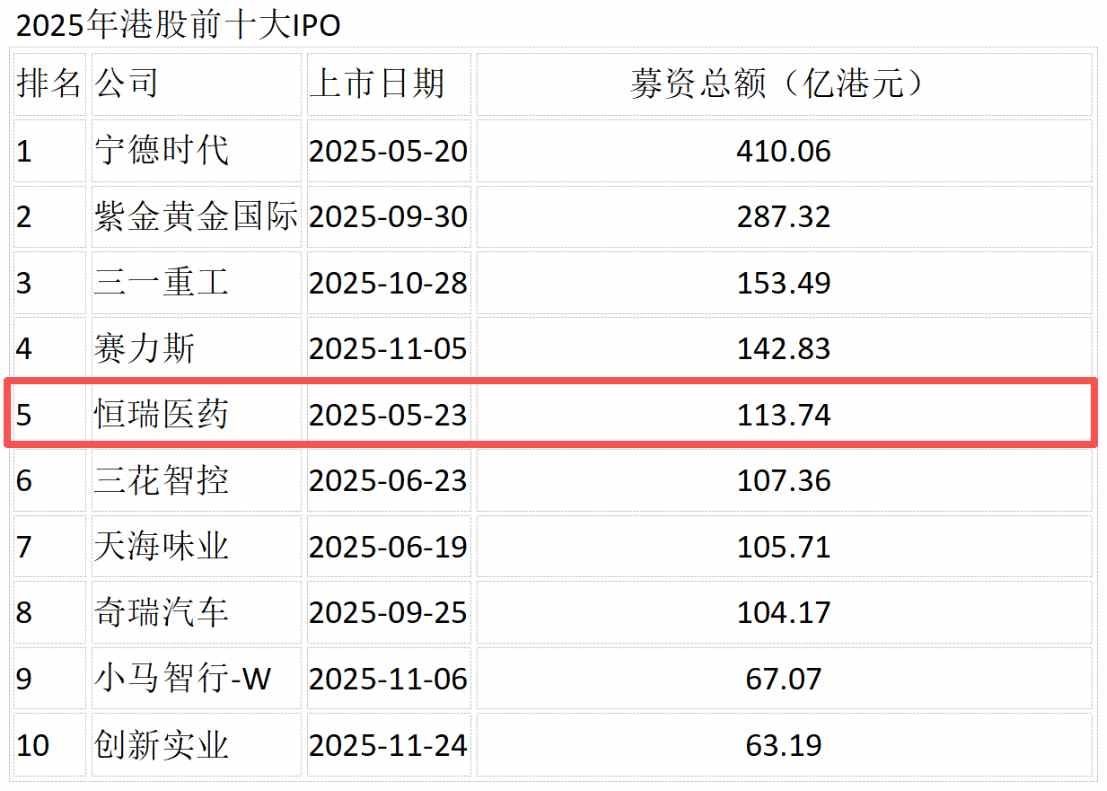
Group 1 - The Hong Kong innovative drug market is returning to a bull market in 2025, driven by a significant BD deal worth $4.8 billion between 3SBio and Pfizer, with the Hang Seng Healthcare Index rising by 102.76% to a peak of 4721.41 points by September [1] - In 2025, the Hong Kong IPO market for new stocks ranked first globally, raising over 280 billion HKD, nearly three times the amount raised in the previous year, marking a new high in four years [1] - A total of 27 healthcare/biotech companies successfully went public in Hong Kong this year, with nearly 10 more companies submitting prospectuses in December, and about 300 companies still waiting in line, with one-third being health-related [1] Group 2 - The top five companies by IPO fundraising in 2025 include CATL with 41.006 billion HKD, Zijin Mining International with 28.732 billion HKD, SANY Heavy Industry with 15.349 billion HKD, Seres with 14.283 billion HKD, and Heng Rui Medicine with 11.374 billion HKD [2] - The performance of newly listed healthcare companies has been remarkable, with some experiencing significant stock price increases, such as Yaojie Ankang-B with a 773.76% increase and Xuanzhu Biotechnology-B with a 507.76% increase [3] Group 3 - The strong performance of the Hong Kong pharmaceutical sector is attributed to policy incentives and breakthroughs in innovation, marking a critical year for the Chinese pharmaceutical industry transitioning from "innovation awakening" to "value realization" [5] - The 2025 domestic pharmaceutical R&D policy focuses on "full-chain support for innovation and multi-level value assurance," significantly enhancing the market's expectations for growth in the innovative drug sector [5] Group 4 - The Hong Kong stock market has seen a significant increase in trading activity, with the total market capitalization reaching 48 trillion HKD, a 41% increase from the previous year, and the average daily trading volume rising by 95% to 255.8 billion HKD [7] - Southbound capital has become a crucial source of liquidity for the Hong Kong market, with a net purchase of 1.4 trillion HKD in 2025, indicating a strong interest in the pharmaceutical sector [7] Group 5 - The new IPO distribution mechanism implemented on August 4, 2025, has improved pricing efficiency and market stability, resulting in a decrease in the IPO failure rate to 28.83% compared to 32%-34% in previous years [8][9] - The innovative drug bull market has led to a lower IPO failure rate of approximately 17% for healthcare companies, with over 35% of new stocks experiencing first-day gains exceeding 100% [9] Group 6 - Despite the overall enthusiasm for the pharmaceutical sector, market sentiment shifted in December, with three healthcare IPOs experiencing significant first-day declines, indicating that investors are becoming more selective based on fundamentals [10] - Companies like Mingji Hospital and Hansi Aitai-B faced substantial first-day drops despite high oversubscription rates, while companies with stronger fundamentals, such as Yinxin Intelligent, achieved significant first-day gains [10]
沪指11连阳强势收官!结构性“科技牛”行情贯穿始终,A500ETF龙头(563800)全年涨超25%,标的指数跑赢上证指数、沪深300指数
Xin Lang Cai Jing· 2025-12-31 09:00
东方财富证券表示,中证A500指数是A股ETF跟踪规模第二大的宽基指数,行业与市值分布均衡、贴近 全A市场,兼具分散风险与全面映射中国经济的优势。其在电子、军工等新兴产业超配,自主可控成分 股权重高,凸显新质生产力特征;同时依托互联互通与ESG筛选、高境外营收占比,国际化属性突出。 指数核心财务指标优异、估值具备吸引力,且历史业绩展现出高弹性与抗跌性,是适配境内外中长期资 金、分享经济升级红利、参与中国资产重估和震荡慢牛进程的优质配置标的。 场内ETF方面,截至2025年12月31日收盘,中证A500指数下跌0.28%,A500ETF龙头(563800)换手 8.46%,成交18.34亿元。成分股方面涨跌互现,蓝色光标20cm涨停,烽火通信、航天电子10cm涨停; 北京君正领跌,信立泰、东方盛虹跟跌;前十大权重股合计占比20.04%。 宏观方面,12月31日,国家统计局公布数据显示,中国12月官方制造业PMI 50.1,为4月份以来首次升 至扩张区间,前值49.2。中国12月经济景气水平总体回升,三大指数均升至扩张区间,其中制造业产需 两端明显回升,大型企业PMI重返扩张区间。非制造业PMI景气度回升,服务业 ...
高股息为盾,静待价值修复
Xiangcai Securities· 2025-12-31 08:21
证券研究报告 2025 年 12 月 31 日 湘财证券研究所 行业研究 银行业年度策略 高股息为盾,静待价值修复 相关研究: 行业评级:增持(维持) 近十二个月行业表现 % 1 个月 3 个月 12 个月 | 相对收益 | -4.85 | 4.99 | -10.62 | | --- | --- | --- | --- | | 绝对收益 | -2.10 | 5.22 | 5.69 | 分析师:郭怡萍 证书编号:S0500523080002 Tel:(8621) 50295327 Email:guoyp@xcsc.com 中国人寿金融中心10楼 核心要点: 市场回顾 今年银行板块行情节奏呈现"前强、中弱、后稳"的走势,主要反映从避 险主导到寻求增长的市场风格转换过程,以及资产风险预期的变化。 政策导向:宽松政策过渡期,金融支持实体经济 | 1. | 《2025年中期策略-价值重估仍 | | --- | --- | | 在进行时》 | 2025.07.02 | | 2. | 《业绩底部修复,配置价值提 | | 升》 | 2025.09.05 | 2026 年,政策环境正从此前的超常规逆周期调节模式,向更具稳定性和 ...
有色金属日度策略-20251231
Fang Zheng Zhong Qi Qi Huo· 2025-12-31 03:09
1. Report Industry Investment Rating No relevant content provided. 2. Core Views of the Report - The non - ferrous metals sector is strong but volatile. As the New Year's Day holiday approaches, the sentiment of profit - taking among funds has increased, and there are stage conversions and rotations in the strength of different metals within the sector. Attention should be paid to risk control and it is advisable to hold light positions during the holiday [12]. - The Chinese government will continue to implement a more proactive fiscal policy in 2026, expanding fiscal expenditure and supporting the replacement of consumer goods. China's industrial production and profit margins declined in November, and the central bank emphasized preventing the "overshoot" of the RMB exchange rate. The Bank of Japan hinted at more interest rate hikes, and there is uncertainty about the next Fed chair [12]. - Different non - ferrous metals have different market trends and investment strategies. For example, copper is expected to rise in the medium - to - long - term; zinc is likely to maintain a relatively strong oscillation; aluminum and its related products are recommended for light - position operations during the holiday; tin is suggested to reduce positions and wait and see; lead is relatively strong but requires attention to market changes; nickel and stainless steel are affected by Indonesian policies and show a stage - based upward trend [13][14][15]. 3. Summary According to the Directory 3.1 First Part: Non - Ferrous Metals Operating Logic and Investment Suggestions - **Macro Logic**: The non - ferrous metals sector is volatile. As the holiday approaches, profit - taking sentiment rises. There are policy changes in China, Japan, and the United States that affect the market. Attention should be paid to holiday closures, PMI data, and Fed policy [12]. - **Non - Ferrous Metals Strategy**: - **Copper**: In the short - term, copper prices fluctuate due to the holiday and profit - taking, but the medium - to - long - term upward trend remains. Macro factors and fundamental factors are favorable. It is recommended to buy on dips, with the upper pressure range at 105,000 - 110,000 yuan/ton and the lower support range at 95,000 - 96,000 yuan/ton [13]. - **Zinc**: Zinc is expected to oscillate strongly. The domestic zinc ingot supply is tightening, and the demand is gradually recovering. It is recommended to go long on dips, with the upper pressure at 23,500 - 23,800 and the lower support at 22,800 - 23,000 [14]. - **Aluminum Industry Chain**: Aluminum and its related products are recommended for light - position operations during the holiday. Aluminum oscillates and consolidates, alumina oscillates and bottoms out, and cast aluminum alloy oscillates strongly [14]. - **Tin**: Tin is in a state of oscillating strongly. Although the production area's operating rate is high, the demand is limited. It is recommended to hold light positions and wait and see during the holiday, with the upper pressure at 350,000 - 355,000 and the lower support at 310,000 - 320,000 [14]. - **Lead**: Lead oscillates strongly. The supply is tightening, and the demand is relatively weak. It is recommended to reduce long positions on rallies, with the upper pressure at 17,500 - 17,700 and the lower support at 16,700 - 16,800 [15]. - **Nickel**: Nickel is in a stage - based upward trend. The Indonesian policy affects the market, and the supply and demand situation is complex. It is recommended to go long in the short - term, with the upper pressure at 135,000 - 136,000 and the lower support at 124,000 - 125,000 [15]. - **Stainless Steel**: Stainless steel is in a stage - based adjustment. The supply is expected to decrease, and the demand is weak. It is recommended to go long on dips, with the upper pressure at 13,000 - 13,200 and the lower support at 12,400 - 12,500 [15]. 3.2 Second Part: Non - Ferrous Metals Market Review - The closing prices and price changes of various non - ferrous metals are provided, such as copper closing at 98,090 with a - 0.78% change, zinc at 23,380 with a 0.54% change, etc. [16] 3.3 Third Part: Non - Ferrous Metals Position Analysis - The position analysis of various non - ferrous metals futures contracts is presented, including the net long - short strength comparison, net long - short position differences, and changes in net long and net short positions, as well as the influencing factors [18]. 3.4 Fourth Part: Non - Ferrous Metals Spot Market - The spot prices and price changes of various non - ferrous metals are given, such as the Yangtze River non - ferrous copper spot price at 97,840 yuan/ton with a - 3.42% change, and the Yangtze River non - ferrous 0 zinc at 23,290 yuan/ton with a - 0.68% change [19][21]. 3.5 Fifth Part: Non - Ferrous Metals Industry Chain - Multiple charts related to the industry chain of each non - ferrous metal are provided, including inventory changes, processing fees, and price trends, which help to understand the supply - demand relationship and price fluctuations in the industry chain [24][27][29] 3.6 Sixth Part: Non - Ferrous Metals Arbitrage - Multiple charts related to the arbitrage of each non - ferrous metal are provided, such as the copper Shanghai - London ratio change, the basis difference between Shanghai copper and London copper, etc., which help to analyze arbitrage opportunities [54][55][58] 3.7 Seventh Part: Non - Ferrous Metals Options - Multiple charts related to the options of each non - ferrous metal are provided, such as the historical volatility and weighted implied volatility of copper options, which help to understand the option market situation [73][75][78]
30日转债行业涨跌参半,估值环比抬升:转债市场日度跟踪20251230-20251231
Huachuang Securities· 2025-12-31 01:13
Report Industry Investment Rating No information provided in the given content. Core Viewpoints - On December 30, the convertible bond industry showed mixed performance in terms of gains and losses, with valuations rising on a month - on - month basis [1]. - The mid - cap growth style was relatively dominant in the market [1]. - The trading sentiment in the convertible bond market weakened [1]. - The convertible bond price center increased, and the proportion of high - price bonds rose [2]. - The convertible bond valuations increased [2]. - In the A - share market, more than half of the underlying stock industry indices declined, while in the convertible bond market, 14 industries rose [3]. Summary by Related Catalogs Market Overview - **Index Performance**: The CSI Convertible Bond Index rose 0.14% month - on - month, the Shanghai Composite Index remained unchanged, the Shenzhen Component Index rose 0.49%, the ChiNext Index rose 0.63%, the SSE 50 Index rose 0.06%, and the CSI 1000 Index rose 0.04% [1]. - **Market Style**: Mid - cap growth was relatively dominant. Large - cap growth rose 0.57%, large - cap value fell 0.13%, mid - cap growth rose 0.81%, mid - cap value rose 0.66%, small - cap growth rose 0.66%, and small - cap value rose 0.34% [1]. - **Fund Performance**: The trading sentiment in the convertible bond market weakened. The trading volume of the convertible bond market was 75.057 billion yuan, a 2.96% month - on - month decrease; the total trading volume of the Wind All - A was 2.161532 trillion yuan, a 0.18% month - on - month increase; the net outflow of the main funds in the Shanghai and Shenzhen stock markets was 23.828 billion yuan, and the yield of the 10 - year treasury bond decreased by 0.02 bp to 1.86% [1]. Convertible Bond Price - The overall weighted average closing price of convertible bonds was 134.53 yuan, a 0.09% month - on - month increase. Among them, the closing price of equity - biased convertible bonds was 202.44 yuan, a 1.47% increase; the closing price of bond - biased convertible bonds was 118.85 yuan, a 0.18% decrease; the closing price of balanced convertible bonds was 129.71 yuan, a 0.01% increase [2]. - The proportion of bonds with a closing price above 130 yuan was 59.95%, a 1.15 - percentage - point increase. The largest change in proportion occurred in the 120 - 130 (including 130) range, with a proportion of 28.01%, a 1.39 - percentage - point decrease. There were no bonds with a closing price below 100 yuan. The median price was 132.60 yuan, a 0.07% month - on - month decrease [2]. Convertible Bond Valuation - The fitted conversion premium rate of 100 - yuan par value was 33.54%, a 0.45 - percentage - point month - on - month increase; the overall weighted par value was 101.88 yuan, a 0.19% month - on - month decrease [2]. - The premium rate of equity - biased convertible bonds was 18.25%, a 1.38 - percentage - point increase; the premium rate of bond - biased convertible bonds was 86.78%, a 2.11 - percentage - point increase; the premium rate of balanced convertible bonds was 25.17%, a 0.42 - percentage - point increase [2]. Industry Performance - **Underlying Stock Market**: Among the A - share industries, the top three decliners were Commerce and Retail (-1.56%), Real Estate (-1.22%), and Utilities (-1.14%); the top three gainers were Petroleum and Petrochemical (+2.63%), Automobile (+1.35%), and Non - Ferrous Metals (+1.31%) [3]. - **Convertible Bond Market**: Among the convertible bond industries, the top three gainers were Automobile (+2.08%), Petroleum and Petrochemical (+1.25%), and Textile and Apparel (+0.77%); the top three decliners were Environmental Protection (-2.57%), National Defense and Military Industry (-1.23%), and Building Materials (-1.16%) [3]. - **By Category**: - **Closing Price**: The large - cycle category decreased by 0.38%, manufacturing increased by 0.54%, technology decreased by 0.24%, large - consumption increased by 0.10%, and large - finance decreased by 0.05% [3]. - **Conversion Premium Rate**: The large - cycle category decreased by 0.21 percentage points, manufacturing increased by 0.57 percentage points, technology increased by 0.028 percentage points, large - consumption increased by 0.63 percentage points, and large - finance increased by 0.79 percentage points [3]. - **Conversion Value**: The large - cycle category decreased by 0.74%, manufacturing increased by 0.17%, technology decreased by 0.36%, large - consumption decreased by 0.43%, and large - finance decreased by 0.20% [3]. - **Pure Bond Premium Rate**: The large - cycle category decreased by 0.55 percentage points, manufacturing increased by 0.81 percentage points, technology decreased by 0.16 percentage points, large - consumption increased by 0.12 percentage points, and large - finance decreased by 0.065 percentage points [4]. Industry Rotation - Industries such as Petroleum and Petrochemical, Automobile, and Non - Ferrous Metals led the gains. For example, Petroleum and Petrochemical had a daily increase of 2.63% in the underlying stock market and 1.25% in the convertible bond market; Automobile had a 1.35% increase in the underlying stock market and 2.08% in the convertible bond market [54].
上证指数明天能否站上4000点?2026“慢牛”有望延续?|前瞻2026
清华金融评论· 2025-12-30 10:42
Core Viewpoint - The article emphasizes that if the Shanghai Composite Index can close above 4000 points by the end of 2025, it will instill strong confidence in the market, encouraging more incremental capital to enter in the future. The market is expected to continue a slow bull trend in 2026, with a focus on technology growth, cyclical stocks, and resource stocks [2][3]. Economic Dimension - The economic landscape is characterized by accelerated structural transformation and the rise of new productive forces. Manufacturing PMI is stabilizing, and retail consumption is recovering. High-end manufacturing sectors like smart devices and new energy vehicles are growing significantly faster than the overall economy, becoming key drivers of new productive forces [5]. Financial Dimension - Valuations are aligning with performance, showing significant horizontal space. Non-financial sectors' net profit grew by 1.04% year-on-year in the first half of 2025, with technology sectors like AI (up 19.24%) and semiconductors (up 32.41%) showing remarkable profitability. A-shares are undervalued compared to U.S. stocks, with financial and infrastructure sectors still having safety margins [5]. Policy Dimension - The policy environment is focused on stabilizing expectations and increasing incremental capital. Reforms in the capital market, such as raising the equity investment cap for insurance funds to 50%, and optimizing delisting and dividend mechanisms, are enhancing investment functionality. The "15th Five-Year Plan" emphasizes support for new industries like AI and commercial aerospace [5]. Capital Dimension - Continuous inflow of capital is observed, with insurance funds increasing their equity investments to over 4.7 trillion yuan, adding more than 600 billion yuan in 2025. There is ample room for growth, as evidenced by a reduction of 1.11 trillion yuan in household deposits and a 2.14 trillion yuan increase in non-bank deposits, with funds entering the market through ETFs and mutual funds [6]. Industry Dimension - The dual focus on technology and cyclical sectors is evident. In technology growth, there is a surge in demand for AI computing power, storage, and commercial aerospace driven by policy support. In cyclical sectors, the supply-demand gap for industrial metals like copper and aluminum is widening, with expectations of a 150,000-ton shortfall in refined copper in 2026 [6]. Company Dimension - Overall profitability is improving, showcasing resilience. Leading companies in innovation-driven sectors, such as CATL, are achieving high capacity utilization rates close to 90%, with technological breakthroughs driving down costs [7]. Outlook for 2026 - Multiple brokerages express optimism for the A-share market in 2026, predicting a continuation of the slow bull market. The core driving logic is expected to shift from valuation recovery to profit support, with anticipated earnings growth of 5% to 12% [9][10]. The recovery of PPI is seen as a key factor that will drive nominal GDP growth and improve overall profitability in the market [11]. Key Investment Themes - Key investment themes include technology growth led by AI and hard technology, with a focus on areas like optical modules and computing chips. The cyclical and resource sectors are also expected to benefit from improved supply-demand dynamics, with industrial metals and energy sectors showing potential for cash flow improvement and high dividend yields [12].

国投证券国际:2026年布局逻辑聚焦管线兑现、技术突围与估值修复 重点关注RSV疫苗等创新品种
智通财经网· 2025-12-30 10:01
Core Viewpoint - The A-share vaccine sector is expected to underperform, with a projected increase of 9% by December 28, 2025, lagging behind the broader market by 10 percentage points, indicating a weak overall performance in the sector [1] Group 1: Industry Overview - The 2026 investment strategy for the vaccine sector focuses on three main lines: pipeline realization, technological breakthroughs, and valuation recovery, while avoiding highly competitive products like bivalent HPV and traditional rabies vaccines [1] - Key areas of focus include vaccines with high technological barriers, multi-valent options, potential for business development collaborations, and favorable competitive landscapes, such as RSV vaccines [1] Group 2: Company Highlights - **CanSino Biologics**: The DTcP-Hib-MCV4 combination vaccine and inhaled tuberculosis vaccine (5-type adenovirus vector) are in Phase I clinical trials. The quadrivalent meningococcal conjugate vaccine was exported to Indonesia in September, marking a significant achievement post-COVID vaccine exports. The PCV13i vaccine has gained access in over half of China's provinces and started vaccinations in October. Several vaccines are advancing towards commercialization, with multiple NDA applications submitted [2] - **Aimee Vaccine**: The PCV13, PPSV23, and rabies vaccines are in the final stages of market entry. Aimee has 20 vaccines in development, with 15 products having received 23 clinical approvals. The PCV13 has submitted for market registration, and the iterative rabies vaccine is also in the registration process. The PPSV23 has completed Phase III clinical serum testing and is moving towards statistical unblinding [3] - **Clover Biopharmaceuticals**: The respiratory combined vaccine (RSV-hMPV-PIV3) has gained global attention, with positive Phase I clinical trial results in older adults. This vaccine is expected to advance to Phase II trials in the first half of 2026, addressing unmet clinical needs related to RSV and enhancing immune protection through repeat vaccinations [4] Group 3: Investment Recommendations - Suggested stocks in the Hong Kong vaccine sector include CanSino, Clover Biopharmaceuticals-B, and Aimee Vaccine, indicating potential investment opportunities in these companies [4]
东证指数创36年来年终新高!年末行情显韧性 企业治理改革推动下明年或跑赢日经225
智通财经网· 2025-12-30 09:08
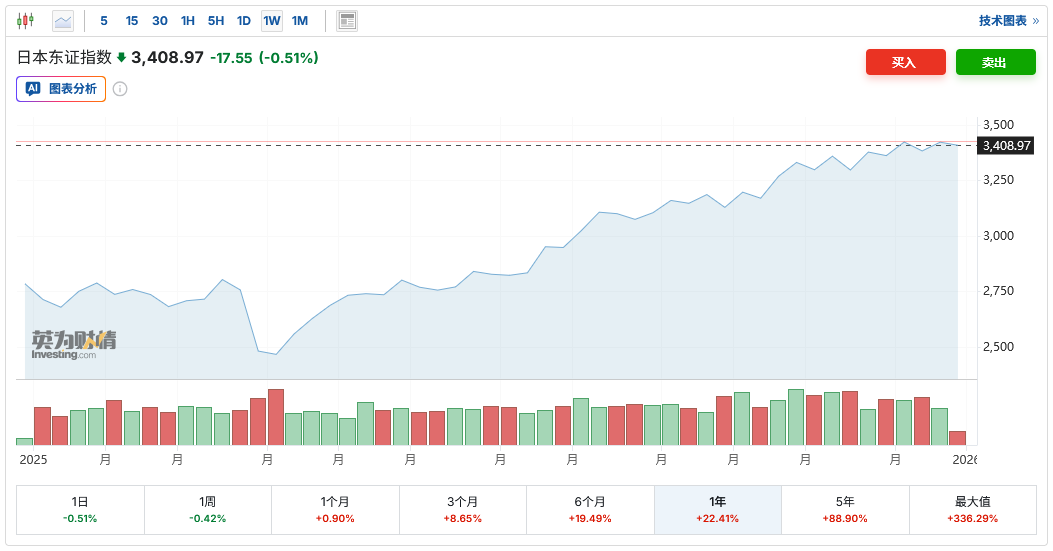
Core Viewpoint - The Japanese stock market, represented by the TOPIX and Nikkei 225 indices, has shown significant growth in 2025, with the TOPIX closing at 3408.97 points, surpassing its previous high in 1989, and the Nikkei 225 reaching 50339.48 points, marking a new annual high for the second consecutive year. Both indices have recorded substantial year-to-date gains of 22% and 26% respectively, indicating a robust recovery and investor interest in Japanese equities [1][4]. Group 1 - The TOPIX index experienced a notable rebound after a sharp decline in April due to trade war concerns, driven by improved corporate earnings, government fiscal stimulus, and a favorable global liquidity environment [4]. - The interest in Japanese stocks has expanded to include small-cap stocks, with mid-cap and small-cap segments of the TOPIX rising by 27% and 26% respectively, outperforming large-cap stocks which gained 21% since 2022 [4]. - The chief strategist at Nomura Asset Management highlighted that the new high for the TOPIX indicates an expanding buying base in the Japanese stock market, with a trend of valuation recovery across various sectors [4]. Group 2 - Key drivers of the 2025 market growth include companies like Advantest and SoftBank Group, with Advantest's market capitalization surpassing 10 trillion yen and a year-to-date increase of approximately 114%, benefiting from sustained AI spending [5]. - SoftBank Group has also seen its stock price rise over 90% this year, as its investments in OpenAI have positioned it as a critical indicator of market confidence in the non-public company [6]. - Despite the Nikkei 225's long-term outperformance, the recent resilience of the TOPIX suggests it may outperform the Nikkei 225 in 2026, driven by planned revisions to corporate governance guidelines that encourage companies to utilize cash and improve price-to-book ratios [6].
外资持续看好中国资产:盈利接棒估值,科技仍是主线
2 1 Shi Ji Jing Ji Bao Dao· 2025-12-29 14:08
Core Viewpoint - Foreign institutions are optimistic about the Chinese stock market for 2026, shifting their focus from "valuation repair" in 2025 to "profit growth" in 2026, driven by accelerating corporate earnings, macro policy support, and RMB appreciation [1][2][5]. Investment Trends - As of December 20, 2025, global investment in Chinese assets through ETFs has seen a net inflow of $83.1 billion, with the technology sector receiving the most inflow at $9.5 billion [1][9]. - Active foreign capital is expected to return to the Chinese stock market, with some institutions already increasing their positions in preparation for 2026 [10][12]. Earnings Forecasts - Goldman Sachs predicts a 38% increase in the Chinese stock market by the end of 2027, with corporate earnings expected to grow by 14% in 2026 and 12% in 2027 [3]. - UBS forecasts an increase in the Hang Seng Tech Index target to 7,100 points and the MSCI China Index target to 100 points by the end of 2026, indicating significant upside potential [3]. Valuation Insights - Morgan Stanley and Goldman Sachs believe there is still about a 10% potential for valuation repair in the Chinese stock market, which will support market growth [4][5]. - JPMorgan has upgraded its rating on the Chinese market to "overweight," citing reasonable valuations and light positions among international investors [4]. Sector-Specific Opportunities - The technology sector is highlighted as a core focus for profit growth, with opportunities in artificial intelligence, semiconductors, and high-end manufacturing [6]. - Traditional industries are also attracting foreign investment, with improvements in state-owned enterprise profitability and dividend increases acting as a dual engine for market growth [7][8]. Market Dynamics - The report indicates that the Chinese stock market will enter a new phase dominated by fundamentals, with a focus on structural investment opportunities [2][5]. - The anticipated return of active foreign capital is expected to be driven by improving corporate fundamentals, a weaker dollar, and the attractiveness of RMB assets [12].