
直接融资

Search documents
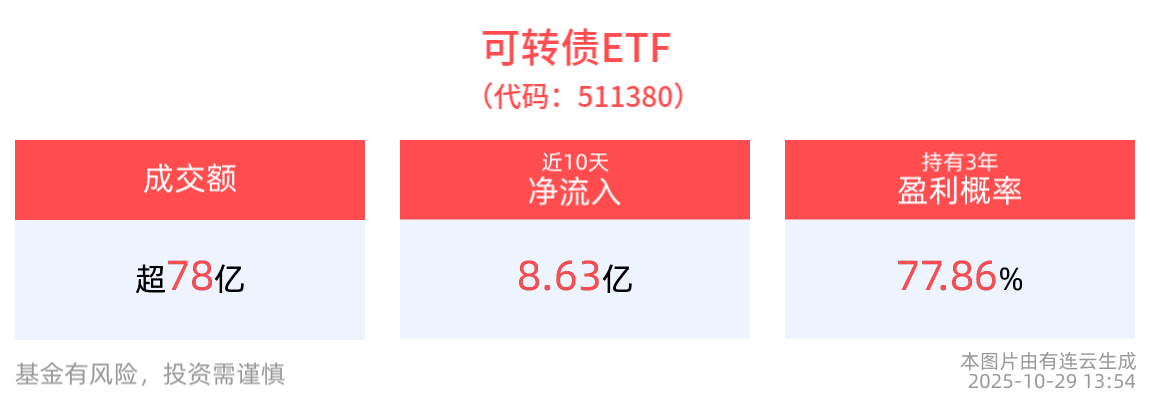
债市延续向好态势,可转债ETF(511380)午后冲高,盘中交投活跃
Sou Hu Cai Jing· 2025-10-29 06:19
Core Insights - The China Securities Convertible Bond and Exchangeable Bond Index (931078) increased by 0.58% as of October 29, 2025, with the Convertible Bond ETF (511380) rising by 0.55% to a latest price of 13.51 yuan [2] - The recent report from the Central Committee emphasizes the need for proactive macroeconomic policies to stabilize growth, employment, and expectations, while also enhancing risk management in key areas such as real estate and local government debt [2] - The issuance of convertible bonds by banks is viewed as a cost-effective financing method, which can bolster core Tier 1 capital and support business expansion and risk resilience [3] Market Activity - The Convertible Bond ETF recorded a turnover rate of 13.16% with a trading volume of 7.825 billion yuan, indicating active market participation [2] - Over the past week, the Convertible Bond ETF has accumulated a rise of 0.83% [2] - The latest scale of the Convertible Bond ETF reached 59.363 billion yuan, with a net outflow of 638 million yuan recently [3] Investment Opportunities - Despite ongoing market uncertainties, investment opportunities are emerging, particularly in equity assets benefiting from the AI wave and policy support in the technology growth sector [3] - The recent trend shows that in the last 10 trading days, there were net inflows on 6 days, totaling 863 million yuan, with an average daily net inflow of 8.632 million yuan [3] - The Convertible Bond ETF closely tracks the performance of the China Securities Convertible Bond and Exchangeable Bond Index, which is composed of convertible and exchangeable bonds listed on the Shanghai and Shenzhen exchanges [3]

解读来了!关于资本市场、经济金融等
Zhong Guo Zheng Quan Bao· 2025-10-28 16:58
Capital Market Development - The proposal emphasizes improving the inclusiveness and adaptability of the capital market, enhancing the coordination between investment and financing functions [1] - The China Securities Regulatory Commission (CSRC) plans to deepen the reform of the Growth Enterprise Market, establishing listing standards that better align with the characteristics of emerging industries and innovative enterprises [1][2] - The focus is on providing more precise and inclusive financial services for new industries, new business formats, and new technologies [1] Direct Financing Enhancement - The proposal advocates for the active development of direct financing methods such as equity and bonds, while steadily advancing futures, derivatives, and asset securitization [2] - It calls for further deepening capital market reforms to enhance financing capabilities for various types of enterprises, particularly in supporting technological innovation [2] Resource Allocation and Market Functionality - The proposal aims to accelerate the establishment of a market-oriented resource allocation system, promoting efficient allocation of various resources [3] - A well-functioning capital market is deemed crucial for achieving the goals of the 14th Five-Year Plan and contributing to China's modernization process [3] Macroeconomic Governance - The proposal highlights the need to enhance macroeconomic governance effectiveness, emphasizing the coordination of fiscal and monetary policies [4] - It aims to create a more internally driven economic growth model, focusing on consumption and domestic demand [4] Fiscal Policy and Financial Sustainability - The proposal stresses the importance of active fiscal policies to enhance fiscal sustainability and ensure financial resources are allocated effectively [5] - It suggests optimizing the fiscal relationship between central and local governments to improve financial coordination [5] Monetary Policy Transmission - The proposal calls for improvements in the central bank's system and the establishment of a robust monetary policy framework to ensure effective transmission mechanisms [6][7] Financial Regulation - The proposal emphasizes the need for comprehensive financial regulation, enhancing collaboration between central and local regulatory bodies [8] - It aims to build a risk prevention and resolution system to ensure the stability of the financial system [8] State-Owned Enterprise Reform - The proposal advocates for deepening the reform of state-owned enterprises (SOEs) to enhance their core functions and competitiveness [9] - It emphasizes the integration of technological and industrial innovation to drive sustainable development [9] Private Economy Development - The proposal aims to implement laws and systems that ensure equal access to production factors and fair market competition for the private economy [10] - It emphasizes the need for practical measures to stimulate private investment and address the challenges faced by private enterprises [10] Consumer-Oriented Policies - The proposal suggests increasing government spending on social welfare to enhance consumer confidence and stimulate consumption [11] - It aims to improve the institutional mechanisms that promote consumption and support consumer rights [11] Investment Approval Reform - The proposal calls for reforms in the investment approval system to clarify investment directions and priorities at both central and local levels [12] - It emphasizes the need for a unified online approval platform to streamline the investment project approval process [12] Real Estate Development - The proposal focuses on promoting high-quality development in the real estate sector, advocating for a new development model [14] - It emphasizes the importance of macro-prudential management and supporting quality real estate enterprises in financing [14]
“十五五”规划建议:稳步发展期货、衍生品和资产证券化
Bei Jing Shang Bao· 2025-10-28 11:08
Core Viewpoint - The Central Committee of the Communist Party of China has released recommendations for the 15th Five-Year Plan, emphasizing the importance of developing direct financing methods such as equity and bonds, and promoting the steady growth of futures, derivatives, and asset securitization [1] Group 1 - The recommendations highlight the need for active development of direct financing methods, including equity and bond markets [1] - There is a focus on the gradual development of futures and derivatives markets [1] - The plan also emphasizes the importance of asset securitization as a means to enhance financial stability and efficiency [1]
金融支持新质生产力发展的逻辑与路径|宏观经济
清华金融评论· 2025-10-25 08:50
Core Viewpoint - The article emphasizes the importance of developing "new quality productivity" in China as a strategic support for enhancing core competitiveness, with financial support playing a crucial role in this development [2][4]. Financial Support for New Quality Productivity Development - Financial functions are evolving to better meet the needs of the real economy, facilitating a positive cycle between finance and the real economy [4]. - Financial services can act as intermediaries to connect current savings with future investments, particularly in technology research and development [4]. - The financial system can guide funds to the most efficient sectors, enhancing the allocation of production factors and supporting technological innovation [4]. - Financial tools can help mitigate risks associated with high-cost, long-cycle, and high-risk technological innovations [4]. Historical Perspective on Financial Development - Historical analysis shows that financial systems have historically supported productivity advancements, with financial innovation needing to adapt to different economic stages [5]. - The relationship between finance and productivity is reciprocal, where financial support enables productivity growth, which in turn generates returns for the financial sector [5]. Role of Financial Technology - Financial technology enhances the ability of financial services to support new quality productivity by breaking spatial and informational barriers [6]. - It broadens the coverage of financial services to technology-oriented small and medium-sized enterprises, driving innovation and high-quality development in the economy [6]. - Financial technology is crucial for banks' innovation financing, improving efficiency in customer marketing, transaction security, risk assessment, and intellectual property valuation [6]. Challenges in Financial Support for New Quality Productivity - Despite a relatively complete financial system, there are mismatches between the financial structure and the needs of new quality productivity development [8]. - Traditional bank credit products and service models are struggling to adapt to the innovation-driven economic model, as they are typically conservative and focused on short-term loans [9]. - Direct financing mechanisms for technology innovation enterprises need strengthening, as current capital market structures present barriers for small and medium-sized tech firms [10]. - The venture capital market is not fully developed, with a lack of diverse exit channels and a predominance of government-led funding, limiting support for technology innovation [11]. - Coverage of financial services for private enterprises, which are vital for technological innovation, remains insufficient, leading to unmet financing needs [12].

四川商投集团发行西南地区首单北交所公司债券
Zhong Guo Jin Rong Xin Xi Wang· 2025-10-25 07:24
Core Insights - Sichuan Commercial Investment Group successfully issued the first corporate bond on the Beijing Stock Exchange in Southwest China, with a scale of 1 billion yuan and a term of 3 years at an interest rate of 2.45% [1] Company Overview - Sichuan Commercial Investment Group is the only provincial-level modern commercial circulation service investment platform and modern supply chain security platform in Sichuan, focusing on ensuring livelihood, promoting consumption, leading openness, and serving industries [1] Bond Issuance Details - The bond issuance is aimed at repaying interest-bearing debts, and it marks the company's first appearance in the exchange market with an AAA rating [1] - Multiple financial institutions participated in the subscription, including Chengdu Bank, Huaxia Wealth Management, Guiyang Bank, and others [1] Market Context - The corporate bond market on the Beijing Stock Exchange is set to officially open on January 15, 2024, with a product system that includes various types of bonds such as corporate bonds, enterprise bonds, and support bonds for small and micro enterprises [1] - The Beijing Stock Exchange has been actively conducting bond research and training to meet the financing needs of quality issuers nationwide [1]
前三季度广东社会融资规模实现增量2.4万亿元
Zhong Guo Xin Wen Wang· 2025-10-24 10:49
编辑:张澍楠 广告等商务合作,请点击这里 本文为转载内容,授权事宜请联系原著作权人 从融资渠道和工具结构看,直接融资规模持续扩大,占比进一步提高。1—9月,广东非金融企业债券、 股票和地方政府债券等市场化直接融资增加7622亿元,同比多增1702亿元,占广东社会融资规模增量的 31.9%,同比提升3.1个百分点。 从资金流向结构看,金融资源进一步聚焦重大战略、重点领域和薄弱环节。其中,科技贷款同比增长 9%,养老产业贷款同比增长103.3%,数字经济产业贷款同比增长6.5%,普惠贷款同比增长8%,绿色贷 款同比增长24.5%。 社会综合融资成本低位持续下行。9月,广东辖内(不含深圳)银行业机构新发放一般贷款加权平均利率 2.94%,同比下降57个基点;其中,新发放企业贷款加权平均利率2.68%,同比下降47个基点;个人住 房贷款加权平均利率3.01%,同比下降13个基点。(完) 来源:中国新闻网 前三季度广东社会融资规模实现增量2.4万亿元 中新社广州10月24日电 (记者 许青青)据中国人民银行广东省分行24日举行的2025年度三季度广东省金 融运行形势新闻发布会消息,今年1—9月,广东社会融资规模实现增量 ...
多元化视角看社会融资规模
Sou Hu Cai Jing· 2025-10-20 22:53
Group 1 - The social financing scale increment in China for the first three quarters of this year reached 30.09 trillion yuan, an increase of 4.42 trillion yuan compared to the same period last year, indicating strong support for economic recovery and a moderately loose monetary policy [1] - The financing structure has improved, with government and corporate bond financing accounting for 43% of the social financing scale increment, while the proportion of RMB loans to the real economy has decreased to 48%, showing a shift towards more diversified financing channels [1] - Banks play a crucial role in credit issuance and are also major participants in bond investments, holding about 25% of their assets in bonds, with approximately 70% of government bonds and 20% of corporate credit bonds held by banks [1] Group 2 - The total social financing scale in China exceeds 430 trillion yuan, with broad money (M2) at over 330 trillion yuan, indicating a substantial funding capacity to meet the financing needs of the real economy [2] - The current macroeconomic environment is characterized by insufficient demand, low inflation, and low interest rates, suggesting that future financial impacts on the real economy will primarily occur through interest rate pathways [2] - There is a need to address structural imbalances in demand, particularly the over-investment and under-consumption issues, which require a shift in fiscal spending from investment-focused to improving livelihoods [2] Group 3 - The redistribution system needs further improvement, with a focus on coordinating initial distribution, redistribution, and third distribution systems, enhancing the regulatory effects of taxes, social security, and transfer payments [3] - The macro policy direction has shifted towards benefiting people's livelihoods and promoting consumption, with future fiscal spending expected to prioritize social welfare issues such as elderly care, healthcare, education, and housing security [3] - These measures aim to promote social equity while improving economic circulation, which is beneficial for balancing demand and supply [3]
央行:着力培育支持 科技创新的金融市场生态
Zhong Guo Zheng Quan Bao· 2025-10-19 20:16
Core Insights - The People's Bank of China emphasizes the need for a financial system tailored to the country's technological development stage, advocating for direct financing and a multi-tiered capital market to support innovation-driven growth [1][2] Group 1: Financial System Development - The development of a financial system that aligns with technological advancements is crucial for deepening supply-side structural reforms in finance [1] - The central bank aims to cultivate a financial market ecosystem that supports technological innovation, enhancing the capacity and intensity of financial support [1] Group 2: Bond Market Innovations - The introduction of the "Technology Board" in the bond market has led to significant growth in technology innovation bond financing, with approximately 670 billion yuan issued by around 280 entities in the interbank bond market [2] - The characteristics of the technology innovation bond market include a diverse range of tech enterprises, flexible issuance methods, and lower financing costs, with an average coupon rate of about 2% [2]
今年前三季度我国社会融资规模达30万亿元
Huan Qiu Wang· 2025-10-19 02:01
Core Insights - The People's Bank of China reported robust financial support for the real economy in the first three quarters of the year, with significant growth in social financing and credit, creating a favorable monetary environment for economic recovery [1] Group 1: Social Financing and Credit Growth - The cumulative increase in social financing for the first three quarters reached 30.09 trillion yuan, an increase of 4.42 trillion yuan year-on-year [3] - As of the end of September, the total social financing stock was 437.08 trillion yuan, reflecting a year-on-year growth of 8.7%, which is 0.7 percentage points higher than the same period last year [3] Group 2: Direct Financing and Government Bonds - The steady growth in social financing is attributed to the improved direct financing channels, with government bonds playing a crucial role [4] - In the first three quarters, net financing from government bonds reached 11.46 trillion yuan, an increase of 4.28 trillion yuan year-on-year, supporting domestic demand and risk prevention [4] Group 3: Credit Structure Optimization - Total RMB loans increased by 14.75 trillion yuan in the first three quarters, with corporate loans being the main contributor, increasing by 13.44 trillion yuan [5] - The demand for long-term funding is strong, as evidenced by an increase of 8.29 trillion yuan in medium to long-term loans, indicating corporate investment confidence [5] Group 4: Financing Costs and Policy Support - The average interest rate for newly issued corporate loans in September was approximately 3.1%, down about 40 basis points year-on-year, indicating ample credit supply [6] - Policies such as interest subsidies for consumer and business loans have effectively reduced interest costs, stimulating demand for personal loans [6][7] Group 5: Future Outlook - Analysts believe that with stabilizing internal and external environments and the gradual effectiveness of growth-stabilizing policies, there is a solid foundation for achieving annual economic and social development goals [7]
前三季度,新增社会融资规模超30万亿元——金融支持实体力度保持稳固
Xin Hua Wang· 2025-10-18 23:23
Core Insights - The financial statistics released by the People's Bank of China indicate a robust financial support for the real economy, driven by a moderately loose monetary policy [1] Monetary Supply and Financing - As of the end of September, the M2 balance reached 335.38 trillion yuan, with a year-on-year growth of 8.4%, maintaining a high growth rate despite last year's high base [2] - The total social financing stock was 437.08 trillion yuan, showing a year-on-year increase of 8.7%, which is 0.7 percentage points higher than the same period last year [2] - In the first three quarters, the cumulative increase in social financing amounted to 30.09 trillion yuan, which is 4.42 trillion yuan more than the previous year [2] Credit Structure and Loan Growth - By the end of September, the balance of RMB loans was 270.39 trillion yuan, reflecting a year-on-year growth of 6.6% [3] - In the first three quarters, RMB loans increased by 14.75 trillion yuan, with household loans rising by 1.1 trillion yuan and corporate loans increasing by 13.44 trillion yuan [3] - The loan structure is improving, with significant growth in medium to long-term loans for both households and enterprises, particularly in key industries like equipment manufacturing and high-tech manufacturing [3][4] Policy Support and Cost of Financing - The average interest rate for newly issued corporate loans was approximately 3.1% in September, which is about 40 basis points lower than the same period last year, indicating a stable decline in financing costs [5] - Recent policies aimed at reducing interest costs for personal consumption loans and service industry loans have further stimulated demand [5] - Adjustments in housing purchase policies in major cities have led to a rebound in personal housing loan demand, with the average interest rate for new personal housing loans also at approximately 3.1%, down about 25 basis points year-on-year [5] Economic Outlook - The internal and external environments are showing signs of stabilization and improvement, with positive changes in corporate operations, consumer spending, and trade [6] - The monetary policy is expected to continue supporting the real economy in the fourth quarter, alongside active fiscal policies and the gradual realization of previously introduced measures [6] - Long-term structural transformation and industrial upgrades in the Chinese economy are anticipated to progress steadily, leading to a more balanced supply-demand relationship in the real economy [6]