
行业轮动

Search documents
3年收益翻倍,招商基金这只基金却增聘基金经理
Sou Hu Cai Jing· 2025-07-23 04:22
Core Viewpoint - The announcement of the appointment of Lu Wenkai as a co-manager for the招商优势企业混合基金 alongside the original manager Zhai Xiangdong indicates a potential shift in management strategy, as Zhai has achieved significant returns since taking over the fund in April 2022 [2][7]. Fund Performance - The招商优势企业混合基金 has delivered a return of 115.81% since Zhai Xiangdong took over, with an annualized return of 26%, ranking 5th among 2901 similar funds [3][5]. - The fund has consistently outperformed its benchmark over the past two years, with returns of 30.16% in 2024 and 27.25% in 2023, compared to benchmark returns of 16.62% and -5.36% respectively [4]. Fund Growth - The fund's assets have surged from 193 million yuan at the end of Q2 2022 to 10.1 billion yuan by the end of Q1 2025, reflecting a significant increase in investor confidence and performance [5]. Manager Background - Zhai Xiangdong, who has a background in TMT research, joined招商基金 in June 2020 and has been managing the fund since April 2022, leading to a remarkable turnaround in performance [5]. Portfolio Composition - The fund's holdings are primarily concentrated in the TMT sector, with notable positions in companies like全蝶国际, 腾讯控股, and 美团-W, showcasing a strategy of sector rotation and agile management during market fluctuations [6]. Management Changes - The recent appointment of Lu Wenkai may suggest that Zhai Xiangdong could be stepping down, as such changes in management often precede a departure, especially since Zhai only manages this single fund [7].


行业轮动周报:ETF资金净流入红利流出高位医药,指数与大金融回调有明显托底-20250721
China Post Securities· 2025-07-21 10:13
Quantitative Models and Construction Methods - **Model Name**: Diffusion Index Model **Construction Idea**: The model is based on price momentum principles, aiming to capture upward trends in industry performance[25][37] **Construction Process**: 1. Calculate the diffusion index for each industry based on price momentum 2. Rank industries by their diffusion index values 3. Select industries with the highest diffusion index values for portfolio allocation **Formula**: Not explicitly provided in the report **Evaluation**: The model performs well during upward trends but struggles during reversals, as seen in historical performance[25][37] - **Model Name**: GRU Factor Model **Construction Idea**: The model leverages GRU (Gated Recurrent Unit) deep learning networks to analyze minute-level volume and price data for industry rotation[38][33] **Construction Process**: 1. Input minute-level volume and price data into the GRU network 2. Train the model using historical data to identify industry rotation signals 3. Generate GRU factor scores for each industry and rank them 4. Allocate portfolio weights based on GRU factor rankings **Formula**: Not explicitly provided in the report **Evaluation**: The model performs well in short cycles but faces challenges in long cycles and extreme market conditions[38][33] Model Backtesting Results - **Diffusion Index Model**: - Monthly average return: -0.81% - Excess return over equal-weighted industry benchmark: -1.61% (July 2025)[29] - Year-to-date excess return: 1.48%[24][29] - **GRU Factor Model**: - Weekly average return: -0.46% - Excess return over equal-weighted industry benchmark: -1.27% (July 2025)[36] - Year-to-date excess return: -5.75%[33][36] Quantitative Factors and Construction Methods - **Factor Name**: Diffusion Index **Construction Idea**: Measures industry momentum based on price trends[25][26] **Construction Process**: 1. Calculate the diffusion index for each industry using price data 2. Rank industries by diffusion index values 3. Select industries with the highest diffusion index values for portfolio allocation **Formula**: Not explicitly provided in the report **Evaluation**: Effective in capturing upward trends but vulnerable to reversals[25][26] - **Factor Name**: GRU Factor **Construction Idea**: Utilizes GRU deep learning networks to analyze minute-level volume and price data for industry rotation[38][33] **Construction Process**: 1. Input minute-level volume and price data into the GRU network 2. Train the model using historical data to identify industry rotation signals 3. Generate GRU factor scores for each industry and rank them 4. Allocate portfolio weights based on GRU factor rankings **Formula**: Not explicitly provided in the report **Evaluation**: Performs well in short cycles but struggles in long cycles and extreme market conditions[38][33] Factor Backtesting Results - **Diffusion Index Factor**: - Top-ranked industries (July 18, 2025): Comprehensive Finance (1.0), Comprehensive (0.998), Non-Banking Finance (0.996), Steel (0.995), Nonferrous Metals (0.994), Communication (0.993)[26][27] - Weekly changes in rankings: Consumer Services (+0.224), Food & Beverage (+0.208), National Defense (+0.091)[28] - **GRU Factor**: - Top-ranked industries (July 18, 2025): Banking (2.68), Transportation (2.42), Nonferrous Metals (-0.87), Steel (-1.92), Construction (-2.19), Coal (-2.36)[34] - Weekly changes in rankings: Building Materials (+), Banking (+), Comprehensive Finance (+)[34]
国金证券:AI投顾助力股民把握行业轮动机会
Xin Lang Cai Jing· 2025-07-19 09:17
Core Viewpoint - The A-share market has recently returned to around 3500 points, with noticeable acceleration in industry rotation, leading to challenges for investors in timing and selection of stocks [1] Group 1: Market Environment - The recent market environment has seen a shift from banking and financial sectors to technology stocks represented by AI and robotics, indicating a rapid change in investment focus [1] - Investors often face difficulties in adapting to the fast-changing market dynamics, where a single investment strategy may not suffice [1] Group 2: AI Investment Advisory - Guojin Securities' AI investment advisory service addresses common investment pain points by providing a comprehensive solution covering pre-investment diagnosis, strategy generation, signal tracking, and post-investment support [1][2] - The AI advisory service customizes investment strategies based on investor preferences, focusing on valuation safety margins for large-cap investors and growth potential for small-cap investors [2] Group 3: Strategy and Technology Integration - The AI investment advisory utilizes hundreds of strategies and nearly a thousand underlying factors to filter out ineffective information and capture key variables in sector rotation [2] - The strategies are validated through years of historical backtesting, ensuring that only those meeting success criteria are implemented in practice [2] Group 4: Enhanced Investor Experience - The AI advisory service provides real-time tracking of portfolio dynamics and alerts investors to significant stock movements, enhancing the overall investment experience [2][3] - By leveraging advanced technologies like big data and AI, the service democratizes access to sophisticated investment tools, allowing individual investors to receive tailored asset allocation plans [3][4]

沪指再创年内新高!盘中这一重要变化 你发现了吗?
Mei Ri Jing Ji Xin Wen· 2025-07-18 07:59
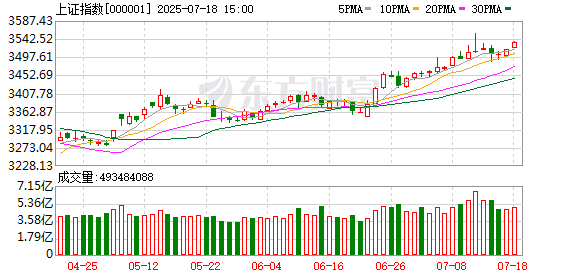
Market Overview - The market experienced fluctuations on July 18, with the Shanghai Composite Index reaching a new closing high for the year, while the ChiNext Index hit a new high before retreating. The Shanghai Composite Index rose by 0.5%, the Shenzhen Component Index increased by 0.37%, and the ChiNext Index gained 0.34% [2] - The trading volume in the Shanghai and Shenzhen markets was 1.57 trillion yuan, an increase of 31.7 billion yuan compared to the previous trading day [2] Sector Performance - Sectors such as rare earth permanent magnets, lithium mining, non-ferrous metals, and coal saw significant gains, while sectors like gaming, photovoltaics, CPO, and consumer electronics experienced declines [2] - The banking sector, which had declined for three consecutive days, stabilized and rebounded, contributing to the overall market performance [5] Investment Trends - Institutional funds showed consistent large-scale buying, while funds from major players, retail investors, and others exhibited noticeable outflows, with a slight return of funds at the end of the trading day [8] - The report from Xiangcai Securities suggests that the market will maintain a "slow bull" trend, with long-term funds focusing on dividend-related sectors such as banking and insurance [13] Rare Earth Sector Insights - The rare earth permanent magnet sector experienced notable activity, driven by three main positive factors: 1. The National Security Department's announcement to cut illegal export channels for rare earth-related items, enhancing resource and national security [17] 2. The discovery of a new rare earth mineral named "Ned Yellow River" in Inner Mongolia [18] 3. The increasing demand for rare earths in humanoid robots, which is a significant application area [19] - Companies in the rare earth sector, such as Huahong Technology and Northern Rare Earth, reported substantial profit increases, with Northern Rare Earth expecting a net profit growth of 1883% to 2015% year-on-year for the first half of the year [19]

2025.07月中旬市场点评:当下行情依然属于“慢牛”范畴
Xiangcai Securities· 2025-07-17 09:36
Group 1 - The current market is characterized as a "slow bull" phase, with the Shanghai Composite Index fluctuating around 3500 points, indicating a lack of potential for a "crazy bull" market [1][2][8] - The market is in the sixth cycle since 2005, showing a disconnection between the Shanghai Composite Index and macroeconomic short cycles, reflecting a weak macroeconomic backdrop [10][20] - The management is actively working to prevent a repeat of the brief "crazy bull" markets seen in 2006-2007 and 2014-2015, which could lead to prolonged bear markets [10][20] Group 2 - The outlook for 2025 suggests a prolonged "slow bull" market, with a focus on time over height, influenced by long-term capital inflows, particularly in dividend-related sectors like banking and insurance [4][20] - The investment logic for upstream industries is challenging due to weak PPI, while downstream industries are expected to perform better, aligning with domestic consumption policies [4][20] - The consumer sector may face significant differentiation, with new consumption segments likely to attract more capital, depending on the strength of policy support [20][21] Group 3 - The 2025 market is expected to operate under a combination of the new "National Nine Articles" and a "four trillion" investment trend, with a high probability of a "slow bull" market [21] - Key areas of focus for 2025 include technology, green initiatives, consumption, and infrastructure, as highlighted in the government work report [21] - The market is anticipated to experience slight upward fluctuations in July, supported by long-term capital inflows, particularly in dividend sectors [21]
红利国企ETF(510720)昨日净流入超1.2亿,市场关注行业轮动与股息率稳定性
Mei Ri Jing Ji Xin Wen· 2025-07-16 02:15
Group 1 - The low interest rate environment highlights the value of dividend asset allocation, with the transportation industry showing high dividend yields above current government bond yields [1] - As of July 9, 2025, the dividend yields for various sectors are approximately 1.5% for highways, 1% for ports, and 5% for shipping [1] - The scale of dividend products has accelerated since 2024, exceeding 200 billion yuan by Q1 2025, with dividend ETFs contributing significantly to this growth [1] Group 2 - The Redundant State-Owned Enterprise ETF tracks the Shanghaizhengqun Dividend Index, which selects high-quality companies with stable dividend records listed on the Shanghai Stock Exchange [1] - These companies typically exhibit strong financial health and profitability, covering multiple industries but leaning towards mature and stable sectors [1] - The index aims to reflect the overall performance of quality listed companies that can provide investors with stable returns [1]
超2600只个股上涨
第一财经· 2025-07-14 04:08
Core Viewpoint - The A-share market shows mixed performance with the Shanghai Composite Index breaking through the 3500-point level, indicating potential upward momentum in the market [1][10]. Market Performance - As of the midday close on July 14, the Shanghai Composite Index stood at 3525.4 points, up 0.43%, while the Shenzhen Component Index was at 10671.48 points, down 0.23%, and the ChiNext Index at 2190.82 points, down 0.74% [1][2]. - The overall market saw over 2600 stocks rising, indicating a relatively balanced performance between gainers and losers [2]. Sector Performance - The PEEK materials sector led the gains, followed by precious metals, small home appliances, humanoid robots, and the power sector [4]. - Conversely, the diversified financial sector was sluggish, with cultural media and real estate sectors showing weakness [4]. Capital Flow - Main capital inflows were observed in machinery, electrical equipment, and automotive sectors, while outflows were noted in computing, non-bank financials, and media sectors [6]. - Specific stocks such as Siyuan Electric, Greenland Holdings, and Xiangyang Bearing saw net inflows of 8.63 billion, 7.38 billion, and 7.26 billion respectively [7]. - On the outflow side, stocks like Dazhihui, Dongfang Caifu, and BYD faced sell-offs amounting to 11.1 billion, 9.1 billion, and 7.77 billion respectively [8]. Institutional Insights - Analysts suggest that the Shanghai Composite Index's breakout above 3500 points could open further upward space, with long-term funds continuously buying into bank-led dividend sectors [10]. - The market is advised to focus on sector rotation opportunities, particularly in innovative pharmaceuticals, computing power chains, PCB, and solid-state batteries [10]. - Technical analysis highlights the importance of the 3490-point support level for the Shanghai Composite Index, with potential buying opportunities if the index dips [10].





策略周聚焦:新高确认牛市全面启动
Huachuang Securities· 2025-07-14 02:15
Group 1 - The recent surge in the A-share market indicates the confirmation of a bull market, with the Shanghai Composite Index breaking through previous high points and showing significant trading volume, suggesting a recovery from earlier declines [1][8][6] - The impact of tariffs announced by Trump is viewed as limited, with historical examples indicating that trade wars do not significantly affect economic performance, as seen during the 1930 trade war [1][17][20] - The bull market is expected to generate three wealth effects: stabilizing expectations, supporting consumption, and restoring financing functions, with increased retail participation in the stock market [1][25][39] Group 2 - Historical analysis shows that sectors tend to rotate after new highs, with financials, cyclical resources, and military industries frequently leading the market, while manufacturing and consumer sectors rely more on their own trends [2][43][44] - Potential rotation directions in the current market include non-bank financials and cyclical resource sectors, with expectations for real estate stabilization being crucial for economic recovery [3][7] - The report highlights that the current bull market is characterized by a significant inflow of funds into the stock market, driven by increased retail investor activity and policy support [1][25][39]
转债市场日度跟踪20250711-20250711
Huachuang Securities· 2025-07-11 14:50
Report Industry Investment Rating No relevant content provided. Core Viewpoints - On July 11, 2025, most convertible bond industries rose, and the valuation increased month - on - month. The trading sentiment in the convertible bond market weakened [1]. - The convertible bond price center increased, and the proportion of high - price bonds decreased. The convertible bond valuation increased [2]. - In the stock market, more than half of the underlying stock industry indices rose. In the convertible bond market, 22 industries rose [3]. Summary by Directory 1. Market Main Index Performance - The CSI Convertible Bond Index rose 0.03% month - on - month, the Shanghai Composite Index rose 0.01%, the Shenzhen Component Index rose 0.61%, the ChiNext Index rose 0.80%, the SSE 50 Index fell 0.01%, and the CSI 1000 Index rose 0.85% [1]. - Small - cap growth stocks were relatively dominant. The large - cap growth index rose 0.55%, the large - cap value index fell 0.80%, the mid - cap growth index rose 0.28%, the mid - cap value index fell 0.13%, the small - cap growth index rose 0.68%, and the small - cap value index rose 0.18% [1]. 2. Market Fund Performance - The trading volume in the convertible bond market was 66.069 billion yuan, a 1.25% month - on - month decrease. The total trading volume of the Wind All - A Index was 1736.61 billion yuan, a 14.62% month - on - month increase. The net outflow of the main funds in the Shanghai and Shenzhen stock markets was 14.038 billion yuan [1]. - The yield of the 10 - year treasury bond rose 0.37bp month - on - month to 1.67% [1]. 3. Convertible Bond Valuation - After excluding convertible bonds with a closing price > 150 yuan and a conversion premium rate > 50%, the fitted conversion premium rate of 100 - yuan par value was 25.38%, a 0.08pct month - on - month increase. The overall weighted par value was 94.40 yuan, a 0.52% month - on - month decrease [2][21]. - The conversion premium rates of all types of convertible bonds (divided by stock - bond nature) increased. The conversion premium rate of equity - biased convertible bonds rose 1.23pct, that of debt - biased convertible bonds rose 0.39pct, and that of balanced convertible bonds rose 0.34pct [2]. 4. Industry Performance - In the A - share market, the top three rising industries were non - bank finance (+2.02%), computer (+1.93%), and steel (+1.93%); the top three falling industries were bank (-2.41%), building materials (-0.67%), and coal (-0.60%) [3]. - In the convertible bond market, 22 industries rose. The top three rising industries were non - bank finance (+1.97%), computer (+1.09%), and non - ferrous metals (+1.05%); the top three falling industries were bank (-0.72%), textile and apparel (-0.44%), and media (-0.27%) [3]. - In terms of closing price, the large - cycle sector rose 0.81%, the manufacturing sector rose 0.05%, the technology sector fell 0.22%, the large - consumption sector rose 0.12%, and the large - finance sector rose 0.66% [3]. - In terms of conversion premium rate, the large - cycle sector rose 0.45pct, the manufacturing sector rose 0.35pct, the technology sector fell 0.22pct, the large - consumption sector rose 0.31pct, and the large - finance sector rose 1.2pct [3]. - In terms of conversion value, the large - cycle sector rose 0.18%, the manufacturing sector fell 0.18%, the technology sector rose 0.43%, the large - consumption sector rose 0.22%, and the large - finance sector rose 0.71% [3]. - In terms of pure - bond premium rate, the large - cycle sector rose 0.53pct, the manufacturing sector rose 0.15pct, the technology sector rose 0.59pct, the large - consumption sector rose 0.13pct, and the large - finance sector rose 0.71pct [4]. 5. Industry Rotation - Non - bank finance, computer, and steel led the rise. The daily increase of non - bank finance in the underlying stock market was 2.02%, and 1.97% in the convertible bond market; the daily increase of computer was 1.93% in the underlying stock market and 1.09% in the convertible bond market; the daily increase of steel was 1.93% in the underlying stock market and 0.13% in the convertible bond market [56].
使用投资雷达把握行业轮动机会
HUAXI Securities· 2025-07-11 14:15
Quantitative Models and Construction Methods 1. Model Name: Industry Investment Radar - **Model Construction Idea**: The model identifies four states of industry trends (volume increase with price rise, volume increase with price drop, volume decrease with price drop, and volume decrease with price rise) based on the direction of price and trading volume changes. These states are visualized in a polar coordinate system to locate investment opportunities when industries move into specific regions of the radar[7][8][11] - **Model Construction Process**: 1. **State Classification in Cartesian Coordinates**: - Price and trading volume changes are categorized into four states: - Volume increase with price rise (Quadrant 1) - Volume increase with price drop (Quadrant 2) - Volume decrease with price drop (Quadrant 3) - Volume decrease with price rise (Quadrant 4)[11] 2. **Polar Coordinate Transformation**: - **Polar Angle**: Calculated using the arctangent function to represent the ratio of trading volume change to price change $ \theta = \arctan2(\text{Volume Change}, \text{Price Change}) $[14][18] - **Polar Radius**: Calculated using the Mahalanobis distance to measure the distance between the current and historical price-volume data $ \rho = \sqrt{(x-y)^T \cdot \Sigma^{-1} \cdot (x-y)} $ where $x$ is the current price-volume vector, $y$ is the historical price-volume vector, and $\Sigma$ is the covariance matrix[13][14] 3. **State Mapping in Polar Coordinates**: - Quadrants are mapped to specific polar angle ranges: - 0°-90°: Volume increase with price rise - 90°-180°: Volume increase with price drop - 180°-270°: Volume decrease with price drop - 270°-360°: Volume decrease with price rise[17][18] - **Model Evaluation**: The model provides a clear and interpretable framework for identifying industry rotation opportunities, leveraging historical price-volume relationships to predict future performance[8][18] 2. Model Name: Position Parameter Table - **Model Construction Idea**: This model establishes a mapping between historical price-volume states and future returns by dividing the polar coordinate space into regions and calculating the average future returns for each region[29][38] - **Model Construction Process**: 1. **Region Division**: - The polar radius is divided into five equal segments, and the polar angle is divided into 16 equal regions, resulting in 80 distinct regions[29] 2. **Return Mapping**: - For each region, the average future 20-day return is calculated based on historical data[29][38] 3. **Multi-Dimensional Expansion**: - **Dimension 1**: Multiple historical periods are analyzed for their relationship with future 20-day returns[47] - **Dimension 2**: Multiple historical dates are aggregated to identify stable investment regions[45] - **Model Evaluation**: The position parameter table enhances the model's robustness by incorporating multi-period and multi-date data, providing a more comprehensive mapping of historical states to future returns[47][50] --- Model Backtesting Results 1. Industry Investment Radar - **Weekly Rebalancing Portfolio**: - Cumulative Return: 369.06% - Benchmark Return: 80.97% - Excess Return: 288.09%[56] - **Monthly Rebalancing Portfolio**: - Cumulative Return: 388.85% - Benchmark Return: 80.97% - Excess Return: 307.88%[59] - **Semi-Annual Rebalancing Portfolio**: - Cumulative Return: 279.77% - Benchmark Return: 80.97% - Excess Return: 198.80%[60] 2. Position Parameter Table - **Future 20-Day Return Mapping**: - Example Regions: - Polar Radius (1/5, 2/5), Polar Angle (4π/8, 5π/8): 5.55% - Polar Radius (0, 1/5), Polar Angle (-5π/8, -4π/8): 4.64% - Polar Radius (1/5, 2/5), Polar Angle (-6π/8, -5π/8): 4.09%[42][44] --- Quantitative Factors and Construction Methods 1. Factor Name: Price-Volume State Factor - **Factor Construction Idea**: This factor captures the relationship between price and trading volume changes to classify industry states and predict future returns[7][8][11] - **Factor Construction Process**: - Derived from the polar coordinate transformation of price and volume data, incorporating both polar radius and polar angle as key metrics[13][14][18] - **Factor Evaluation**: The factor is intuitive and interpretable, effectively linking historical price-volume dynamics to future performance[8][18] 2. Factor Name: Regional Return Factor - **Factor Construction Idea**: This factor quantifies the average future returns of industries based on their historical positions in the polar coordinate system[29][38] - **Factor Construction Process**: - Calculated as the average future 20-day return for each region in the position parameter table[29][38] - **Factor Evaluation**: The factor provides a systematic approach to identifying high-return regions, leveraging historical data to enhance predictive accuracy[45][47] --- Factor Backtesting Results 1. Price-Volume State Factor - **Future 20-Day Return Examples**: - Polar Radius (2/5, 3/5), Polar Angle (5π/8, 6π/8): 3.51% - Polar Radius (0, 1/5), Polar Angle (4π/8, 5π/8): 2.49%[42][44] 2. Regional Return Factor - **Future 20-Day Return Examples**: - Polar Radius (3/5, 4/5), Polar Angle (6π/8, 7π/8): -3.06% - Polar Radius (0, 1/5), Polar Angle (3π/8, 4π/8): -3.95%[42][44]